
Written by Arthur Simitian | PartsAdvisory
The steering column lock is an anti-theft device that prevents the steering wheel from turning when the ignition is off and the key is removed. On older vehicles, this was a purely mechanical system: removing the key allowed a spring-loaded pin to engage a slot in the steering column, locking the wheel in place. Turning the key retracted the pin and allowed the wheel to turn.
On modern vehicles with push-button start and electronic ignition, the mechanical key-operated lock has been replaced by an electronic Steering Column Lock Actuator. This is a small electric motor or solenoid mounted on the steering column that extends or retracts a locking pin based on commands from the vehicle's body control module (BCM) or immobilizer system. When the driver presses the start button with a valid key fob present, the BCM signals the actuator to retract the pin, unlocking the steering column. When the driver shuts off the engine and exits the vehicle, the BCM signals the actuator to extend the pin, locking the column.
When this actuator fails, the result is one of two scenarios, both of which strand the driver:
The actuator fails in the locked position. The steering wheel cannot turn. The vehicle cannot be driven. The engine may or may not start (depending on the vehicle's programming), but even if it starts, the wheels cannot be steered. The vehicle is immobile.
The actuator fails in the unlocked position. The steering column is permanently unlocked. The vehicle can be driven, but the anti-theft function is disabled. The vehicle may display a warning light or message, and some vehicles will not start at all if the BCM detects that the steering lock has not engaged properly, interpreting the failure as a security fault.
Either way, the driver is dealing with a vehicle that does not function as expected, often in a parking lot or driveway with no warning. The failure is typically sudden because the actuator is an electromechanical device that either works or does not.
This post is built for aftermarket catalog teams, marketplace sellers, and buyers who want fewer mistakes and fewer returns.
Status in New Databases
Status in New Databases
Current: PIES 7.2 + PCdb Future: PIES 8.0 + PCdb 2.0 Status: No change
What Steering Column Lock Actuator Means in the Aftermarket
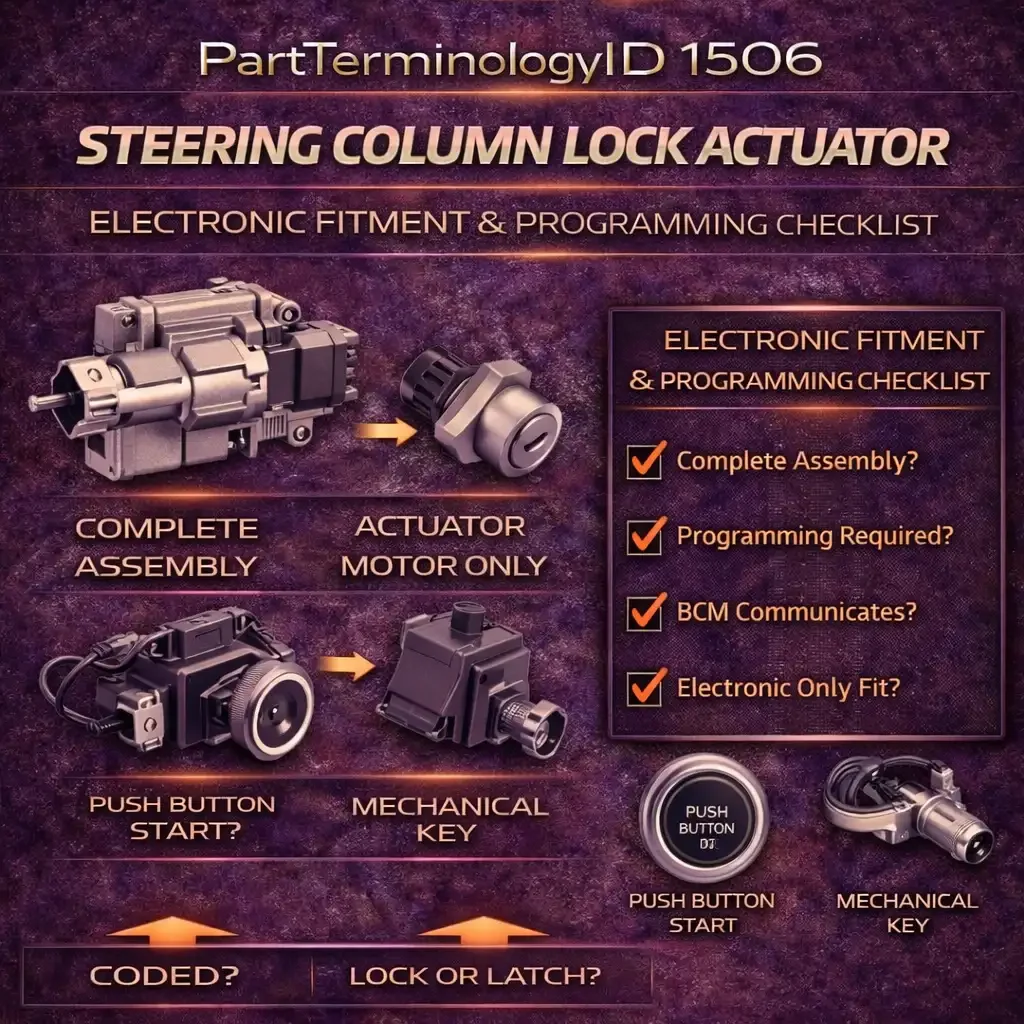
Steering Column Lock Actuator (PartTerminologyID 1506) refers to the electronic motor or solenoid assembly that engages and disengages the steering column lock on vehicles with electronic steering lock systems.
In catalog reality, this covers:
Complete actuator assembly. The electric motor or solenoid, the locking pin, the housing, the mounting bracket, and the electrical connector. This is the standard replacement product. The assembly bolts to the steering column and connects to the vehicle's wiring harness via a multi-pin connector.
Actuator motor only. On some designs, the electric motor can be replaced independently of the housing and pin mechanism. Less common as a product form because the labor to disassemble and reassemble the actuator is close to the labor to replace the entire assembly.
Steering column lock module. On some vehicles, the actuator is part of a larger module that includes the locking mechanism and the electronic control circuit. The module communicates with the BCM or immobilizer via a data bus (CAN bus on most modern vehicles). Replacing this module may require programming or initialization with a dealer-level scan tool so the BCM recognizes the new module as an authorized component.
What this part does NOT cover
Ignition lock cylinder. The mechanical lock cylinder on key-operated vehicles where the driver inserts and turns a physical key. Different PartTerminologyID. That is the traditional steering lock mechanism, not an electronic actuator.
Ignition switch. The electrical switch behind the lock cylinder (key vehicles) or the push-button start switch. Different PartTerminologyID.
Steering column. The entire column assembly. Different PartTerminologyID.
Immobilizer module / transponder system. The electronic anti-theft system that verifies the key or fob. Different PartTerminologyID. The immobilizer commands the steering lock actuator but is not the actuator itself.
Tilt/telescoping steering column motor. The motor that adjusts the steering column position. Different function.
Which Vehicles Have Electronic Steering Column Lock Actuators
This is an important scoping question for catalog teams. Electronic steering column lock actuators are found primarily on:
Push-button start vehicles. Any vehicle with keyless ignition and push-button start typically has an electronic steering lock because there is no physical key to mechanically retract the lock pin. This includes the vast majority of vehicles produced since the mid-2010s and many produced since the late 2000s.
Some key-operated vehicles with electronic steering lock. A few manufacturers transitioned to electronic steering lock actuators before fully adopting push-button start. These vehicles use a traditional key but the steering lock is electronically controlled rather than mechanically controlled by the key turning.
Vehicles that have eliminated the steering lock entirely. Some manufacturers (notably some European brands) have eliminated the steering column lock altogether on certain models, relying on the immobilizer and transmission lock (shift lock) as anti-theft measures instead. On these vehicles, PartTerminologyID 1506 does not apply because there is no steering lock to actuate.
Older vehicles with purely mechanical steering locks do not use this part. The traditional key-operated mechanical lock pin that is retracted by the key turning in the ignition cylinder is not an actuator. It is a mechanical component integrated into the ignition lock housing.
The Programming and Initialization Requirement
This is the most important post-installation consideration and the one that generates the most buyer frustration:
On many vehicles, the replacement steering column lock actuator must be programmed or initialized using a dealer-level scan tool or an advanced aftermarket scan tool with immobilizer programming capability. The BCM must recognize the new actuator as an authorized security component. Without this programming step, the vehicle may:
Refuse to start (BCM detects unauthorized or unrecognized steering lock module)
Display a steering lock warning or security fault
Lock the steering column and not release it
Enter a security lockout mode requiring a tow to the dealer
This programming requirement means the steering column lock actuator is not a simple bolt-on, plug-in replacement for most vehicles. The buyer or their mechanic must have access to the appropriate scan tool and software. For some manufacturers, this programming can only be done at the dealer.
Catalog impact: Every listing must state whether programming is required and what level of tool is needed. "Programming with [manufacturer-specific] scan tool required after installation. Dealer programming may be necessary." This sets the expectation that the buyer cannot simply install the part and drive away.
Common Failure Causes
Motor failure. The electric motor burns out or seizes. The actuator cannot retract or extend the pin.
Gear or pin mechanism failure. Internal gears strip or the pin jams in the extended or retracted position.
Electrical connector corrosion. The multi-pin connector corrodes (particularly in humid or salt-spray environments), causing intermittent communication between the actuator and the BCM. This produces intermittent steering lock warnings and occasional failure to unlock.
BCM communication fault. The data bus communication between the BCM and the actuator module is interrupted. The BCM cannot command the actuator, so the lock remains in its last state. This may be a wiring or BCM issue rather than an actuator failure.
Software fault. Some steering lock actuator failures are caused by a software glitch in the BCM or the actuator module's internal controller rather than a hardware failure. A software update or module reset at the dealer may resolve the issue without replacing the actuator. This is worth noting in listing descriptions to prevent unnecessary parts purchases.
Top Return Causes
1) Programming not performed after installation
Buyer installs the actuator, vehicle does not start or displays a security fault. The actuator itself is fine but the BCM does not recognize it.
Prevention: Bold note in the listing: "PROGRAMMING REQUIRED. This actuator must be programmed/initialized with a compatible scan tool after installation. The vehicle will not operate correctly without this step. Dealer-level programming may be required."
2) Wrong vehicle application
Actuators are highly vehicle-specific. The mounting geometry, connector pinout, and communication protocol vary between vehicles and between model years within the same platform.
Prevention: Full ACES fitment with exact year, make, model, submodel. OEM part number cross-reference. Do not use broad year ranges.
3) Actuator ordered when the problem is the BCM or wiring
The actuator is functioning but the BCM is not sending the unlock command due to a wiring fault, BCM failure, or software issue.
Prevention: Diagnostic note: "Before replacing the actuator, verify that the BCM is commanding the steering lock to release. A scan tool can read the BCM's steering lock command status. If the BCM is not sending the command, the problem may be in the BCM, wiring, or key fob recognition system rather than the actuator."
4) Buyer cannot program the actuator and returns it
The actuator is correct but the buyer does not have access to the required scan tool.
Prevention: "Programming requires [specific tool or dealer visit]. Confirm you have access to the required programming tool before ordering."
5) Mechanical steering lock vehicle, actuator not applicable
Buyer with an older key-operated vehicle orders an electronic actuator that does not apply.
Prevention: Fitment data must limit to electronic steering lock vehicles only. "For vehicles with electronic steering column lock. Not for vehicles with mechanical key-operated steering lock."
Compatibility Checklist for Buyers
1) Confirm your vehicle has an electronic steering column lock. Push-button start vehicles almost always do. Key-operated vehicles typically use a mechanical lock and do not need this part.
2) Diagnose before ordering. Use a scan tool to verify the BCM is commanding the actuator and the actuator is not responding. If the BCM is not sending the command, the problem may be elsewhere.
3) Confirm you have access to the required programming tool. Dealer visit, advanced aftermarket scan tool, or locksmith with immobilizer programming capability.
4) Confirm full vehicle details. Year, make, model, submodel. OEM part number cross-reference strongly recommended.
5) Check for technical service bulletins (TSBs). Some steering lock actuator failures are addressed by manufacturer TSBs with updated parts or software reflashes rather than simple actuator replacement.
Catalog Checklist for Attributes
Core taxonomy: Product form (complete actuator assembly, actuator motor only, steering column lock module). Separate from Ignition Lock Cylinder, Ignition Switch, Steering Column, Immobilizer Module, and Tilt/Telescoping Motor.
Fitment: Year, make, model, submodel. Electronic steering lock vehicles only. OEM part number cross-reference (critical for this part).
Installation requirements: Programming required (yes/no). Programming tool type (dealer-only, manufacturer-specific scan tool, advanced aftermarket). Initialization procedure reference.
Physical specs: Mounting location on column. Connector type and pin count. Locking pin type.
Package contents: Actuator assembly, mounting hardware, connector (if pigtail included).
Images: Actuator assembly from multiple angles, connector close-up showing pin count, mounting bracket detail, and installed reference showing location on the steering column.
FAQ
My steering wheel is locked and the car will not start. Is it the actuator?
Possibly. On push-button start vehicles, a steering lock warning message or security light usually indicates the actuator has failed in the locked position. However, the same symptoms can be caused by a dead key fob battery (the vehicle cannot verify the fob and will not unlock the steering), a BCM communication fault, or a low vehicle battery. Check the fob battery and vehicle battery first before ordering an actuator.
Can I just delete the steering column lock?
Some aftermarket solutions and locksmith services offer steering lock delete kits or procedures that permanently disable the electronic steering lock. This eliminates future actuator failures but also eliminates the anti-theft function. Some jurisdictions and insurance policies may have implications for disabling factory anti-theft systems. Some vehicles also require a software modification to prevent the BCM from faulting when it detects the missing lock.
Why does the replacement actuator need programming?
The steering column lock is part of the vehicle's anti-theft security system. The BCM must recognize the actuator as an authorized component to prevent a thief from installing a bypass device. Programming links the new actuator to the vehicle's specific BCM so they communicate securely.
Final Take for Aftermarket Teams
Steering Column Lock Actuator (PartTerminologyID 1506) is a security component where the post-installation programming requirement is as important as the fitment data. The actuator itself may be a straightforward bolt-on replacement, but without programming, the vehicle will not function. The catalog teams that reduce returns and frustration in this category state the programming requirement prominently in every listing, specify the tool level needed, include diagnostic guidance that prevents unnecessary actuator replacement when the BCM or wiring is the actual failure, and limit fitment to electronic steering lock vehicles only. The part costs $100 to $400. The dealer programming visit costs $100 to $200. The buyer must budget for both before they order.