
Glove Box Lock (PartTerminologyID 1504): The Lock Nobody Thinks About Until They Cannot Open the Glove Box or Cannot Keep It Closed
Written by Arthur Simitian | PartsAdvisory
The glove box lock is a small keyed cylinder or latch mechanism that secures the glove box (glove compartment) door on the passenger side of the dashboard. It is one of the least thought-about locks on a vehicle until it fails, at which point the owner either cannot open the glove box to access their registration, insurance card, and owner's manual, or cannot keep the glove box closed and it flops open every time they hit a bump.
The glove box lock is a low-cost, low-complexity part. The cylinder itself typically costs $10 to $40. But it generates catalog and fitment challenges that are disproportionate to its price because of keying, the distinction between the lock cylinder and the latch mechanism, and the wide variation in lock and latch designs across vehicles.
This post ties back to the Coded Door Lock Set (PartTerminologyID 1372) and Tailgate Lock (PartTerminologyID 1425), which covered the same keying challenges (coded, uncoded, random) for other lock positions on the vehicle.
This post is built for aftermarket catalog teams, marketplace sellers, and buyers who want fewer mistakes and fewer returns.
Status in New Databases
Status in New Databases
Current: PIES 7.2 + PCdb Future: PIES 8.0 + PCdb 2.0 Status: No change
What Glove Box Lock Means in the Aftermarket
Glove Box Lock (PartTerminologyID 1504) refers to the keyed lock cylinder or locking latch mechanism that secures the glove box door.
In catalog reality, this covers:
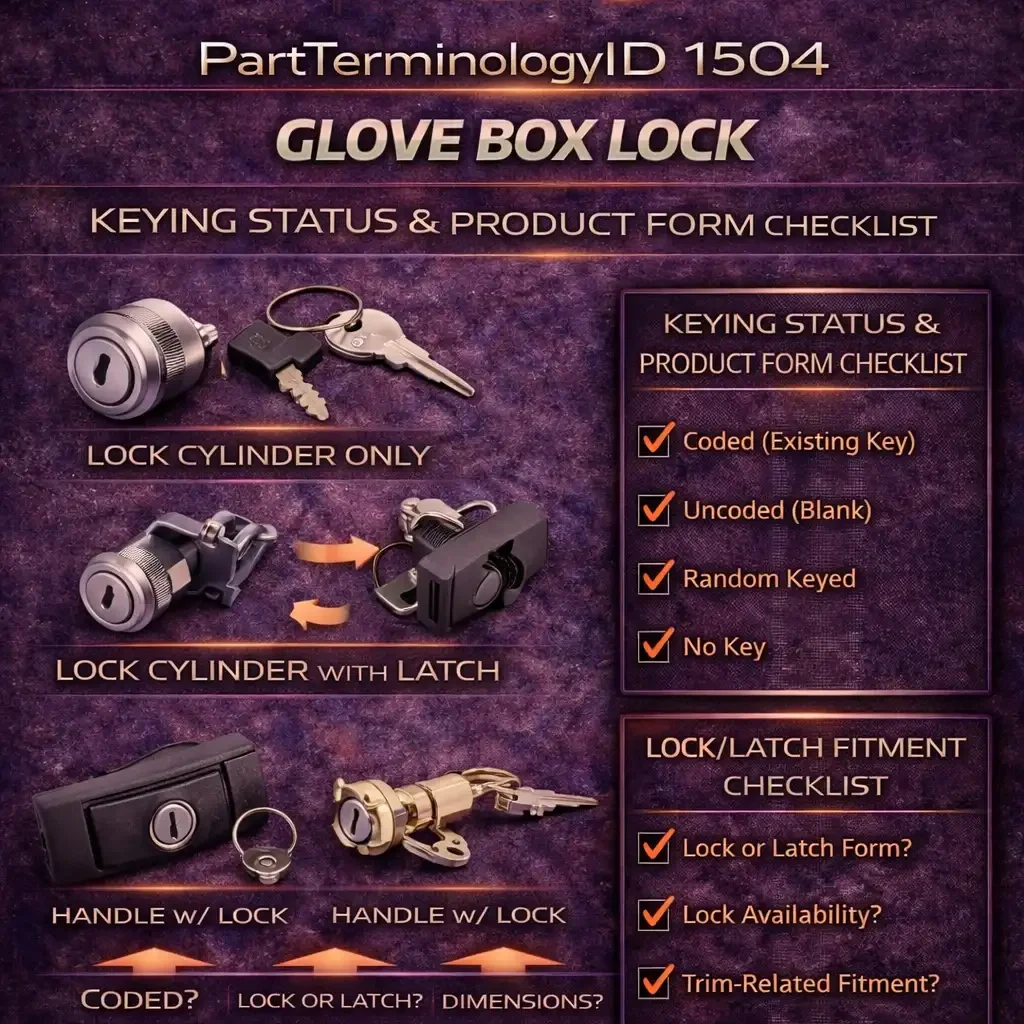
Lock cylinder only. The keyed cylinder that inserts into the glove box door or latch. Turning the key engages or disengages the lock. The cylinder may be sold with keys (random keyed or coded) or without keys (uncoded, for locksmith keying to match the vehicle's existing key).
Lock cylinder with latch. The lock cylinder pre-assembled into the latch mechanism. The latch is the mechanical device that holds the glove box door shut and releases it when the button, lever, or handle is pressed. On some vehicles, the lock and latch are an integrated unit and cannot be purchased separately.
Latch mechanism only (no lock). On some vehicles, particularly base trims, the glove box has a latch (push-button release) but no keyed lock. The latch holds the door closed and releases on demand, but there is no key cylinder. If the vehicle never had a glove box lock, a latch-only replacement is the correct part. A lock cylinder assembly from a higher trim will not fit because the glove box door may not have a lock cylinder hole.
Glove box door handle with lock. On some vehicles, the lock cylinder is integrated into the glove box door handle or pull. The handle, lock, and release mechanism are one assembly.
What this part does NOT cover
Glove box door. The entire door panel of the glove compartment. Different PartTerminologyID.
Glove box hinge. The hinge that allows the door to open and close.
Glove box damper / check strap. The device that controls the speed at which the glove box door opens.
Ignition lock cylinder. The lock on the steering column. Completely different location and function.
Door lock cylinder. The lock in the exterior door handle. Different PartTerminologyID.
The Keying Challenge
The same keying issues from the Coded Door Lock Set (1372) and Tailgate Lock (1425) posts apply here:
Coded (matched to existing key). The lock cylinder is cut to match the vehicle's existing key. The buyer uses the same key for the ignition, doors, and glove box. This is the ideal but most expensive option. On older vehicles, the glove box lock may have been keyed differently from the ignition and doors from the factory (a separate glove box key was common through the 1980s on many vehicles). On newer vehicles, a single key typically operates all locks.
Uncoded (blank, requires locksmith). The lock cylinder has no cuts. A locksmith must cut the cylinder to match the vehicle's existing key, or the buyer uses the new keys that come with the cylinder (which will not match any other lock on the vehicle).
Random keyed. The lock cylinder comes pre-cut with its own key that does not match the vehicle's other locks. The buyer has a separate key just for the glove box. This is acceptable to some buyers and unacceptable to others.
No key (lock cylinder without keys). The cylinder is sold without keys. The buyer must have a locksmith create keys for the cylinder or rekey it to match their existing key.
The keying status is the number one source of buyer dissatisfaction in this category. A buyer who expects the new lock to work with their existing car key and receives a random-keyed cylinder with a separate key is disappointed even if the part fits perfectly.
Why This Category Creates Fitment Problems
Lock versus latch confusion
The lock and the latch are different things. The lock is the keyed cylinder that prevents unauthorized opening. The latch is the mechanism that holds the door shut and releases it. Some vehicles have both. Some have only a latch (no lock). Some integrate them into one assembly. The buyer must know which component has failed and which product form they need.
Trim level determines lock availability
Base trims may not include a glove box lock. Mid and upper trims may include one. If the buyer's base-trim vehicle never had a glove box lock, ordering a lock cylinder assembly does not help because the glove box door has no provision for a lock cylinder. Conversely, if the buyer's upper-trim vehicle has a lock and they order a latch-only replacement, the lock function is lost.
Lock cylinder dimensions and keyway
Lock cylinders are vehicle-specific. The cylinder diameter, length, keyway profile, and retaining method (clip, ring, screw) vary by vehicle. A cylinder that is 1mm too long will not seat properly. A cylinder with the wrong keyway profile will not accept the vehicle's key even if it is uncoded.
Glove box door design changes
The glove box door and latch design may change with interior refreshes during a vehicle generation. A mid-cycle update that changes the dashboard or glove box door shape may change the lock and latch mounting geometry. Year-range fitment must account for these mid-cycle changes.
Left-hand drive versus right-hand drive
On left-hand-drive vehicles (most of the U.S. market), the glove box is on the right (passenger) side. On right-hand-drive vehicles (UK, Japan, Australia), the glove box is on the left side. The lock and latch orientation may be mirrored. This is primarily relevant for imported and JDM vehicles.
Top Return Causes
1) Random-keyed cylinder, buyer expected match to existing key
The most common dissatisfaction. The lock works perfectly but the buyer has a separate key they did not want.
Prevention: Keying status in the title: "Random Keyed (Separate Key, Does NOT Match Vehicle Key)" or "Uncoded (Requires Locksmith to Match Existing Key)" or "Coded to Match (Specify Key Code at Checkout)."
2) Lock cylinder ordered when latch was the failure
The lock turns fine but the glove box does not stay closed or does not release. The latch mechanism is the failure, not the lock.
Prevention: "This is the LOCK CYLINDER only (keyed security). If your glove box does not stay closed or does not release when pressed, you may need the LATCH MECHANISM instead."
3) Vehicle does not have a glove box lock
Base trim with no lock provision. The cylinder has nowhere to install.
Prevention: Fitment data must include trim-level qualifiers: "For vehicles equipped with glove box lock. Base trims without lock provision require latch-only replacement."
4) Wrong cylinder dimensions
Cylinder is too long, too short, or the wrong diameter for the glove box door.
Prevention: Full ACES fitment with year, make, model, submodel. OEM part number cross-reference. Physical dimensions in the listing.
5) Lock cylinder ordered with latch when only the cylinder was needed
Buyer pays more for an integrated lock-and-latch assembly when only the cylinder needed replacement. Or buyer orders cylinder-only when the entire latch assembly was needed.
Prevention: Specify product form clearly: "Lock Cylinder Only" versus "Lock Cylinder with Latch Assembly."
Compatibility Checklist for Buyers
1) Determine what failed. Is the lock (keyed cylinder) broken, or is the latch (release mechanism) broken? If the key turns but the door does not stay closed, the latch is the problem. If the key does not turn or the cylinder is missing/damaged, the lock is the problem.
2) Confirm your vehicle has a glove box lock. Check whether there is a key slot on the glove box door. Base trims may not have one.
3) Decide on keying. Do you want the new lock to match your existing key (coded or uncoded for locksmith), or are you okay with a separate key (random keyed)?
4) Confirm product form. Lock cylinder only, latch only, or lock and latch assembly.
5) Confirm full vehicle details. Year, make, model, submodel, trim level.
Catalog Checklist for Attributes
Core taxonomy: Product form (lock cylinder only, lock cylinder with latch, latch only, handle with lock). Separate from Glove Box Door, Glove Box Hinge, Ignition Lock Cylinder, and Door Lock Cylinder.
Fitment: Year, make, model, submodel, trim level (lock equipped yes/no). OEM part number cross-reference.
Keying: Coded (specify key code system), uncoded (locksmith required), random keyed (separate key included), no key (keys not included). Number of keys included.
Physical specs: Cylinder diameter, cylinder length, keyway type, retaining method.
Package contents: Lock cylinder, keys (quantity and type), latch (if included), retaining clip or hardware.
Images: Lock cylinder front (keyway visible), lock cylinder rear (showing retaining method), keys (if included), latch assembly (if included), installed reference showing location on glove box door.
FAQ
Will the new glove box lock match my car key?
Only if you order a coded lock or have an uncoded lock rekeyed by a locksmith. Random-keyed locks come with their own separate key that does not match your vehicle's other locks.
My glove box pops open over bumps. Is it the lock?
Probably not. If the glove box opens on its own, the latch mechanism is worn or broken. The latch holds the door closed. The lock prevents unauthorized opening. Replace the latch, not the lock.
Did my car come with a glove box lock?
It depends on the trim level. Many base and mid trims do not include a keyed glove box lock. Check for a key slot on the glove box door. If there is no key slot, the vehicle was not equipped with a lock.
Final Take for Aftermarket Teams
Glove Box Lock (PartTerminologyID 1504) is a low-cost part with high-friction fitment issues driven by keying status, lock-versus-latch confusion, and trim-level lock availability. The catalog teams that reduce returns in this category put keying status in the title of every listing, clearly separate lock cylinder products from latch mechanism products, specify which trims were equipped with a lock, and set the expectation on whether the new lock will match the vehicle's existing key. It is a $10 to $40 part that generates $10 to $40 returns when the keying status is not communicated upfront.