
Engine Coolant Temperature Gauge (PartTerminologyID 1500): The One Temperature Gauge Every Vehicle Actually Has, and the One Every Driver Misreads
Written by Arthur Simitian | PartsAdvisory
The Engine Oil Temperature post (PartTerminologyID 1472) covered a gauge that no factory dashboard includes. This post covers the opposite: the temperature gauge that every vehicle includes. The engine coolant temperature gauge is the most universal temperature instrument on any vehicle. If a car, truck, or SUV has any temperature gauge at all, it is this one.
The coolant temperature gauge displays the temperature of the engine coolant (antifreeze) as it circulates through the engine block and cylinder head. It tells the driver whether the engine is at normal operating temperature, still warming up, or overheating. On most vehicles, the gauge reads from C (Cold) on the left to H (Hot) on the right, with the normal operating range in the center.
What makes this gauge interesting from a catalog perspective is that while it is universally present as a factory instrument, it is almost never a standalone replacement part on modern vehicles. And the way most factory coolant temperature gauges actually work surprises most buyers: they are not real-time, linear instruments. They are heavily damped, processed, and in many cases deliberately inaccurate.
This post is built for aftermarket catalog teams, marketplace sellers, and buyers who want fewer mistakes and fewer returns.
Status in New Databases
Status in New Databases
Current: PIES 7.2 + PCdb Future: PIES 8.0 + PCdb 2.0 Status: No change
What Engine Coolant Temperature Gauge Means in the Aftermarket
Engine Coolant Temperature Gauge (PartTerminologyID 1500) refers to the dashboard instrument that displays engine coolant temperature.
In catalog reality, this covers:
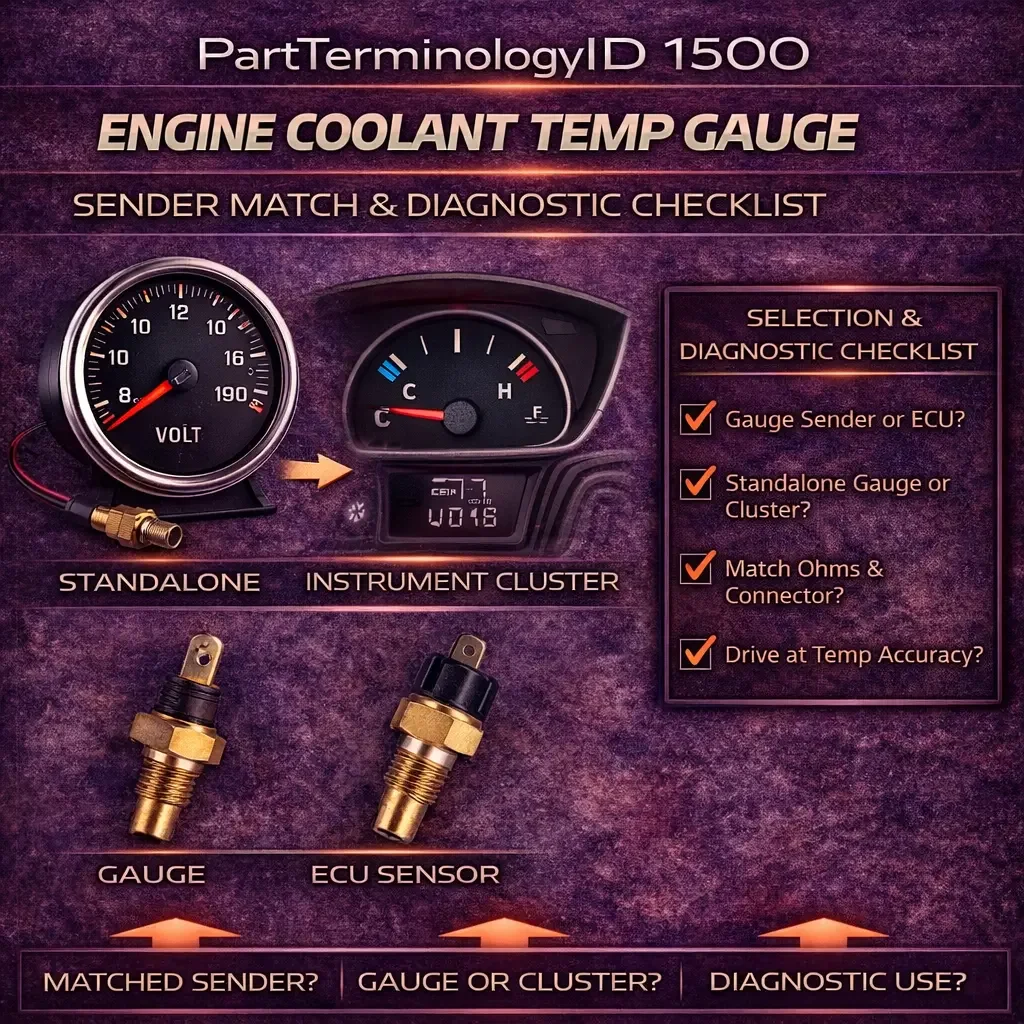
OEM replacement coolant temperature gauge. A gauge designed to replace the original factory gauge in a specific vehicle's instrument cluster. On classic cars and older vehicles with individual gauges, this is a standalone instrument that can be removed and replaced. Must match diameter, face style, graphics, sender impedance, and illumination.
Aftermarket universal coolant temperature gauge. A standalone gauge in standard aftermarket diameters (2-1/16 inch, 2-5/8 inch) for custom builds, hot rods, and vehicles where the buyer wants a more accurate or more responsive gauge than the factory unit. Available in electric (sender-based) and mechanical (capillary tube) versions.
Digital coolant temperature gauge. Electronic display showing temperature numerically with programmable warning thresholds and peak temperature recall.
Coolant temperature gauge as part of an instrument cluster. On virtually all modern vehicles, the coolant temperature gauge is integrated into the electronic instrument cluster and cannot be replaced individually. If the gauge fails, the cluster must be replaced or rebuilt. For these vehicles, PartTerminologyID 1500 as a standalone replacement does not apply.
Coolant temperature sender only. The thermistor sensor threaded into the engine block or cylinder head that provides the temperature signal to the gauge. Different from the ECU coolant temperature sensor (which reports to the engine computer), though on some vehicles the same sensor serves both functions.
What this part does NOT cover
Engine oil temperature gauge (PartTerminologyID 1472). Measures oil temperature, not coolant.
Coolant temperature sensor (ECU). The sensor that reports to the engine management computer for fuel and ignition control. May be the same physical sensor or a different one from the gauge sender.
Thermostat. The valve that controls coolant flow based on temperature. Different component.
Instrument cluster. The complete gauge assembly.
Temperature warning light. The binary overheating indicator. Different from a gauge.
The Factory Gauge Secret: Most Are Not Real Gauges
This is the most important piece of content for this category because it explains why buyers search for aftermarket replacements even when their factory gauge appears to work:
Factory coolant temperature gauges on most modern vehicles are not linear, real-time instruments. They are processed displays controlled by the body control module (BCM) or instrument cluster processor. The BCM reads the actual coolant temperature from the sensor, applies a damping algorithm, and outputs a signal to the gauge that moves the needle slowly and keeps it parked in the "normal" zone across a wide temperature range.
On many vehicles, the gauge needle sits at the center mark from approximately 185 degrees F all the way to 225 degrees F or higher. The actual temperature can vary by 40+ degrees within what the gauge shows as "normal." The needle only moves toward H when the temperature reaches a genuinely critical level (typically 230 to 250+ degrees F depending on the vehicle).
Why manufacturers do this: To prevent driver anxiety. If the needle moved in real-time with every thermostat cycle, traffic stop heat soak, and cold start warm-up, drivers would see constant fluctuation and flood dealership service departments with unnecessary overheating complaints. The damped gauge keeps the needle steady and the phone lines quiet.
Why enthusiasts and tow vehicle owners hate this: Because by the time the factory gauge moves toward H, the engine is already significantly overheated. The gauge provides no early warning. A driver towing a heavy trailer up a grade in summer has no idea whether the coolant is at 205 degrees (comfortable) or 235 degrees (concerning) because the factory gauge shows the same needle position for both.
This is the primary reason aftermarket coolant temperature gauges exist for modern vehicles: buyers want a real, linear, responsive gauge that shows actual temperature in degrees rather than a processed approximation that parks the needle in the middle.
The Gauge-Sender Impedance Match
The same impedance matching requirement from every other gauge in this series applies. The coolant temperature gauge and the coolant temperature sender must be matched. The sender is a thermistor (a resistor whose resistance changes with temperature). Different manufacturers use different resistance curves.
Key distinction: gauge sender versus ECU sensor. Many engines have two temperature sensors. One feeds the gauge (or the BCM for the factory processed gauge). The other feeds the ECU for engine management. They may have different resistance curves, different connectors, and different locations on the engine. When installing an aftermarket gauge, the buyer needs a sender compatible with the aftermarket gauge, not the factory ECU sensor. Some aftermarket gauge kits include a T-fitting or adapter that adds a second sender port to the existing sensor location so both the factory system and the aftermarket gauge can operate simultaneously.
Normal Operating Temperatures
Normal: 195 to 220 degrees F (91 to 104 degrees C). Most modern engines are designed to operate in this range. The thermostat opens at 195 to 205 degrees F, allowing coolant to flow through the radiator. The cooling system maintains the temperature in this range under normal driving.
Elevated: 220 to 235 degrees F (104 to 113 degrees C). Common during towing, heavy traffic on hot days, and sustained high-load driving. The cooling fans should be running. The temperature should stabilize and not continue climbing.
Overheating: 235 to 260+ degrees F (113 to 127+ degrees C). The cooling system is unable to reject enough heat. Coolant may boil (the pressurized system raises the boiling point, but it has limits). Head gasket failure, warped cylinder head, and engine damage become real risks. Pull over, stop the engine, and allow it to cool.
Cold: Below 185 degrees F (85 degrees C) after extended driving. The thermostat may be stuck open, allowing coolant to flow through the radiator continuously. The engine runs cold, which reduces fuel efficiency, increases emissions, and causes poor heater performance.
Top Return Causes
1) Buyer replaces gauge when the sender is the actual failure
Same pattern as Fuel Level (1456) and Oil Pressure (1468). The sender fails far more often than the gauge.
Prevention: Diagnostic content: "Before replacing the gauge, test the sender. Disconnect the sender wire and ground it with the ignition on. If the gauge reads maximum (Hot), the gauge and wiring are functional. The sender is the likely problem."
2) Sender impedance mismatch
Aftermarket gauge installed with the factory sender or a mismatched aftermarket sender. Reading is inaccurate.
Prevention: "This gauge is calibrated for [brand/type] senders with a [resistance range] curve. Factory OEM senders may not be compatible."
3) Gauge is integrated into the cluster, standalone not available
Buyer orders a standalone gauge for a modern vehicle where the gauge is part of the electronic cluster.
Prevention: Fitment data must specify standalone gauge vehicles only. "For vehicles with individually replaceable coolant temperature gauge. Modern vehicles with integrated instrument clusters require cluster replacement or repair."
4) Buyer confuses gauge sender with ECU coolant temperature sensor
Buyer replaces the ECU sensor thinking it feeds the gauge, or replaces the gauge sender thinking it feeds the ECU. On vehicles with two sensors, each serves a different function.
Prevention: "Coolant temperature GAUGE sender. For the gauge/instrument cluster signal. This is NOT the engine management coolant temperature sensor for the ECU (which controls fuel and ignition). Your vehicle may have both. Verify which sensor you need before ordering."
5) Aftermarket gauge reads differently from factory gauge, buyer assumes it is wrong
Buyer installs an aftermarket gauge alongside the factory gauge. The aftermarket reads 215 degrees F while the factory needle sits in the middle of "normal." The buyer thinks the aftermarket gauge is defective.
Prevention: Explain in the listing: "Aftermarket gauges display actual temperature in real-time. Factory gauges on modern vehicles are processed and damped, showing a steady center reading across a wide temperature range. A difference between your factory gauge and this aftermarket gauge is normal and expected."
Compatibility Checklist for Buyers
1) Diagnose before ordering. Is the problem the gauge, the sender, the wiring, or the thermostat? Use the grounding test from the Fuel Level and Oil Pressure posts.
2) Confirm your vehicle has a separately replaceable gauge. Modern electronic clusters are not separable.
3) If installing an aftermarket gauge, buy a matched gauge-and-sender kit. Do not rely on the factory sender unless verified compatible.
4) Distinguish gauge sender from ECU sensor. Your engine may have two coolant temperature sensors for different purposes.
5) Confirm gauge diameter. 2-1/16 inch or 2-5/8 inch for aftermarket. OEM-specific for restoration.
6) Choose temperature scale. Fahrenheit or Celsius.
Catalog Checklist for Attributes
Core taxonomy: Product form (OEM replacement, universal electric, universal mechanical/capillary, digital, sender only). Separate from Engine Oil Temperature Gauge, ECU Coolant Temperature Sensor, Thermostat, Instrument Cluster, and Temperature Warning Light.
Specs: Temperature range (typically 100-280 degrees F). Gauge type: electric, mechanical, digital. Sender type and impedance curve. Gauge diameter.
Kit contents: Gauge, sender (if included), sender adapter or T-fitting (if included), wiring, mounting hardware.
Fitment (OEM): Year, make, model, submodel, cluster option. OEM part number cross-reference.
Images: Gauge face showing temperature range and scale, sender, T-fitting adapter (if included), rear showing terminals, illuminated photo.
FAQ
Why does my factory temperature gauge always sit in the middle?
Factory gauges on modern vehicles are processed by the BCM to show a steady center reading across a wide normal temperature range (roughly 185 to 225+ degrees F). The gauge is designed to prevent driver anxiety, not to display precise temperature. An aftermarket gauge displays actual real-time temperature.
Should I use the factory coolant sensor for my aftermarket gauge?
Only if the aftermarket gauge is specifically calibrated for your factory sensor's resistance curve. Most aftermarket gauges include their own sender matched to the gauge. Use the included sender for accurate readings.
My aftermarket gauge reads 215 degrees F. Is my engine overheating?
Probably not. 215 degrees F is within the normal operating range for most modern engines (195 to 220 degrees F). Your factory gauge would show this as a steady center-needle reading. The aftermarket gauge is simply showing you the actual number that the factory gauge hides behind "normal."
Final Take for Aftermarket Teams
Engine Coolant Temperature Gauge (PartTerminologyID 1500) is the most universally present gauge on any vehicle and the one where the factory instrument deliberately hides the real temperature from the driver. The aftermarket exists because buyers who tow, modify, or simply want real information need a gauge that shows actual degrees rather than a processed center-needle approximation. The catalog challenges are the same as every gauge in this series: sender impedance matching, standalone versus integrated cluster, gauge diameter, and including diagnostic content that prevents the buyer from replacing the gauge when the sender is the actual failure. The unique content opportunity is explaining why the aftermarket gauge reads differently from the factory gauge, because that explanation prevents the most frustrating return in the category: a perfectly functioning aftermarket gauge sent back by a buyer who thought it was wrong because it did not match the factory needle.