
Vacuum Gauge (PartTerminologyID 1492): The Oldest Engine Diagnostic Gauge Still in Use and the One That Tells You More About Engine Health Than Any Other Single Instrument
Written by Arthur Simitian | PartsAdvisory
A vacuum gauge measures the intake manifold vacuum of a gasoline engine. When a gasoline engine is running, the pistons draw air through the intake manifold, creating a partial vacuum (negative pressure relative to atmospheric). A healthy engine at idle produces a steady 17 to 22 inches of mercury (inHg) of vacuum. The specific reading and the behavior of the needle tell a trained technician more about the internal condition of the engine than almost any other single measurement.
A steady, high vacuum reading means the cylinders are sealing well, the valves are seating properly, and the ignition timing is correct. A low reading means air is leaking in somewhere it should not (vacuum leak, leaking valve, blown head gasket). A fluctuating needle means one or more cylinders are not contributing equally (burnt valve, weak valve spring, misfiring cylinder). A needle that drops during acceleration and recovers slowly means the rings are worn and the engine is losing compression.
This diagnostic power made the vacuum gauge one of the first instruments mechanics used to evaluate engines, dating back to the early days of the automobile. It remains relevant today on naturally aspirated gasoline engines, though its role has narrowed as OBD-II diagnostics and scan tools have taken over much of the diagnostic process.
On turbocharged and supercharged engines, the intake manifold operates under both vacuum (at idle and light load) and positive pressure (under boost). On these engines, the gauge that measures manifold pressure is called a boost/vacuum gauge and reads from vacuum through zero into positive pressure (typically -30 inHg to +30 PSI). The boost/vacuum gauge is a different product with a different PartTerminologyID, though it serves a related function.
This post is built for aftermarket catalog teams, marketplace sellers, and buyers who want fewer mistakes and fewer returns.
Status in New Databases
Status in New Databases
Current: PIES 7.2 + PCdb Future: PIES 8.0 + PCdb 2.0 Status: No change
What Vacuum Gauge Means in the Aftermarket
Vacuum Gauge (PartTerminologyID 1492) refers to a gauge that measures intake manifold vacuum in inches of mercury (inHg).
In catalog reality, this covers:
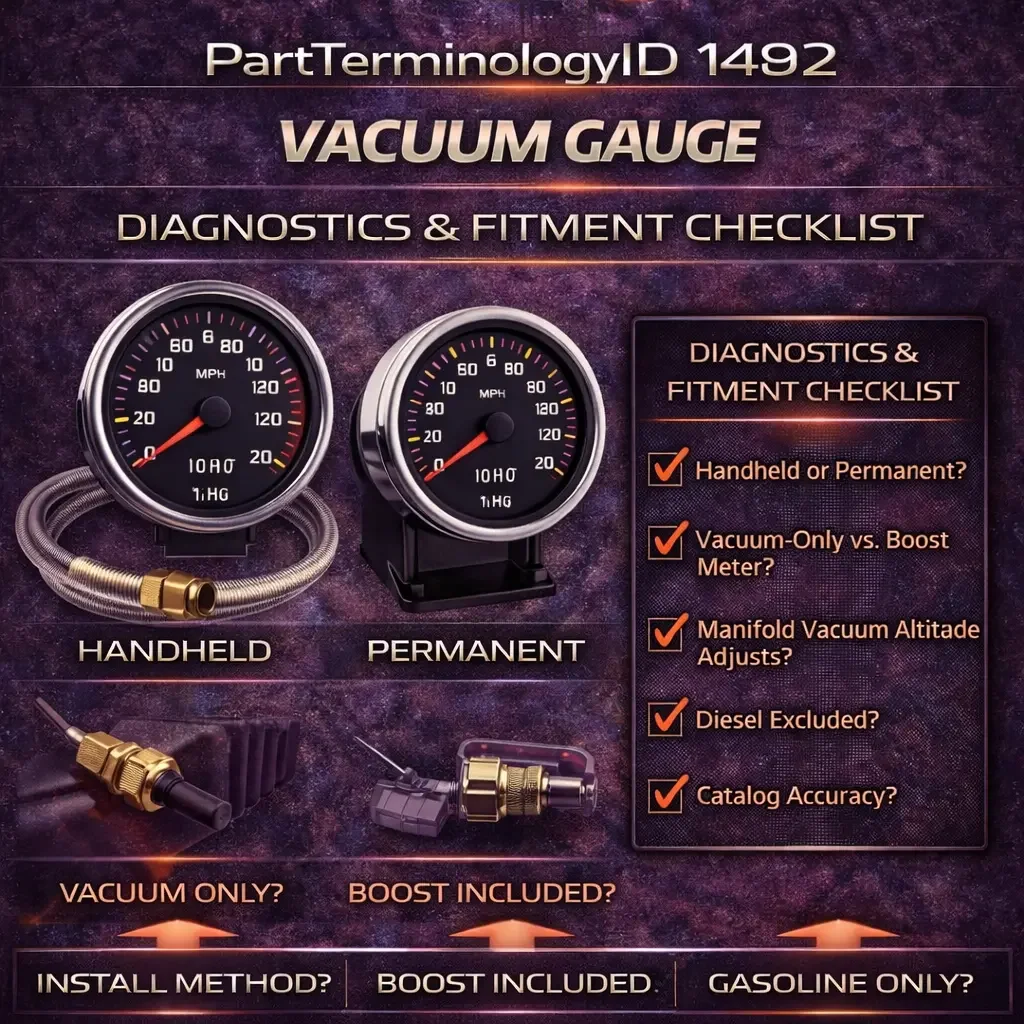
Diagnostic vacuum gauge (handheld). A portable gauge with a hose and adapter that connects to a vacuum port on the intake manifold. The technician reads the vacuum, interprets the needle behavior, and removes the gauge when diagnosis is complete. This is a tool, not a permanently installed instrument.
Permanent-mount vacuum gauge (dashboard). A gauge installed in the cabin (A-pillar pod, under-dash panel, or custom panel) for continuous monitoring. Less common as a standalone vacuum-only gauge on modern vehicles but still installed by some enthusiasts for engine health monitoring and fuel economy coaching (higher vacuum = lighter throttle = better fuel economy).
Vacuum/boost gauge (combination). A gauge that reads vacuum at idle and light load, crosses through zero at wide-open throttle on a naturally aspirated engine, and reads positive boost pressure on turbocharged or supercharged engines. The scale typically ranges from -30 inHg to +15 or +30 PSI. This is the far more common modern product, but it is a different PartTerminologyID because it includes the boost (positive pressure) range.
Economy gauge / fuel economy gauge. A vacuum gauge relabeled and marketed as a fuel economy indicator. The gauge face may be marked with zones (e.g., "Economy," "Normal," "Power") rather than inHg numbers. The underlying measurement is the same: intake manifold vacuum. Higher vacuum (light throttle) corresponds to lower fuel consumption. Lower vacuum (heavy throttle) corresponds to higher fuel consumption. Some 1970s and 1980s vehicles included factory economy gauges in the instrument cluster.
What this part does NOT cover
Boost/vacuum gauge. Combines vacuum and positive boost pressure measurement. Different PartTerminologyID.
Fuel pressure gauge (PartTerminologyID 1458). Measures fuel system pressure, not manifold vacuum.
Barometric pressure sensor. Measures atmospheric pressure for the ECU. Different component.
Brake booster vacuum. The vacuum supply for the power brake booster comes from the intake manifold, but the brake booster is a different system and PartTerminologyID.
What the Vacuum Gauge Tells You
This diagnostic content is the most valuable information a catalog listing can provide because it helps the buyer understand why they want the gauge and how to interpret what they see:
Steady 17 to 22 inHg at idle: Normal, healthy engine. Exact reading varies by altitude (vacuum is lower at higher elevations because atmospheric pressure is lower) and by engine design.
Steady but low (12 to 16 inHg at idle): Retarded ignition timing, restricted exhaust (clogged catalytic converter), or vacuum leak.
Needle fluctuates regularly at idle (drops 1 to 2 inHg rhythmically): One or more valves are not seating properly. A burnt exhaust valve is the classic cause. The needle drops each time the affected cylinder's exhaust valve fails to seal.
Needle fluctuates erratically at idle (jumps randomly): Misfire, intermittent vacuum leak, or worn valve guides.
Needle drops sharply on acceleration, slow to recover: Worn piston rings. The rings are not sealing the cylinders under load.
Needle drops to near zero and stays low: Massive vacuum leak, blown head gasket to atmosphere, or timing chain jumped significantly.
Steady 3 to 8 inHg at idle: Timing chain or belt has jumped several teeth, severely retarding valve timing.
This interpretive guide makes the vacuum gauge one of the most powerful low-cost diagnostic tools available, and including it in the product listing adds genuine value for the buyer.
Who Buys This Gauge
Classic car owners and restorers. The vacuum gauge is a traditional tuning instrument for carbureted engines. Setting idle mixture, adjusting timing, and diagnosing running problems are all aided by a vacuum gauge. Many classic car dashboards include a factory vacuum or economy gauge.
DIY mechanics and home diagnostics. A $15 to $30 diagnostic vacuum gauge provides a quick snapshot of engine health without a scan tool. Useful for pre-purchase inspections and troubleshooting rough idle or misfires on older vehicles.
Hypermilers and fuel economy enthusiasts. A permanently installed vacuum gauge provides real-time feedback on throttle input, encouraging lighter-foot driving habits. This is a niche but real buyer segment.
Marine engine diagnostics. Boat engines are not connected to OBD-II scan tools in the same way as cars. A vacuum gauge is a primary diagnostic tool for marine gasoline engines.
Naturally aspirated performance engines. On naturally aspirated engines, monitoring vacuum helps the driver understand engine load and volumetric efficiency. A well-tuned naturally aspirated engine pulls close to zero vacuum at wide-open throttle, indicating the engine is breathing efficiently.
Why This Category Creates Fitment Problems
Vacuum-only versus boost/vacuum confusion
The most common ordering error. A buyer with a turbocharged vehicle orders a vacuum-only gauge (reads 0 to -30 inHg). Under boost, the manifold pressure goes positive, which the vacuum-only gauge cannot read. The needle pegs at zero and stays there. The buyer needs a boost/vacuum gauge that reads both negative and positive.
Connection method
The gauge must connect to a vacuum source on the intake manifold. Most intake manifolds have one or more vacuum ports (small nipples or plugged holes). The gauge hose must fit the port diameter. Common port sizes are 3/16 inch, 1/4 inch, and 5/16 inch. A diagnostic gauge kit should include adapter fittings for multiple port sizes.
Permanently installed gauges need a T-fitting in an existing vacuum line or a dedicated port. The installer must ensure the vacuum tap does not affect the operation of other vacuum-operated systems (brake booster, PCV, HVAC controls) by using a source large enough to serve all connected systems.
Altitude affects readings
A vacuum gauge calibrated at sea level reads lower at altitude because the atmospheric pressure is lower. At 5,000 feet elevation, a healthy engine may read 15 to 19 inHg rather than the 17 to 22 inHg expected at sea level. This is not a gauge error. It is physics. Catalog descriptions should note: "Normal vacuum readings decrease approximately 1 inHg per 1,000 feet of elevation above sea level."
Not applicable to diesel engines
Diesel engines do not have a throttle plate (in most designs) and do not create significant intake manifold vacuum in the same way gasoline engines do. A vacuum gauge on a diesel engine reads near zero at all times and provides no useful diagnostic information. Diesel engine diagnostics use different tools (boost pressure, exhaust gas temperature, injection pressure).
Top Return Causes
1) Vacuum-only gauge ordered for turbocharged vehicle
Gauge pegs at zero under boost and cannot read positive pressure.
Prevention: "Vacuum ONLY gauge (reads 0 to -30 inHg). For turbocharged or supercharged engines, see Boost/Vacuum Gauge (reads vacuum AND positive boost pressure)."
2) Gauge connection hose does not fit the vacuum port
Prevention: Include multiple adapter fittings in diagnostic kits. Specify hose inner diameter and note common vacuum port sizes.
3) Buyer expects OBD-II-level diagnostics from a $20 gauge
Prevention: Set expectations in the description. The vacuum gauge provides engine health indicators, not fault codes or component-level diagnosis. "A vacuum gauge indicates overall engine condition. For specific fault diagnosis, use an OBD-II scan tool."
4) Diesel engine buyer, gauge reads nothing useful
Prevention: "For gasoline engines only. Diesel engines do not produce significant intake manifold vacuum and will not provide useful readings on this gauge."
5) Low reading assumed to be gauge error when it is altitude effect
Prevention: "Normal readings decrease approximately 1 inHg per 1,000 feet of elevation. At 5,000 feet, a healthy engine reads approximately 15 to 19 inHg."
Compatibility Checklist for Buyers
1) Confirm your engine is naturally aspirated gasoline. If turbocharged or supercharged, you need a boost/vacuum gauge, not a vacuum-only gauge. If diesel, a vacuum gauge is not applicable.
2) Determine your use case. Diagnostic (portable, connect and remove) or permanent installation (dashboard mount).
3) Identify a vacuum source. Locate a vacuum port on the intake manifold. Confirm the port size.
4) Know your altitude. Expect lower readings at higher elevations.
5) Confirm gauge diameter if permanently mounting. 2-1/16 inch or 2-5/8 inch.
Catalog Checklist for Attributes
Core taxonomy: Product form (diagnostic handheld, permanent mount, economy gauge). Separate from Boost/Vacuum Gauge, Fuel Pressure Gauge, and Barometric Pressure Sensor.
Specs: Measurement range (0 to -30 inHg typical). Units: inHg, mmHg, or kPa. Gauge diameter (for permanent mount).
Kit contents (diagnostic): Gauge, hose, adapter fittings (list sizes), carrying case.
Kit contents (permanent mount): Gauge, hose, T-fitting, adapter fittings, mounting hardware, wiring (if illuminated).
Images: Gauge face showing scale, hose and adapter fittings, installed reference (for permanent mount).
FAQ
What is a normal vacuum reading?
17 to 22 inHg at idle at sea level for a healthy gasoline engine. Readings decrease about 1 inHg per 1,000 feet of elevation.
Can I use a vacuum gauge on my turbocharged car?
A vacuum-only gauge reads manifold vacuum at idle and light load, but it cannot read positive boost pressure. For turbocharged or supercharged engines, a boost/vacuum gauge that reads both vacuum and positive pressure is the correct instrument.
Is a vacuum gauge the same as an economy gauge?
Functionally, yes. An economy gauge is a vacuum gauge with the face labeled in zones (Economy, Normal, Power) rather than inHg. The underlying measurement is identical: higher vacuum equals lighter throttle equals lower fuel consumption.
Final Take for Aftermarket Teams
Vacuum Gauge (PartTerminologyID 1492) is the oldest diagnostic gauge in the series and still one of the most informative for naturally aspirated gasoline engines. The catalog challenges are separating vacuum-only gauges from boost/vacuum gauges, excluding diesel applications, noting altitude effects on readings, and including the diagnostic interpretation guide that makes the gauge genuinely useful to the buyer. The teams that include "what the needle behavior means" content in their listings sell a diagnostic tool, not just a gauge. That content is what turns a $20 product into a $20 product the buyer actually uses, understands, and does not return.