
Automatic Transmission Oil Temperature Gauge (PartTerminologyID 1490): The Gauge That Saves Transmissions and Pays for Itself the First Time It Warns You
Written by Arthur Simitian | PartsAdvisory
The Engine Oil Temperature post (PartTerminologyID 1472) covered why oil temperature matters for engine protection. This post covers the same concept for a different and arguably more vulnerable component: the automatic transmission.
Automatic transmissions are heat machines. The torque converter, the clutch packs, the planetary gear sets, and the fluid pump all generate heat during normal operation. Automatic transmission fluid (ATF) is the cooling medium, the lubricant, and the hydraulic working fluid all at once. When ATF temperature stays within its design range (175 to 200 degrees Fahrenheit for most transmissions), the fluid maintains its viscosity, its friction modifier properties, and its ability to protect internal components. When ATF temperature exceeds that range, the fluid degrades rapidly.
The industry rule of thumb is that for every 20 degrees Fahrenheit above 200 degrees, the fluid's useful life is cut in half. At 220 degrees, fluid life is half of normal. At 240 degrees, a quarter. At 260 degrees, an eighth. At 275 to 300 degrees, the fluid begins to varnish, the seals harden, the clutch material glazes, and the transmission is on a path to failure. A single sustained overheating event (towing a heavy trailer up a long mountain grade on a hot day, for example) can cause enough damage to shorten a transmission's life by tens of thousands of miles.
No mainstream production vehicle has a transmission temperature gauge on the dashboard. Some trucks display transmission temperature as a secondary readout in the driver information center (often only when the temperature exceeds a threshold), but a dedicated analog gauge with real-time display is strictly an aftermarket product. Like the engine oil temperature gauge, this is a gauge the factory never provides but that every towing, performance, and heavy-use buyer should have.
This post is built for aftermarket catalog teams, marketplace sellers, and buyers who want fewer mistakes and fewer returns.
Status in New Databases
Status in New Databases
Current: PIES 7.2 + PCdb Future: PIES 8.0 + PCdb 2.0 Status: No change
What Automatic Transmission Oil Temperature Gauge Means in the Aftermarket
Automatic Transmission Oil Temperature Gauge (PartTerminologyID 1490) refers to a gauge that displays the temperature of the automatic transmission fluid (ATF).
In catalog reality, this covers the same product forms as the engine oil temperature gauge:
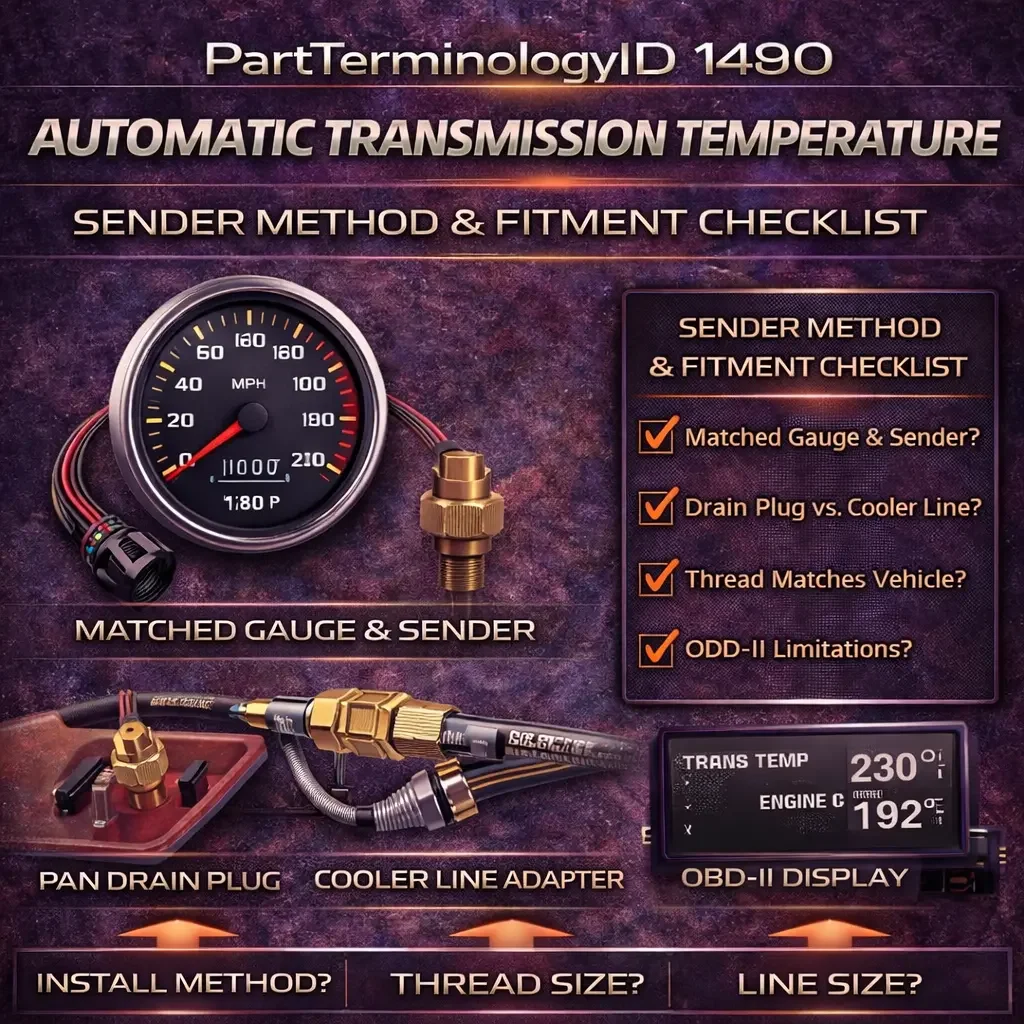
Electric transmission temperature gauge with sender. The standard product. A gauge (2-1/16 inch or 2-5/8 inch) mounted in the cabin, paired with a temperature sender (thermistor) installed in the transmission's fluid circuit. The sender threads into the transmission pan, a transmission cooler line fitting, or a transmission cooler line adapter.
Mechanical transmission temperature gauge. A capillary tube gauge with a bulb sensor installed in the transmission fluid circuit. Less common than electric due to routing difficulty.
Digital transmission temperature gauge. Electronic gauge with LCD/LED display, programmable warnings, and peak temperature recall.
Transmission temperature sender only. The sensor without the gauge. For buyers who already have a compatible gauge.
OBD-II based transmission temperature display. Some aftermarket devices read the transmission temperature from the vehicle's OBD-II port (the factory transmission temperature sensor reports to the ECU on many modern vehicles) and display it on a screen or smartphone app. This is not a traditional gauge but serves the same informational purpose without adding a sender to the transmission.
What this part does NOT cover
Engine oil temperature gauge (PartTerminologyID 1472). Measures engine oil, not transmission fluid.
Engine coolant temperature gauge. Measures coolant, not ATF.
Transmission temperature sensor (OEM). The factory sensor that reports to the ECU. Different PartTerminologyID.
Transmission cooler. The heat exchanger that cools the ATF. Different system, different PartTerminologyID.
Who Buys This Gauge
The buyer population is more specific than for most gauges in this series:
Tow vehicle owners. The primary market. Towing a trailer, boat, camper, or equipment dramatically increases transmission heat generation. The torque converter slips more under heavy load, the transmission shifts more frequently on grades, and the ATF temperature climbs. A tow vehicle without a transmission temperature gauge is operating blind during the most demanding use case for the transmission.
Performance and racing. Modified vehicles with higher-than-stock power output stress the transmission beyond its design envelope. Drag racing, road racing, and high-performance street driving generate transmission heat that the factory cooling system may not manage.
Heavy-duty and commercial use. Delivery vehicles, work trucks, and fleet vehicles that operate in stop-and-go traffic with heavy loads generate sustained transmission heat.
Off-road vehicles. Low-speed, high-load off-road driving (rock crawling, sand, mud) generates significant torque converter heat because the converter is slipping at low vehicle speeds with high engine RPM.
Hot climate drivers. Ambient temperature affects the transmission cooler's ability to reject heat. A vehicle towing in 105-degree Arizona heat generates significantly more ATF temperature than the same vehicle towing in 70-degree Pacific Northwest weather.
Sender Installation Methods
The sender must access the ATF to measure its temperature. Common installation methods:
Transmission pan drain plug adapter. Replace the transmission pan drain plug with a plug that includes a threaded sender boss. The sender threads into the boss and sits in the fluid pool in the pan. This measures sump temperature, which is the hottest fluid in the system after it has circulated through the transmission.
Transmission cooler line adapter (inline fitting). An adapter fitting that installs inline in the transmission cooler line (the line that runs from the transmission to the cooler, typically in front of the radiator). The sender threads into the adapter and measures fluid temperature in the line. This measures fluid temperature as it exits the transmission heading to the cooler, which is a good indicator of the peak operating temperature.
Transmission pan with sender boss. Some aftermarket transmission pans (deeper pans designed to hold more fluid for improved cooling) include a pre-welded sender boss. The sender threads directly into the pan.
OBD-II tap. No physical sender installation required. An OBD-II reader pulls the temperature data from the factory transmission temperature sensor via the vehicle's diagnostic bus. This is the easiest installation but requires a compatible display device and may not be available on all vehicles.
Gauge-Sender Impedance Matching
Same requirement as every other gauge in this series. The gauge and sender must be from the same manufacturer or verified compatible. A gauge calibrated for one sender's resistance curve will not read correctly with a different sender. Buy matched gauge-and-sender kits.
Temperature Ranges and What Normal Looks Like
Normal operating range: 175 to 200 degrees F (80 to 93 degrees C). ATF is designed to operate here. Fluid life is maximized.
Elevated but manageable: 200 to 220 degrees F (93 to 104 degrees C). Common during towing and heavy use. Fluid life is reduced but not critically. Monitor and reduce load if temperature continues climbing.
Warning zone: 220 to 250 degrees F (104 to 121 degrees C). Fluid degradation is accelerating. Reduce load, slow down, pull over if possible, and allow the transmission to cool. Consider adding a transmission cooler if this range is reached regularly.
Danger zone: 250+ degrees F (121+ degrees C). Fluid is breaking down rapidly. Varnishing, seal hardening, and clutch glazing are occurring. Stop towing, pull over, and let the transmission cool completely. A single sustained event at this temperature can cause permanent damage.
Including these ranges in the product description helps the buyer understand what the gauge is telling them and what action to take.
Top Return Causes
1) Gauge and sender not impedance-matched
Prevention: Sell matched kits. If selling gauge alone: "Requires [brand] transmission temperature sender (sold separately). Not compatible with other sender brands without verification."
2) Sender does not fit the transmission pan or cooler line
Thread size on the drain plug adapter or inline fitting does not match the vehicle's transmission.
Prevention: Specify thread sizes. "Includes 1/8 NPT sender. Drain plug adapter fits transmissions with [thread size] drain plug. Cooler line adapter fits 3/8 inch transmission cooler lines."
3) Buyer confuses transmission temperature with engine oil temperature or coolant temperature
Orders the wrong gauge or the wrong sender for the wrong fluid.
Prevention: Clear naming: "AUTOMATIC TRANSMISSION Fluid Temperature Gauge. Measures ATF temperature. This gauge does NOT measure engine oil or engine coolant temperature."
4) OBD-II reader does not display transmission temperature for the vehicle
Not all vehicles report transmission temperature via OBD-II. Some vehicles use proprietary protocols that generic OBD-II readers cannot access.
Prevention: For OBD-II products: "Transmission temperature display via OBD-II is vehicle-dependent. Not all vehicles report ATF temperature through standard OBD-II protocols. Check compatibility with your specific vehicle before purchasing."
5) Buyer does not know what temperature is normal
Gauge reads 190 degrees F and the buyer thinks the transmission is overheating because they have no reference point.
Prevention: Include normal operating range in the listing: "Normal ATF temperature: 175 to 200 degrees F. Temperatures above 220 degrees F under sustained load indicate the transmission is working harder than normal."
Compatibility Checklist for Buyers
1) Buy a matched gauge-and-sender kit.
2) Determine your sender installation method. Drain plug adapter, cooler line adapter, aftermarket pan with boss, or OBD-II.
3) If using a drain plug adapter, confirm your transmission pan drain plug thread size.
4) If using a cooler line adapter, confirm your transmission cooler line diameter (typically 3/8 inch or 5/16 inch).
5) Confirm gauge diameter. 2-1/16 inch or 2-5/8 inch.
6) Choose temperature scale. Fahrenheit or Celsius.
Catalog Checklist for Attributes
Core taxonomy: Product form (gauge with sender kit, gauge only, sender only, OBD-II display). Separate from Engine Oil Temperature Gauge, Coolant Temperature Gauge, OEM Transmission Temperature Sensor, and Transmission Cooler.
Specs: Temperature range (typically 100-300 degrees F). Gauge type: electric, mechanical, digital, OBD-II. Sender type and impedance. Gauge diameter.
Kit contents: Gauge, sender, drain plug adapter (thread size), cooler line adapter (line diameter), wiring, mounting hardware, instructions.
Images: Gauge face, sender, drain plug adapter or cooler line adapter, complete kit laid out, installed reference.
FAQ
At what temperature should I worry about my transmission?
Above 220 degrees F under sustained load is elevated. Above 250 degrees F is dangerous. If you regularly see temperatures above 220 degrees F while towing or in heavy use, consider adding or upgrading a transmission cooler.
Do I need a transmission temperature gauge if my truck has a factory temperature readout?
Many factory readouts only display temperature when it exceeds a preset threshold, and some only show a vague "hot" warning rather than an actual number. An aftermarket gauge provides real-time, continuous temperature display so you can see trends and take action before the factory warning activates.
Will a transmission cooler lower my ATF temperature?
Yes. An auxiliary transmission cooler (typically an air-to-oil heat exchanger mounted in front of the radiator or A/C condenser) can reduce ATF temperatures by 20 to 50 degrees F depending on size, airflow, and conditions. The transmission temperature gauge tells you whether you need a cooler and how effective it is after installation.
Final Take for Aftermarket Teams
Automatic Transmission Oil Temperature Gauge (PartTerminologyID 1490) is the tow vehicle owner's most important aftermarket gauge. ATF degrades exponentially with temperature, and the factory provides no real-time visibility into this critical parameter on most vehicles. The catalog must sell matched gauge-and-sender kits, specify sender installation methods with thread sizes and line diameters, include normal and danger-zone temperature ranges in the description, and clearly separate this gauge from engine oil temperature and coolant temperature at the naming level. The gauge costs $30 to $80. A transmission replacement costs $3,000 to $6,000. The math sells itself.