
Tachometer Gauge (PartTerminologyID 1488): The RPM Gauge That Tells You When to Shift, When to Back Off, and Whether the Engine Is Running Right
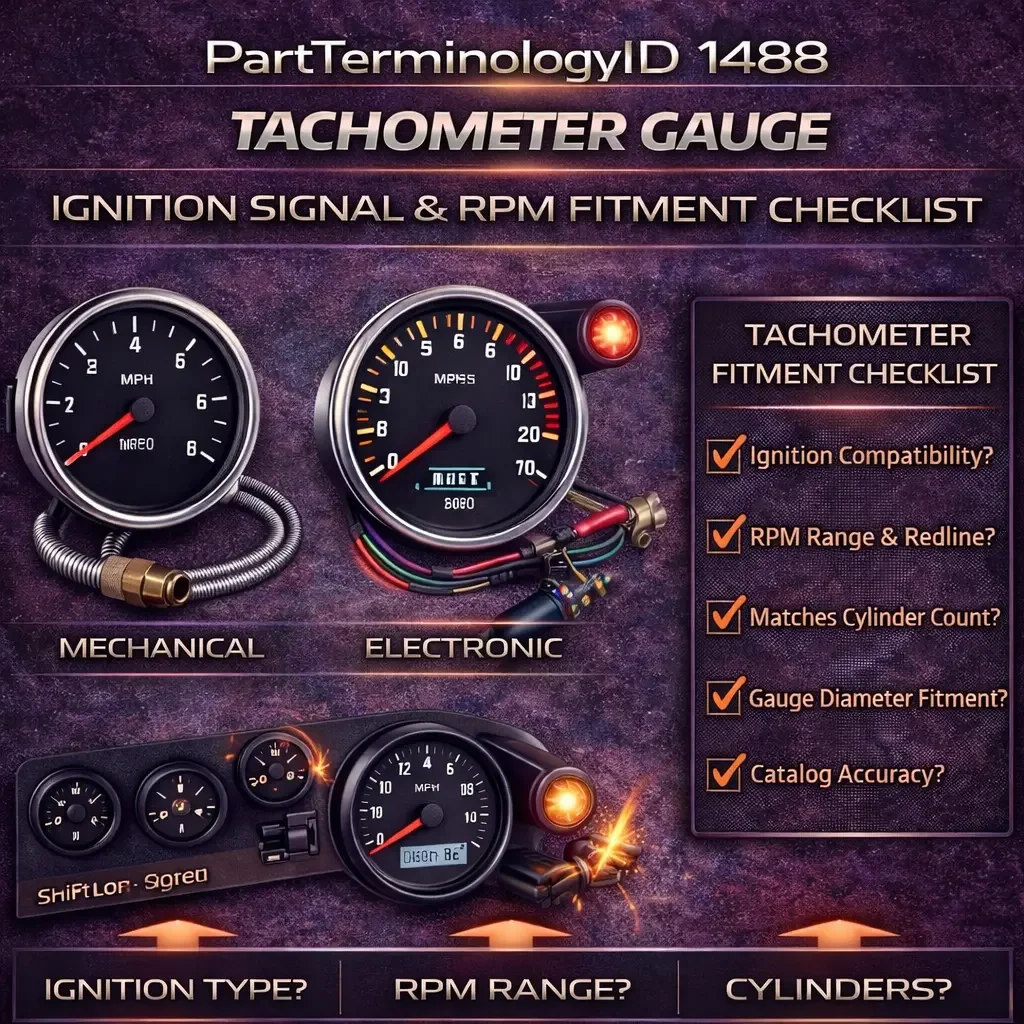
Written by Arthur Simitian | PartsAdvisory
The Speedometer Gauge (PartTerminologyID 1484) tells the driver how fast the vehicle is going. The Tachometer Gauge tells the driver how fast the engine is spinning. Both are primary instruments, but they serve different purposes. The speedometer is a legal requirement. The tachometer is a performance and driving information instrument that most vehicles include but some base trims still omit.
The tachometer displays engine RPM (revolutions per minute) on a scale typically ranging from 0 to 6,000, 8,000, or 10,000 RPM depending on the engine. Most tachometers include a redline zone (a red-shaded area at the top of the scale) indicating the maximum safe RPM for the engine. Exceeding the redline risks valve float, bearing damage, and catastrophic engine failure.
The Tachometer Cable post (PartTerminologyID 1444) covered the mechanical cable that drives a tachometer on classic cars. This post covers the tachometer gauge itself, whether it is driven by a cable or an electronic signal.
This post is built for aftermarket catalog teams, marketplace sellers, and buyers who want fewer mistakes and fewer returns.
Status in New Databases
Status in New Databases
Current: PIES 7.2 + PCdb Future: PIES 8.0 + PCdb 2.0 Status: No change
What Tachometer Gauge Means in the Aftermarket
Tachometer Gauge (PartTerminologyID 1488) refers to the dashboard instrument that displays engine RPM.
In catalog reality, this covers:
OEM replacement tachometer. A gauge designed to replace the original factory tachometer in a specific vehicle's instrument cluster. Must match diameter, face graphics, RPM range, redline position, needle style, illumination, and input type. This is the restoration and repair market product.
Aftermarket universal tachometer. A standalone tachometer in standard primary gauge diameters (3-3/8 inch or 5 inch) with various face styles. Used for custom builds, hot rods, race cars, and vehicles where the buyer is adding a tachometer that was not factory-equipped. Available in mechanical (cable-driven, rare) and electronic (ignition signal) versions.
Shift light tachometer. A tachometer with a built-in programmable shift light that illuminates at a preset RPM to signal the driver to upshift. Common in the performance and racing market. The shift point is adjustable.
Digital tachometer. An electronic display showing RPM numerically or on a bar graph. May include peak RPM recall, programmable shift light, and data logging.
Tachometer as part of an instrument cluster. On most modern vehicles, the tachometer is integrated into the cluster and cannot be replaced separately. If the tachometer fails, the cluster must be replaced or rebuilt.
What this part does NOT cover
Tachometer cable (PartTerminologyID 1444). The mechanical cable on classic cars.
Instrument cluster. The complete gauge assembly.
Shift light (standalone). A separate shift indicator light mounted on the dashboard or steering column without a tachometer.
Engine RPM signal from the ECU. The electronic signal source, not the display instrument.
Signal Type and Ignition Compatibility
This is the primary technical specification and the most common source of fitment problems. The tachometer must be compatible with the vehicle's ignition system:
Points ignition (classic cars). The tachometer reads the opening and closing of the ignition points in the distributor. The signal is a relatively clean square wave. Most aftermarket tachometers are compatible with points ignition.
Electronic ignition (HEI, Duraspark, Chrysler Electronic, etc.). The tachometer reads the electronic ignition module's trigger signal. The signal characteristics differ from points ignition. Most aftermarket tachometers are compatible, but some older or budget tachometers designed specifically for points ignition may not read correctly with electronic ignition.
Distributorless ignition (DIS) / waste spark. The tachometer must read from the ignition module or coil pack. The signal may require a specific connection point. Some tachometers need an adapter or a specific tach output wire from the ignition module.
Coil-on-plug (COP) ignition. Modern engines with individual coils on each spark plug. There is no single ignition wire to tap for a tachometer signal. The tachometer must connect to the ECU's tach output (if available) or use a signal adapter that reads one coil's trigger wire. This is the most common compatibility issue on modern vehicles.
Diesel engines. Diesel engines have no ignition system (no spark plugs, no coils). Tachometers for diesel engines must read an alternator signal (W terminal) or a crankshaft position sensor signal rather than an ignition signal. A gasoline tachometer connected to a diesel engine has nothing to read.
Cylinder count
The tachometer must know how many cylinders the engine has to calculate RPM correctly. A 4-cylinder engine fires twice per crankshaft revolution. A V8 fires four times. The tachometer uses the number of ignition pulses per revolution to calculate RPM. If the cylinder count setting is wrong, the RPM reading is wrong by a proportional factor.
Most aftermarket tachometers have a selector switch or programmable setting for cylinder count (4, 6, or 8 cylinders). Some also support odd-fire configurations (like some V6 engines) and rotary engines (which have a different firing pattern).
RPM Range and Redline Position
The RPM range on the tachometer face must be appropriate for the engine:
0-6,000 RPM. Appropriate for most diesel engines, large displacement V8s, and trucks. Redline typically at 5,000 to 5,500 RPM.
0-8,000 RPM. The most common range for gasoline engines. Covers most naturally aspirated 4-cylinder and V6 engines. Redline typically at 6,000 to 7,000 RPM.
0-10,000 RPM. For high-revving engines: sport motorcycles, racing 4-cylinders, and some naturally aspirated high-performance engines (Honda S2000, Ferrari, Porsche GT3). Redline at 8,000 to 9,000+ RPM.
A 10,000 RPM tachometer on a diesel truck that redlines at 4,500 RPM is nearly useless because the needle operates in the bottom third of the scale. A 6,000 RPM tachometer on a motorcycle that revs to 14,000 RPM will peg the needle and potentially damage the gauge.
Mechanical vs. Electronic
Mechanical (cable-driven). Connected to the engine via a tachometer cable (PartTerminologyID 1444). The cable spins a magnetic cup mechanism similar to a mechanical speedometer. Only found on classic cars and some vintage motorcycles. Requires a tachometer drive on the engine (distributor or camshaft).
Electronic (signal-driven). Reads the ignition signal or an ECU tach output. No cable, no mechanical connection. This is the standard for all vehicles from the 1970s forward, and for all aftermarket tachometers today. The gauge connects to the ignition system via a signal wire.
Why This Category Creates Fitment Problems
Ignition system incompatibility
A tachometer designed for points ignition may not work with COP ignition. A gasoline tachometer will not work on a diesel engine. The listing must specify compatible ignition types.
Cylinder count not set correctly
The tachometer reads incorrectly because the cylinder count does not match the engine. This is an installation error rather than a fitment error, but including a note in the listing helps: "Set cylinder count selector to match your engine before installation. Incorrect cylinder count will produce inaccurate RPM readings."
Gauge diameter
Primary tachometer diameters (3-3/8 inch, 5 inch) must match the cluster or panel opening. Same issue as the speedometer.
RPM range mismatch
Tachometer scale does not match the engine's operating range.
Standalone gauge versus integrated cluster
On modern vehicles, the tachometer is part of the cluster. A standalone aftermarket tachometer will not replace a failed cluster tachometer without the buyer also finding a mounting location and signal connection.
Top Return Causes
1) Tachometer does not work with the ignition system
Most common on COP and diesel applications.
Prevention: Specify compatible ignition types: "Compatible with points, electronic, and HEI ignition. For coil-on-plug or distributorless ignition, connect to ECU tach output wire or use a signal adapter. Not compatible with diesel engines (see diesel-specific tachometers)."
2) Wrong RPM range
6,000 RPM tachometer on a high-revving engine, or 10,000 RPM tachometer on a low-revving engine.
Prevention: RPM range in the title: "0-8,000 RPM Tachometer" or "0-10,000 RPM Tachometer."
3) Wrong gauge diameter
Prevention: Diameter in the title: "3-3/8 Inch Tachometer" or "5 Inch Tachometer."
4) Mechanical tachometer ordered for vehicle without tach drive
Buyer orders a cable-driven tachometer but the engine has no tachometer drive port.
Prevention: "Mechanical (cable-driven). Requires tachometer drive on engine (distributor or camshaft). For engines without tachometer drive, use an electronic tachometer."
5) Cylinder count confusion causes wrong reading
Buyer installs the tachometer and the RPM reads double or half the actual value because the cylinder count is set wrong.
Prevention: Note: "Set cylinder count to match your engine: 4, 6, or 8 cylinders. Factory default may not match your engine."
Compatibility Checklist for Buyers
1) Confirm signal type. Mechanical cable or electronic ignition signal. If electronic, confirm your ignition type: points, electronic, DIS, COP, or diesel.
2) Confirm RPM range. Match to your engine's redline. Allow headroom above the redline for readability.
3) Confirm gauge diameter. 3-3/8 inch or 5 inch for primary gauges. 2-1/16 inch or 2-5/8 inch for auxiliary-size mini tachometers.
4) Confirm cylinder count. The tachometer must be set to match your engine's cylinder count.
5) For diesel engines, confirm the tachometer is diesel-compatible. Standard gasoline tachometers do not work on diesels.
6) For OEM replacement, confirm exact vehicle year and cluster option.
Catalog Checklist for Attributes
Core taxonomy: Product form (OEM replacement, universal electronic, universal mechanical, shift light tachometer, digital). Separate from Tachometer Cable, Instrument Cluster, and Shift Light.
Signal specs: Input type (mechanical cable, electronic ignition signal, ECU tach output, alternator W terminal for diesel). Compatible ignition types. Cylinder count selector (4/6/8, programmable, or fixed).
Physical specs: Gauge diameter. RPM range. Redline position. Shift light (yes/no, programmable). Face style, needle color, bezel finish, illumination.
Images: Gauge face showing RPM range and redline, rear showing signal connection and cylinder count selector, illuminated photo, shift light (if equipped).
FAQ
My tachometer reads double the actual RPM. What is wrong?
The cylinder count is set incorrectly. If the tachometer is set for 4 cylinders but the engine is a V8, the gauge reads double because it is counting twice as many ignition events per revolution as it should. Change the cylinder count setting to match your engine.
Can I add a tachometer to a vehicle that only has a speedometer?
Yes. An aftermarket electronic tachometer can be installed on any vehicle. Connect the signal wire to the ignition system's tach output, coil negative terminal, or ECU tach signal (depending on the ignition type), set the cylinder count, mount the gauge, and connect power and ground.
Does a tachometer work on a diesel engine?
Only diesel-specific tachometers. Standard tachometers read ignition signals, and diesel engines have no ignition system. Diesel tachometers read the alternator's W terminal (a signal proportional to engine RPM) or a crankshaft position sensor signal.
Final Take for Aftermarket Teams
Tachometer Gauge (PartTerminologyID 1488) is the companion to the Speedometer Gauge (1484): both are primary instruments, both come in similar diameters, and both require signal type compatibility as the first fitment check. The unique challenge for tachometers is ignition system compatibility, which has become more complex as ignition technology has progressed from points to COP. The teams that catalog this well specify the compatible ignition types, include the cylinder count setting reminder, match the RPM range to the engine type, and separate diesel tachometers from gasoline tachometers at the product level. The tachometer is the performance driver's most-watched gauge. The listing must give them the right one for their engine.