
Speedometer Gauge (PartTerminologyID 1484): The One Gauge Every Vehicle Has, Every Driver Watches, and Every Cop Cares About
Written by Arthur Simitian | PartsAdvisory
The gauge series covered auxiliary and supplemental gauges: ammeter, fuel level, oil pressure, oil temperature, fuel pressure, and hour meter. The Speedometer Gauge is different from all of them because it is not optional, not supplemental, and not limited to certain vehicles or trims. Every road-legal vehicle has a speedometer. It is the one gauge that is legally required, universally present, and the basis for speeding tickets, speed limit compliance, and odometer-based vehicle valuation.
That legal and regulatory weight makes the speedometer a more sensitive replacement part than any other gauge. An oil pressure gauge that reads 5 PSI off is a diagnostic nuisance. A speedometer that reads 5 MPH off is a legal liability. An odometer that does not accurately record mileage (because it is mechanically linked to or digitally derived from the speedometer system) is a federal crime to tamper with under 49 U.S.C. 32703.
This post connects to the Speedometer Cable (PartTerminologyID 1440) covered earlier, the Gauge Set (1480) just completed, and the broader gauge series. It covers the speedometer as a standalone replacement instrument.
This post is built for aftermarket catalog teams, marketplace sellers, and buyers who want fewer mistakes and fewer returns.
Status in New Databases
Status in New Databases
Current: PIES 7.2 + PCdb Future: PIES 8.0 + PCdb 2.0 Status: No change
What Speedometer Gauge Means in the Aftermarket
Speedometer Gauge (PartTerminologyID 1484) refers to the dashboard instrument that displays the vehicle's current speed in MPH, KPH, or both.
In catalog reality, this covers:
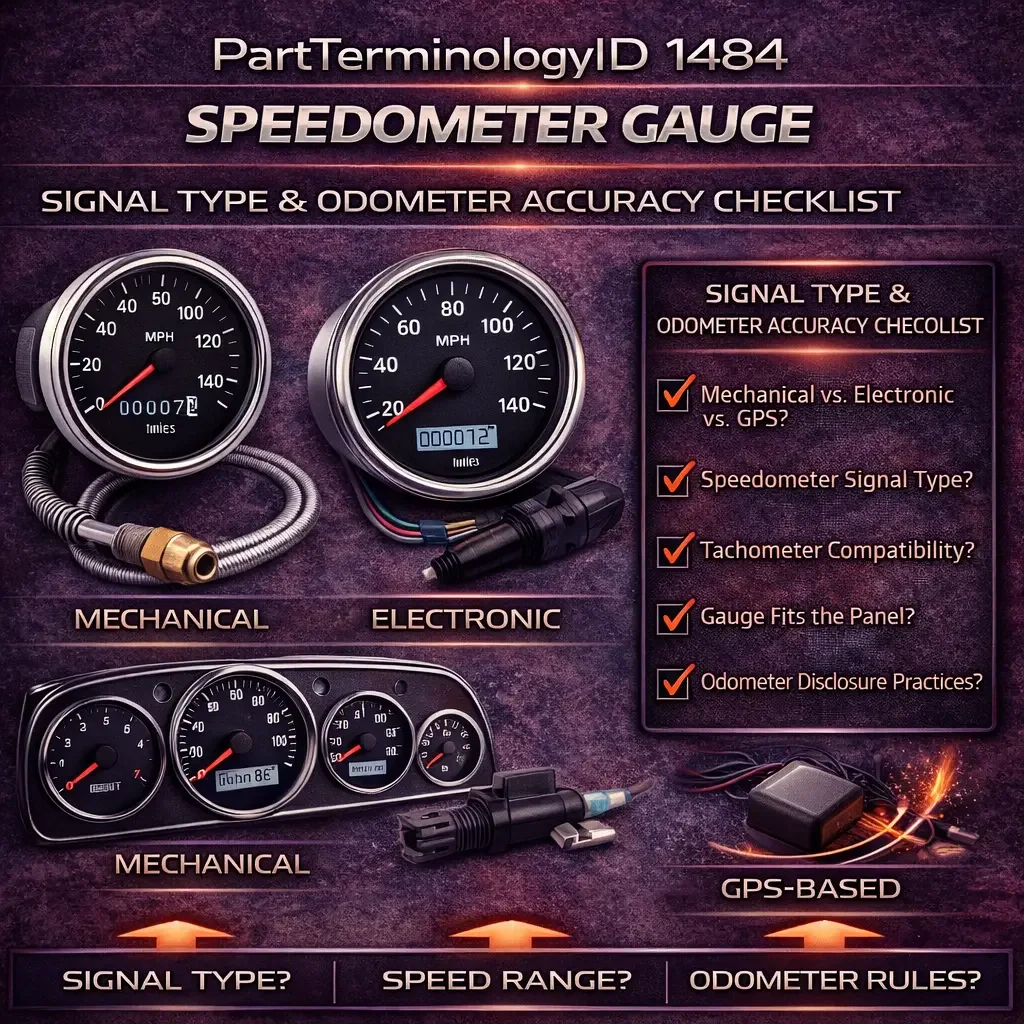
OEM replacement speedometer head. A gauge designed to replace the original speedometer in a specific vehicle's instrument cluster. Must match the original in diameter, face graphics, speed range, needle style, illumination, input type (mechanical cable or electronic signal), and odometer type (mechanical or electronic). This is the restoration and repair market product.
Aftermarket universal speedometer. A standalone speedometer available in standard diameters (3-3/8 inch and 5 inch are the most common primary gauge sizes) with various face styles. Used for custom builds, hot rods, kit cars, and race vehicles. Available in mechanical (cable-driven) and electronic (programmable pulse input) versions.
Digital speedometer. An electronic display that shows speed numerically on an LCD or LED screen. May include programmable features, GPS speed input, trip computer functions, and configurable units (MPH/KPH).
Speedometer as part of an instrument cluster. On virtually all modern vehicles (1990 and newer), the speedometer is integrated into the instrument cluster and cannot be replaced as a standalone gauge. If the speedometer fails, the entire cluster must be replaced or rebuilt. For these vehicles, PartTerminologyID 1484 as a standalone replacement does not apply.
What this part does NOT cover
Speedometer cable (PartTerminologyID 1440). The mechanical cable that drives the speedometer on older vehicles.
Vehicle speed sensor (VSS). The electronic sensor on the transmission that provides the speed signal on modern vehicles.
Instrument cluster. The complete gauge assembly. Different PartTerminologyID.
GPS speedometer apps or heads-up displays. Aftermarket electronic devices that display speed using GPS. Not a gauge in the traditional sense.
Signal Type: The Most Important Technical Specification
The speedometer must match the vehicle's speed signal source. This is the same issue discussed in the Gauge Set post (1480), but it is critical enough to revisit for standalone speedometer replacement:
Mechanical (cable-driven). The speedometer cable (PartTerminologyID 1440) spins the speedometer's input shaft. The cable rotation drives a magnetic cup mechanism inside the speedometer that moves the needle. The speed displayed is proportional to cable rotation speed, which is determined by the speedometer drive gear ratio in the transmission. If the drive gear ratio, tire size, or transmission is changed, the speedometer reading changes. Recalibration requires either changing the drive gear in the transmission or installing a speedometer ratio adapter.
Classic cars and older vehicles use this system. The replacement speedometer must have a cable input (a square or slotted socket on the back of the gauge that the cable end engages).
Electronic (pulse signal). A vehicle speed sensor (VSS) on the transmission generates a pulsed electrical signal. The number of pulses per mile depends on the sensor, the transmission, and the final drive ratio. Common values range from 2,000 to 128,000 pulses per mile. The electronic speedometer counts pulses and displays the corresponding speed.
Programmable electronic speedometers allow the buyer to set the pulse count to match their vehicle. Non-programmable electronic speedometers are calibrated for a fixed pulse count and only work correctly with vehicles that match that count.
GPS-based. Some aftermarket speedometers use a GPS antenna to calculate speed from satellite position changes. GPS speedometers are independent of the transmission and drivetrain. They work on any vehicle regardless of cable, VSS, tire size, or gear ratio. The trade-off is a slight delay in response (GPS updates are typically 1 to 5 times per second versus instantaneous mechanical or high-frequency electronic updates) and signal loss in tunnels, parking garages, and dense urban areas.
The Odometer Complication
Every speedometer includes or is associated with an odometer. The odometer records cumulative mileage and is a critical component of the vehicle's legal identity. Federal law prohibits odometer tampering, and the odometer reading directly affects the vehicle's resale value.
When a speedometer is replaced, the odometer situation must be addressed:
Mechanical odometer. On classic cars with mechanical speedometers, the odometer is a set of rotating number wheels inside the speedometer head driven by the cable. When a new speedometer is installed, the odometer reads zero (or whatever the new gauge is set to). The vehicle's actual mileage must be documented. Some states require an odometer disclosure statement when the odometer is replaced, and the title may be noted as "odometer replaced" or "actual mileage unknown."
Electronic odometer. On vehicles with electronic clusters, the odometer reading is stored in the cluster's memory. Replacing the cluster or speedometer resets the displayed mileage. Reprogramming the correct mileage into a replacement cluster requires a dealer-level tool or a cluster programming service. Selling a vehicle with an incorrect odometer reading (whether intentional or not) is a legal issue.
Aftermarket speedometers with trip odometer only. Some universal aftermarket speedometers include a trip odometer but not a permanent cumulative odometer. These are acceptable for race cars and off-road vehicles but may not meet legal requirements for road-registered vehicles.
Catalog teams should note the odometer situation for every speedometer listing: "Odometer reads zero on new unit. Document actual vehicle mileage at time of installation. Check state requirements for odometer disclosure."
Why This Category Creates Fitment Problems
Cable input versus electronic input
A mechanical speedometer cannot accept an electronic signal. An electronic speedometer cannot accept a cable input (unless it includes a cable-to-electronic signal converter, which some aftermarket models do). This is the most basic and most common fitment error.
Speed range on the face
Speedometers are available in different maximum speed ranges: 80 MPH, 100 MPH, 120 MPH, 140 MPH, 160 MPH, and 200+ MPH. The speed range affects the face graphics and the needle sweep calibration. A 120 MPH speedometer on a vehicle that regularly exceeds 120 MPH (track use) is useless above that speed. An 85 MPH speedometer (common on 1980s U.S.-market vehicles) looks period-correct for restoration but is functionally limited. A 200 MPH speedometer on a vehicle that tops out at 110 MPH has a needle that barely moves past the halfway point, making it difficult to read at normal driving speeds.
Gauge diameter
Primary speedometer gauges come in several diameters: 3-3/8 inch (86mm), 3-1/8 inch (80mm), 4-5/8 inch (117mm), and 5 inch (127mm). The gauge must fit the cluster or panel opening. Unlike auxiliary gauges which are almost universally 2-1/16 inch, speedometer diameters vary significantly between vehicles.
MPH versus KPH versus dual scale
U.S.-market vehicles display MPH as the primary scale. Canadian and international vehicles may display KPH as primary with MPH secondary. The replacement must match the buyer's market and preference.
Pulse count for electronic speedometers
If the electronic speedometer is not programmable, the pulse count must match the vehicle's VSS output exactly. A speedometer calibrated for 8,000 pulses per mile on a vehicle that outputs 4,000 pulses per mile will read half the actual speed.
Top Return Causes
1) Cable input ordered for electronic vehicle (or vice versa)
Prevention: Signal type in the title: "Mechanical (Cable-Driven) Speedometer" or "Electronic (Programmable Pulse) Speedometer."
2) Wrong gauge diameter
Prevention: Diameter in the title: "3-3/8 Inch Speedometer" or "5 Inch Speedometer."
3) Wrong speed range
Buyer needs a 120 MPH speedometer and receives an 85 MPH version, or vice versa.
Prevention: Speed range in the title: "0-120 MPH Speedometer" or "0-160 MPH Speedometer."
4) Electronic speedometer not programmable, wrong pulse count
Speedometer is factory-calibrated for a pulse count that does not match the vehicle.
Prevention: "Programmable: accepts 2,000 to 128,000 pulses per mile" or "Fixed calibration: 8,000 pulses per mile. Verify your vehicle's VSS output before ordering."
5) Odometer discrepancy not understood
Buyer installs new speedometer and the odometer reads zero. They did not document the actual mileage or understand the legal implications.
Prevention: Odometer note in every listing: "Odometer reads zero on new unit. Federal law requires accurate odometer disclosure. Document actual vehicle mileage at time of installation."
Compatibility Checklist for Buyers
1) Confirm signal type. Mechanical cable or electronic pulse. If electronic, is the speedometer programmable or fixed calibration?
2) Confirm gauge diameter. Measure the cluster or panel opening. Common sizes: 3-3/8 inch, 3-1/8 inch, 4-5/8 inch, 5 inch.
3) Confirm speed range. Match to your vehicle's capability and your use case (street, track, restoration).
4) Confirm MPH, KPH, or dual scale.
5) Address the odometer. Document actual mileage before installation. Check state requirements for odometer disclosure.
6) For OEM replacement, confirm exact vehicle year and cluster option. Face graphics, speed range, and gauge diameter changed between years.
Catalog Checklist for Attributes
Core taxonomy: Product form (OEM replacement, universal mechanical, universal electronic programmable, digital, GPS-based). Separate from Speedometer Cable, VSS, Instrument Cluster, and Gauge Set.
Signal specs: Input type (mechanical cable, electronic pulse, GPS). Programmable (yes/no). Pulse range (if programmable). Fixed pulse count (if not programmable).
Physical specs: Gauge diameter. Speed range (maximum MPH/KPH). Scale: MPH, KPH, or dual. Odometer type (mechanical, electronic, trip only, none). Face style, needle color, bezel finish, illumination type and color.
Legal note: Odometer reads zero on new unit. Federal odometer disclosure requirements.
Images: Gauge face showing speed range and scale, rear showing input connection (cable socket or electrical connector), odometer display, illuminated photo, and for OEM replacements, reference photo in the original cluster.
FAQ
Will the odometer on a new speedometer match my vehicle's mileage?
No. A new speedometer reads zero. Your vehicle's actual mileage must be documented separately. Federal law requires accurate odometer disclosure when selling a vehicle. Some states require a title notation when the odometer is replaced.
Can I use a GPS speedometer to avoid the cable or VSS signal issue?
Yes. GPS speedometers calculate speed from satellite position and work independently of the drivetrain. They are a good option for custom builds, engine/transmission swaps, or vehicles where the cable or VSS signal is problematic. The trade-off is a slight response delay and no signal in tunnels.
My speedometer reads 5 MPH fast after a tire size change. Is the speedometer wrong?
No. Changing tire diameter changes the relationship between wheel rotation speed and vehicle speed. Larger tires cause the speedometer to read slower than actual. Smaller tires cause it to read faster than actual. The fix is recalibrating the speedometer drive gear (mechanical) or reprogramming the pulse count (electronic), not replacing the speedometer.
Final Take for Aftermarket Teams
Speedometer Gauge (PartTerminologyID 1484) carries more legal and regulatory weight than any other gauge in the catalog. The odometer is a federal legal instrument. The speed reading is the basis for traffic enforcement. Catalog teams must specify signal type (mechanical cable versus electronic pulse versus GPS), gauge diameter, speed range, and programmability for electronic units. Every listing must note the odometer situation: new unit reads zero, document actual mileage, comply with federal disclosure law. The speedometer is the gauge that matters most. The catalog must treat it that way.