
Gauge Set (PartTerminologyID 1480): The All-in-One Package That Replaces or Upgrades an Entire Instrument Cluster's Worth of Gauges at Once
Written by Arthur Simitian | PartsAdvisory
The gauge series has covered individual gauges one at a time: Ammeter (1452), Fuel Level (1456), Fuel Pressure (1458), Hour Meter (1460), Gauge Light Kit (1464), Engine Oil Pressure (1468), Engine Oil Temperature (1472), and Gauge Panel (1476). The Gauge Set is all of them sold together as a matched package.
A Gauge Set is a coordinated collection of gauges designed to be installed together, with matching face styles, bezels, needle colors, illumination, and gauge diameters. Instead of buying a speedometer from one brand, a tachometer from another, and an oil pressure gauge from a third, the buyer purchases a complete set where every gauge looks identical. The result is a unified, professional-looking instrument cluster rather than a mismatched collection of individual gauges.
This is primarily a classic car restoration, hot rod, kit car, and marine market product. The buyer is either replacing a complete set of worn or damaged factory gauges with matching reproductions, or building a custom instrument panel from scratch and wants a coordinated set.
This post is built for aftermarket catalog teams, marketplace sellers, and buyers who want fewer mistakes and fewer returns.
Status in New Databases
Status in New Databases
Current: PIES 7.2 + PCdb Future: PIES 8.0 + PCdb 2.0 Status: No change
What Gauge Set Means in the Aftermarket
Gauge Set (PartTerminologyID 1480) refers to a matched collection of two or more gauges sold as a single package with coordinated appearance and compatible specifications.
In catalog reality, this covers:
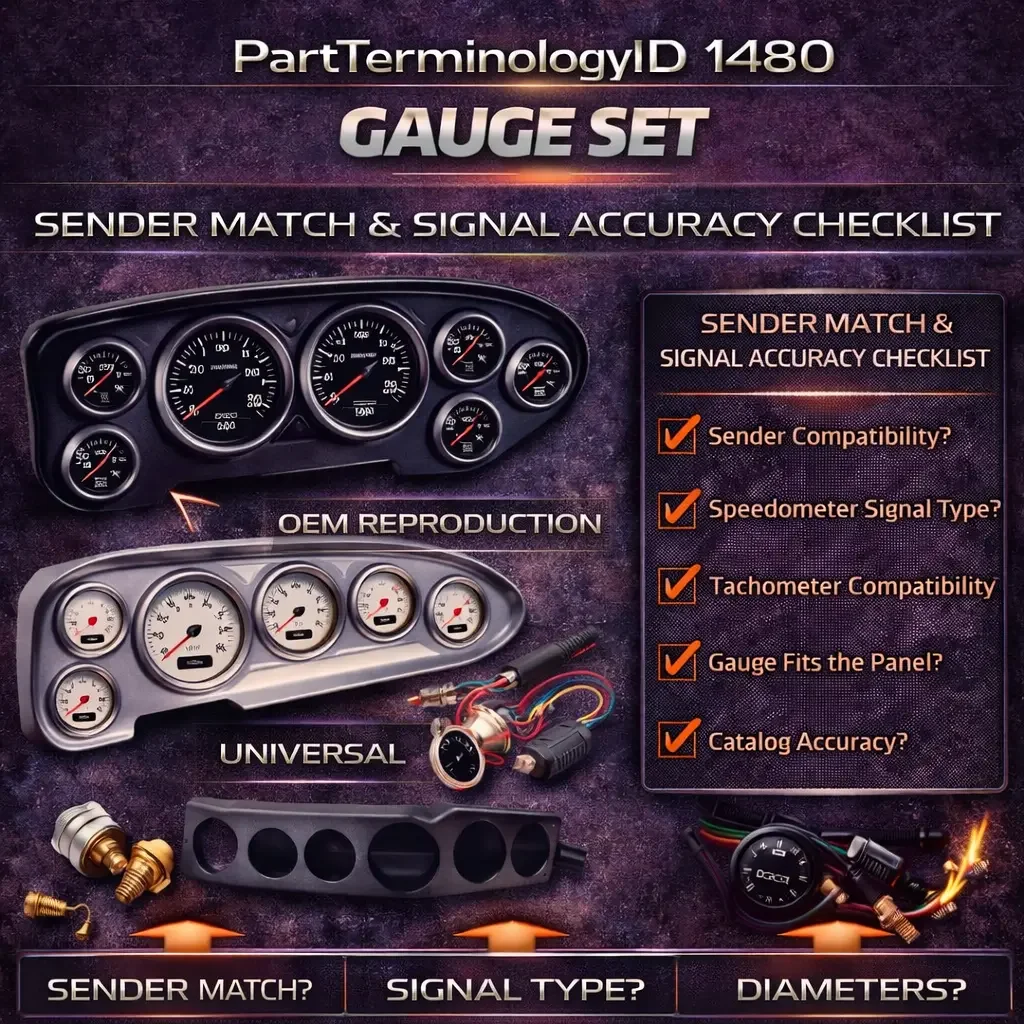
OEM reproduction gauge set. A matched set of gauges designed to replicate the factory instruments for a specific classic car. Includes all gauges in the cluster: speedometer, tachometer (if originally equipped), fuel level, oil pressure, water temperature, ammeter or voltmeter, and sometimes a clock. Each gauge matches the original in diameter, face graphics, font, needle color, and illumination. These sets are vehicle-specific and are the restoration market product.
Aftermarket universal gauge set. A matched set of gauges from a single aftermarket manufacturer (Auto Meter, VDO, Classic Instruments, Dakota Digital, etc.) in a coordinated style. The set includes a speedometer, tachometer, and 4 auxiliary gauges (typically fuel level, oil pressure, water temperature, and voltmeter). All gauges share the same face design, bezel finish, needle style, and illumination color. Available in multiple aesthetic styles: classic (white face, chrome bezel), modern (black face, black bezel), retro (cream face, brushed bezel), and many others.
Partial gauge set. A set of auxiliary gauges without the speedometer and tachometer. Typically a 4-gauge set of fuel level, oil pressure, water temperature, and voltmeter. Used when the buyer is keeping their existing speedometer and tachometer but wants to replace or add the smaller auxiliary gauges.
5-gauge set or 6-gauge set. The number refers to how many individual gauges are in the package. A 5-gauge set commonly includes speedometer, tachometer, fuel, oil pressure, and water temperature. A 6-gauge set adds a voltmeter or ammeter.
Digital gauge set. A complete set of digital (LCD or LED) gauges with programmable displays. Some digital sets use a single large screen that displays all gauge functions in a configurable layout, essentially a complete aftermarket digital instrument cluster.
What this part does NOT cover
Instrument cluster assembly. The complete factory dashboard gauge housing with gauges installed. Different PartTerminologyID.
Individual gauges. Single gauges sold separately (covered in PartTerminologyIDs 1452 through 1472).
Gauge panel / gauge pod (PartTerminologyID 1476). The mounting surface. May or may not be included with a gauge set.
Why Buyers Buy Sets Instead of Individual Gauges
Visual consistency
This is the primary reason. Gauges from different manufacturers, even in the same general style, do not match. The white on one brand is slightly different from the white on another. The font is different. The needle sweep angle is different. The bezel radius is different. The illumination color at night is different. When these gauges sit side by side in a cluster, the mismatches are obvious and the result looks cobbled together. A matched set eliminates this entirely.
Sender and signal compatibility
A matched gauge set from a single manufacturer typically uses a consistent sender system. The fuel level gauge, oil pressure gauge, and water temperature gauge in the set are all calibrated for the same brand's senders. This simplifies the wiring and eliminates the impedance matching confusion covered in the Fuel Level (1456) and Oil Pressure (1468) posts. The buyer installs the set's senders and the set's gauges and everything reads correctly because it was designed as a system.
Cost savings
A gauge set is typically less expensive than buying the same gauges individually. Manufacturers price sets as packages to encourage complete purchases rather than piecemeal buying.
Simplified ordering
One part number, one box, one purchase. The buyer does not need to select individual gauges, verify compatibility, and place multiple orders.
Why This Category Creates Fitment Problems
Sender compatibility across the set
While the gauges within a set are matched to each other, they may not be matched to the vehicle's existing senders. If the buyer installs the new gauges but keeps the vehicle's original senders, the readings may be wrong because the old senders use a different impedance range than the new gauges expect. Most gauge sets include senders for the oil pressure, water temperature, and sometimes fuel level gauges. But the fuel level sender is the most problematic because it is inside the fuel tank and is expensive and labor-intensive to replace. The buyer may keep the old fuel sender and discover that the new fuel gauge does not read correctly with it.
Prevention: Specify which senders are included and which are not. "Set includes oil pressure sender and water temperature sender. Fuel level sender NOT included. This set is calibrated for senders with a 240-33 ohm resistance range. Verify your existing fuel level sender resistance range before installation."
Speedometer signal type
Gauge sets that include a speedometer must be matched to the vehicle's speed signal:
Mechanical (cable-driven). Classic cars with a speedometer cable. The speedometer in the set must have a cable input.
Electronic (pulse signal from VSS or ECU). Modern vehicles with a vehicle speed sensor. The speedometer must accept an electronic pulse signal. The number of pulses per mile varies by vehicle (common values: 4,000, 8,000, 16,000, or 128,000 pulses per mile). Programmable electronic speedometers allow the buyer to calibrate the pulse count.
GPS-based. Some aftermarket digital gauge sets use a GPS antenna to calculate vehicle speed, bypassing the need for a cable or VSS signal entirely.
A buyer with a cable-driven vehicle who orders a set with an electronic-only speedometer cannot use the speedometer without adding a cable-to-electronic signal converter.
Tachometer signal type
If the set includes a tachometer, it must be matched to the ignition system:
4-cylinder, 6-cylinder, or 8-cylinder. The tachometer must know the cylinder count to calculate RPM correctly from the ignition signal. Most aftermarket tachometers have a selector switch for cylinder count.
Points ignition versus electronic ignition versus coil-on-plug. Different ignition systems produce different signal characteristics. Some tachometers do not work with certain ignition types without a signal adapter.
Gauge diameter compatibility with the cluster or panel
The gauges in the set must physically fit the buyer's mounting arrangement. A set with 5-inch speedometer and tachometer gauges may not fit a cluster designed for 3-3/8 inch primary gauges. The auxiliary gauge diameter (2-1/16 inch or 2-5/8 inch) must match the gauge panel or pod.
OEM reproduction sets must match the vehicle exactly
For restoration buyers, the gauge set must match the specific vehicle year, model, and trim. A 1967 Camaro gauge set is different from a 1969 Camaro gauge set. A 1970 Chevelle SS set with a tachometer is different from a 1970 Chevelle base set without one. The face graphics, gauge positions, and even the gauge diameters within the cluster changed between model years.
Top Return Causes
1) Fuel level gauge does not read correctly with existing sender
Set is calibrated for a different sender resistance range than the vehicle's in-tank sender.
Prevention: Specify the fuel level sender resistance range the set is calibrated for. Note whether a fuel level sender is included. "Fuel level gauge calibrated for 240-33 ohm senders. If your vehicle uses a GM 0-90 ohm sender, recalibration or sender replacement is required."
2) Speedometer signal type mismatch
Set includes an electronic speedometer but the vehicle uses a mechanical cable, or vice versa.
Prevention: Specify speedometer signal type: "Mechanical (cable-driven)" or "Electronic (programmable, pulse signal)" or "GPS-based."
3) Gauges do not fit the cluster or panel
Primary gauge diameter is wrong for the cluster housing, or auxiliary gauge diameter does not match the pod.
Prevention: Specify all gauge diameters: "Speedometer and Tachometer: 3-3/8 inch. Auxiliary Gauges: 2-1/16 inch."
4) Wrong vehicle year for OEM reproduction set
Set is correct for the model but wrong for the specific year due to face style or gauge configuration changes.
Prevention: Exact year range: "1967-1968 Camaro Gauge Set" not "1967-1969 Camaro Gauge Set" if the 1969 changed.
5) Tachometer does not work with ignition system
Tachometer cannot read the ignition signal from the vehicle's specific ignition type.
Prevention: Specify compatible ignition types. "Compatible with points ignition, electronic ignition, and HEI. For coil-on-plug or distributorless ignition, a signal adapter may be required."
Compatibility Checklist for Buyers
1) Confirm speedometer signal type. Mechanical cable, electronic pulse (specify pulse count), or GPS.
2) Confirm fuel level sender compatibility. What resistance range does the set require? What does your existing sender output? Will you replace the sender or keep the existing one?
3) Confirm gauge diameters. Primary gauges (speedometer, tachometer) and auxiliary gauges (fuel, oil, temp, volt) must fit your cluster, panel, or pod.
4) Confirm tachometer cylinder count and ignition type compatibility.
5) For OEM reproduction sets, confirm exact vehicle year. Face graphics and gauge configurations changed between years on many vehicles.
6) Check what senders are included. Oil pressure sender, water temperature sender, fuel level sender: included or not?
Catalog Checklist for Attributes
Core taxonomy: Product form (complete 5-gauge or 6-gauge set, partial auxiliary set, OEM reproduction set, digital set). Separate from Individual Gauges, Instrument Cluster, and Gauge Panel.
Set contents: List every gauge in the set with its type and diameter. List every included sender with its type and thread size. List any included hardware, wiring harnesses, or signal adapters.
Compatibility specs: Speedometer signal type and programmable pulse range. Tachometer cylinder count selector and ignition compatibility. Fuel level sender resistance range. Oil pressure and water temperature sender included (yes/no).
Physical specs: All gauge diameters. Face style name/series. Bezel finish. Illumination color. Needle color.
Fitment: For OEM reproduction: exact year, make, model, trim, cluster option. For universal: speedometer and tachometer signal type, sender compatibility, gauge diameters.
Images: All gauges laid out as a set showing coordinated appearance, individual gauge faces for detail, rear of gauges showing terminals and connections, senders (if included), and an installed reference photo showing the complete set in a cluster or panel.
FAQ
Can I buy one gauge from a set separately if it fails later?
Most aftermarket gauge manufacturers sell individual replacement gauges in the same style series as their sets. Check whether the manufacturer offers individual gauges in your set's style for future replacement.
Do gauge sets include senders?
Most sets include the oil pressure and water temperature senders. Most do NOT include the fuel level sender because fuel senders are tank-specific and vehicle-specific. Check the set contents carefully.
Will the speedometer in a gauge set work with my transmission?
If the set has a mechanical speedometer, it works with any transmission that has a cable-drive speedometer output. If the set has an electronic speedometer, it needs a pulse signal from a vehicle speed sensor. Programmable electronic speedometers can be calibrated to match your vehicle's specific pulse count per mile.
Final Take for Aftermarket Teams
Gauge Set (PartTerminologyID 1480) is the package product that ties the entire gauge series together. The catalog advantage of a set over individual gauges is visual consistency, sender compatibility, and simplified ordering. The catalog challenges are the same ones covered across every gauge post in this series: sender impedance matching (especially fuel level), speedometer signal type, tachometer ignition compatibility, gauge diameter fit, and for OEM reproduction sets, exact vehicle year specificity. The teams that catalog gauge sets well list every component in the set with its specs, specify the sender resistance range the set is calibrated for, state the speedometer signal type, and include a complete photo of all gauges laid out as a coordinated system. The buyer is purchasing a unified instrument experience. The listing must deliver a unified information experience to match.