
Written by Arthur Simitian | PartsAdvisory
The previous post covered Engine Oil Pressure Gauge (PartTerminologyID 1468), the gauge that tells the driver whether oil is circulating. This post covers Engine Oil Temperature Gauge, the gauge that tells the driver whether the oil can actually do its job.
Oil temperature matters because oil viscosity is temperature-dependent. Cold oil is thick and does not flow well into tight clearances. Hot oil is thin and loses its ability to maintain a protective film between moving parts. Every engine oil has an optimal operating temperature range (typically 190 to 230 degrees Fahrenheit for most engines), and when oil exceeds that range, it begins to break down. The detergents degrade, the viscosity drops below the protective threshold, and the oil starts oxidizing into sludge. Sustained operation above 250 to 270 degrees Fahrenheit can cause accelerated bearing wear, oil seal failure, and eventual engine damage.
No mainstream production vehicle has ever included an oil temperature gauge on the dashboard as a standard instrument. A few high-performance vehicles (Porsche, some BMW M cars, some Corvettes) have included one as part of a performance display, but even these are typically digital readouts buried in a secondary screen rather than a prominent analog gauge.
The oil temperature gauge is almost exclusively an aftermarket instrument installed by performance, racing, and enthusiast buyers who push their engines beyond the assumptions of factory cooling system design. Turbocharged builds, track day cars, tow vehicles pulling heavy loads in hot weather, and any engine with modified power output benefit from oil temperature monitoring because these conditions generate heat that the factory oil cooling system may not fully manage.
This post is built for aftermarket catalog teams, marketplace sellers, and buyers who want fewer mistakes and fewer returns.
Status in New Databases
Status in New Databases
Current: PIES 7.2 + PCdb Future: PIES 8.0 + PCdb 2.0 Status: No change
What Engine Oil Temperature Gauge Means in the Aftermarket
Engine Oil Temperature Gauge (PartTerminologyID 1472) refers to a gauge that displays the temperature of the engine oil, typically measured at the oil pan, the oil filter housing, or an oil cooler line.
In catalog reality, this covers:
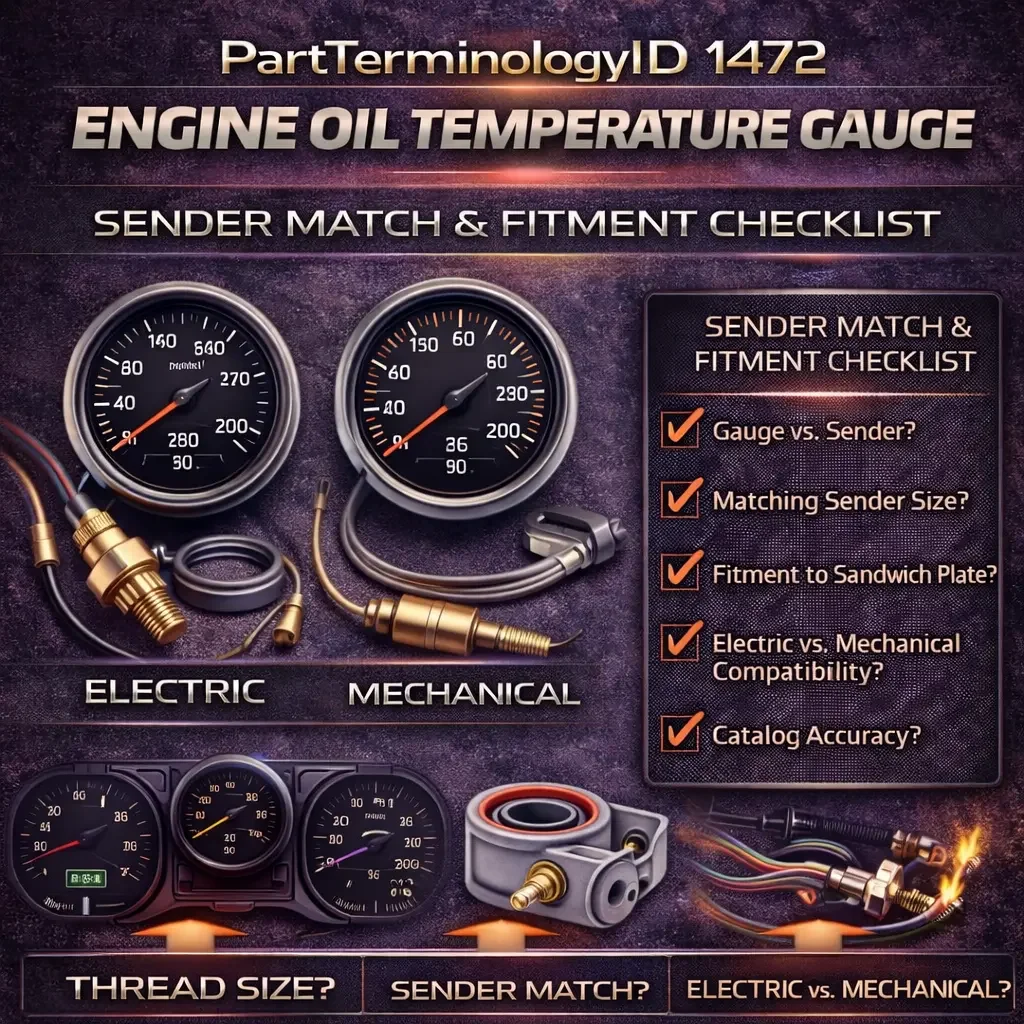
Electric oil temperature gauge with sender. The most common product form. An electric gauge (2-1/16 inch or 2-5/8 inch) mounted in the cabin, paired with a temperature sender (thermistor) installed in the engine's oil system. The sender threads into the oil pan drain plug (replacing the factory drain plug with a drain plug that has a sender boss), into an oil filter sandwich plate adapter, or into an oil cooler line fitting. The sender's resistance changes with temperature, and the gauge displays the reading.
Mechanical oil temperature gauge. A gauge with a capillary tube and bulb sensor. The bulb is installed in the oil system, and the capillary tube runs to the gauge. Oil temperature causes the fluid in the bulb to expand, mechanically driving the gauge needle. No electrical connection required. More accurate than electric but the capillary tube is fragile, difficult to route, and cannot be shortened or lengthened.
Digital oil temperature gauge. An electronic gauge with an LCD or LED display showing temperature numerically. May include programmable warning thresholds, peak temperature recall, and data logging. Common in the modern performance aftermarket.
Oil temperature sender/sensor only. The temperature sensor without the gauge. For buyers who already have a compatible gauge or a digital display that accepts a temperature input.
What this part does NOT cover
Engine coolant temperature gauge. Measures the temperature of the engine coolant (antifreeze), not the oil. Different fluid, different location, different PartTerminologyID. This is the temperature gauge that is standard on virtually every vehicle dashboard.
Engine oil pressure gauge (PartTerminologyID 1468). Measures oil pressure, not temperature.
Transmission temperature gauge. Measures automatic transmission fluid temperature. Different fluid, different system.
Oil temperature warning light (OEM). Some vehicles have a factory oil temperature warning light that illuminates at extreme temperatures. This is a binary indicator, not a gauge.
Oil Temperature vs. Coolant Temperature: Why Both Matter
Most drivers only see coolant temperature on their dashboard. If the coolant temperature is normal, they assume the engine is fine. But oil temperature and coolant temperature are not the same measurement and do not always track together:
Oil heats up slower than coolant. On a cold start, the coolant reaches operating temperature (190 to 210 degrees F) within a few minutes. The oil may take 10 to 15 minutes of driving to reach its operating temperature (190 to 230 degrees F). This is why performance enthusiasts avoid high RPM in the first few minutes of driving even after the coolant gauge shows normal: the oil is still cold and thick.
Oil can overheat while coolant stays normal. Under sustained high-load conditions (towing, track driving, aggressive mountain passes), the oil can exceed its safe temperature range while the coolant temperature stays within normal limits. The cooling system manages coolant temperature via the radiator and thermostat. Oil cooling is typically passive (oil-to-engine-block heat transfer) unless the vehicle has a dedicated oil cooler. When the oil's heat generation exceeds its cooling capacity, oil temperature climbs even though coolant temperature is stable.
This gap is the reason the oil temperature gauge exists. It tells the driver something the coolant gauge cannot: whether the oil is being pushed beyond its thermal limits.
Why This Category Is Almost Entirely Aftermarket
Because no mainstream vehicle includes an oil temperature gauge, nearly every product in this category is an aftermarket add-on. This means:
No OEM replacement market. Unlike oil pressure gauges, ammeter gauges, or fuel level gauges where there is a restoration and replacement market for factory instruments, the oil temperature gauge has virtually no OEM replacement demand.
The buyer is always adding a gauge, not replacing one. This means the buyer needs the gauge, the sender, the mounting hardware, and the wiring. Kits that include everything are more valuable than a gauge sold alone.
Sender installation requires an oil system access point. The sender must be threaded into the oil system somewhere. The most common installation methods are an oil filter sandwich plate adapter (installs between the engine block and the oil filter, with ports for the sender and optionally for oil cooler lines), an oil pan drain plug with a sender boss, or a fitting in an oil cooler line. The sandwich plate is the most popular because it does not require drilling or permanent modification to the engine.
No ACES fitment data in the traditional sense. Since this is not a factory component, there are no vehicle-specific ACES records. The gauge itself is universal. The sender is universal. The vehicle-specific element is the sandwich plate adapter, which must match the oil filter thread size and the filter mounting stud length for the specific engine. Common thread sizes include 3/4-16, 20mm x 1.5, and 22mm x 1.5.
Sender Impedance and Gauge Matching
The same impedance matching requirement from the Fuel Level Gauge (1456) and Oil Pressure Gauge (1468) posts applies. The temperature sender (thermistor) has a resistance curve that changes with temperature. The gauge must be calibrated to that specific curve. Most aftermarket gauge manufacturers (Auto Meter, VDO, GlowShift, AEM, Innovate) sell matched gauge-and-sender kits to eliminate this problem. Buying a gauge from one manufacturer and a sender from another without verifying the resistance curve will produce inaccurate readings.
Top Return Causes
1) Gauge and sender not impedance-matched
Buyer purchases a gauge from one brand and a sender from another. The temperature reading is inaccurate.
Prevention: Sell matched gauge-and-sender kits. If selling the gauge alone, specify the sender resistance curve and list compatible senders: "Requires VDO-type 10-180 ohm temperature sender (sold separately)."
2) Sandwich plate adapter does not fit the engine
The oil filter thread size on the buyer's engine does not match the sandwich plate included in the kit.
Prevention: Specify the sandwich plate thread size and list compatible engines. "Includes 3/4-16 sandwich plate adapter. Compatible with most GM, Ford, and Chrysler V8 engines. Not compatible with engines using metric oil filter threads (20mm or 22mm)."
3) Buyer confuses oil temperature with coolant temperature
Buyer orders an oil temperature gauge thinking it replaces the factory coolant temperature gauge.
Prevention: Clear naming: "Engine OIL Temperature Gauge (Measures Oil Temperature, Not Coolant). This gauge does NOT replace your factory coolant temperature gauge."
4) Sender installation location not understood
Buyer receives the gauge and sender but does not know where to install the sender. No sandwich plate or drain plug adapter is included.
Prevention: Specify sender installation method: "Sender installs via included oil filter sandwich plate adapter" or "Sender threads into oil pan drain plug adapter (sold separately)" or "Sender requires 1/8 NPT bung welded into oil pan (fabrication required)."
5) Temperature reading seems wrong because buyer does not know normal oil temperature
Buyer installs the gauge and sees 210 degrees F. They think the engine is overheating because their coolant gauge normally reads 195 degrees F. Oil at 210 degrees F is perfectly normal.
Prevention: Include a normal operating range note: "Normal engine oil temperature: 190 to 230 degrees F. Oil temperatures above 250 degrees F for extended periods may indicate the need for an oil cooler."
Compatibility Checklist for Buyers
1) This is an aftermarket add-on, not a factory replacement. There is no factory oil temperature gauge on most vehicles.
2) Buy a matched gauge-and-sender kit. Gauge and sender must be from the same manufacturer or verified compatible.
3) Determine your sender installation method. Oil filter sandwich plate (most popular, no permanent modification), oil pan drain plug adapter, or welded bung.
4) If using a sandwich plate, confirm your engine's oil filter thread size. 3/4-16 (most domestic V8), 20mm x 1.5 (many import 4-cylinder and V6), or 22mm x 1.5.
5) Confirm gauge diameter. 2-1/16 inch or 2-5/8 inch. Match to your gauge pod or mounting location.
6) Choose temperature scale. Fahrenheit or Celsius. Most gauges are available in both.
Catalog Checklist for Attributes
Core taxonomy: Product form (gauge with sender kit, gauge only, sender only, gauge with sandwich plate kit, digital gauge). Separate from Coolant Temperature Gauge, Oil Pressure Gauge, Transmission Temperature Gauge, and Oil Temperature Warning Light.
Specs: Temperature range (typically 100-300 degrees F or 40-150 degrees C). Gauge type: electric, mechanical (capillary), or digital. Sender type: thermistor resistance curve. Gauge diameter.
Kit contents: Gauge, sender, sandwich plate adapter (thread size), wiring harness, mounting hardware, sender fittings, installation instructions.
Images: Gauge face, sender, sandwich plate adapter (showing thread and ports), complete kit contents laid out, installed reference showing sandwich plate between filter and block.
FAQ
What is a normal engine oil temperature?
190 to 230 degrees F (88 to 110 degrees C) for most engines under normal driving conditions. Above 250 degrees F (120 degrees C) for sustained periods indicates the oil cooling capacity is being exceeded. Above 270 degrees F (132 degrees C) risks accelerated oil breakdown and engine damage.
Do I need an oil cooler if my oil temperature is high?
If your oil temperature regularly exceeds 240 to 250 degrees F under your driving conditions (towing, track use, hot climate), an oil cooler is recommended. The oil temperature gauge tells you whether you need the cooler. Install the gauge first, monitor under your worst-case conditions, and add a cooler if temperatures consistently exceed the safe range.
Is an oil temperature gauge the same as a coolant temperature gauge?
No. They measure different fluids in different locations. The coolant temperature gauge (standard on all vehicles) measures engine coolant temperature. The oil temperature gauge (aftermarket only on most vehicles) measures engine oil temperature. Both are important, but they do not read the same values and are not interchangeable.
Final Take for Aftermarket Teams
Engine Oil Temperature Gauge (PartTerminologyID 1472) is a pure aftermarket performance category with no OEM replacement market. The buyer is always adding a gauge, never replacing one. The catalog must sell complete kits (gauge, sender, sandwich plate, wiring) rather than individual components wherever possible, specify sandwich plate thread sizes for engine compatibility, match gauge and sender impedance, and include normal operating temperature ranges so the buyer knows what a healthy reading looks like. This is the gauge that tells the driver whether the oil is doing its job. The catalog's job is making sure the gauge does its job too.