
Written by Arthur Simitian | PartsAdvisory
If you read the Fuel Level Gauge post (PartTerminologyID 1456), you already know the diagnostic pattern that applies here. When the oil pressure gauge reads wrong, the buyer has to determine whether the problem is the gauge, the oil pressure sender (the sensor screwed into the engine block), the wiring, or the instrument voltage regulator (classic cars). Four failure points, one symptom, and the most common mistake is replacing the wrong component.
The difference between the fuel gauge and the oil pressure gauge is what is at stake. A wrong fuel gauge reading means the driver misjudges how far they can drive before filling up. A wrong oil pressure reading can mean the driver ignores a genuine low oil pressure condition, continues driving, and destroys the engine. Oil pressure is the engine's life support signal. When oil pressure drops to zero, the engine's bearings, camshaft, crankshaft, and other rotating components are running metal-on-metal with no lubrication. Catastrophic engine failure follows within minutes or less.
This makes oil pressure gauge accuracy not just a convenience issue but a safety and mechanical survival issue. And it makes the diagnostic content in every listing just as important as the fitment data.
This post is built for aftermarket catalog teams, marketplace sellers, and buyers who want fewer mistakes and fewer returns.
Status in New Databases
Status in New Databases
Current: PIES 7.2 + PCdb Future: PIES 8.0 + PCdb 2.0 Status: No change
What Engine Oil Pressure Gauge Means in the Aftermarket
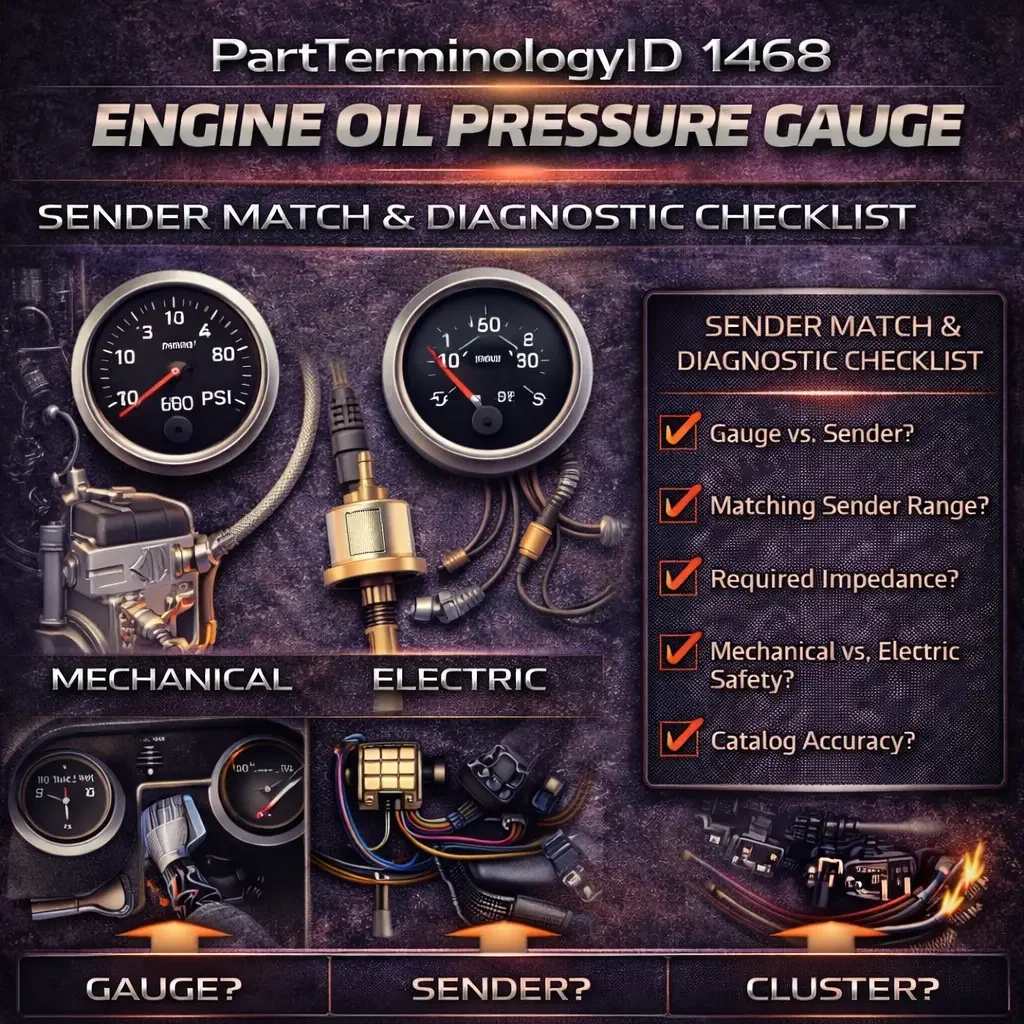
Engine Oil Pressure Gauge (PartTerminologyID 1468) refers to the dashboard instrument that displays engine oil pressure in PSI, bar, or kPa.
In catalog reality, this covers the same product forms as the other gauge categories:
OEM replacement oil pressure gauge. A gauge designed to replace the original factory gauge in a specific vehicle's instrument cluster. Must match diameter, face style, graphics, needle, illumination, terminals, and critically the sender impedance range.
Universal/aftermarket oil pressure gauge. A standalone gauge in standard diameters (2-1/16 inch, 2-5/8 inch) for custom builds, hot rods, performance vehicles, and vehicles where the owner wants a real gauge to replace a factory idiot light. Available in mechanical (direct oil line connection) and electric (sender-based) versions.
Oil pressure gauge as part of an instrument cluster. On most modern vehicles, the oil pressure gauge (if present at all) is integrated into the electronic instrument cluster and is not separately replaceable.
Mechanical oil pressure gauge. A gauge connected directly to the engine's oil system via a small-diameter oil line. Oil pressure acts directly on the gauge's Bourdon tube. This is the most accurate type because there is no electrical sender in the signal path. The trade-off is the same safety concern as the mechanical fuel pressure gauge (PartTerminologyID 1458): a pressurized oil line runs from the engine, through the firewall, and to the gauge in the cabin. If this line leaks or fails, hot pressurized oil sprays into the cabin.
Electric oil pressure gauge. A gauge driven by an electrical signal from an oil pressure sender (a variable resistor or voltage sender) threaded into the engine block. Only an electrical wire crosses the firewall. Safer than mechanical but slightly less responsive and less accurate because the sender introduces an interpretation layer.
What this part does NOT cover
Oil pressure sender / sending unit. The sensor threaded into the engine block that reads oil pressure and sends a signal to the gauge. Different PartTerminologyID. This is the component that fails most often.
Oil pressure switch (idiot light sender). A simple on/off switch that grounds a warning light circuit when oil pressure drops below a threshold (typically 5 to 10 PSI). Different from a variable sender that drives a gauge. Different PartTerminologyID.
Instrument cluster. The complete gauge assembly. Different PartTerminologyID.
Oil level indicator. Some modern vehicles display oil level (how much oil is in the engine) rather than oil pressure. Different measurement, different PartTerminologyID.
Gauge vs. Warning Light: The "Idiot Light" Problem
Most modern vehicles do not have an oil pressure gauge. They have an oil pressure warning light. The light is controlled by a simple pressure switch: below approximately 5 to 10 PSI, the light turns on. Above that threshold, the light turns off. The driver gets a binary signal: pressure is okay (light off) or pressure is critically low (light on).
The problem is that the warning light only activates when oil pressure has already dropped to a dangerously low level. It does not show the driver that pressure is gradually declining, which would indicate a developing problem (worn bearings, failing oil pump, low oil level) before it becomes an emergency. A gauge shows the real-time pressure, allowing the driver to see trends and catch problems early.
This is why performance and enthusiast buyers install aftermarket oil pressure gauges on vehicles that only came with a warning light. They want real information, not a binary alarm that activates after the damage has started. This "idiot light to real gauge" upgrade is a significant portion of the oil pressure gauge market.
For catalog teams, this upgrade market means the buyer may not be replacing an existing gauge. They may be adding a gauge where one never existed. The product must include or reference the correct oil pressure sender for the vehicle (the factory idiot light switch does not drive a gauge), mounting hardware, and wiring.
The Gauge-Sender Impedance Match
The same impedance matching concept from the Fuel Level Gauge post (1456) applies here. The oil pressure gauge and the oil pressure sender must be matched.
GM standard: The sender resistance range varies by era. Classic GM senders typically use a 0-90 ohm range.
Ford standard: Different resistance range from GM. Ford senders and GM gauges are not interchangeable without recalibration.
VDO standard: 10-180 ohm range. Common on European vehicles and widely used in the aftermarket universal gauge market.
Mechanical gauges bypass this entirely. Because the oil pressure acts directly on the gauge, there is no sender and no impedance matching. The gauge reads pressure directly regardless of manufacturer.
If the buyer installs a gauge designed for one sender type with a sender designed for a different gauge type, the pressure reading will be wrong. The gauge may read 40 PSI when actual pressure is 60 PSI, or vice versa. On a gauge that monitors engine health, an inaccurate reading is worse than no reading because the driver makes decisions based on wrong information.
The Diagnostic Problem: Same Pattern as the Fuel Gauge
The four failure points
1) Oil pressure sender (most common failure). The sender is threaded into the engine block and exposed to heat, oil, and vibration. It fails more often than the gauge. A failed sender may read zero (causing a false low-pressure alarm), read maximum (masking a real low-pressure condition), or read erratically.
2) Oil pressure gauge (less common). The gauge movement can seize, the needle can stick, or the internal circuit can fail.
3) Wiring. Corroded connections, broken wires, or a bad ground between the sender and the gauge.
4) Instrument voltage regulator (classic cars). Same as the fuel gauge: if all three gauges (fuel, temperature, oil pressure) read incorrectly simultaneously, the IVR is the likely cause.
The diagnostic shortcut
If all three gauges (fuel, temp, oil) are wrong: replace the IVR, not the individual gauges. This saves the buyer from purchasing three gauges when one voltage regulator is the actual failure.
If only the oil pressure gauge is wrong: Disconnect the sender wire at the engine and ground it with the ignition on. If the gauge swings to maximum, the gauge and wiring are functional and the sender is the problem. If the gauge does not move, the gauge or wiring is the problem.
Pressure Ranges and What Normal Looks Like
Including normal operating pressure ranges in listing descriptions helps buyers understand what they should see on the gauge and when to be concerned:
Normal hot idle: 15 to 30 PSI (varies by engine). Lower pressure at idle is normal because the oil pump turns slower at idle speed.
Normal cruising (2,000 to 3,000 RPM): 30 to 60 PSI. Pressure increases with RPM because the oil pump turns faster.
Cold start: Pressure may spike to 60 to 80+ PSI briefly because cold oil is thicker and creates more resistance. This is normal and drops as the oil warms up.
Below 10 PSI at idle: Cause for concern. May indicate worn bearings, a weak oil pump, low oil level, or the wrong oil viscosity.
Zero PSI while driving: Immediate engine shutdown required. The engine is running without oil pressure and will be damaged within minutes.
Top Return Causes
1) Buyer replaces gauge when the sender is the actual failure
Same pattern as the fuel gauge. New gauge installed, reading still wrong, because the sender was the problem.
Prevention: Diagnostic content in the description. "Before replacing the gauge, test the sender. Disconnect the sender wire and ground it with the ignition on. If the gauge reads maximum pressure, the sender is the problem."
2) Sender impedance mismatch
Gauge and sender are from different systems (GM gauge with VDO sender, for example). Reading is inaccurate.
Prevention: Specify sender compatibility: "For use with GM 0-90 ohm oil pressure senders" or "For use with VDO 10-180 ohm senders." If the gauge includes a sender, state it prominently.
3) Mechanical gauge ordered without understanding cabin oil line safety risk
Prevention: Same safety note as the fuel pressure gauge: "Mechanical oil pressure gauges route pressurized oil into the cabin. If the line leaks, hot oil sprays into the interior. For street vehicles, an electric gauge with a remote sender is the safer option."
4) Gauge is integrated into the cluster, standalone not available
Buyer orders a standalone gauge for a modern vehicle where the gauge is part of the electronic cluster.
Prevention: Fitment data must specify standalone gauge vehicles only.
5) Wrong pressure range
A gauge with a 0-100 PSI range on an application where 0-80 PSI would provide better resolution, or vice versa.
Prevention: Specify range in the title: "0-80 PSI Oil Pressure Gauge" or "0-100 PSI Oil Pressure Gauge."
6) IVR is the actual failure, all gauges wrong
Buyer replaces only the oil pressure gauge when the instrument voltage regulator has failed.
Prevention: "If your fuel, temperature, AND oil pressure gauges all read incorrectly, the instrument voltage regulator is the likely cause."
Compatibility Checklist for Buyers
1) Diagnose before ordering. Is the problem the gauge, the sender, the wiring, or the IVR? Use the diagnostic shortcut above.
2) Confirm your vehicle has a separately replaceable oil pressure gauge. If your vehicle has an electronic cluster, the gauge is integrated.
3) If adding a gauge to a vehicle with only a warning light, you also need an oil pressure sender. The factory idiot light switch does not drive a gauge. A variable sender must be installed.
4) Confirm sender compatibility. The gauge and sender must be impedance-matched (GM, Ford, VDO, etc.).
5) Choose mechanical or electric. Mechanical is more accurate but routes an oil line into the cabin. Electric is safer with the sender at the engine.
6) Confirm gauge diameter. 2-1/16 inch or 2-5/8 inch for universal gauges. Vehicle-specific for OEM replacements.
7) Confirm pressure range. 0-80 PSI or 0-100 PSI for most gasoline engines.
Catalog Checklist for Attributes
Core taxonomy: Product form (OEM replacement, universal mechanical, universal electric, cluster component). Separate from Oil Pressure Sender, Oil Pressure Switch, Instrument Cluster, and Oil Level Indicator.
Fitment: For OEM: year, make, model, cluster option. For universal: gauge diameter, sender type/impedance, pressure range.
Electrical/mechanical specs: Gauge type (mechanical or electric). Sender impedance range (for electric). Pressure range. Connection thread size (for mechanical: typically 1/8 NPT).
Physical specs: Gauge diameter. Mounting depth. Bezel type and finish. Face color, needle color, illumination type and color.
Package contents: Gauge, sender (if included), oil line and fittings (if mechanical), mounting hardware, wiring, installation instructions.
Images: Gauge face, rear terminals/connection, sender (if included), oil line and fittings (if mechanical), installed reference photo.
FAQ
What is normal oil pressure?
At hot idle: 15 to 30 PSI. At cruising RPM: 30 to 60 PSI. Cold start may spike to 60 to 80+ PSI temporarily. Below 10 PSI at idle is cause for concern. Zero PSI while driving requires immediate engine shutdown.
Should I use a mechanical or electric oil pressure gauge?
Mechanical is more accurate and responsive but routes an oil line into the cabin (fire and burn risk if it leaks). Electric uses a sender at the engine and only runs a wire to the cabin (safer). For street vehicles, electric is recommended. For racing and dyno applications, mechanical is common.
My oil pressure warning light came on. Is it the sender or is oil pressure actually low?
Check the oil level first. If the oil level is correct, the sender may be faulty (common) or oil pressure may be genuinely low (serious). A mechanical oil pressure gauge temporarily connected to the engine's sender port provides the definitive answer. Do not drive the vehicle until the actual oil pressure is verified.
Final Take for Aftermarket Teams
Engine Oil Pressure Gauge (PartTerminologyID 1468) follows the same diagnostic and fitment pattern as the Fuel Level Gauge (1456) with one critical difference: the stakes are higher. A wrong fuel gauge reading is an inconvenience. A wrong oil pressure reading can cost the driver an engine. The catalog teams that serve this category well include diagnostic content that prevents the buyer from replacing the gauge when the sender is the actual failure, specify sender impedance compatibility, note the mechanical-versus-electric safety trade-off, and cross-reference the instrument voltage regulator for classic car buyers whose fuel, temperature, and oil pressure gauges are all reading wrong. The gauge monitors the engine's most critical operating parameter. The catalog must help the buyer get the right gauge, or better yet, help them figure out that they do not need a gauge at all and that a $20 sender is the real fix.