
Written by Arthur Simitian | PartsAdvisory
Every analog gauge on the dashboard is illuminated from behind by a small bulb. The speedometer, tachometer, fuel level, temperature, oil pressure, and ammeter gauges all glow at night because there is a tiny incandescent bulb (or a cluster of them) behind each gauge face. When one of those bulbs burns out, that section of the instrument cluster goes dark. The gauge still works. The needle still moves. But the driver cannot read it at night.
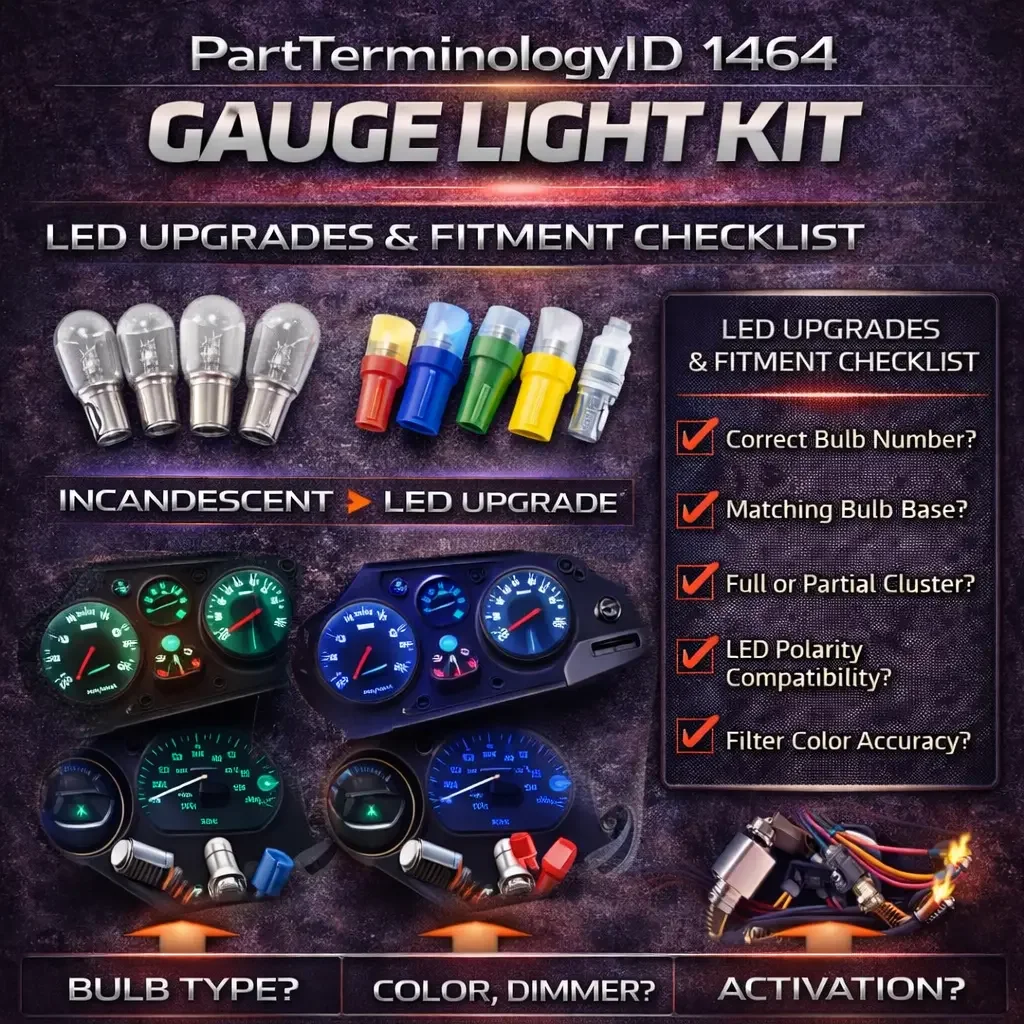
A Gauge Light Kit is a set of replacement bulbs designed to re-illuminate the instrument cluster. It may include bulbs for a single gauge, a complete set for the entire cluster, or an LED upgrade kit that replaces the original incandescent bulbs with LEDs in the buyer's chosen color.
This is a small, inexpensive part category that generates high search volume because burned-out gauge lights are one of the most common and most visible instrument cluster complaints on older vehicles, and because the LED upgrade market has turned a maintenance repair into a customization opportunity.
This post is built for aftermarket catalog teams, marketplace sellers, and buyers who want fewer mistakes and fewer returns.
Status in New Databases
Status in New Databases
Current: PIES 7.2 + PCdb Future: PIES 8.0 + PCdb 2.0 Status: No change
What Gauge Light Kit Means in the Aftermarket
Gauge Light Kit (PartTerminologyID 1464) refers to a set of small bulbs or LED replacements designed to illuminate the gauges and indicators in a vehicle's instrument cluster.
In catalog reality, this covers:
Incandescent bulb replacement kit. A set of miniature incandescent bulbs that match the original factory bulbs. These are direct replacements that restore the original illumination color and intensity. Common bulb types include #194, #168, #74, #37, #73, and various wedge-base and twist-lock miniatures. A complete cluster kit may include 8 to 20+ bulbs depending on the vehicle.
LED conversion kit. A set of LED bulbs designed to replace the original incandescent bulbs in the instrument cluster. LEDs are available in multiple colors (white, blue, green, red, amber, pink, purple) and offer brighter, more even illumination with significantly longer life. LED gauge light kits are the dominant product in this category by sales volume because they combine a maintenance repair (replacing burned-out bulbs) with a customization upgrade (changing the cluster color).
Individual bulbs. Single bulbs sold individually rather than as a kit. The buyer purchases the quantity they need. This is the simplest product form but requires the buyer to know the exact bulb number and quantity for their cluster.
Bulb and socket assembly. Some cluster bulbs are integrated into a twist-lock socket that plugs into the back of the cluster circuit board. The bulb and socket are replaced as a unit. These assemblies are vehicle-specific because the socket design matches the cluster's circuit board.
What this part does NOT cover
Instrument cluster. The complete gauge assembly. Different PartTerminologyID.
Dashboard illumination dimmer switch. The control that adjusts the brightness of the cluster lighting. Different PartTerminologyID.
Warning light bulbs. Bulbs for individual warning indicators (check engine, ABS, airbag, etc.) may or may not be included in a gauge light kit depending on the kit's scope. Some kits include all cluster bulbs. Others include only the gauge illumination bulbs.
Exterior lighting bulbs. Headlight, taillight, turn signal, etc. Completely different category.
The LED Upgrade Market
The LED conversion is what makes this category interesting beyond simple maintenance:
Why buyers upgrade to LED
Brightness. LEDs produce more light per watt than incandescent bulbs. A dim, yellow-tinted incandescent cluster becomes a bright, crisp, clearly readable cluster with LEDs.
Color choice. Incandescent bulbs produce a warm yellowish-white light (or green, if the cluster uses green filters, as many 1980s and 1990s vehicles do). LEDs are available in virtually any color. The buyer can change their cluster from factory green to white, blue, red, or any other color. This is the primary customization appeal.
Longevity. LEDs last 25,000 to 50,000+ hours compared to 1,000 to 2,000 hours for incandescent bulbs. Once LEDs are installed, the buyer is unlikely to ever replace them again.
Lower heat. Incandescent bulbs generate heat. In a tightly enclosed instrument cluster, this heat can contribute to gauge face discoloration and plastic degradation over time. LEDs produce minimal heat.
Why LED conversion is not always straightforward
Polarity sensitivity. Incandescent bulbs work regardless of which direction current flows through them. LEDs are polarity-sensitive: they only light up if the positive and negative connections are correct. If an LED is inserted backward in the socket, it will not light. The fix is simple (rotate the bulb 180 degrees), but it confuses buyers who assume the bulb is defective.
Color appearance through tinted lenses. Many instrument clusters have colored filters, diffusers, or tinted gauge faces between the bulb and the driver's eyes. A white LED behind a green filter produces green light. A blue LED behind a green filter produces an unpredictable color (often teal or muddy blue-green). Buyers who want a specific final color must account for any existing filters in their cluster. Some LED kits include instructions for removing factory color filters to achieve a pure LED color.
Hot spots and uneven illumination. Incandescent bulbs emit light in all directions (360 degrees). LEDs emit light directionally (primarily forward). An LED that replaces an incandescent in a reflective socket may create a bright hot spot directly behind the gauge face rather than the even wash of light the original bulb produced. Higher-quality LED gauge bulbs use diffused or multi-directional LED elements to minimize hot spots.
Dimmer compatibility. Some vehicle dimmer circuits are designed for the resistance characteristics of incandescent bulbs. LEDs have very different resistance. On some vehicles, LEDs may not dim smoothly (they flicker, jump between brightness levels, or do not respond to the dimmer at all). Resistor packs or LED-compatible dimmer modules can resolve this.
Why This Category Creates Fitment Problems
Bulb base type
Instrument cluster bulbs use several different base types: T10 wedge (like #194/#168), T5 wedge (like #74/#37/#73), twist-lock (BA9S, BAX9S), and other miniature bases. The base must match the cluster's socket. A T10 LED will not fit a T5 socket.
Bulb number
Each position in the cluster may use a different bulb number. The gauge illumination bulbs may be #194 while the indicator lights may be #74. A kit must include the correct bulb numbers in the correct quantities for the specific cluster.
Vehicle-specific kits versus universal bulb packs
Vehicle-specific kits include the exact bulbs (or LEDs) in the exact quantities for one vehicle's instrument cluster. Universal packs sell a quantity of one bulb type and leave it to the buyer to determine compatibility and quantity. Vehicle-specific kits reduce fitment errors but require more SKUs. Universal packs are simpler to inventory but put the fitment burden on the buyer.
Twist-lock socket assemblies
On vehicles where the bulb is integrated into a twist-lock socket, the entire socket assembly must be matched. The socket shape, pin orientation, and lock tab position vary between vehicles and between positions within the same cluster.
Top Return Causes
1) Wrong bulb base type
LED or bulb does not fit the cluster socket (T10 ordered when T5 was needed, or vice versa).
Prevention: Specify bulb number and base type: "#194 T10 Wedge" or "#74 T5 Wedge." For vehicle-specific kits, list all included bulb types and quantities.
2) LED polarity (bulb does not light)
LED is inserted in the wrong polarity. Buyer assumes it is defective.
Prevention: Include a note: "LEDs are polarity-sensitive. If the LED does not light, remove it and rotate 180 degrees before reinstalling."
3) LED color does not match expectation due to cluster filters
Buyer installs white LEDs expecting a white cluster, but the factory green filter turns the output green.
Prevention: Note: "If your cluster has factory-tinted filters or colored gauge faces, the final color will be affected. For a pure LED color, remove the factory color filters (where applicable). See installation instructions."
4) Kit does not include all cluster bulbs
Buyer expects a complete cluster kit but receives bulbs for the gauges only, not the warning indicators (or vice versa).
Prevention: Specify kit scope: "Complete Cluster Kit (Gauge Illumination + Warning Indicators, XX Bulbs Total)" or "Gauge Illumination Only (Warning Indicator Bulbs NOT Included)."
5) LED flicker or dimmer incompatibility
LEDs flicker or do not respond to the dashboard dimmer.
Prevention: Note: "Some vehicles may require a resistor pack or LED-compatible dimmer module for smooth dimming. If LEDs flicker or do not dim, a load resistor may be needed (sold separately)."
Compatibility Checklist for Buyers
1) Identify the bulb numbers used in your instrument cluster. Check your vehicle's owner's manual, a bulb cross-reference guide, or remove a bulb from the cluster and read the number printed on the base.
2) Count the number of bulbs in your cluster. If ordering a kit, confirm the kit includes the correct quantity for your vehicle.
3) If upgrading to LED, decide on color. Account for any factory color filters in your cluster that may alter the final appearance.
4) Confirm base type. T10 wedge, T5 wedge, twist-lock, or other. Match to your cluster sockets.
5) If your vehicle has a dimmer, check LED compatibility. Some dimmers do not work smoothly with LEDs without a resistor pack.
Catalog Checklist for Attributes
Core taxonomy: Product form (complete cluster kit, gauge illumination kit, individual bulbs, bulb and socket assembly). Bulb technology: incandescent or LED. Separate from Instrument Cluster, Dimmer Switch, Warning Light Bulbs (if sold separately), and Exterior Lighting.
Fitment: For vehicle-specific kits: year, make, model, submodel, cluster option. For universal: bulb number, base type. OEM bulb number cross-reference.
Specs: Bulb number(s) included, base type(s), quantity per kit, LED color (if LED), LED polarity (bi-directional or polarity-sensitive), voltage (12V), dimmer compatible (yes/no/resistor required).
Images: Kit contents laid out showing all bulbs, close-up of bulb base type, illuminated comparison (before/after, incandescent vs LED), color options available.
FAQ
How do I know which bulbs my instrument cluster uses?
Check your owner's manual for the bulb application chart, or remove the instrument cluster and pull one of the bulbs from its socket. The bulb number is typically printed on the metal base. Common gauge light bulbs include #194, #168, #74, #37, and #73.
Will LED gauge lights work with my dimmer?
On most vehicles, yes. On some vehicles, LEDs may flicker at certain dimmer settings or not dim smoothly because the dimmer circuit is designed for incandescent bulb resistance. A small load resistor (included in some kits, sold separately in others) resolves this.
Can I mix LED and incandescent bulbs in the same cluster?
Technically yes, but the color temperature and brightness difference between LED and incandescent will be visible. For a uniform appearance, replace all cluster bulbs with the same type and color.
Final Take for Aftermarket Teams
Gauge Light Kit (PartTerminologyID 1464) is a high-volume, low-cost category where the LED upgrade opportunity has transformed a simple maintenance repair into a customization product. The catalog challenges are bulb number and base type accuracy, kit scope (complete cluster versus partial), LED-specific considerations (polarity, color through filters, dimmer compatibility), and helping the buyer understand that their cluster's factory color filters affect the final appearance of colored LEDs. The teams that win here offer vehicle-specific kits with correct bulb types and quantities, include the polarity and filter notes in every LED listing, and show before-and-after illumination photos that set the correct color expectation.