
Written by Arthur Simitian | PartsAdvisory
An hour meter counts the number of hours an engine or machine has been running. It is the runtime equivalent of an odometer: instead of measuring distance traveled, it measures time operated. When the engine is running, the hour meter counts. When the engine stops, it stops.
Passenger cars and trucks use odometers. Equipment, generators, boats, aircraft, tractors, construction machinery, and stationary engines use hour meters. The reason is simple: a tractor plowing a field, a generator running during a power outage, or a boat idling at a dock accumulates engine wear based on runtime, not distance. A tractor may only travel a few thousand miles in its life but accumulate 10,000 hours of engine runtime. The hour meter is how the owner tracks maintenance intervals (oil changes every 200 hours, for example), monitors equipment utilization, and determines resale value.
This PartTerminologyID exists in the automotive aftermarket catalog standard, but its primary market is non-automotive: marine, agricultural, construction, industrial, and powersport. The passenger car applications are extremely limited. Understanding where this part lives and who buys it is the first catalog decision.
This post is built for aftermarket catalog teams, marketplace sellers, and buyers who want fewer mistakes and fewer returns.
Status in New Databases
Status in New Databases
Current: PIES 7.2 + PCdb Future: PIES 8.0 + PCdb 2.0 Status: No change
What Hour Meter Gauge Means in the Aftermarket
Hour Meter Gauge (PartTerminologyID 1460) refers to an instrument that records cumulative engine or equipment runtime in hours and tenths of hours.
In catalog reality, this covers:
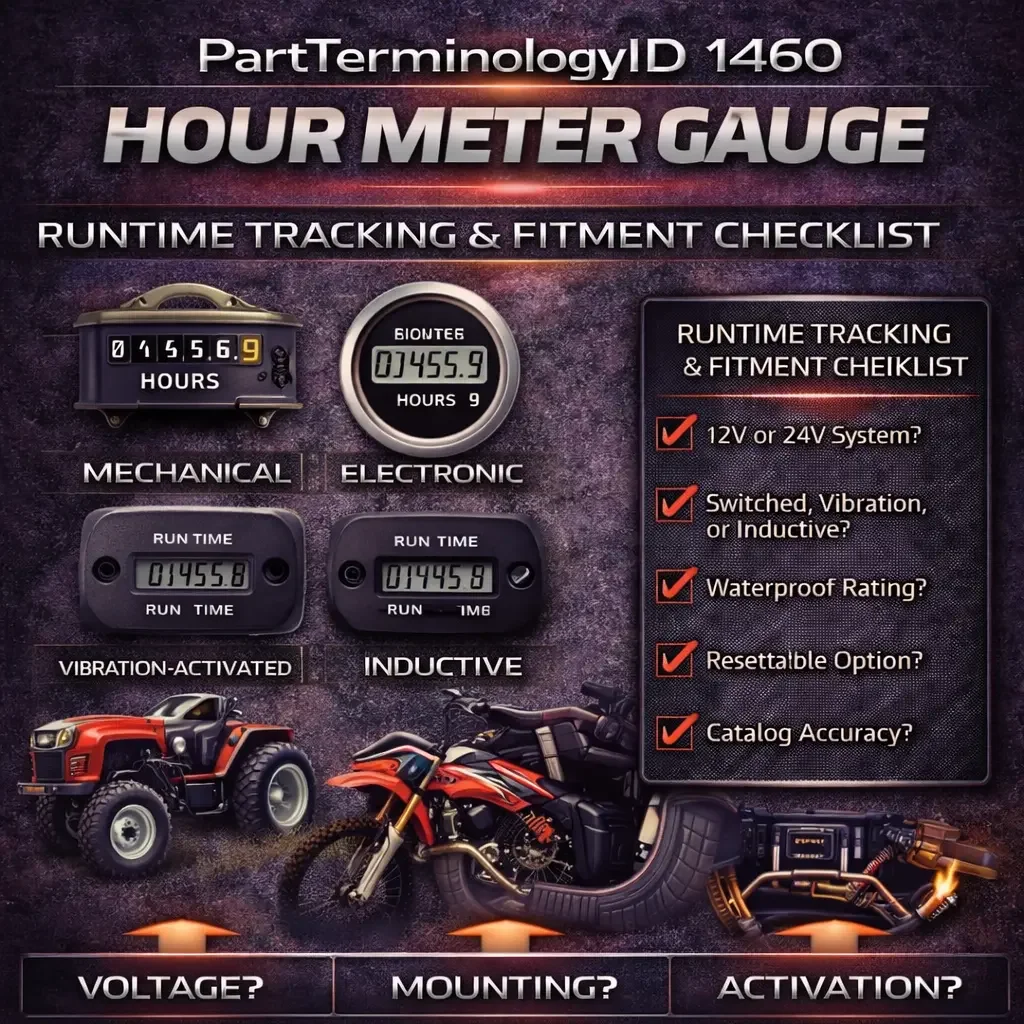
Mechanical hour meter. A clock-type mechanism driven by the vehicle's electrical system. When the ignition is on and the engine is running, the meter counts. The display is a series of rotating number wheels (similar to a mechanical odometer) that show accumulated hours. Mechanical hour meters are self-contained, reliable, and do not reset. They are common on older equipment.
Electronic/digital hour meter. A digital display that counts runtime electronically. Powered by the vehicle's electrical system or by an internal battery. Some digital hour meters also display RPM, voltage, or maintenance reminders. Digital meters are standard on modern equipment and increasingly common as aftermarket additions to older equipment.
Vibration-activated hour meter. A self-contained hour meter with an internal vibration sensor. It counts runtime based on engine vibration rather than an electrical connection. The meter is adhesive-mounted to the engine or frame, detects vibration when the engine is running, and counts hours automatically. No wiring required. This is the simplest installation option and is popular for small engines (lawn mowers, generators, compressors) and rental equipment where wiring is impractical.
Inductive hour meter. An hour meter that wraps around the spark plug wire and counts runtime based on ignition pulses. Common on gasoline small engines. No direct electrical connection to the engine's wiring system.
Combination hour meter / tachometer. A single instrument that displays both runtime hours and engine RPM. Common on marine and powersport applications where both measurements are useful.
OEM instrument cluster hour meter. Some vehicles, particularly diesel trucks, commercial vehicles, and heavy equipment, include an hour meter as a factory instrument in the dashboard cluster. On these vehicles, the hour meter may be integrated into the cluster and not separately replaceable.
What this part does NOT cover
Odometer. Measures distance traveled, not runtime. Different instrument.
Tachometer. Measures engine RPM in real-time, not cumulative runtime. Different PartTerminologyID (1444 for cable-driven tachometer).
Trip computer / engine information display. Modern vehicles may display runtime as one parameter in a digital trip computer, but this is a software function of the instrument cluster, not a standalone hour meter.
Where This Part Is Actually Used
Marine
Hour meters are standard on boat engines. Marine engines accumulate runtime at varying speeds (trolling, cruising, full throttle) and the hour meter is the primary indicator for oil change intervals, impeller replacement, and overall engine condition. A boat with 500 hours on a marine engine is significantly different in value and condition from one with 2,000 hours. Hour meters on marine engines are a critical resale value tool.
Agricultural and construction equipment
Tractors, skid steers, excavators, wheel loaders, and other equipment use hour meters as their primary maintenance and utilization tracking instrument. Service intervals on commercial equipment are based on hours, not miles.
Generators and stationary engines
Standby generators, pumps, compressors, and other stationary engines use hour meters to track runtime for maintenance scheduling. A standby generator that runs 200 hours per year needs oil changes and maintenance based on those 200 hours, not on any distance measurement.
Powersport
ATVs, UTVs, dirt bikes, and snowmobiles use hour meters to track engine runtime. Aftermarket hour meters are popular additions to powersport vehicles that did not include one from the factory.
Commercial and fleet vehicles
Some commercial trucks, particularly diesel trucks, include factory hour meters because these vehicles may idle for extended periods (delivery trucks, utility trucks, construction vehicles). The hour meter tracks engine runtime separately from the odometer mileage, providing a more accurate picture of engine wear.
Passenger cars (rare)
Some performance and racing enthusiasts install hour meters on modified passenger cars to track engine runtime separately from miles. Track day cars may accumulate relatively few miles but significant hours of high-RPM operation. An hour meter helps the owner maintain the engine based on actual operating time.
Why This Category Creates Fitment Problems
Gauge diameter and mounting
Hour meters are available in standard round gauge diameters (2-1/16 inch, 2-5/8 inch) for panel mounting, in rectangular formats for console mounting, and in small self-contained housings for surface mounting or adhesive mounting. The buyer must know where and how they intend to mount the meter.
Power source and activation method
This is the primary technical specification:
Switched 12V or 24V. The meter connects to a circuit that is energized only when the ignition is on (or when the engine is running). 12V for most automotive, marine, and light equipment. 24V for heavy equipment, military, and some marine applications. Connecting a 12V meter to a 24V system will damage the meter.
Vibration-activated. No wiring. Detects engine vibration. Sensitivity settings may need adjustment. Some vibration meters false-trigger from transport or nearby equipment.
Inductive (spark plug wire wrap). Counts ignition pulses. Only works on gasoline engines with spark plug wires. Does not work on diesel engines (no spark plug), coil-on-plug ignition (no accessible wire), or electric motors.
Battery-powered with internal sensor. Some digital meters have an internal battery and a vibration or inductive sensor, operating independently of the vehicle's electrical system.
Resettable versus non-resettable
Most hour meters are non-resettable. Once they start counting, the total accumulates permanently. This is intentional because the hour meter serves as a permanent record of engine runtime, similar to an odometer. However, some digital meters offer a resettable trip-hour function alongside the permanent total. And some buyers want a resettable meter for rental equipment or project tracking. The listing must specify: non-resettable (permanent count), resettable, or both (permanent total plus resettable trip).
Waterproof rating
Marine and outdoor applications require waterproof meters. An IP67 or IP68 rating means the meter is submersible. Standard automotive gauges are not waterproof and will fail in marine or outdoor equipment applications.
Top Return Causes
1) Wrong voltage (12V meter on 24V system or vice versa)
Prevention: Specify voltage in the title: "12V Hour Meter" or "24V Hour Meter."
2) Inductive meter ordered for diesel engine
Inductive meters require spark plug wires. Diesel engines have no spark plugs.
Prevention: "For gasoline engines with accessible spark plug wires only. Not compatible with diesel engines or coil-on-plug ignition systems."
3) Non-waterproof meter used in marine application
Standard meter fails from water exposure on a boat.
Prevention: Specify waterproof rating: "IP67 Waterproof, Suitable for Marine Use" or "Not Waterproof, Indoor/Automotive Use Only."
4) Buyer expected resettable, received non-resettable
Prevention: Specify in the title: "Non-Resettable Hour Meter (Permanent Count)" or "Hour Meter with Resettable Trip Function."
5) Vibration meter false-triggers or does not trigger
Vibration sensitivity is too high (counts hours when engine is off from road vibration or nearby equipment) or too low (does not detect engine running).
Prevention: Note in description: "Vibration-activated meters may require sensitivity adjustment after installation. Mount directly on the engine block or frame near the engine for best results."
Compatibility Checklist for Buyers
1) Determine your application. Marine, agricultural, generator, powersport, commercial vehicle, or performance/racing passenger car.
2) Determine your activation method. Switched electrical (requires wiring), vibration (no wiring), or inductive (spark plug wire wrap, gasoline only).
3) Confirm voltage. 12V or 24V. Match to your engine's electrical system.
4) Confirm waterproof requirements. Marine and outdoor equipment need waterproof meters (IP67+).
5) Determine mounting type. Round panel mount (specify diameter), rectangular console mount, surface/adhesive mount, or handlebar mount (powersport).
6) Determine resettable or non-resettable. Do you need a permanent-only count or a trip-hour reset function?
Catalog Checklist for Attributes
Core taxonomy: Product form (mechanical, digital, vibration-activated, inductive, combination hour/tach). Separate from Odometer, Tachometer, and Trip Computer.
Electrical specs: Operating voltage (12V, 24V, battery-powered). Activation method (switched power, vibration, inductive). Current draw.
Physical specs: Display type (mechanical wheels, LCD, LED). Gauge diameter or housing dimensions. Mounting type (panel, surface, adhesive, handlebar). Waterproof rating (IP65, IP67, IP68, none).
Functional specs: Resettable (yes/no). Resolution (hours and tenths, hours and hundredths). Maximum hour count. Maintenance reminder function (yes/no). Combination tachometer (yes/no).
Application: Automotive, marine, agricultural, industrial, powersport, generator.
Images: Front face showing display, rear showing wiring terminals or mounting method, and for vibration/inductive meters, the sensor and mounting interface.
FAQ
What is the difference between an hour meter and an odometer?
An odometer counts distance (miles or kilometers). An hour meter counts engine runtime (hours). A vehicle that idles for 8 hours per day accumulates 8 hours on the hour meter but zero miles on the odometer. Equipment like generators and tractors use hour meters because their engines run without traveling significant distances.
How do I know when to change oil based on hours?
Most engine manufacturers specify oil change intervals in both miles and hours. For example, "every 5,000 miles or 200 hours, whichever comes first." If your equipment does not have a manufacturer recommendation, a general guideline is every 100 to 200 hours for gasoline engines and every 200 to 500 hours for diesel engines, depending on operating conditions.
Can I install an hour meter on my car?
Yes. Aftermarket hour meters can be installed on any vehicle. Connect to a switched 12V source (one that is only energized when the engine is running) and mount the meter in a visible location. This is useful for track cars, modified vehicles, and any application where you want to track engine runtime separately from mileage.
Final Take for Aftermarket Teams
Hour Meter Gauge (PartTerminologyID 1460) lives primarily outside the passenger car market. Its buyer population is marine, agricultural, construction, powersport, and commercial fleet. The catalog challenges are voltage (12V versus 24V), activation method (switched electrical, vibration, inductive), waterproof rating, resettable versus non-resettable, and mounting type. The teams that serve this category well clearly specify these attributes, separate marine-rated meters from standard automotive meters, note the inductive method's limitation to gasoline engines with spark plug wires, and help the buyer select the correct activation method for their equipment.