
Fuel Pressure Gauge (PartTerminologyID 1458): The Diagnostic Gauge That Was Never on the Dashboard and Is Not a Replacement Part
Written by Arthur Simitian | PartsAdvisory
Every other gauge covered in this series (Ammeter 1452, Fuel Level 1456) is a dashboard instrument that the driver watches while driving. The Fuel Pressure Gauge is different. It was never a factory-installed dashboard gauge on any mainstream production vehicle. No driver monitors fuel pressure while commuting. No instrument cluster has a fuel pressure needle between the fuel level and the temperature gauges.
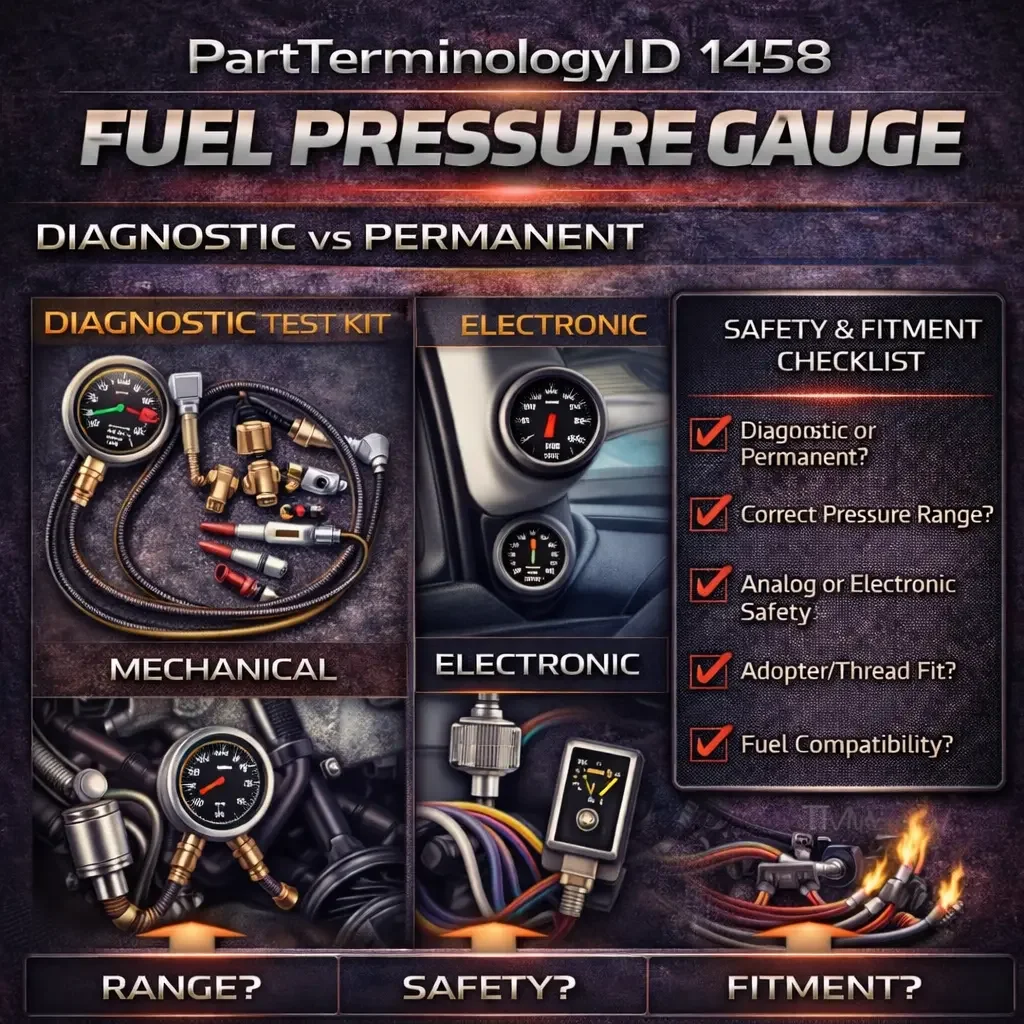
The Fuel Pressure Gauge is a diagnostic and performance instrument. It measures the fuel system pressure at the fuel rail, the fuel filter, or the fuel pump output. It exists in two contexts:
Diagnostic tool. A technician connects a fuel pressure gauge to the fuel rail test port (Schrader valve) to verify that the fuel pump is delivering the correct pressure, the fuel pressure regulator is maintaining the correct range, and the fuel system is not losing pressure due to a leak, a weak pump, or a failed regulator. This is a tool, not a vehicle component. The technician uses it during diagnosis and removes it when done.
Performance gauge (permanent installation). On modified, racing, and performance vehicles, a fuel pressure gauge may be permanently mounted in the cabin (on the A-pillar, in a gauge pod, or on the dashboard) to give the driver real-time visibility into fuel system pressure. This is critical on turbocharged, supercharged, and high-horsepower vehicles where fuel delivery must keep pace with the engine's demand. A drop in fuel pressure under boost indicates the fuel system is reaching its limit, which can cause a lean condition and engine damage.
This dual identity as both a tool and a vehicle component creates a unique catalog challenge. The same PartTerminologyID covers products sold to two very different buyers with very different needs.
This post is built for aftermarket catalog teams, marketplace sellers, and buyers who want fewer mistakes and fewer returns.
Status in New Databases
Status in New Databases
Current: PIES 7.2 + PCdb Future: PIES 8.0 + PCdb 2.0 Status: No change
What Fuel Pressure Gauge Means in the Aftermarket
Fuel Pressure Gauge (PartTerminologyID 1458) refers to a pressure gauge that measures fuel system pressure in pounds per square inch (PSI) or bar.
In catalog reality, this covers:
Diagnostic fuel pressure gauge kit. A handheld gauge with a hose, a collection of adapters for different fuel rail test port sizes and thread types, and usually a bleed valve. The kit connects to the fuel rail test port, the technician reads the pressure, and the kit is removed. This is sold in the tools and equipment category but may be cataloged under PartTerminologyID 1458.
Permanent-mount fuel pressure gauge (mechanical). A small-diameter gauge (typically 1-1/2 inch or 2-1/16 inch) with a direct pressure connection. A fuel line runs from the fuel rail or an inline fitting to the gauge. The gauge reads pressure directly via a Bourdon tube mechanism. This is the simplest and most responsive permanent installation. The disadvantage is that a fuel line running into the cabin creates a fire risk in a crash. Most racing sanctioning bodies require a fuel pressure isolator or a liquid-filled gauge for safety.
Permanent-mount fuel pressure gauge (electric/electronic). A gauge that uses an electronic pressure sender (transducer) mounted on the fuel rail and sends an electrical signal to the gauge in the cabin. No fuel line in the cabin. This is the safer option for street vehicles because only an electrical wire crosses the firewall, not pressurized fuel. Electronic gauges are available in standard 2-1/16 inch and 2-5/8 inch diameters.
Fuel pressure sender/transducer only. The electronic pressure sensor that mounts on the fuel rail and converts fuel pressure to an electrical signal. This may be sold separately from the gauge for buyers who already have a compatible gauge and need a replacement sender.
Inline fuel pressure gauge. A small gauge that installs inline in the fuel line (typically between the fuel filter and the fuel rail) without requiring a dedicated test port. Used for quick diagnostics or semi-permanent monitoring on vehicles without a Schrader valve test port.
What this part does NOT cover
Fuel pressure regulator. The component that controls fuel system pressure. Different PartTerminologyID.
Fuel pump. The component that generates fuel pressure. Different PartTerminologyID.
Oil pressure gauge. Measures engine oil pressure, not fuel pressure. Different instrument, different PartTerminologyID.
Boost/vacuum gauge. Measures intake manifold pressure. Different measurement, different PartTerminologyID, though boost and fuel pressure gauges are often installed together on turbocharged vehicles.
Fuel rail pressure sensor (OEM). The factory-installed electronic sensor on modern fuel-injected vehicles that reports fuel rail pressure to the ECU. This is an engine management sensor, not a gauge. Different PartTerminologyID.
Pressure Ranges and Fuel System Types
The pressure range of the gauge must match the fuel system type. This is the most important technical specification:
Port fuel injection (PFI/MFI): 30 to 80 PSI. Most port-injected vehicles operate fuel pressure between 35 and 65 PSI, with some variation based on engine vacuum. A gauge with a 0-100 PSI range covers all PFI applications with good needle resolution.
Throttle body injection (TBI): 9 to 15 PSI. Older throttle body injection systems operate at much lower pressure than port injection. A 0-100 PSI gauge will work but the needle will barely move, making it difficult to read small changes. A 0-15 PSI or 0-30 PSI gauge provides much better resolution for TBI diagnostics.
Gasoline direct injection (GDI): 500 to 3,000+ PSI. Modern direct injection systems operate at extremely high pressures, far beyond the range of any standard fuel pressure gauge. GDI fuel pressure is monitored via the ECU and an OEM high-pressure sensor. Standard aftermarket fuel pressure gauges cannot measure GDI high-pressure rail pressure. They can, however, measure the low-pressure supply side (fuel pump to high-pressure pump), which operates at 40 to 80 PSI on most GDI systems.
Carbureted vehicles: 3 to 8 PSI. Carbureted engines operate at very low fuel pressure. A 0-15 PSI gauge is appropriate. A 0-100 PSI gauge is essentially useless for carbureted diagnostics because the pressure is so low the needle is indistinguishable from zero.
Diesel fuel systems: varies widely. Diesel common rail systems operate at 5,000 to 30,000+ PSI. Like GDI, these pressures are far beyond aftermarket gauge capability. Low-pressure supply side measurement (fuel pump to injection pump) is in the 5 to 50 PSI range and can be measured with a standard gauge.
A single "fuel pressure gauge" listing without specifying the pressure range is guaranteed to create confusion. A buyer diagnosing a carbureted engine does not need a 0-100 PSI gauge. A buyer monitoring a turbocharged port-injected engine does not need a 0-15 PSI gauge.
The Safety Consideration: Fuel in the Cabin
This is unique to fuel pressure gauges and must be addressed in catalog content:
Mechanical gauges route pressurized fuel into the cabin. A mechanical fuel pressure gauge uses a direct connection: a fuel line from the fuel rail, through the firewall, to the gauge. If this line leaks, cracks, or is severed in a collision, pressurized fuel sprays into the cabin interior. This is a fire hazard.
Liquid-filled gauges reduce this risk slightly. Liquid-filled mechanical gauges (filled with glycerin or silicone) dampen needle vibration and, in theory, slow a fuel leak at the gauge. But they do not eliminate the hazard.
Electronic gauges eliminate the hazard. An electronic fuel pressure gauge uses a pressure transducer on the fuel rail that sends an electrical signal to the gauge. Only an electrical wire crosses the firewall. No fuel enters the cabin. For street vehicles, electronic fuel pressure gauges are the recommended option.
Racing sanctioning body requirements. Most racing organizations (NHRA, SCCA, NASA) require that any fuel line entering the cabin be a steel braided line with AN fittings and a firewall bulkhead fitting, or that an electronic gauge be used instead. Catalog descriptions for mechanical fuel pressure gauges should note the fire safety consideration.
Why This Category Creates Fitment Problems
Pressure range mismatch
A gauge intended for port injection (0-100 PSI) used on a carbureted engine (3-8 PSI) is unreadable. A gauge intended for carbureted engines (0-15 PSI) connected to a port injection system (45-65 PSI) will peg the needle and may damage the gauge.
Thread and adapter compatibility
Fuel rail test ports use various thread sizes and types. The most common are 1/8 NPT, 7/16-20, 5/16 SAE, and Schrader valve (similar to a tire valve). A diagnostic kit needs the correct adapter to connect to the vehicle's test port. A permanent installation needs the correct fitting for the fuel rail or fuel line.
Mechanical versus electronic confusion
A buyer looking for a permanent installation gauge may order a diagnostic kit (handheld, with hose and adapters). Or they may order a mechanical gauge planning to mount it in the cabin without understanding the safety implications.
Fuel compatibility
The gauge, fittings, hose, and seals must be compatible with the fuel type. Gasoline, E85 ethanol, methanol, and diesel require different seal and hose materials. Standard rubber hoses and seals degrade when exposed to high ethanol content fuels. Gauges and kits intended for E85 or methanol must use ethanol-resistant materials (fluoroelastomer seals, PTFE-lined hoses).
Not a factory replacement part
Unlike most parts in this blog series, the fuel pressure gauge is not replacing a factory component that failed. No factory component is being removed and a new identical part installed. This means standard ACES fitment data (year, make, model) is less relevant than the fuel system type and pressure range. The fitment question is not "what vehicle does this fit" but "what fuel system type and pressure range does this measure."
Top Return Causes
1) Wrong pressure range
Gauge range does not match the fuel system type. Needle either barely moves or pegs at maximum.
Prevention: Pressure range in the title: "0-100 PSI Fuel Pressure Gauge (Port Fuel Injection)" or "0-15 PSI Fuel Pressure Gauge (Carbureted / TBI)."
2) Diagnostic kit ordered when permanent gauge was needed (or vice versa)
Buyer wants a permanently installed cabin gauge and receives a diagnostic test kit with a handheld gauge and hose.
Prevention: Clear product form: "Diagnostic Fuel Pressure Test Kit (Handheld, With Adapters)" versus "2-1/16 Inch Fuel Pressure Gauge (Panel Mount, Permanent Installation)."
3) Mechanical gauge ordered without understanding cabin fuel line safety risk
Buyer installs a mechanical gauge in the cabin and later realizes (or is informed) that routing a fuel line through the firewall is a safety concern.
Prevention: Safety note in the description: "Mechanical fuel pressure gauges route pressurized fuel into the cabin. For street vehicles, an electronic fuel pressure gauge with a remote sender/transducer is recommended to eliminate the fuel-in-cabin fire risk."
4) Wrong adapter or thread size for fuel rail test port
Diagnostic kit does not include the correct adapter for the vehicle's test port.
Prevention: List all included adapters with thread sizes. Note: "Check your vehicle's fuel rail test port thread size before ordering. Common sizes: Schrader valve, 1/8 NPT, 7/16-20."
5) Gauge not compatible with E85 or alternative fuel
Seals or hose degrade from ethanol exposure.
Prevention: Specify fuel compatibility: "Compatible with gasoline and E10. For E85, methanol, or flex-fuel applications, use our ethanol-compatible gauge kit."
Compatibility Checklist for Buyers
1) Identify your fuel system type. Carbureted, throttle body injection, port fuel injection, or direct injection (low-pressure side only).
2) Select the correct pressure range. 0-15 PSI for carbureted/TBI. 0-100 PSI for port injection. Do not use standard gauges on GDI or diesel high-pressure rails.
3) Determine your use case. Diagnostic (temporary connection, test and remove) or permanent installation (mounted in cabin for ongoing monitoring).
4) If permanent installation, choose electronic over mechanical for street vehicles. Electronic gauges do not route pressurized fuel into the cabin.
5) Confirm fuel compatibility. If running E85, methanol, or other alternative fuels, ensure all seals, hoses, and fittings are compatible.
6) Confirm thread size for connection. Match the gauge or adapter to your fuel rail test port or fuel line fitting.
Catalog Checklist for Attributes
Core taxonomy: Product form (diagnostic kit, permanent-mount mechanical gauge, permanent-mount electronic gauge, fuel pressure sender/transducer, inline gauge). Separate from Fuel Pressure Regulator, Fuel Pump, Oil Pressure Gauge, Boost Gauge, and OEM Fuel Rail Pressure Sensor.
Pressure specs: Gauge range (0-15 PSI, 0-30 PSI, 0-100 PSI, 0-150 PSI). Accuracy rating. Units (PSI, bar, kPa).
Physical specs: Gauge diameter (1-1/2 inch, 2-1/16 inch, 2-5/8 inch). Mounting type (panel mount, pod mount, handheld). Connection thread size. Sender type (for electronic: resistance, voltage, or frequency output).
Fuel compatibility: Gasoline, E10, E85, methanol, diesel.
Safety: Mechanical (fuel line to cabin) or electronic (electrical signal only). Liquid-filled (yes/no).
Package contents: Gauge, sender/transducer (if electronic), hose, adapters (list all sizes), fittings, mounting hardware, wiring.
Images: Gauge face showing range and markings, rear/side showing connection fitting, full kit laid out showing all included adapters and hoses, electronic sender close-up (if applicable).
FAQ
Do I need a fuel pressure gauge on my daily driver?
Not typically. Modern vehicles have an OEM fuel rail pressure sensor that reports to the ECU and will trigger a check engine light if fuel pressure is out of range. A fuel pressure gauge is most useful on carbureted vehicles (which have no electronic monitoring), modified or turbocharged vehicles (where fuel delivery is pushed beyond stock limits), and for diagnostic purposes when troubleshooting fuel system issues.
Can I use a regular fuel pressure gauge on a direct injection engine?
Only on the low-pressure supply side (fuel pump to high-pressure pump), which operates at 40 to 80 PSI. The high-pressure rail on a GDI engine operates at 500 to 3,000+ PSI, far exceeding the range of standard aftermarket gauges. GDI high-pressure rail monitoring requires the OEM sensor and a scan tool.
Is it safe to run a fuel line through the firewall to a mechanical gauge?
It works, and many performance vehicles do it, but it introduces a fire risk. If the line leaks or is severed in a collision, pressurized fuel sprays into the cabin. An electronic gauge with a remote transducer on the fuel rail is the safer alternative for street vehicles. For racing applications, use steel braided lines with AN fittings and a firewall bulkhead fitting.
What fuel pressure should my vehicle have?
Carbureted: 3 to 8 PSI. Throttle body injection: 9 to 15 PSI. Port fuel injection: 35 to 65 PSI (varies by vehicle, check service manual). Direct injection (low-pressure side): 40 to 80 PSI. If your pressure is outside the specified range, the problem is typically the fuel pump, the fuel pressure regulator, or a fuel system leak.
Final Take for Aftermarket Teams
Fuel Pressure Gauge (PartTerminologyID 1458) is unique in this blog series because it is not a factory replacement part. No production vehicle has a fuel pressure gauge on the dashboard. It is a diagnostic tool and a performance instrument, which means the fitment question is not "what vehicle does this fit" but "what fuel system type and pressure range does this measure." The catalog teams that serve this category well specify pressure range prominently, separate diagnostic kits from permanent installation gauges, note the mechanical-versus-electronic safety distinction, specify fuel compatibility for ethanol and alternative fuel applications, and list the included adapters and thread sizes so the buyer knows whether the kit will connect to their fuel rail before they order.