
Fuel Level Gauge (PartTerminologyID 1456): The Gauge Every Driver Looks At, Nobody Trusts, and Almost Nobody Diagnoses Correctly
Written by Arthur Simitian | PartsAdvisory
The fuel level gauge is the most frequently viewed instrument on the dashboard. Drivers check it dozens of times per week. It is the gauge that determines whether they can make it to work, whether they need to stop for gas, and whether that fuel light coming on means right now or in 30 miles.
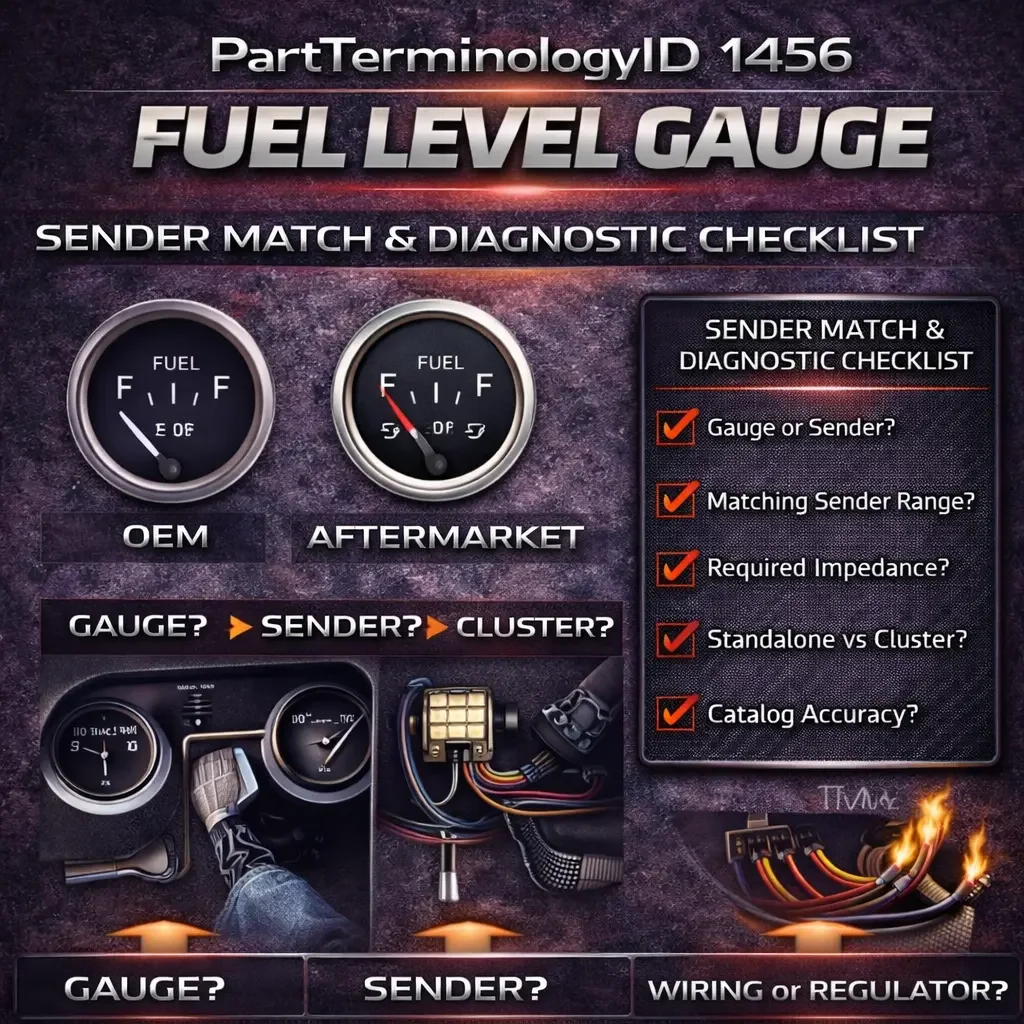
It is also the gauge that generates some of the most frustrating diagnostic problems in the aftermarket. When the fuel gauge reads wrong, reads empty when the tank is full, reads full all the time, bounces between full and empty, or stops working entirely, the buyer has to determine whether the problem is the gauge itself (in the instrument cluster), the fuel level sender (in the fuel tank), the wiring between them, or the instrument cluster's voltage regulator. Four possible failure points for one symptom. And the most common mistake is replacing the wrong one.
This makes Fuel Level Gauge a category where catalog accuracy and product description content have an outsized impact on returns. The buyer who orders a gauge when the problem is the sender wastes money and still has a broken fuel gauge. The buyer who orders a sender when the problem is the gauge wastes money, has to drop a fuel tank for nothing, and still has a broken fuel gauge. The part descriptions and FAQ content in this category are as important as the fitment data because they help the buyer diagnose before they order.
This post is built for aftermarket catalog teams, marketplace sellers, and buyers who want fewer mistakes and fewer returns.
Status in New Databases
Status in New Databases
Current: PIES 7.2 + PCdb Future: PIES 8.0 + PCdb 2.0 Status: No change
What Fuel Level Gauge Means in the Aftermarket
Fuel Level Gauge (PartTerminologyID 1456) refers to the dashboard instrument that displays the fuel level in the tank. The gauge receives a signal from the fuel level sender (a variable resistor attached to a float arm in the fuel tank) and converts that signal into a needle position on the gauge face.
In catalog reality, this covers:
OEM replacement fuel level gauge. A gauge designed to replace the original factory fuel level gauge in a specific vehicle's instrument cluster. Must match the original in diameter, bezel style, face graphics, needle style, illumination, terminal configuration, and critically, the impedance range that matches the fuel level sender in the tank.
Universal/aftermarket fuel level gauge. A standalone gauge not tied to a specific vehicle. Available in standard diameters (2-1/16 inch, 2-5/8 inch) with various face styles. Used for custom builds, hot rods, kit cars, and marine applications. Universal gauges must be matched to the sender's resistance range.
Fuel level gauge as part of an instrument cluster. On most modern vehicles (roughly 1990 and newer), the fuel level gauge is not a separate replaceable component. It is integrated into the instrument cluster as a stepper motor driven by the cluster's internal circuit board. If the fuel level gauge fails on these vehicles, the entire instrument cluster must be replaced or repaired by a cluster rebuild service. For these vehicles, PartTerminologyID 1456 as a standalone replacement does not apply.
Fuel level gauge for marine, powersport, and industrial applications. Boats, ATVs, generators, and other equipment with fuel tanks use fuel level gauges that may be physically similar to automotive gauges but are designed for different environmental conditions (waterproof, vibration-resistant) and may use different sender resistance ranges.
What this part does NOT cover
Fuel level sender / fuel level sending unit. The variable resistor and float arm assembly inside the fuel tank. Different PartTerminologyID. This is the component that most buyers actually need when their fuel gauge reads incorrectly.
Fuel pump assembly with integrated sender. Many modern fuel pump modules include the fuel level sender as an integrated component. Different PartTerminologyID.
Instrument cluster. The complete gauge cluster assembly. Different PartTerminologyID. On modern vehicles, the fuel gauge is part of the cluster.
Low fuel warning light. The dashboard warning light that illuminates when the fuel level drops below a threshold. May be part of the gauge or part of the cluster, depending on the vehicle.
Digital fuel level display. On vehicles with fully digital instrument clusters, the fuel level is displayed as a graphic, bar, or number on a screen. No mechanical gauge exists. Different technology.
The Gauge-Sender Impedance Match: The Most Important Technical Concept in This Category
This is the single most critical piece of information for catalog teams and buyers. The fuel level gauge and the fuel level sender must be impedance-matched. If they are not matched, the gauge will read incorrectly, and no amount of troubleshooting will fix it.
How the system works
The fuel level sender is a variable resistor (rheostat) attached to a float arm in the fuel tank. As the fuel level changes, the float moves up or down, which moves a wiper along a resistor strip, changing the resistance. This changing resistance is the signal that the gauge reads.
The gauge is calibrated to interpret a specific resistance range as "Empty" and a specific resistance range as "Full." When the sender resistance matches the gauge's expected range, the needle moves accurately from E to F.
The problem: different resistance ranges
Different manufacturers use different resistance ranges for their fuel level systems. The three most common ranges in the automotive aftermarket are:
GM standard: 0 ohms = Full, 90 ohms = Empty. When the tank is full, the sender reads near zero ohms. When the tank is empty, the sender reads near 90 ohms. The gauge is calibrated for this range.
Ford/Chrysler standard: 73 ohms = Empty, 10 ohms = Full. The range is similar to GM (low resistance = full, high resistance = empty) but the specific values are different.
European standard (many variations): 0-180 ohms, 10-180 ohms, or other ranges. European manufacturers use a wider variety of resistance ranges.
Reverse range (some applications): High resistance = Full, low resistance = Empty. Some marine and aftermarket applications use the opposite relationship where the resistance increases as the tank fills.
If a buyer installs a gauge calibrated for a GM sender (0-90 ohms) with a Ford sender (10-73 ohms), the gauge will read in the ballpark but will never be accurate at the extremes. If they install a gauge with a completely different range (say, 240-33 ohms, which is a common marine/European range) with a GM sender, the gauge will read nonsensically.
Why this matters for the catalog
Every fuel level gauge listing must specify the sender resistance range it is designed to work with. "Universal fuel level gauge" is not enough information. "Universal fuel level gauge, compatible with 240-33 ohm senders" is the minimum necessary specification. For OEM replacement gauges, the resistance range is implied by the vehicle application, but it should still be stated explicitly to prevent cross-application errors.
The Diagnostic Problem: Gauge, Sender, Wiring, or Voltage Regulator?
This section is critical catalog content because the majority of buyers searching for a fuel level gauge do not actually need a new gauge. They need to diagnose the actual failure point. Including diagnostic guidance in the listing description reduces returns from buyers who replace the gauge when the problem is elsewhere.
The four failure points
1) Fuel level sender (most common failure). The resistor strip or the wiper contact in the sender wears out, corrodes, or develops dead spots. A worn sender causes the gauge to read intermittently, bounce, stick at one position, or read empty regardless of fuel level. Because the sender sits inside the fuel tank, submerged in fuel, it is subject to corrosion from ethanol blends and sulfur compounds in modern gasoline. Sender failure is the most common cause of incorrect fuel gauge readings by a wide margin.
2) Fuel level gauge (less common failure). The gauge itself can fail, but it is less common than sender failure on vehicles with mechanical gauges. Gauge failures include a stuck needle (the gauge movement is seized), a dead gauge (no needle movement at all), or an inaccurate gauge (reads consistently high or low). On vehicles with electronic clusters, the stepper motor that drives the gauge needle can fail, causing erratic or stuck readings.
3) Wiring (intermittent or no signal). The wiring between the sender and the gauge can develop breaks, corrosion, or poor ground connections. A bad ground is one of the most common and most overlooked causes of erratic fuel gauge readings. The ground wire from the sender must have a clean, tight connection to the vehicle frame or body.
4) Instrument cluster voltage regulator (classic cars). On classic cars with analog gauges, the instrument cluster contains a voltage regulator (often called an instrument voltage regulator or IVR) that provides a stable 5V or 6V reference to the fuel, temperature, and oil pressure gauges. When the IVR fails, all three gauges read incorrectly simultaneously. If only the fuel gauge is wrong, the IVR is not the problem. If all three gauges are wrong, the IVR is likely the cause, not the individual gauges.
The diagnostic sequence
A well-written listing description can include this sequence to help buyers diagnose before ordering:
Step 1: Are all gauges wrong, or just the fuel gauge? If all gauges (fuel, temperature, oil pressure) read incorrectly, the instrument voltage regulator is the likely cause (classic cars only). If only the fuel gauge is wrong, proceed to Step 2.
Step 2: Disconnect the sender wire at the tank and ground it. With the ignition on, disconnect the wire from the fuel level sender at the tank and touch it to a clean ground on the frame. If the gauge moves to Full, the gauge and wiring are functional, and the sender is the problem. If the gauge does not move, the problem is in the gauge or the wiring.
Step 3: Check for voltage at the gauge terminals. With a multimeter, verify that the gauge is receiving power from the ignition switch and that the sender wire has continuity from the gauge terminal to the tank. This isolates whether the problem is the gauge or the wiring.
This diagnostic content saves the buyer from ordering the wrong part and saves the seller from processing a return.
Why This Category Creates Fitment Problems
Standalone gauge versus integrated cluster
The fundamental split, same as many other instrument categories. On classic cars and older vehicles, the fuel level gauge is a separate instrument that can be removed from the cluster and replaced individually. On modern vehicles, the gauge is integrated into the cluster and cannot be replaced separately. The buyer searching for a "fuel level gauge" for their 2015 Civic needs an instrument cluster repair or replacement, not a standalone gauge.
Sender resistance range mismatch
As detailed above, the gauge must match the sender's resistance range. A universal gauge designed for a GM sender will not read correctly with a Ford sender.
Gauge diameter
Same issue as the Ammeter Gauge (PartTerminologyID 1452). The gauge must physically fit the instrument cluster opening. Standard diameters (2-1/16 inch, 2-5/8 inch) apply to universal gauges. OEM gauges must match the vehicle-specific cluster opening.
Face style and graphics for restoration
For restoration buyers, the gauge face must match the original in every detail: font, color scheme, E and F positions (some gauges read E on the left, others on E on the right), hash mark spacing, and manufacturer markings.
Fuel type considerations for modern applications
On flex-fuel vehicles, the fuel composition (gasoline versus E85 ethanol) can affect sender resistance because ethanol is more corrosive to certain sender materials and has different electrical conductivity than gasoline. Some senders designed for flex-fuel applications use different materials. The gauge itself is not directly affected by fuel type, but the sender it is paired with may be.
Dual-tank vehicles
Some trucks (particularly older Ford F-series and Chevy/GMC trucks) have dual fuel tanks with a tank selector switch. Each tank has its own sender. The gauge must display the level of whichever tank is currently selected. The wiring from the tank selector switch to the gauge must route the correct sender signal. A gauge replacement in a dual-tank vehicle must account for the selector switch circuit.
Empty and Full orientation
Different gauge designs place E (Empty) on the left and F (Full) on the right, or E on the right and F on the left. The gauge face orientation must match the vehicle's original design. An upside-down reading (full when empty, empty when full) may indicate reversed wiring rather than a wrong gauge, but it can also indicate a gauge designed for a different sender resistance relationship (low resistance = full versus high resistance = full).
Digital fuel level display considerations
On vehicles with fully digital instrument clusters (common since the mid-2010s and now standard on many vehicles), there is no mechanical gauge at all. The fuel level is displayed as a graphic bar, arc, or numerical percentage on an LCD or OLED screen. The sender signal is read by the cluster's processor and rendered digitally. If the display fails, the entire screen module or cluster must be replaced or reprogrammed. This is a fundamentally different product and service category from a mechanical gauge replacement.
Aftermarket digital fuel level displays
For custom builds and classic car restorations that want modern technology, aftermarket digital fuel level displays are available that read a sender signal and display the level on a small LCD or LED bar graph. These must be matched to the sender resistance range just like analog gauges. They offer programmable calibration that allows the user to set the empty and full resistance values, making them compatible with a wider range of senders. This programmability is a significant advantage over fixed-calibration analog gauges.
The OEM vs. Aftermarket vs. Rebuild Decision
OEM replacement gauges
Exact match for the vehicle's cluster opening, face style, impedance range, and terminal configuration. The correct choice for period-accurate restoration. OEM gauges are increasingly difficult to source for older vehicles as manufacturers discontinue parts. NOS (New Old Stock) gauges command premium prices in the restoration market.
Aftermarket reproduction gauges
Available for high-demand classic car applications (1960s and 1970s GM, Ford, and Mopar muscle cars). Quality varies. The best reproductions match the original face graphics, needle style, and impedance range precisely. Lower-quality reproductions may have slightly different fonts, color shades, or illumination characteristics that are visible to a knowledgeable restorer.
Universal aftermarket gauges
Available from gauge manufacturers like Auto Meter, VDO, Sunpro, and others in standard diameters. Multiple face styles from classic to modern. Available in multiple sender resistance ranges. The buyer must select the correct resistance range for their sender. These are the standard choice for custom builds, hot rods, and non-restoration applications.
Instrument cluster rebuild services
For modern vehicles where the fuel gauge is integrated into the cluster, specialty rebuild services disassemble the cluster, replace the failed stepper motor or circuit board component, and return the cluster with the fuel gauge functioning correctly. This is often less expensive than a new OEM cluster ($150 to $300 for rebuild versus $500 to $1,500+ for a new OEM cluster). The rebuild service must receive the original cluster, repair it, and return it, which means the vehicle is without its cluster for the shipping and repair turnaround time (typically 1 to 3 business days plus shipping).
For catalog teams, cluster rebuild services are a cross-reference opportunity: when a buyer searches for a fuel level gauge for a modern vehicle, directing them to a cluster rebuild service is more helpful than showing them a standalone gauge that cannot be installed.
Marine and Powersport Applications
The fuel level gauge category has significant volume outside of automotive:
Marine fuel level gauges. Boats use fuel level gauges that must be waterproof, corrosion-resistant (saltwater environment), and compliant with marine electrical standards. Marine senders commonly use a 240-33 ohm or 10-180 ohm resistance range, which differs from most automotive standards. Marine gauges are available in standard automotive mounting diameters (2-1/16 inch) and in marine-specific sizes and bezels (white face, stainless bezel).
Powersport fuel level gauges. ATVs, UTVs, snowmobiles, and motorcycles use fuel level gauges in smaller diameters and with different mounting configurations. Some powersport applications use proprietary sender resistance ranges.
Generator and industrial equipment. Stationary engines, generators, and industrial equipment with fuel tanks use fuel level gauges for fuel management. These may use standard automotive sender ranges or industrial-specific ranges.
For catalog teams, the key distinction is the sender resistance range. A marine gauge that looks identical to an automotive gauge but is calibrated for a 240-33 ohm sender will not work with a GM 0-90 ohm sender. The application type (automotive, marine, powersport, industrial) should be a primary category filter.
Top Return Causes
1) Buyer replaces gauge when the problem is the sender
The most common return. Buyer installs a new gauge, the reading is still wrong because the sender in the tank is the actual failure.
Prevention: Diagnostic content in the description: "Before replacing the fuel level gauge, test the fuel level sender. Disconnect the sender wire at the tank and ground it. If the gauge reads Full, the sender is the problem, not the gauge."
2) Sender resistance range mismatch
Universal gauge is not compatible with the vehicle's sender resistance range. Gauge reads nonsensically.
Prevention: Specify sender resistance range in the title and specs: "For use with 240-33 ohm senders" or "For use with GM 0-90 ohm senders."
3) Gauge is integrated into instrument cluster, standalone not available
Buyer orders a standalone gauge for a modern vehicle where the gauge is part of the cluster.
Prevention: Fitment data must specify standalone gauge vehicles only. Note: "For vehicles with individually replaceable fuel level gauge. Modern vehicles with integrated instrument clusters require cluster replacement or repair."
4) Wrong gauge diameter
Gauge does not fit the cluster opening.
Prevention: Specify diameter in the title: "2-1/16 Inch Fuel Level Gauge."
5) Wrong face orientation (E and F reversed)
Gauge reads backward because E and F are on the opposite sides from the original.
Prevention: Specify orientation: "E on left, F on right" or "E on right, F on left." Include a clear photo of the gauge face.
6) Dual-tank vehicle wiring incompatibility
Gauge does not work correctly with the tank selector switch circuit.
Prevention: For dual-tank applications, note: "For single-tank vehicles. Dual-tank vehicles require gauge compatible with tank selector switch circuit."
7) Instrument voltage regulator is the actual problem (classic cars)
All gauges read incorrectly, buyer replaces only the fuel gauge. The IVR is the actual failure.
Prevention: Diagnostic content: "If your fuel, temperature, AND oil pressure gauges all read incorrectly, the instrument voltage regulator (IVR) is the likely cause. Replacing individual gauges will not fix the problem."
Compatibility Checklist for Buyers
1) Diagnose before ordering. Is the problem the gauge, the sender, the wiring, or the voltage regulator? Use the diagnostic sequence described above.
2) Confirm your vehicle has a separately replaceable fuel level gauge. If your vehicle has an electronic instrument cluster, the gauge is integrated and cannot be replaced individually.
3) Confirm the sender resistance range. Check whether your vehicle uses a GM (0-90 ohm), Ford/Chrysler (10-73 ohm), European, or other resistance range. The gauge must match.
4) Confirm gauge diameter. Measure the cluster opening. Match to the replacement gauge.
5) Confirm face orientation. E on left or E on right. Match to the original.
6) For restoration, confirm face style. Font, color, markings, and illumination must match the original for period-correct restoration.
7) For dual-tank trucks, confirm compatibility with the tank selector switch.
8) Confirm full vehicle details. Year, make, model, submodel, instrument cluster option.
Catalog Checklist for Attributes
Core taxonomy: Product form (OEM replacement gauge, universal gauge, gauge cluster component). Separate from Fuel Level Sender, Fuel Pump Assembly, Instrument Cluster, Low Fuel Warning Light, and Instrument Voltage Regulator.
Fitment: For OEM replacements: year, make, model, submodel, cluster option. For universal: gauge diameter, sender resistance range, and face orientation. OEM part number cross-reference.
Electrical specs: Sender resistance range (ohms empty to ohms full, specifying which is which). Operating voltage. Terminal type and count.
Physical specs: Gauge diameter (exact, to 1/16 inch). Mounting depth. Bezel type and finish (chrome, black, brushed).
Appearance specs: Face color scheme, font style, E/F orientation, needle color, illumination type (incandescent, LED), illumination color.
Package contents: Gauge, mounting hardware, wiring instructions, bulb (if included).
Images: Gauge face (front view showing E/F positions, graphics, and bezel), rear view showing terminals and mounting depth, illuminated photo showing backlight color, and for OEM replacements, a reference photo of the gauge in the original cluster.
Common Buyer Scenarios
Scenario 1: Gauge replaced, reading still wrong
A classic car owner with a 1970 Chevelle replaces the fuel level gauge because it reads empty all the time. The new gauge also reads empty all the time. The problem was never the gauge. The fuel level sender in the tank has a corroded wiper contact that reads maximum resistance (empty) regardless of fuel level.
What went wrong: The buyer replaced the gauge without testing the sender first.
What helps: Diagnostic content in the listing: "If the gauge reads empty constantly, disconnect the sender wire at the tank and ground it to the frame with the ignition on. If the new gauge reads full, the sender is the problem."
Scenario 2: Universal gauge reads backward
A hot rod builder installs a universal 2-1/16 inch fuel level gauge. The gauge reads Full when the tank is empty and Empty when the tank is full. The gauge is designed for a sender where high resistance = full, but the installed sender reads low resistance = full (GM style).
What went wrong: The gauge and sender have opposite resistance relationships.
What helps: Sender resistance range clearly stated: "This gauge reads Full at 240 ohms and Empty at 33 ohms. For GM senders (Full at 0 ohms, Empty at 90 ohms), use our GM-compatible gauge (link)."
Scenario 3: All gauges wrong, buyer replaces fuel gauge only
A 1972 Ford F-100 owner notices the fuel gauge reads wrong. They replace it. The new gauge also reads wrong. They then notice the temperature gauge and oil pressure gauge are also reading incorrectly. The instrument voltage regulator has failed, sending incorrect voltage to all three gauges.
What went wrong: The buyer did not check whether other gauges were also affected before diagnosing the fuel gauge as the failure.
What helps: Diagnostic content: "Step 1: Check whether your temperature and oil pressure gauges are also reading incorrectly. If all three gauges are wrong, the instrument voltage regulator is the likely cause."
Scenario 4: Modern vehicle buyer orders standalone gauge
A buyer with a 2018 Toyota Corolla searches for a "fuel level gauge" because their fuel gauge reads erratically. They find a universal aftermarket gauge and order it. The gauge arrives and there is no way to install it in the electronic instrument cluster.
What went wrong: The buyer's vehicle uses an integrated electronic cluster. The fuel gauge is a stepper motor on the cluster circuit board, not a standalone instrument.
What helps: Fitment data that excludes modern electronic cluster vehicles. Note: "This is a standalone mechanical fuel level gauge for vehicles with individually replaceable gauges. Not compatible with electronic instrument clusters. For modern vehicles, consult an instrument cluster repair service."
FAQ
My fuel gauge reads empty all the time. Is it the gauge?
More likely the fuel level sender. The sender is the most common failure point. Test by disconnecting the sender wire at the tank and grounding it to the frame with the ignition on. If the gauge reads Full, the sender is bad. If the gauge does not move, the problem is in the gauge or wiring.
What does "240-33 ohm" mean on a fuel level gauge?
It means the gauge reads Empty when the sender resistance is 240 ohms and Full when the sender resistance is 33 ohms. This resistance range must match your fuel level sender. If your sender uses a different range (like GM's 0-90 ohm), the gauge will not read correctly.
Can I use a GM gauge with a Ford sender?
Not accurately. GM senders use a 0-90 ohm range. Ford senders use approximately a 10-73 ohm range. The gauge will give approximate readings but will not be accurate at the extremes. For correct readings, the gauge and sender must be impedance-matched.
Why does my fuel gauge bounce up and down?
The fuel level sender has worn spots or dead spots on its resistor strip. As the float moves across these spots (especially during driving over bumps or around corners), the resistance jumps, causing the needle to bounce. Replacing the sender resolves this. Some vehicles also use a fuel gauge damping circuit that slows needle movement to hide minor fluctuations. If this circuit fails, normal sender fluctuations become visible as bouncing.
All three of my gauges (fuel, temp, oil) read wrong. What is going on?
On classic cars with analog gauges, all three are powered by a common instrument voltage regulator (IVR). When the IVR fails, all three gauges read incorrectly. Replacing the IVR resolves all three gauges simultaneously. This is much cheaper than replacing three individual gauges.
Final Take for Aftermarket Teams
Fuel Level Gauge (PartTerminologyID 1456) is a category where the most valuable thing the catalog can do is help the buyer diagnose before they order. The majority of fuel gauge complaints are caused by the sender, not the gauge. The catalog teams that include diagnostic content in their listings (the grounding test, the all-gauges-wrong check, the resistance range explanation) prevent the most common return in the category: a new gauge that does not fix the problem because the gauge was never the problem.
After diagnosis, the fitment variables are sender resistance range (the most critical specification), gauge diameter, face orientation, face style, and the standalone-versus-integrated-cluster split. For classic car and restoration buyers, period-correct face graphics and illumination matter as much as electrical compatibility. For custom and hot rod builders, universal gauges must be clearly labeled with the sender resistance range they are designed for.
The fuel level gauge is the most watched instrument on the dashboard. The catalog exists to make sure the buyer gets the right one, and more importantly, to make sure they actually need one before they order.