
Parking Brake Pedal Release Handle (PartTerminologyID 1450): The Small Interior Part That Strands You in Your Driveway When It Breaks
Written by Arthur Simitian | PartsAdvisory
On vehicles with a foot-operated parking brake (the pedal you press with your left foot near the dead pedal area), the Parking Brake Pedal Release Handle is the mechanism that disengages the parking brake so you can drive away. You set the parking brake by pressing the pedal down. You release it by pulling the release handle, which is typically a small T-handle, lever, or pull knob mounted under the dashboard near the driver's left knee.
When this handle breaks, the parking brake cannot be released through normal means. The driver sets the parking brake, goes inside, comes back the next morning, and cannot release it. The vehicle is stuck with the rear brakes locked. The handle itself has snapped, the cable connecting the handle to the release mechanism has broken, or the release lever has failed. The driver either has to crawl under the dashboard and manually manipulate the release mechanism, or call for service.
This is one of those parts where the failure creates a problem completely out of proportion to the size and cost of the component. The handle itself costs $10 to $50. The inconvenience of not being able to release the parking brake is significant. And the part breaks frequently because it is made of plastic, it is in a cramped location where it gets kicked and bumped by feet and knees, and the release action requires a firm pull that stresses the plastic attachment points every time.
This post is built for aftermarket catalog teams, marketplace sellers, and buyers who want fewer mistakes and fewer returns.
Status in New Databases
Status in New Databases
Current: PIES 7.2 + PCdb Future: PIES 8.0 + PCdb 2.0 Status: No change
What Parking Brake Pedal Release Handle Means in the Aftermarket
Parking Brake Pedal Release Handle (PartTerminologyID 1450) refers to the interior handle, lever, or pull mechanism that the driver operates to disengage a foot-operated parking brake.
In catalog reality, this covers:
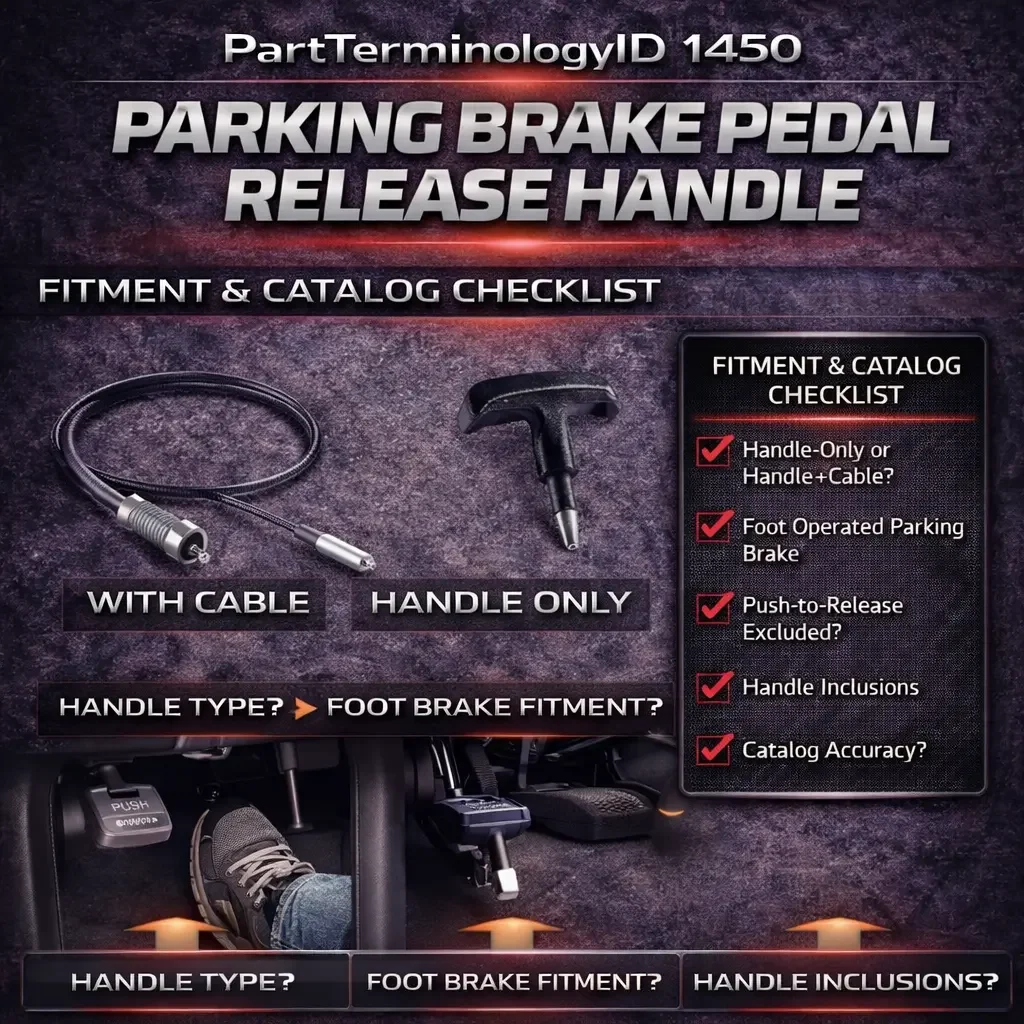
T-handle with cable. The most common design. A T-shaped or knob-shaped handle connected to a short cable that runs to the parking brake pedal release mechanism. Pulling the handle pulls the cable, which trips the release pawl on the pedal ratchet, allowing the pedal to spring back to the disengaged position. The T-handle is mounted under the left side of the dashboard, typically below and to the left of the steering column.
Pull lever (no cable). On some vehicles, the release is a mechanical lever rather than a cable-operated handle. The lever directly engages the release mechanism through a linkage. Pulling the lever disengages the ratchet. This design is less common but exists on some older and some GM platforms.
Integrated release on the pedal itself. Some foot-operated parking brakes use a push-to-set, push-again-to-release design with no separate release handle. The driver presses the pedal once to set the brake and presses it again (or presses it slightly further) to release. On these vehicles, PartTerminologyID 1450 does not apply because there is no separate release handle. The release mechanism is internal to the pedal assembly.
Dashboard-mounted pull handle. On some vehicles, the release handle is mounted in the lower dashboard panel rather than hanging below it on a cable. It may be a flush-mount pull or a recessed lever. The mounting method and trim integration vary.
What this part does NOT cover
Parking brake pedal (the foot pedal itself that sets the parking brake). Different PartTerminologyID.
Parking brake cable (the cable that runs from the parking brake mechanism to the rear brake calipers or drums). Different PartTerminologyID and a much larger, more complex part.
Hand brake lever / emergency brake handle (the center console lever used on vehicles with a hand-operated parking brake). Different mechanism entirely.
Electronic parking brake switch (the button on vehicles with electronic parking brakes). Completely different technology. No pedal, no cable, no release handle.
Parking brake pedal release cable (the short cable from the release handle to the pedal release mechanism). This may be included with the handle assembly or sold separately depending on the manufacturer.
The Parking Brake Technology Landscape
Understanding where foot-operated parking brakes fit in the broader market helps catalog teams understand the buyer population:
Foot-operated parking brake (pedal). Common on trucks, SUVs, and large sedans from the 1960s through the 2010s. The driver presses a pedal near the dead pedal to set the brake, and pulls a release handle to disengage it. This is the application for PartTerminologyID 1450. Still found on many vehicles currently on the road, particularly trucks and SUVs from the 2000s and 2010s.
Hand-operated parking brake (lever). The traditional center console lever. Common on sports cars, small sedans, and many vehicles through the 2010s. No pedal, no pedal release handle. Not covered by this PartTerminologyID.
Electronic parking brake (EPB). Increasingly standard on modern vehicles since the mid-2010s. A button on the console or dashboard activates an electric motor on the rear calipers. No pedal, no lever, no cable, no release handle. The EPB is replacing both foot-operated and hand-operated systems across the industry.
The foot-operated parking brake is a declining technology, similar to the speedometer cable and headlight motor categories covered earlier. But millions of vehicles with foot-operated parking brakes are still on the road and will need release handle replacements for years to come. The GM full-size truck and SUV platform (Silverado, Sierra, Tahoe, Suburban, Yukon) is one of the highest-volume applications because GM used foot-operated parking brakes on these vehicles for decades.
Why This Part Breaks
The failure mode is almost always the same: plastic fatigue.
The handle is plastic. The T-handle, knob, or lever is injection-molded plastic. It is designed to be pulled firmly every time the parking brake is released. Over years and thousands of pull cycles, the plastic fatigues.
The attachment point cracks. The handle attaches to the cable or lever via a molded plastic hook, clip, or socket. This attachment point bears the full force of every pull. It is the weakest structural point and the first thing to break.
The mounting bracket cracks. The bracket that holds the handle assembly under the dashboard is also plastic on most vehicles. It cracks from the repeated pull force or from being kicked by the driver's foot or passenger's knee.
The cable frays or seizes. The short cable between the handle and the release mechanism can fray (reducing its ability to transmit the pull force) or seize in its housing (making the handle hard to pull, which causes the driver to pull harder, which accelerates plastic fatigue on the handle).
Location invites damage. The release handle is tucked under the left side of the dashboard at knee height. It gets kicked getting in and out of the vehicle. It gets bumped by objects placed on the floor. On trucks and SUVs with high seating positions, the handle is in the exact path of the driver's left knee during entry and exit.
Why This Category Creates Fitment Problems
Vehicle-specific handle design
Every manufacturer designs their own release handle with a unique shape, cable length, attachment method, and mounting configuration. A GM release handle does not fit a Ford. A Toyota handle does not fit a Chrysler. The handle is specific to the vehicle platform.
Model year changes
The handle design may change within a vehicle generation if the dashboard or lower trim panel was updated. A mid-cycle refresh that changes the lower dashboard panel may change the handle mounting location or the cable routing, requiring a different handle assembly.
Cable included versus not included
Some replacement handles include the short release cable as an integrated assembly. Others sell the handle only, requiring the buyer to reuse the existing cable or purchase it separately. If the buyer's cable is broken (a common companion failure), a handle-only product does not solve the problem.
Push-to-release vehicles have no separate handle
On vehicles where the parking brake is released by pressing the pedal again, there is no separate release handle. A buyer searching for a "parking brake release" for one of these vehicles will not find a handle because none exists. The release mechanism is internal to the pedal assembly.
Pedal release handle versus pedal pad
Some buyers searching for "parking brake pedal" parts confuse the release handle (the pull mechanism that disengages the brake) with the pedal pad (the rubber or plastic pad on the face of the parking brake pedal that the foot presses against). These are different parts in different locations with different functions.
Top Return Causes
1) Wrong vehicle platform
Handle from one manufacturer ordered for a different manufacturer. These are not interchangeable.
Prevention: Full ACES fitment data. OEM part number cross-reference.
2) Cable not included when cable is also broken
Buyer orders a handle to fix their broken release, but the actual failure is in the cable, not the handle. Or both are broken. The handle-only replacement does not solve the problem.
Prevention: Specify in the title: "Release Handle with Cable" or "Release Handle Only (Cable Not Included)." Include a note: "If the release is hard to pull or does not engage the release mechanism, the cable may also need replacement."
3) Vehicle uses push-to-release pedal, no separate handle exists
Buyer searches for a release handle for a vehicle that releases the parking brake by pressing the pedal a second time. No standalone handle exists.
Prevention: Fitment data must exclude push-to-release vehicles. Note: "For vehicles with separate pull-type parking brake release handle. Not for vehicles with push-to-release parking brake pedal."
4) Wrong model year (dashboard refresh changed handle)
Handle is correct for the vehicle platform but wrong for the specific model year due to a dashboard or trim panel update.
Prevention: Narrow year ranges in fitment data. Note production date splits where the dashboard was updated.
5) Handle confused with pedal pad
Buyer needs the rubber pad on the parking brake pedal and orders the release handle instead.
Prevention: Clear naming: "Parking Brake Pedal Release Handle (Pull Handle to Disengage Brake)" versus "Parking Brake Pedal Pad (Rubber Cover on Brake Pedal Face)."
Compatibility Checklist for Buyers
1) Confirm your vehicle has a foot-operated parking brake with a separate pull release. If your parking brake is a hand lever, an electronic button, or a push-to-release pedal, this part does not apply.
2) Identify what is broken. Is the handle itself cracked or snapped? Is the cable frayed or disconnected? Is the mounting bracket broken? This determines whether you need the handle only, the cable only, or both.
3) Confirm whether you need the handle with cable or handle only. Check the listing carefully for what is included.
4) Confirm full vehicle details. Year, make, model, submodel. Note any mid-cycle dashboard updates.
5) Check the OEM part number if possible. The dealer parts counter can look this up by VIN for exact identification.
Catalog Checklist for Attributes
Core taxonomy: Product form (handle with cable, handle only, cable only, handle with mounting bracket). Separate from Parking Brake Pedal, Parking Brake Cable, Hand Brake Lever, Electronic Parking Brake Switch, and Parking Brake Pedal Pad.
Fitment: Year, make, model, submodel. Parking brake type: foot-operated with separate pull release. Exclude push-to-release, hand brake, and electronic parking brake vehicles. OEM part number cross-reference.
Physical specs: Handle type (T-handle, knob, lever), cable length (if included), mounting method (clip, screw, snap-fit), handle color (typically black but some vehicles match interior trim color).
Package contents: Handle, cable (if included), mounting bracket (if included), mounting hardware/clips.
Images: Handle from front and back, cable attachment point, mounting bracket, and installed reference photo showing location under the dashboard.
FAQ
My parking brake is stuck and the release handle broke. How do I release it?
With the vehicle safely on level ground, locate the parking brake release mechanism under the dashboard near the pedal assembly. There is typically a release lever or pawl that can be manually tripped with a flat screwdriver or by hand. Consult your vehicle's service manual for the specific procedure. Some vehicles can also be released by pressing the parking brake pedal slightly and then quickly releasing it, though this does not work on all designs.
Why does the release handle keep breaking?
The handle is made of plastic and is subjected to a firm pulling force every time the parking brake is released. Over thousands of cycles, the plastic fatigues and cracks at the attachment point. The location under the dashboard also exposes it to accidental kicks and bumps. Aftermarket handles made of reinforced or thicker plastic may last longer than the original.
Is a foot-operated parking brake the same as an emergency brake?
Functionally, yes. The "parking brake" and "emergency brake" are the same system. The term "parking brake" is preferred by manufacturers because the primary function is holding the vehicle stationary when parked. The term "emergency brake" dates from when the system was intended as a backup braking method, though it is rarely effective as an emergency stop at highway speeds.
Can I convert my foot-operated parking brake to electronic?
This is not a standard or recommended conversion. Electronic parking brakes use electric motors integrated into the rear brake calipers, a different wiring system, and BCM integration. Converting from a cable-operated foot pedal system to an electronic system would require replacing the rear calipers, adding wiring, and reprogramming the BCM. It is not practical for most vehicles.
Final Take for Aftermarket Teams
Parking Brake Pedal Release Handle (PartTerminologyID 1450) is a low-cost, high-inconvenience part that breaks from normal use and leaves the driver unable to release the parking brake. The catalog challenges are specifying whether the cable is included, excluding vehicles with push-to-release pedals, hand brakes, and electronic parking brakes, and not confusing the release handle with the pedal pad. The buyer population is broad because foot-operated parking brakes were standard on millions of trucks, SUVs, and large sedans. The handle is cheap to manufacture, cheap to ship, and cheap to install. The catalog investment is making sure the buyer gets the right handle with the right cable for the right vehicle so they can pull the release and drive away.