
Tachometer Cable (PartTerminologyID 1444): The Speedometer Cable's Sibling That Measures Engine Speed Instead of Vehicle Speed
Written by Arthur Simitian | PartsAdvisory
If you just read the Speedometer Cable post (PartTerminologyID 1440), you already understand 90% of what you need to know about Tachometer Cable. The physical construction is nearly identical: a flexible inner steel cable spinning inside a protective outer housing with fittings on each end. The routing is different (engine to instrument cluster rather than transmission to instrument cluster), and the measurement is different (engine RPM rather than vehicle speed), but the catalog challenges, failure modes, and fitment variables are the same family of problems.
The tachometer cable connects a mechanical drive takeoff on the engine (typically off the distributor, camshaft, or a dedicated tachometer drive port) to a mechanical tachometer in the instrument cluster. As the engine spins, the cable spins, and the tachometer needle displays the engine RPM.
Like the speedometer cable, the tachometer cable is a legacy technology. Electronic tachometers driven by the ignition signal or a crankshaft position sensor replaced mechanical tachometer cables on most passenger vehicles by the late 1980s. But the same three vehicle populations that keep the speedometer cable alive also sustain the tachometer cable market: classic cars, motorcycles and powersport vehicles, and commercial/marine/specialty equipment. The overlap is nearly complete. If a vehicle uses a mechanical speedometer cable, it likely uses a mechanical tachometer cable too (if it has a tachometer at all, since many base-trim classic cars did not include a tachometer from the factory).
This post is built for aftermarket catalog teams, marketplace sellers, and buyers who want fewer mistakes and fewer returns.
Status in New Databases
Status in New Databases
Current: PIES 7.2 + PCdb Future: PIES 8.0 + PCdb 2.0 Status: No change
What Tachometer Cable Means in the Aftermarket
Tachometer Cable (PartTerminologyID 1444) refers to the flexible mechanical cable assembly that connects the engine speed takeoff to the tachometer in the instrument cluster.
In catalog reality, this covers:
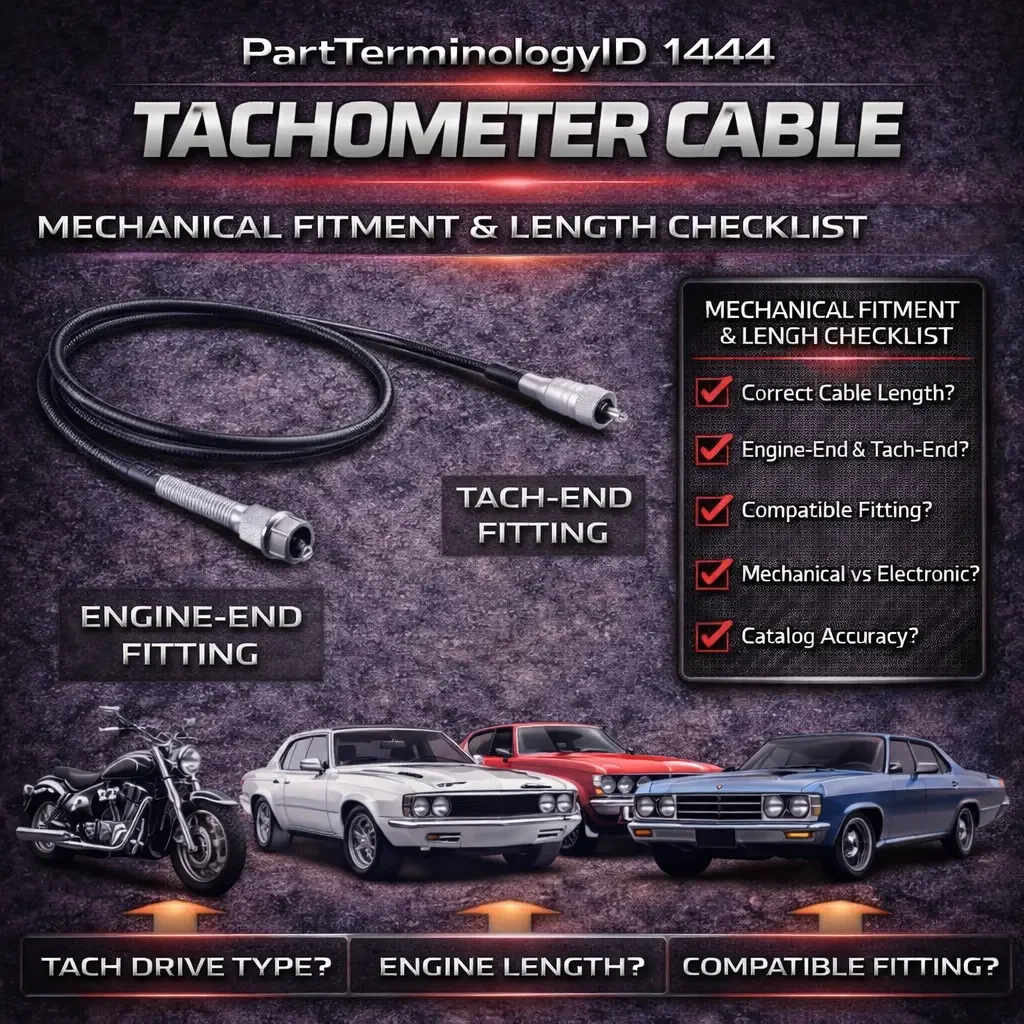
Complete cable assembly. Inner cable inside the outer housing with fittings on both ends. The engine-end fitting connects to the tachometer drive port (distributor, cam drive, or dedicated port). The cluster-end fitting connects to the back of the tachometer head. This is the standard replacement product.
Inner cable only. The rotating inner cable without the outer housing. For applications where the housing is intact and only the inner cable needs replacement.
Tachometer drive adapter. A short adapter that converts between different engine-end drive configurations. Used when an engine swap or distributor change introduces a different tachometer drive fitting than the original.
What this part does NOT cover
Speedometer cable (PartTerminologyID 1440). Measures vehicle speed from the transmission. Different source, different routing, different length.
Tachometer / tachometer head. The gauge instrument that displays RPM. Different PartTerminologyID.
Electronic tachometer signal wire. On vehicles with electronic tachometers, the RPM signal is carried by a wire from the ignition system or crankshaft position sensor, not by a mechanical cable. Completely different technology.
Tachometer drive gear. The gear on the engine that drives the cable. Different PartTerminologyID.
How Tachometer Cable Differs From Speedometer Cable
While the construction is similar, there are important differences that affect catalog accuracy:
Different source point
The speedometer cable connects to the transmission. The tachometer cable connects to the engine (distributor, camshaft, or dedicated drive port). This means the tachometer cable routing is entirely in the engine bay and through the firewall, while the speedometer cable routes from under the vehicle through the firewall.
Typically shorter
Because the tachometer drive is on the engine (which is close to the firewall), the tachometer cable is generally shorter than the speedometer cable. The cable runs from the back of the engine, through the firewall, and to the back of the instrument cluster. There is less variation in length across different vehicle configurations because the engine-to-firewall distance does not change with cab configuration or wheelbase the way the transmission-to-instrument-cluster distance does for speedometer cables.
Engine option determines the drive location
Different engines in the same vehicle may have the tachometer drive in different locations. A straight-six engine has the distributor in a different position than a V8 in the same chassis. This affects cable length and routing. The cable fitting type at the engine end may also differ if the tachometer drive port varies between engine options.
Drive ratio
Speedometer cables spin at a rate proportional to vehicle speed (driven by the transmission output shaft through a gear set). Tachometer cables spin at a rate proportional to engine RPM (driven by the engine directly). The drive ratio is usually 1:1 from the engine drive to the cable, but some applications use a reduction gear. The cable itself does not contain a gear ratio, but the tachometer head is calibrated to a specific cable drive ratio. If the cable drives at a different ratio than the tachometer expects (which can happen with an engine swap or aftermarket tachometer), the RPM reading will be incorrect.
Not all vehicles have one
Many base-trim classic cars did not include a tachometer. The speedometer was standard, but the tachometer was an option or included only on sport and performance trims. A buyer searching for a tachometer cable for a base-trim 1970 Chevy Nova may find that the vehicle was not originally equipped with one. If they have added an aftermarket tachometer, they may need a universal cable rather than a vehicle-specific one.
Why This Category Creates Fitment Problems
Cable length
Same issue as speedometer cables. The cable must be the correct length for the specific vehicle. Too short and it will not reach. Too long and it creates binding loops. However, the length variation is less extreme than speedometer cables because the engine-to-cluster distance is more consistent across configurations.
Engine-end fitting type
The fitting that connects to the engine tachometer drive port varies by engine and manufacturer. Some use a threaded collar similar to speedometer cable fittings. Some use a push-in fitting that locks with a retaining clip. Some use a right-angle adapter because the drive port orientation requires the cable to exit at 90 degrees. The fitting must match the engine's drive port.
Cluster-end fitting type
Same issue as speedometer cables. The cluster-end fitting must match the tachometer head input.
Engine option
As noted above, different engines have the tachometer drive in different positions and may use different fitting types. A cable for a 350 V8 may not fit a 305 V8 in the same vehicle if the distributor or tachometer drive port is in a different location.
Mechanical versus electronic tachometer confusion
Same fundamental issue as speedometer cables. A buyer searches for a "tachometer cable" for a vehicle that uses an electronic tachometer. No cable exists for that application. The RPM signal is electronic.
Top Return Causes
1) Wrong cable length
Prevention: Full ACES fitment with engine option as a qualifier. Specify cable length in inches or centimeters.
2) Wrong engine-end fitting
Cable does not connect to the buyer's tachometer drive port because the fitting type or angle is wrong.
Prevention: Specify fitting type and angle (straight or right-angle) for the engine end. Include a photo. Cross-reference to OEM part number.
3) Vehicle uses electronic tachometer
No mechanical cable exists for the application.
Prevention: "For vehicles with mechanical (cable-driven) tachometer only. Not for vehicles with electronic tachometer." Exclude electronic tachometer vehicles from fitment data.
4) Vehicle was not originally equipped with a tachometer
Buyer added an aftermarket tachometer and searches for a vehicle-specific cable. No factory cable exists.
Prevention: Note in the fitment data if the tachometer was optional or not available on certain trims. Direct the buyer to universal tachometer cables if the vehicle was not factory-equipped.
5) Speedometer cable ordered instead of tachometer cable (or vice versa)
Buyer confuses the two cables. They are different lengths, different routings, and connect to different source points.
Prevention: Clear naming: "Tachometer Cable (Engine RPM, Connects to Distributor/Engine Drive)" versus "Speedometer Cable (Vehicle Speed, Connects to Transmission)."
Compatibility Checklist for Buyers
1) Confirm your vehicle has a mechanical tachometer. If your tachometer is electronic (RPM signal from ignition system), you do not need a cable.
2) Confirm your vehicle was factory-equipped with a tachometer. If you added an aftermarket tachometer, you may need a universal cable rather than a vehicle-specific one.
3) Confirm this is a tachometer cable, not a speedometer cable. Tachometer = engine RPM, connects to engine. Speedometer = vehicle speed, connects to transmission.
4) Confirm engine option. The tachometer drive location and fitting type vary by engine.
5) Check both end fittings on the old cable. Note the fitting type, size, and angle at both ends. Compare to the listing.
6) Measure the old cable if possible. Lay it out straight and measure overall length.
Catalog Checklist for Attributes
Core taxonomy: Product form (complete cable assembly, inner cable only, drive adapter). Separate from Speedometer Cable, Tachometer Head, Electronic Tachometer Signal, and Tachometer Drive Gear.
Fitment: Year, make, model, submodel. Engine option (CRITICAL). Mechanical tachometer vehicles only. Tachometer equipped from factory (yes/optional/no). OEM part number cross-reference.
Physical specs: Overall cable length (inches or centimeters). Engine-end fitting type, thread size, and angle (straight or right-angle). Cluster-end fitting type and size. Inner cable drive shape. Outer housing diameter.
Package contents: Cable assembly, firewall grommet (if included), retaining clips, routing clamps.
Images: Full cable showing overall length, close-up of engine-end fitting (noting angle), close-up of cluster-end fitting, inner cable end shape.
FAQ
What is the difference between a speedometer cable and a tachometer cable?
The speedometer cable connects the transmission to the speedometer and measures vehicle speed. The tachometer cable connects the engine to the tachometer and measures engine RPM. They are different lengths, route to different source points, and have different end fittings. They are not interchangeable.
My tachometer needle bounces at idle. Is it the cable?
Likely. A dry, fraying, or kinked inner cable binds and releases as it rotates, causing the needle to bounce. Replacing the cable and lubricating the new one before installation usually resolves this. If the bounce continues with a new cable, the tachometer drive gear or the tachometer head may be worn.
Can I add a tachometer to a car that did not come with one?
Yes. Aftermarket mechanical tachometers and universal tachometer cables are available for vehicles with a mechanical tachometer drive port on the engine. If your engine does not have a tachometer drive port, an electronic aftermarket tachometer that reads the ignition signal is the easier option.
Final Take for Aftermarket Teams
Tachometer Cable (PartTerminologyID 1444) is the sibling of Speedometer Cable (1440), serving the same legacy vehicle populations with the same physical construction and the same catalog challenges: exact length, correct end fittings, mechanical-versus-electronic confusion, and engine option as the primary fitment variable instead of transmission type. The additional nuance is that not all vehicles were factory-equipped with a tachometer, which means the cable may not exist as a factory part for base trims. Catalog teams that already handle Speedometer Cable well can apply the same discipline here: specify length, photograph both fittings, exclude electronic tachometer vehicles, and note engine option as a mandatory qualifier.