
Written by Arthur Simitian | PartsAdvisory
The speedometer cable is a flexible rotating cable that mechanically transmits the rotational speed of the transmission output shaft to the speedometer head in the instrument cluster. As the vehicle moves, a gear in the transmission turns the cable, the cable spins inside a protective outer housing, and the spinning cable drives the speedometer needle. No electronics. No sensors. No body control module. Just a spinning wire inside a tube.
This is a technology that has been virtually eliminated from modern passenger vehicles. By the mid-1990s, most manufacturers had switched to electronic speedometers driven by a vehicle speed sensor (VSS) mounted on the transmission. The sensor sends an electrical signal to the instrument cluster, and the speedometer displays the speed digitally or via an electronically driven needle. No cable required.
But the speedometer cable has not disappeared from the aftermarket. It remains a real and active category for three distinct vehicle populations:
Classic cars. Every vehicle built before the electronic speedometer transition (roughly pre-1990, varying by manufacturer) uses a mechanical speedometer cable. The classic car restoration and maintenance market keeps this category alive. A 1969 Camaro, a 1972 Chevelle, a 1965 Mustang, and a 1987 Buick Grand National all use speedometer cables. The enthusiast owner base for these vehicles is large, active, and willing to pay for the correct part.
Motorcycles, ATVs, and powersport vehicles. Many motorcycles and powersport vehicles continued using mechanical speedometer cables well into the 2000s and some current-production models still use them. The powersport aftermarket is a significant volume driver for this PartTerminologyID.
Commercial and specialty vehicles. Some commercial trucks, agricultural equipment, marine applications, and specialty vehicles use mechanical speedometer cables or similar rotating cable drives for tachometers and hour meters.
This post is built for aftermarket catalog teams, marketplace sellers, and buyers who want fewer mistakes and fewer returns.
Status in New Databases
Status in New Databases
Current: PIES 7.2 + PCdb Future: PIES 8.0 + PCdb 2.0 Status: No change
What Speedometer Cable Means in the Aftermarket
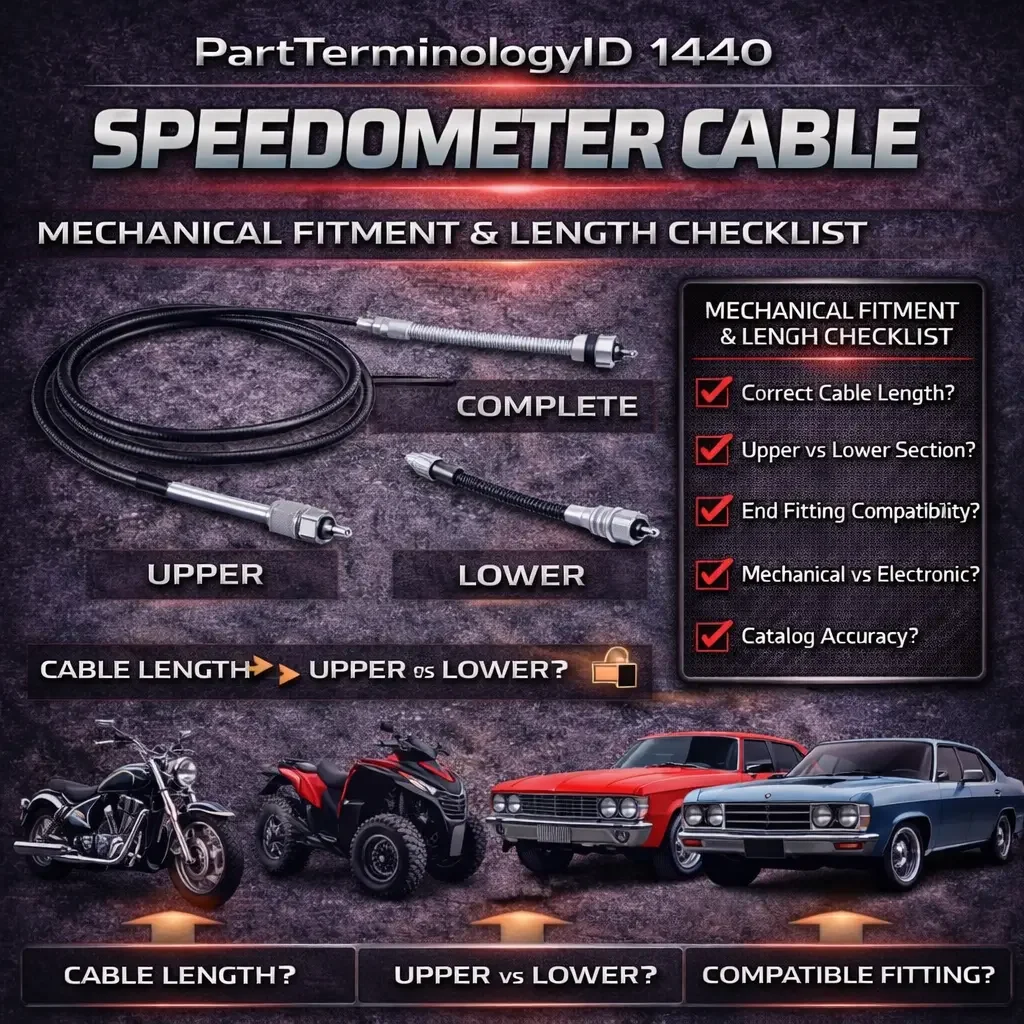
Speedometer Cable (PartTerminologyID 1440) refers to the flexible mechanical cable assembly that connects the transmission speed takeoff to the speedometer in the instrument cluster.
In catalog reality, this covers:
Complete cable assembly. The inner cable (a flexible steel wire, typically square-cut on the ends to engage the drive fittings) inside the outer housing (a spiral-wound metal or plastic sheath with threaded fittings on each end). This is the standard replacement product. The complete assembly runs from the transmission to the instrument cluster, routed through the firewall.
Inner cable only. On some vehicles and cable designs, the inner cable can be replaced independently of the outer housing. The housing stays in place (routed through the vehicle) and the new inner cable is fed through it. This is less common in the automotive aftermarket but exists for some commercial and marine applications.
Upper and lower cable sections. On some vehicles, particularly trucks with longer cable runs, the speedometer cable is split into two sections connected by a coupling or junction. The upper cable runs from the firewall to the instrument cluster. The lower cable runs from the transmission to the firewall. Either section can fail independently. The listing must specify: Upper, Lower, or Complete (one-piece).
Speedometer cable adapter. A short adapter piece that converts between different cable end fittings or transmission speed takeoff configurations. Used when a transmission swap introduces a different speed takeoff than the original.
What this part does NOT cover
Vehicle speed sensor (VSS). The electronic sensor that replaced the mechanical cable on modern vehicles. Different PartTerminologyID. If the buyer's vehicle has an electronic speedometer, they need a VSS, not a cable.
Speedometer head / instrument cluster. The gauge unit that displays the speed. Different PartTerminologyID.
Speedometer drive gear. The small plastic or metal gear inside the transmission that drives the cable. Different PartTerminologyID, though failure of this gear is a common companion problem.
Tachometer cable. A similar rotating cable that drives a tachometer. Different instrument, potentially different PartTerminologyID, though the physical construction is similar.
Why This Category Creates Fitment Problems
Cable length
This is the single most critical fitment specification. The speedometer cable must be exactly the right length for the specific vehicle. Too short and it will not reach from the transmission to the instrument cluster, or it will pull at an angle that creates binding and premature wear. Too long and the cable will have excess slack that creates loops, which bind and break.
Cable length varies by:
Vehicle model and wheelbase. A longer wheelbase means a longer distance from the transmission to the instrument cluster.
Transmission type and position. Different transmissions mount in different positions and have speed takeoff ports at different locations. A manual transmission may have the takeoff in a different position than an automatic in the same vehicle.
Engine option. Different engines sit at different positions in the engine bay, which affects the transmission position and therefore the cable routing distance.
Cab configuration (trucks). A regular cab truck has a shorter cable than an extended cab or crew cab because the firewall-to-instrument-cluster distance is shorter.
End fittings
The cable has a fitting on each end:
Transmission end. Typically a threaded fitting (often a screw-on collar) that attaches to the speed takeoff port on the transmission. The thread size, thread pitch, and fitting style must match. Common types include a threaded collar that screws onto the transmission housing and a snap-lock clip fitting.
Instrument cluster end. A fitting that plugs into the back of the speedometer head. Typically a knurled nut or a push-in fitting with a retaining clip. The fitting size and style must match the speedometer head.
If either end fitting is wrong, the cable cannot be installed. A cable with the correct length but the wrong fittings is useless.
Inner cable drive shape
The ends of the inner cable are shaped to engage the drive fittings. The most common shape is a square-cut end, but the square size varies. Some cables use a slotted or keyed end. The inner cable end shape must match both the transmission drive gear and the speedometer head input.
Routing and firewall grommet
The cable must route from the transmission through the engine bay, through the firewall, and to the back of the instrument cluster. The path follows the original routing, often along the inner fender, through a grommet in the firewall, and behind the dashboard. If the cable does not include the correct firewall grommet or the housing diameter does not match the firewall hole, the buyer has a sealing and routing problem.
Mechanical versus electronic speedometer confusion
The most fundamental ordering error. A buyer searches "speedometer cable" for a vehicle that uses an electronic speedometer. The cable does not exist for their vehicle. They need a vehicle speed sensor instead.
This is less common on vehicles that obviously predate electronic speedometers (1960s muscle cars, for example) but is a real issue on vehicles from the transition era (late 1980s to mid-1990s) where some trims or transmission options used a cable and others used a sensor.
Common Symptoms of a Failing Speedometer Cable
Speedometer needle bounces or fluctuates. The inner cable is fraying or the lubrication has dried out, causing the cable to bind and release as it rotates. This creates a jerky, bouncing needle.
Speedometer reads zero while driving. The inner cable has broken (snapped), the cable has disconnected from the transmission or the speedometer head, or the transmission drive gear has stripped.
Squealing or whining noise from behind the dashboard. The cable is dry (no lubrication) and the inner cable is rubbing against the outer housing at high speed. This noise increases with vehicle speed.
Odometer stops working but speedometer still functions (or vice versa). On mechanical speedometers, the same cable drives both the speed needle and the odometer. If one works and the other does not, the problem may be in the speedometer head rather than the cable.
Top Return Causes
1) Wrong cable length
Cable is too short or too long for the vehicle. Does not reach, or creates binding loops.
Prevention: Full ACES fitment with wheelbase, transmission type, and cab configuration as qualifiers. Specify cable length in inches or centimeters in the listing.
2) Wrong end fittings
Cable length is correct but the transmission-end or cluster-end fitting does not match.
Prevention: Specify fitting type and size for both ends. Include photos of both fittings. Cross-reference to OEM part number.
3) Vehicle uses electronic speedometer, not a cable
Cable ordered for a vehicle that has a vehicle speed sensor instead.
Prevention: Fitment data must exclude electronic speedometer vehicles. Note in the listing: "For vehicles with mechanical (cable-driven) speedometer only. Not for vehicles with electronic speedometer and vehicle speed sensor (VSS)."
4) Upper cable ordered when lower was needed (or vice versa)
On vehicles with two-piece cable assemblies, the buyer orders the wrong section.
Prevention: Specify: "Upper Cable (Firewall to Instrument Cluster)" or "Lower Cable (Transmission to Firewall)" or "Complete One-Piece Cable (Transmission to Instrument Cluster)."
5) Wrong transmission type
Cable for automatic transmission ordered for a manual transmission vehicle (or vice versa), where the speed takeoff location differs.
Prevention: Transmission type as a fitment qualifier where the transmission affects cable length or fitting type.
Compatibility Checklist for Buyers
1) Confirm your vehicle uses a mechanical speedometer cable. If your instrument cluster is fully electronic or if there is no cable visible running from the transmission to the firewall, your vehicle uses an electronic speed sensor, not a cable.
2) Confirm cable type. One-piece (complete) or two-piece (upper and lower). Identify which section has failed if two-piece.
3) Confirm transmission type. Automatic or manual. Some vehicles use different cables for different transmissions.
4) Confirm cab configuration (trucks). Regular, extended, or crew cab. Cable length varies.
5) Check both end fittings on the old cable. Note the fitting type (threaded collar, snap-lock, push-in) and size at both ends. Compare to the listing photos.
6) Measure the old cable if possible. Lay the old cable out straight and measure the overall length. Compare to the listing specification.
Catalog Checklist for Attributes
Core taxonomy: Product form (complete cable assembly, inner cable only, upper cable, lower cable, adapter). Separate from Vehicle Speed Sensor, Speedometer Head, Speedometer Drive Gear, and Tachometer Cable.
Fitment: Year, make, model, submodel. Transmission type: automatic/manual. Cab configuration (trucks). Wheelbase (where relevant). Mechanical speedometer vehicles only. OEM part number cross-reference.
Physical specs: Overall cable length (inches or centimeters). Transmission-end fitting type and thread size. Cluster-end fitting type and size. Inner cable drive shape (square, keyed). Outer housing diameter. Firewall grommet included (yes/no).
Package contents: Cable assembly, firewall grommet (if included), retaining clips, routing clamps.
Images: Full cable laid out showing overall length, close-up of transmission-end fitting, close-up of cluster-end fitting, inner cable end shape, and firewall grommet.
FAQ
Why does my speedometer needle bounce?
The inner cable is binding inside the outer housing due to dried lubrication, fraying, or kinking. The cable alternately catches and releases as it spins, causing the needle to bounce. Replacing the cable and lubricating the new one with speedometer cable grease before installation resolves this.
Can I lubricate my existing cable instead of replacing it?
If the inner cable is not frayed or kinked, yes. Disconnect the cable from the speedometer head, pull the inner cable out of the housing, clean it, apply speedometer cable lubricant along its length, and reinstall. This can restore smooth operation on cables that are simply dry.
My vehicle is from the early 1990s. Does it use a cable or electronic speedometer?
It depends on the specific vehicle, trim, and transmission. Many vehicles transitioned from cable to electronic during this era. Some used a cable with manual transmissions and electronic with automatics. Check whether you see a cable running from the transmission to the firewall, or consult the vehicle's service manual.
Does the cable affect my odometer reading?
Yes. On mechanical speedometers, the speedometer cable drives both the speed display and the odometer. A broken cable means the odometer also stops recording mileage. Replacing the cable restores both functions.
Final Take for Aftermarket Teams
Speedometer Cable (PartTerminologyID 1440) is a legacy technology category serving classic cars, motorcycles, and specialty vehicles. The catalog challenges are cable length (exact, not approximate), end fitting compatibility, the upper-versus-lower split on two-piece cables, and excluding vehicles with electronic speedometers from the fitment data. The buyer population is predominantly enthusiasts and restorers who are maintaining vehicles they care about. They expect the correct length, the correct fittings, and a cable that spins smoothly from the day it is installed. The teams that catalog this correctly specify length to the inch, photograph both end fittings, separate mechanical speedometer vehicles from electronic speedometer vehicles in the fitment data, and note the transmission type and cab configuration where these affect cable length.