
Written by Arthur Simitian | PartsAdvisory
The door armrest is the padded or molded section of the interior door panel that the driver or passenger rests their arm on while driving. It is one of the most touched interior surfaces in the vehicle. Every time someone sits in the car, their elbow, forearm, or hand lands on the door armrest. Over years and hundreds of thousands of arm placements, the armrest wears, sags, cracks, fades, and eventually fails.
The failure modes are cosmetic but persistent. The vinyl or leather covering peels. The foam padding compresses permanently and the armrest sags. The plastic base cracks from downward pressure when passengers use it as a handhold to pull the door closed or to support their weight entering and exiting the vehicle. The stitching separates. The color fades from UV exposure through the window.
What makes Door Armrest a catalog challenge is not the part itself, which is mechanically simple, but the number of variants generated by trim level, color, material, and body configuration. A single vehicle model in a single model year can have 6 to 12 or more distinct door armrests across its trim levels, interior color options, and door positions. And because the armrest is an interior appearance part, a wrong color, a wrong texture, or a wrong material is immediately obvious and immediately returned.
This post is built for aftermarket catalog teams, marketplace sellers, and buyers who want fewer mistakes and fewer returns.
Status in New Databases
Status in New Databases
Current: PIES 7.2 + PCdb Future: PIES 8.0 + PCdb 2.0 Status: No change
What Door Armrest Means in the Aftermarket
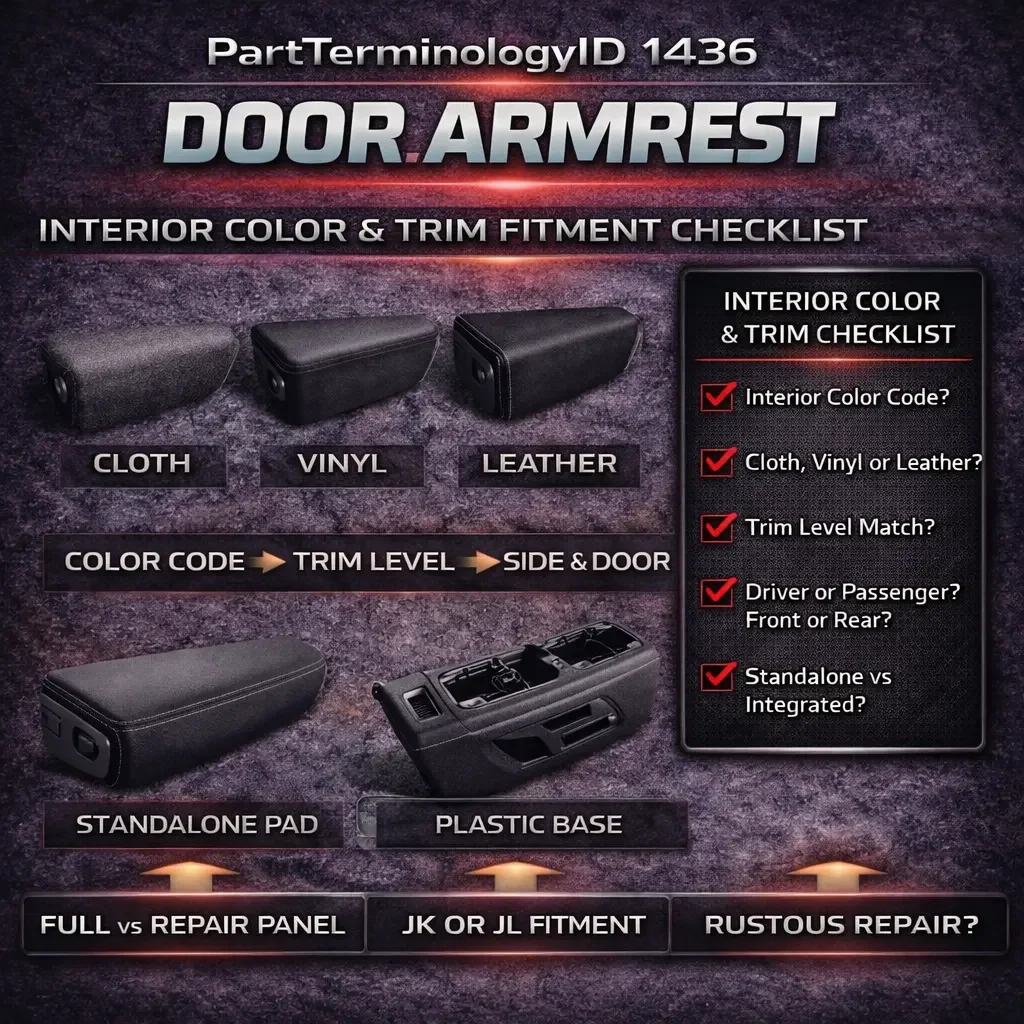
Door Armrest (PartTerminologyID 1436) refers to the armrest component on the interior door panel. Depending on the vehicle design, this may be a separately replaceable component or an integrated part of the door trim panel.
In catalog reality, this covers:
Standalone armrest pad. A separate padded armrest that attaches to the door trim panel via screws, clips, or a snap-fit interface. The armrest can be removed and replaced without removing the entire door panel. This is the ideal product form for the aftermarket because it allows targeted replacement of just the worn component.
Armrest integrated into door trim panel. On many modern vehicles, the armrest is molded as part of the complete interior door trim panel. The armrest foam and covering are bonded to the panel during manufacturing. The armrest cannot be replaced separately. If the armrest is worn, the entire door trim panel must be replaced. For these vehicles, PartTerminologyID 1436 as a standalone replacement does not apply. The buyer needs the complete door trim panel under a different PartTerminologyID.
Armrest base (plastic substrate). The rigid plastic base that provides the structural support for the armrest. On vehicles with separately replaceable armrests, the base may be available independently for situations where the base is cracked but the pad and covering could be reused (uncommon) or where the buyer is recovering or wrapping the armrest in custom material.
Armrest pad/cover only. The soft padded covering that wraps over the plastic base. Some vehicles and aftermarket sources offer just the pad without the base. The pad is the part that wears, fades, and cracks, so this product form allows the lowest-cost repair.
Pull handle integrated armrest. On many vehicles, the door armrest doubles as the door pull handle. The grab area where the occupant pulls the door closed is built into the armrest. This combined design means the armrest must handle both resting force (downward, from the arm) and pulling force (inward, closing the door). The pull handle area is often where the armrest base cracks first.
What this part does NOT cover
Door trim panel / door card (the complete interior panel covering the door). Different PartTerminologyID. The armrest may be part of it or attached to it.
Center console armrest (the armrest between the front seats). Different location, different PartTerminologyID.
Seat armrest (armrests attached to the seat itself). Different PartTerminologyID.
Door pull handle (when it is a separate component from the armrest). On some vehicles the pull handle is a distinct part mounted above or below the armrest.
Why Interior Color Is the Defining Fitment Variable
Exterior body panels arrive primed and get painted to match. Interior parts must arrive in the correct color, material, and texture because they are not painted after installation. They are installed as-is. If the color is wrong, the part is returned. There is no adjustment, no blending, no "close enough."
Interior color codes
Vehicle manufacturers assign interior color codes that define the specific color and material combination for each interior surface. A vehicle with a "Black" interior and a vehicle with a "Jet Black" interior may have visibly different door armrest colors, even though both are called black. A "Saddle Brown" and a "Canyon Brown" from the same manufacturer in the same model year are different colors. The interior trim code from the vehicle's build sheet or door jamb sticker is the definitive identifier.
Material and texture
Within the same interior color, the armrest material varies by trim level:
Cloth/fabric. Base trims. The armrest is covered in fabric that matches or complements the seat cloth. Lower cost, less durable.
Vinyl. Mid trims. The armrest is covered in vinyl (synthetic leather). More durable than cloth, easier to clean, but cracks over time from UV exposure and temperature cycling.
Leather. Upper trims. The armrest is covered in genuine leather. The most premium feel and appearance but can crack, fade, and dry out without conditioning.
Leatherette / synthetic leather. Some manufacturers use a high-quality synthetic leather across multiple trims. It may look similar to genuine leather but has different wear characteristics and a different texture.
Two-tone or contrast stitching. Some trims feature armrests with contrast stitching (for example, black armrest with red or white stitching) or two-tone material (upper portion in one color, lower portion in another). These are distinct part numbers.
A black vinyl armrest from the LX trim is a different part from a black leather armrest from the Limited trim, even though they are the same color and the same shape. The material and texture do not match.
Why This Category Creates Fitment Problems
Front door versus rear door
On most vehicles, the front door armrest is different from the rear door armrest. The front armrest is typically larger (the front door is wider) and may include the window switch panel cutout, memory seat button provisions, or mirror control switch provisions. The rear armrest is smaller and simpler. They are not interchangeable.
Left versus right
Left (driver) and right (passenger) door armrests are often mirror images. On the driver's door, the armrest may include a cutout for the power window master switch panel. On the passenger door, the cutout may be smaller (single window switch) or absent. They are not interchangeable.
Trim level drives everything
As discussed above, the material, color, stitching, and texture are trim-specific. But trim level also affects the armrest shape and features:
Premium trims may have a wider, thicker armrest with more foam padding
Sport trims may have a different bolster shape or grip texture
Base trims may have a thinner, harder armrest with less padding
Trims with ambient lighting may have a light channel integrated into the armrest
Model year changes within a generation
Manufacturers occasionally update interior materials and colors mid-cycle. A 2020 model year may have a slightly different armrest color shade, material, or stitching than a 2022 of the same trim because of a mid-cycle interior refresh. These changes are not always documented in standard fitment data. The OEM interior trim code is the most reliable identifier.
Standalone versus integrated
The fundamental question: can the armrest be replaced independently, or is it part of the door trim panel? If integrated, the buyer who orders a standalone armrest receives a part that does not exist as a separate assembly for their vehicle. If standalone, the buyer who orders a complete door trim panel to fix just the armrest has overspent significantly.
Top Return Causes
1) Wrong interior color
The most common return. The armrest arrives in the wrong shade, wrong color code, or wrong material. "Black" is not a universal color. There are 5 to 10 shades of black across manufacturers and model years.
Prevention: Interior trim color code as a mandatory fitment attribute. Do not use generic color names alone. Specify the OEM interior color code: "Interior Color: Black (Code FB)" or "Interior Color: Jet Black (Code H1T)."
2) Wrong material (cloth versus vinyl versus leather)
Armrest is the correct color but the wrong material. Vinyl armrest ordered for a leather interior, or vice versa.
Prevention: Material in the title: "Leather Door Armrest" or "Vinyl Door Armrest." Tie material to trim level in the fitment data.
3) Wrong door position (front versus rear)
Front armrest ordered for a rear door, or vice versa.
Prevention: Position in the title: "Front Door Armrest" or "Rear Door Armrest."
4) Wrong side (left versus right)
Driver side armrest with master window switch cutout ordered for the passenger door.
Prevention: Side in the title: "Left (Driver Side)" or "Right (Passenger Side)."
5) Standalone armrest ordered for vehicle with integrated door panel
The armrest is not a separate part on the buyer's vehicle. It is molded into the door trim panel.
Prevention: Fitment data must indicate standalone versus integrated. "For vehicles with separately replaceable door armrest. Vehicles with armrest integrated into door trim panel require complete door trim panel replacement."
6) Wrong trim level
Armrest matches the vehicle year, make, and model but is from a different trim with a different material, stitching, or shape.
Prevention: Trim level as a mandatory fitment qualifier. "For Limited/Platinum trims with leather interior" versus "For XLT/Lariat trims with vinyl interior."
Compatibility Checklist for Buyers
1) Determine if your armrest is separately replaceable. Look for visible screws, clips, or a seam line where the armrest meets the door panel. If the armrest appears to be one continuous piece with the door panel, it is likely integrated and not separately replaceable.
2) Identify your interior trim code. Check the door jamb sticker, build sheet, or VIN lookup for the interior color code. Do not rely on generic color names.
3) Confirm material. Cloth, vinyl, leather, or synthetic leather. Match to your vehicle's trim level.
4) Confirm door position. Front or rear.
5) Confirm side. Left (Driver) or Right (Passenger).
6) Confirm trim level. Base, mid, premium, sport, etc. The armrest material and features vary.
7) Note any special features. Contrast stitching, two-tone color, ambient lighting channel, integrated pull handle design.
Catalog Checklist for Attributes
Core taxonomy: Product form (standalone armrest assembly, armrest pad/cover only, armrest base only, armrest integrated into door trim panel). Separate from Door Trim Panel, Center Console Armrest, Seat Armrest, and Door Pull Handle.
Fitment: Year, make, model, submodel, trim level. Door position: Front/Rear. Side: Left/Right. Interior color code (OEM specific). Material: cloth, vinyl, leather, synthetic leather. OEM part number cross-reference.
Appearance attributes: Color name and code, material, texture (smooth, grain, perforated), stitching (single, double, contrast color), two-tone (yes/no, describe).
Physical specs: Attachment method (screw, clip, snap-fit), number of mounting points.
Package contents: Armrest assembly, mounting clips or screws (if included), pull handle (if integrated).
Images: Front face showing color, material, and texture. Back showing mounting clips and attachment interface. Close-up of stitching and material grain. Installed reference photo showing the armrest in context on the door panel. Color reference photo taken in neutral lighting.
FAQ
Why does my door armrest sag?
The foam padding inside the armrest compresses permanently over time from repeated arm weight. Once the foam is compressed, it does not recover. Replacement is the only fix for a sagging armrest.
Can I just recover my armrest instead of replacing it?
If the plastic base is intact, yes. An upholstery shop can remove the old covering, replace the foam, and wrap the armrest in new vinyl or leather. This is common in the classic car restoration market and can be cost-effective when the correct replacement is hard to find or discontinued.
My armrest is part of the door panel. Can I just replace the armrest?
If the armrest is molded into the door trim panel, it cannot be replaced separately through standard channels. Some specialty shops can separate and re-cover the armrest section of the panel, but the standard repair is to replace the entire door trim panel.
Why are there so many variations of door armrests?
Because interior color, material, texture, stitching, and trim level each create a different part number. A vehicle with 4 door positions, 2 sides, 3 trim levels, and 4 interior colors generates dozens of distinct armrest part numbers. This is typical for interior trim parts.
Final Take for Aftermarket Teams
Door Armrest (PartTerminologyID 1436) is an interior trim part where fitment accuracy requires matching five variables simultaneously: door position, side, interior color code, material, and trim level. Missing any one of these produces a visible mismatch that the buyer will return immediately. The standalone-versus-integrated distinction determines whether the part even exists as a separate replacement. The catalog teams that win in this category use OEM interior color codes rather than generic color names, specify material and trim level as mandatory fitment qualifiers, clearly distinguish front from rear and left from right, and indicate when the armrest is integrated into the door trim panel. It is a simple part with a complex variant matrix, and the variant matrix is where the returns live.