
Written by Arthur Simitian | PartsAdvisory
Most people think of the windshield as a piece of glass held in by a rubber seal and some adhesive. That is partially true on modern unibody vehicles where the windshield bonds directly to the body structure. But on a significant number of vehicles, particularly body-on-frame trucks, SUVs, Jeeps, classic cars, and commercial vehicles, the windshield sits in a dedicated Windshield Frame: a separate structural component that holds the glass, provides the mounting interface to the body, and in many cases contributes to the structural integrity of the vehicle's cabin.
The Windshield Frame is not visible from outside the vehicle when the windshield is installed. It hides behind the glass, under the weatherstripping, and beneath the cowl and A-pillar trim. But when it rusts, corrodes, cracks, or gets damaged in a collision, the consequences go far beyond cosmetics. A compromised windshield frame means the windshield cannot seal properly (causing water leaks), cannot stay bonded during a rollover (the windshield is a critical structural element in rollover protection), and cannot support the deployment of passenger-side airbags (which rely on the windshield staying in place to provide a backstop for the inflating airbag).
This is a part that most buyers never search for until they have a problem that cannot be fixed any other way. The typical path to discovering the windshield frame is: water leak around the windshield leads to windshield removal, which reveals severe rust or corrosion in the frame underneath, which makes a simple windshield replacement into a structural repair.
This post is built for aftermarket catalog teams, marketplace sellers, and buyers who want fewer mistakes and fewer returns.
Status in New Databases
Status in New Databases
Current: PIES 7.2 + PCdb Future: PIES 8.0 + PCdb 2.0 Status: No change
What Windshield Frame Means in the Aftermarket
Windshield Frame (PartTerminologyID 1431) refers to the structural frame or channel that surrounds the windshield opening and provides the mounting surface for the windshield glass. The glass is bonded (with urethane adhesive on modern vehicles) or sealed (with a rubber gasket on older vehicles) to this frame.
In catalog reality, this covers several distinct applications:
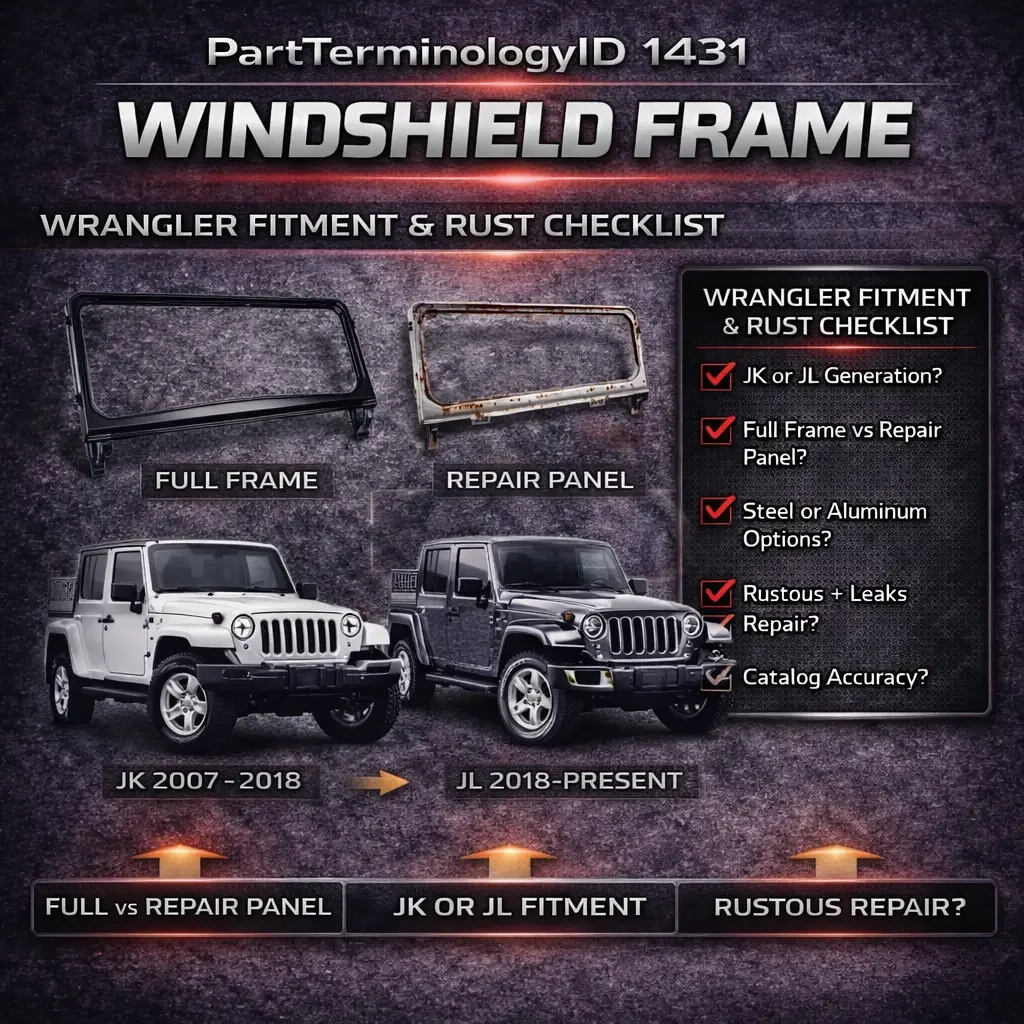
Folding windshield frame (Jeep Wrangler). The highest-volume application for this PartTerminologyID. The Jeep Wrangler (CJ, YJ, TJ, JK, JL) has a windshield frame that is designed to fold flat onto the hood for open-air driving. The frame is a bolt-on assembly that attaches to the cowl area and the A-pillars. It can be removed and replaced independently of the body. This is the most commonly searched and most commonly replaced windshield frame in the aftermarket. Rust and corrosion at the base of the frame where water collects is the primary failure mode.
Body-on-frame truck and SUV windshield channel. On older body-on-frame trucks and SUVs, the windshield opening may include a separate frame or channel piece that is spot-welded or bolted to the cab structure. When this channel corrodes, the windshield loses its mounting surface. Replacement requires cutting out the old channel, fitting the new one, and welding it in place, similar to a quarter panel repair.
Classic car windshield frame. On many classic cars (1930s through 1970s), the windshield sits in a chrome or painted metal frame that is separate from the body structure. The frame holds the glass via a rubber gasket or lock strip and bolts or clips to the body. These frames are visible from outside the vehicle as a trim piece surrounding the windshield. Reproduction windshield frames for classic cars are a significant restoration market.
Convertible windshield frame. On convertibles, the windshield frame is the structural header above the windshield that provides rigidity to the open-top body. Without a roof, the windshield frame is the primary structural element connecting the two A-pillars. On some convertibles, the frame includes the header for the convertible top mounting. This is a safety-critical structural component.
Van and commercial vehicle windshield frame. On some vans and commercial vehicles, the windshield sits in a separate frame or surround that bolts to the cab. These frames are typically larger and heavier than passenger car frames.
What this part does NOT cover
Windshield glass. The glass itself. Different PartTerminologyID.
Windshield molding / trim. The decorative trim or reveal molding around the outside of the windshield. Different PartTerminologyID.
A-pillar. The structural pillar on each side of the windshield. On unibody vehicles, the A-pillar is part of the body structure. Different PartTerminologyID.
Cowl panel. The panel at the base of the windshield between the windshield and the hood. Different PartTerminologyID.
Windshield washer components, wiper arms, or wiper motor. All different parts.
Why the Jeep Wrangler Dominates This Category
The Jeep Wrangler windshield frame represents the overwhelming majority of search volume and sales volume for PartTerminologyID 1431. There are several reasons:
The frame is a bolt-on, removable assembly. Unlike most vehicles where the windshield frame is integrated into the body structure and is not a separately replaceable part, the Wrangler frame is designed to be removed (for folding the windshield flat). This means it is a distinct, catalog-able, purchasable assembly.
Rust is endemic. The Wrangler windshield frame sits in an environment designed for water exposure. Wranglers are driven in rain, through water crossings, through car washes, and with the top down. Water collects at the base of the windshield frame where it meets the cowl. The drain channels clog with debris. Standing water causes rust that eats through the frame from the inside out. On Wranglers older than 10 years, windshield frame rust is almost universal in northern and coastal climates.
The frame is structural. On a Wrangler, the windshield frame provides a significant portion of the open-body rigidity. A rusted or weakened frame affects the vehicle's structural integrity, especially in a rollover. This makes replacement a safety concern, not just a cosmetic or leak concern.
Aftermarket support is strong. Because of the volume, multiple aftermarket manufacturers produce replacement Wrangler windshield frames in various quality tiers. OEM, CAPA-certified, and non-certified options are available. The classic Jeep market (CJ-5, CJ-7) also has reproduction frames.
For catalog teams, the Wrangler application should be the primary focus for PartTerminologyID 1431 in terms of inventory, fitment accuracy, and content depth. Other applications exist but at much lower volume.
Why This Category Creates Fitment Problems
Jeep Wrangler generation splits
The Wrangler windshield frame is different for each generation:
CJ (1944 to 1986): Multiple frame designs across the long CJ production run. CJ-5 and CJ-7 frames are different.
YJ (1987 to 1995): Square headlight era. Different frame from CJ.
TJ (1997 to 2006): Round headlight return. Different frame from YJ.
JK (2007 to 2018): Wider body. Two-door and four-door (Unlimited) use the same windshield frame because the windshield width is the same.
JL (2018 to present): Current generation. Different frame from JK. New mounting provisions and revised hinge design.
A frame from a TJ will not fit a JK. A frame from a JK will not fit a JL. The year ranges are the primary fitment qualifier, and they must be exact.
Hinge and fold mechanism
The windshield folds forward on hinges at the base of the frame. Different generations use different hinge designs, different hinge bolt patterns, and different fold-down mechanisms. The frame must match the hinge configuration on the vehicle.
Windshield glass size
The windshield glass dimensions changed with each Wrangler generation. The frame must accept the correct glass size. A frame that is dimensionally off will not accept the glass or will not seal properly.
Corrosion repair versus full replacement
Some aftermarket products address windshield frame corrosion with partial repair panels (patches for the bottom channel where rust is worst) rather than complete frame replacement. A partial repair panel is less expensive and less labor-intensive but requires welding skill and is only appropriate when the corrosion is limited to the base area. If the frame is corroded throughout, a full replacement is needed. The listing must distinguish between full frame assemblies and partial repair patches.
Classic car frame fitment
Classic car windshield frames are highly vehicle-specific. The frame contour, glass curvature, mounting bolt pattern, and seal type vary by make, model, and year. Reproduction frames must match the original precisely because the glass and rubber gasket are cut to the original frame dimensions. A frame that is even slightly off will not accept the glass or will leave gaps in the seal.
Material and finish
Steel (standard). Most windshield frames are stamped steel, either primed or e-coated for corrosion protection. The buyer must paint or coat the frame before installation.
Stainless steel (upgrade). Some aftermarket Wrangler frames are offered in stainless steel to eliminate future corrosion. These are more expensive but solve the rust problem permanently.
Aluminum. Some aftermarket frames are offered in aluminum for weight reduction. Less common.
Chrome (classic cars). Classic car windshield frames are often chrome-plated for appearance. Chrome reproduction frames must match the original profile and finish quality.
Top Return Causes
1) Wrong Wrangler generation
Frame from one generation ordered for a different generation. The most common error is JK versus JL confusion around the 2018 model year transition.
Prevention: Exact year range in the title: "Jeep Wrangler JK Windshield Frame (2007-2018)" versus "Jeep Wrangler JL Windshield Frame (2018+)." Note that 2018 includes both JK and JL production. Use production date or VIN-based identification for 2018 models.
2) Full frame ordered when partial repair panel was needed (or vice versa)
Buyer needs a bottom channel repair patch and orders a complete frame, or needs a complete frame and receives a repair patch.
Prevention: Specify product form: "Complete Windshield Frame Assembly" versus "Windshield Frame Lower Channel Repair Panel."
3) Classic car frame does not match glass curvature
Reproduction frame is slightly off in contour, and the original or replacement glass does not seat properly.
Prevention: OEM part number cross-reference. Specify which glass part number the frame is designed to accept. Note whether the frame is designed for the original glass or for a modern reproduction glass (which may have slightly different dimensions).
4) Frame arrives without necessary mounting hardware
Windshield frame does not include the hinge bolts, seal, or mounting hardware. The buyer cannot install without sourcing hardware separately.
Prevention: List all included components: frame, hinges (yes/no), hinge bolts, windshield seal/gasket, drain grommets, mounting hardware. State clearly what is and is not in the box.
5) Rust-prone steel frame ordered when stainless was available
Buyer replaces a rusted steel frame with another steel frame that will eventually rust again in the same environment.
Prevention: This is not a return cause but an upsell opportunity. If stainless steel frames are available for the application, note it in the listing: "Also available in stainless steel for permanent corrosion resistance."
Compatibility Checklist for Buyers
1) Confirm your vehicle generation. For Wranglers: CJ, YJ, TJ, JK, or JL. Year alone may not be sufficient (2018 includes both JK and JL).
2) Confirm product form. Complete frame assembly or partial repair panel. Assess the extent of corrosion to determine which you need.
3) Confirm material. Steel (standard, requires coating for corrosion protection), stainless steel (corrosion-proof, premium), or aluminum.
4) Confirm what is included. Frame, hinges, hinge bolts, seal, drain grommets, mounting hardware. Identify what you need to source separately.
5) Plan for windshield removal and reinstallation. Replacing the windshield frame requires removing the windshield glass. Budget for a new windshield seal or urethane adhesive. Budget for potential windshield replacement if the glass cracks during removal.
6) For classic cars, confirm glass compatibility. The frame must match the glass curvature and seal profile for your specific vehicle.
Catalog Checklist for Attributes
Core taxonomy: Product form (complete frame assembly, lower channel repair panel, frame with hinges, frame only). Separate from Windshield Glass, Windshield Molding, A-Pillar, and Cowl Panel.
Fitment: Year, make, model, submodel, generation (especially for Wrangler: CJ/YJ/TJ/JK/JL). Body style: two-door or four-door (where relevant). OEM part number cross-reference.
Material: Steel (with primer/e-coat), stainless steel, aluminum, chrome-plated (classic cars).
Components included: Frame, hinges (yes/no), hinge bolts, windshield seal/gasket, drain grommets, mounting hardware, hold-down knobs or latches.
Images: Complete frame from front and rear, hinge area close-up, bottom channel (the rust-prone area), mounting bolt pattern, and for Wranglers, the fold-down hinge mechanism.
FAQ
Why does my Wrangler windshield frame rust?
Water collects at the base of the frame where it meets the cowl. The factory drain channels clog with leaves, dirt, and debris, trapping standing water against the steel. The water causes rust from the inside out. Regular cleaning of the drain channels and application of corrosion-resistant coating to the frame interior can extend frame life.
Can I repair just the rusted section instead of replacing the whole frame?
If the corrosion is limited to the lower channel area, a partial repair panel can be welded in. If the corrosion extends into the uprights or across the header, a complete frame replacement is recommended because the structural integrity of the entire frame is compromised.
Is a windshield frame structural?
Yes. On Jeep Wranglers and convertibles, the windshield frame provides significant cabin rigidity and contributes to rollover protection. On all vehicles, the windshield frame (or the body structure that serves as the frame) provides the backstop for passenger-side airbag deployment. A compromised frame is a safety issue.
Will I need a new windshield when I replace the frame?
Possibly. Removing the windshield glass risks cracking it, especially on older glass or in cold weather. Budget for a new windshield as a contingency. You will definitely need a new windshield seal or urethane adhesive.
Final Take for Aftermarket Teams
Windshield Frame (PartTerminologyID 1431) is a niche category dominated by one application: the Jeep Wrangler. The Wrangler's removable, bolt-on windshield frame creates a real, high-volume replacement market driven by endemic rust and corrosion. Catalog teams that serve this category well specify the exact Wrangler generation (CJ/YJ/TJ/JK/JL), differentiate between complete frames and repair panels, specify material (steel versus stainless), list all included components, and note the 2018 model year JK/JL overlap. Outside of Wrangler, the category serves classic car restorers and a small number of body-on-frame truck and convertible applications where the windshield frame is a separate replaceable part. For the vast majority of modern unibody vehicles, the windshield frame is integrated into the body structure and is not a standalone replacement part. Knowing where this PartTerminologyID applies and where it does not is the first catalog decision.