
Written by Arthur Simitian | PartsAdvisory
This is the capstone of the tailgate series. We have covered Tailgate Release Cable (PartTerminologyID 1364), Tailgate Lock (PartTerminologyID 1425), and Tailgate Handle (PartTerminologyID 1426). Now we cover the tailgate itself, the entire panel assembly that those components attach to, and one of the most expensive, most returned, and most shipping-damaged parts in the aftermarket.
A modern pickup truck tailgate is not a simple hinged metal panel. It is a multi-thousand-dollar electromechanical assembly that can include a backup camera, power lock actuator, release solenoid, step system, assist mechanism, damper, wiring harness, handle assembly, lock cylinder, emblem, applique panel, and on the newest trucks, a multi-function split design with independent inner and outer gates. A fully loaded OEM tailgate on a current-model-year full-size truck can cost $1,500 to $4,000 from the dealer. Even aftermarket replacement tailgate shells (without any of those components) cost $300 to $800.
This price point creates the single biggest buyer expectation problem in the category. A buyer orders a "tailgate" expecting the complete loaded assembly with all components installed. A bare tailgate shell arrives on a pallet. No handle. No lock. No camera. No wiring. No step. No emblem. No inner panel. The buyer is looking at a bare metal shell that requires 2 to 4 hours of component transfer labor and potentially hundreds of dollars in additional parts before it is functional. The return rate on this misunderstanding alone is staggering.
Combine that expectation gap with the same shipping damage problem that plagues doors, fenders, and hoods, and you have one of the most challenging parts in the aftermarket body parts business. This post covers all of it.
This post is built for aftermarket catalog teams, marketplace sellers, and buyers who want fewer mistakes and fewer returns.
Status in New Databases
Status in New Databases
Current: PIES 7.2 + PCdb Future: PIES 8.0 + PCdb 2.0 Status: No change
What Tailgate Means in the Aftermarket
Tailgate (PartTerminologyID 1427) refers to the hinged rear panel on a pickup truck that folds down to provide access to the truck bed. It is hinged at the bottom and latches at the top via the tailgate latch on each side.
In catalog reality, this covers a wide range of product forms, and the distinction between them is the most important information in every listing:
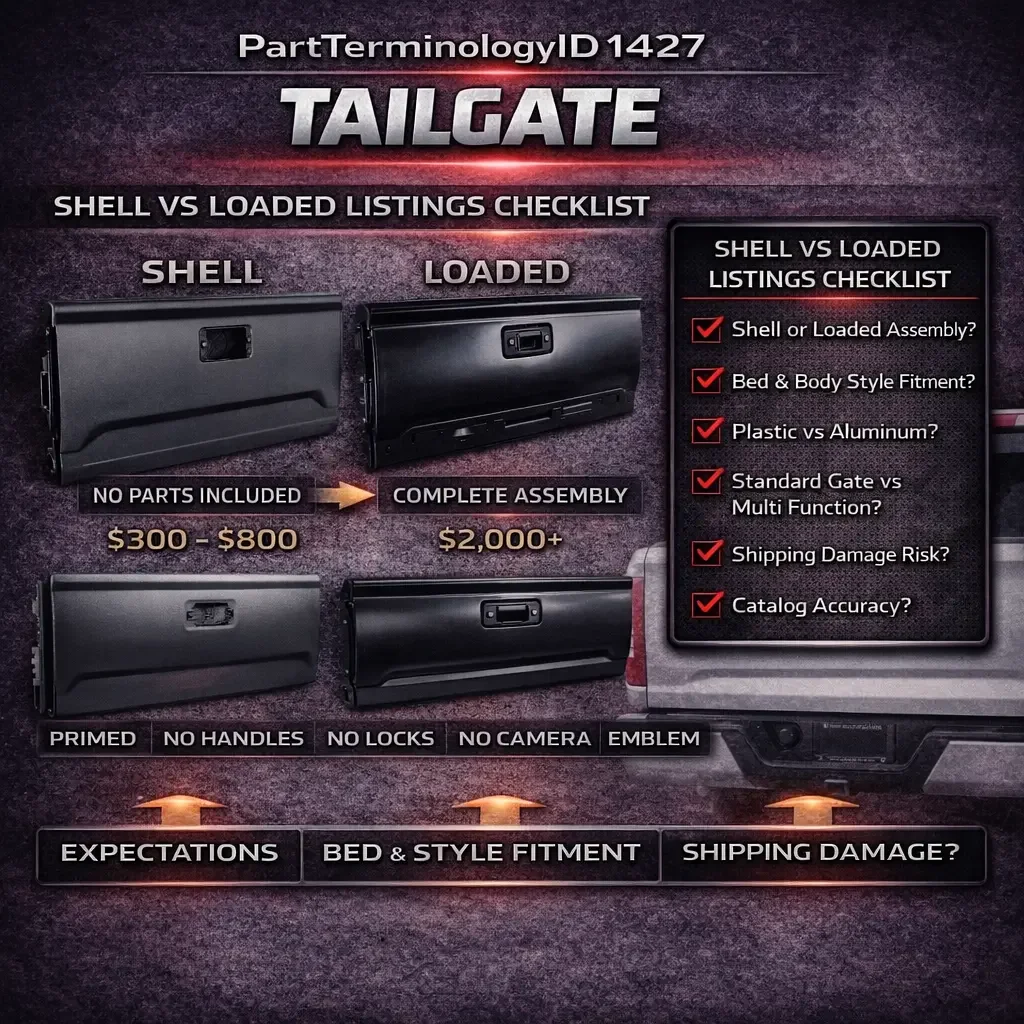
Tailgate shell (unloaded). The outer skin and inner reinforcement structure without any components installed. No handle, no lock, no latch, no camera, no wiring, no step, no emblem, no inner panel trim. This is the most common aftermarket product form. It is a bare structural panel that arrives primed. Every functional component must be transferred from the original tailgate or purchased separately. This is what most aftermarket "tailgate" listings actually sell, and it is the source of the majority of returns due to buyer expectation mismatch.
Tailgate assembly (loaded). The complete tailgate with all components pre-installed: handle, lock, latch, camera, wiring harness, step mechanism, damper, emblem, applique, and inner panel. This is the most expensive configuration and the one that bolts on with minimal transfer work. OEM dealer tailgates may be available loaded. Recycled/salvage tailgates typically arrive partially loaded with some components still attached.
Tailgate assembly (partially loaded). A tailgate with some components installed (typically the latch mechanisms and possibly the inner reinforcement) but not all. Common in recycled inventory where some components were harvested before the tailgate was resold. The buyer must confirm exactly which components are included before purchasing.
Tailgate inner panel / trim panel. The interior-facing panel visible when the tailgate is in the open (horizontal) position. On some trucks, this is a separate plastic or composite panel that snaps or bolts onto the inner structure of the tailgate. It provides a finished appearance, protects the internal components, and may include step system mounting provisions.
Multi-function tailgate assembly. On trucks with multi-function tailgate designs (Ram Multifunction, GMC MultiPro), the entire tailgate system is significantly different from a standard one-piece tailgate. The multi-function design includes separate inner and outer gate panels with independent hinge systems, multiple latch points, and unique handle and release mechanisms. A standard tailgate will not fit a multi-function application and vice versa. These must be cataloged as completely separate product lines.
What this part does NOT cover
Tailgate handle (PartTerminologyID 1426). Covered in the previous post.
Tailgate lock (PartTerminologyID 1425).
Tailgate release cable (PartTerminologyID 1364).
Tailgate support cables / check cables. The cables on each side that catch the tailgate when it folds down and hold it horizontal.
Tailgate hinge. The bottom-mounted hinge that attaches the tailgate to the truck bed.
Tailgate assist / damper. The shock absorber or gas strut that controls the speed at which the tailgate lowers.
Truck bed (the entire bed structure). The tailgate is one component of the bed system.
The Shell vs. Loaded Expectation Problem
This deserves its own section because it is the number one return driver in the category and the number one source of buyer frustration.
What buyers expect
When a buyer searches "tailgate for 2020 Ford F-150" and sees a listing for $400 to $600, they compare it mentally to the complete tailgate on their truck. They assume they are buying a replacement for the complete unit: open the box, bolt it on, done. They are accustomed to buying other complex assemblies this way. When they buy a headlight assembly, it comes with the housing, lens, reflector, and bulbs. When they buy a door mirror, it comes with the glass, motor, and housing. They expect a tailgate to come with the handle, lock, camera, and everything else.
What they actually receive
A bare shell. Two pieces of sheet metal (outer skin and inner reinforcement) welded together with latch striker provisions, hinge provisions, and mounting points for all the components that are not included. It arrives primed, on a pallet, wrapped in protective material. No handle. No lock. No latch. No camera. No wiring. No step mechanism. No emblem. No inner trim panel. Nothing functional.
The labor and cost reality
To make the shell functional, the buyer or shop must:
Remove the handle assembly from the old tailgate (or purchase new: $50 to $300+ depending on camera and finish)
Remove the lock cylinder or power lock actuator (or purchase new: $30 to $150)
Remove both latch mechanisms, left and right (or purchase new: $30 to $80 each)
Remove the tailgate release cables from the old tailgate
Transfer or purchase the backup camera module ($50 to $300)
Transfer the wiring harness (if intact) or purchase a new one ($50 to $200)
Transfer or purchase the step mechanism if equipped ($100 to $400)
Transfer or purchase the tailgate assist/damper ($30 to $100)
Transfer or purchase the emblem and applique panel
Transfer or purchase the inner trim panel
Install all components, test all electrical functions, calibrate the backup camera
Paint the tailgate to match the truck body color
The total component transfer or replacement cost can easily add $300 to $1,200 on top of the tailgate shell price. The labor to transfer components is typically 2 to 4 hours. The paint is another $300 to $600 depending on color complexity. A $500 tailgate shell can become a $1,500 to $2,000 project before it is installed on the truck.
How to prevent the return
Title clarity is everything. The title must say "Tailgate Shell" or "Tailgate Panel (Unloaded)" or "Tailgate Assembly (Loaded, Complete)." Never list a bare shell as simply "Tailgate."
First line of the description must set the expectation. Example: "This is a TAILGATE SHELL ONLY. Handle, lock, latch, camera, wiring, step, emblem, inner panel, and all other components are NOT included and must be transferred from your original tailgate or purchased separately."
List what is NOT included. This is more important than listing what is included, because the buyer's assumption is that everything is included.
Include an image of the tailgate in its shipped condition. A photo of a bare, primed shell with no components installed immediately communicates what the buyer is getting. If the only photo shows a fully loaded tailgate installed on a truck, the buyer will assume that is what they are ordering.
The Shipping and Packaging Challenge
Tailgates share the same shipping nightmare as doors (PartTerminologyID 1376) and hoods (PartTerminologyID 1396), with some tailgate-specific complications:
Size and weight
A full-size truck tailgate shell weighs 40 to 70 pounds depending on the truck and material (steel or aluminum). The dimensions are approximately 5 feet wide by 2 feet tall by 4 to 6 inches deep. It is too large for parcel carriers and must ship LTL freight.
Flat surface vulnerability
Like hoods, tailgates have a large flat outer skin that dents from minor pressure. The center of the tailgate panel is the most vulnerable area. A strap cinched too tight, freight stacked on top, or a forklift bump creates a visible dent that makes the tailgate unusable without additional bodywork.
Edge and corner damage
The top edge of the tailgate (where the latches engage) and the side edges are thin and crease easily. The bottom edge (where the hinges attach) is a structural area that distorts from impact, preventing proper hinge alignment.
Emblem and applique area
Even on a bare shell, the area where the manufacturer emblem and applique panel mount may have locator pins, adhesive pads, or contoured surfaces that can be damaged in shipping. Damage to this area may not be obvious until the emblem is installed and does not sit flat.
Shipping best practices
The same principles from the Door and Hood posts apply:
Flat crating with top protection. Build a crate or use a rigid top cap over the tailgate surface to prevent stacking damage.
Foam blanket on the outer skin. Full-coverage foam or moving blanket secured to the surface to absorb minor impacts.
Edge protectors on all four edges. The top, bottom, and side edges are all vulnerable.
Pallet-mounted, banded, and shrink-wrapped. The tailgate should not move on the pallet during transit.
"DO NOT STACK" and "FRAGILE" labels. These are ignored by some freight handlers, which is why the rigid top cap is essential.
Inspect at delivery. The buyer or shop must inspect the tailgate before signing the freight receipt. Run a hand over the entire outer surface feeling for dents. Check all four edges for creases. Check the hinge and latch areas for distortion. Photograph any damage and note it on the receipt.
The cost of tailgate shipping damage
A tailgate shell costs $300 to $800 aftermarket. LTL freight costs $100 to $300. A shipping damage return costs $200 to $600 in round-trip freight. Like hoods, a single damaged tailgate return can cost more in logistics than the part itself on lower-priced aftermarket shells.
Fitment Variables That Drive Returns
Truck bed style and generation
This is the most critical fitment variable after product form. Truck beds change with vehicle generations, and the tailgate must match the bed:
Bed width. Full-size trucks (F-150, Silverado, Ram 1500) and heavy-duty trucks (F-250/350, Silverado 2500/3500, Ram 2500/3500) may use different bed widths. The tailgate width must match the bed opening.
Bed generation. When a truck generation changes, the bed and tailgate design typically change together. A 2014 Silverado tailgate does not fit a 2019 Silverado because the bed redesign changed the tailgate opening dimensions, hinge locations, and latch positions.
Standard versus multi-function tailgate. As covered in the Tailgate Handle post (1426), multi-function tailgates (Ram Multifunction, GMC MultiPro) are completely different from standard tailgates. The bed itself has different mounting provisions for multi-function versus standard. A standard tailgate cannot be installed on a bed designed for multi-function, and vice versa.
Stepside, Flareside, or specialty beds. Some trucks have been offered with narrow bed options (Ford Flareside, Chevy Stepside) that use a different, narrower tailgate than the standard wide bed. These are different part numbers.
Material
Steel. The traditional standard for most truck tailgates. Heavy, durable, and repairable with standard body shop techniques.
Aluminum. Used on Ford F-150 tailgates since 2015 and on some other models. Lighter than steel, does not rust, but requires different repair techniques. An aluminum tailgate shell for a 2019 F-150 is a different part (and a different price) from a steel shell for a 2014 F-150.
Composite. Some manufacturers have used composite materials for tailgate inner panels or for the entire tailgate structure to reduce weight. The composite properties affect repair options and component mounting.
Trim level and equipment
The tailgate shell itself may be the same across trim levels on some trucks (with the differences being in the components installed on it). But on other trucks, the shell varies by trim:
Step system provisions. Trucks with factory bed step systems (Ford tailgate step, Ram bed step) may have different inner reinforcement structures, cutouts, or mounting brackets in the tailgate shell to accommodate the step mechanism. A shell without step provisions cannot accept a step system.
Tailgate assist provisions. Different damper or assist mechanisms may require different mounting brackets welded or bonded to the inner structure of the tailgate.
Power tailgate provisions. Some trucks offer a power-operated tailgate (raises and lowers electrically). The tailgate shell for power operation may have different hinge mounting, different wiring provisions, and different structural reinforcement compared to a manual tailgate shell.
Emblem and applique differences. Different trim levels may use different emblem sizes, different applique panel shapes, or different badge mounting locations on the tailgate.
Spoiler or cap provisions
Some trucks have a tailgate cap (a protective strip along the top edge) or a small spoiler integrated into the tailgate design for aerodynamics. The tailgate shell must have the correct mounting provisions for the cap or spoiler that the vehicle uses.
Camera and wiring routing
Even though the camera is a component that installs onto the tailgate rather than being part of the shell, the tailgate shell must have the correct wiring routing provisions (holes, channels, or conduits through the inner structure) for the camera wiring to reach from the handle area to the body wiring connector. A shell without wiring routing provisions requires drilling and routing wire through the tailgate structure, which is not a clean installation.
The OEM vs. Aftermarket vs. Recycled Decision
OEM tailgate shells
Exact fit. Correct material, correct inner reinforcement, correct step provisions, correct wiring routing, correct hinge and latch geometry. The most expensive option. OEM shells arrive primed. For aluminum tailgates, OEM is particularly recommended because the alloy and structural engineering are critical.
CAPA-certified aftermarket tailgate shells
Independently tested for fit and dimensional accuracy. Available for high-volume truck applications (F-150, Silverado, Ram 1500). The most reliable aftermarket option. Generally fits well with minor adjustment.
Non-certified aftermarket tailgate shells
Lower cost, no independent dimensional verification. The most common issues are inner reinforcement that does not match OEM (affecting component mounting), latch areas that are slightly misaligned (requiring adjustment), and hinge mounting points that are off (causing the tailgate to sit unevenly when closed). On a tailgate that must align perfectly with the bed sides and the truck body, dimensional variance is visible and problematic.
Recycled (salvage) tailgates
OEM tailgates from wrecked or end-of-life trucks. The advantage is OEM fit and material at a lower price. Recycled tailgates often arrive partially loaded with some components still attached, which can be a significant value. The disadvantage is potential prior damage (repainted, minor dents, bed dents on the inner surface from hauling cargo), corrosion, and faded or mismatched paint.
Recycled tailgates carry a unique identification challenge: the donor truck's trim level determines which components and provisions the tailgate has. A recycled tailgate from a base trim without step provisions cannot accept a step system even though it is OEM. The listing must specify the donor truck's trim and equipment.
The Paint and Color Challenge
Tailgates arrive primed and must be painted to match the truck. The same paint challenges from the Door, Fender, and Hood posts apply:
Color matching across a large flat surface. The tailgate is a wide, flat panel where color match errors are visible, especially in metallic and pearl finishes.
Blending. The paint shop may need to blend into the bed sides for a seamless color transition.
Two-tone trucks. Some trucks have two-tone paint schemes where the lower body is a different color. The tailgate may be one color or may include both colors depending on the design. The replacement must accommodate the correct color break line.
Applique panel. Many modern trucks have a large applique (decorative panel) across the tailgate that bears the manufacturer name or logo. The applique covers a significant portion of the tailgate surface. On some trucks, the applique is body-color. On others, it is chrome, black, or a different accent color. The tailgate shell must have the correct mounting provisions (clips, adhesive surface, locator pins) for the specific applique.
Compatibility Checklist for Buyers
1) Confirm product form. Shell (unloaded), partially loaded, or complete assembly (loaded). Understand what components are and are not included.
2) Confirm truck generation. The tailgate must match the bed generation. Year ranges that span a generation change are the most common fitment error.
3) Confirm bed style. Standard wide bed, narrow bed (Flareside/Stepside), or specialty bed. The tailgate width must match the bed opening.
4) Confirm standard versus multi-function tailgate. Standard one-piece or multi-function split design. These are completely different parts.
5) Confirm material. Steel or aluminum. Must match the truck's body material.
6) Confirm step system provisions. Does your truck have a factory step system in the tailgate? If so, the replacement shell must have step mounting provisions.
7) Confirm power tailgate provisions. Does your truck have a power-operated tailgate? If so, the shell must have the correct reinforcement and wiring provisions.
8) Confirm camera wiring routing. If your truck has a backup camera, the shell should have wiring routing provisions through the inner structure.
9) Plan for component transfer. If ordering a shell, identify every component that must be transferred from the old tailgate: handle, lock, latch (left and right), camera, wiring, step, damper/assist, emblem, applique, inner panel. Assess the condition of each component before ordering.
10) Budget for paint. Tailgate shells arrive primed. Budget for full paint plus blending. Two-tone trucks require additional masking and paint work.
11) Inspect at delivery. Before signing the freight receipt, inspect the outer skin for dents (especially center panel), check all four edges for creases, and check the hinge and latch areas for distortion.
The Insurance and Collision Repair Ecosystem
Tailgate replacement is a major line item on rear-end collision estimates for trucks. The economics are different from other body panels because of the component complexity:
Insurance estimates often underestimate the total cost. The estimate may include the tailgate shell and paint but fail to account for all the components that must be transferred or replaced. If the backup camera was destroyed in the collision, if the handle is cracked, if the lock actuator was damaged, if the step mechanism is bent, each of those is a separate line item that must be added as a supplement. Collision shops that have experience with tailgate repairs know to identify all damaged components upfront, but shops that focus primarily on body panels may miss the electrical and mechanical components until they begin the teardown.
Tailgate theft claims. Because tailgate theft is common on popular trucks (as discussed in the Tailgate Lock post, 1425), insurance claims for stolen tailgates are frequent. When a tailgate is stolen, every component goes with it: handle, camera, wiring, step, the works. The replacement must include everything or the shop must source every component individually. This is one of the few scenarios where a fully loaded tailgate assembly (OEM or recycled) is more cost-effective than a bare shell plus components.
Recycled tailgates are common on insurance repairs. Because of the high cost of new tailgates, insurance adjusters frequently specify recycled (LKQ) tailgates. A recycled OEM tailgate from the same trim level arrives with most or all components already installed. The shop paints it to match, installs it, tests the electronics, and the repair is complete with significantly less labor than building up a bare shell. The trade-off is the recycled tailgate may have cosmetic wear, prior paint work, or components in unknown condition.
ADAS calibration after replacement. On trucks with a backup camera in the tailgate, the camera must be tested and potentially recalibrated after installation. On vehicles with dynamic grid lines or surround-view camera systems, the recalibration may require a dealer-level scan tool and a specific calibration procedure (driving at a set speed, or positioning the vehicle in front of calibration targets). This calibration cost ($100 to $300) must be included in the estimate.
Common Buyer Scenarios
Scenario 1: Buyer receives bare shell, expected complete tailgate
A truck owner orders a "tailgate" for their 2021 Ram 1500 from a marketplace listing priced at $550. The listing title says "Tailgate for 2019-2023 Ram 1500." The listing photo shows a fully loaded tailgate installed on a Ram. A bare, primed shell arrives on a pallet. No handle, no camera, no lock, no emblem, no inner panel. The buyer is furious and returns the part.
What went wrong: The listing title did not specify "shell" or "unloaded." The listing photo showed a fully loaded installed tailgate, creating a false expectation. The description may have mentioned "components not included" in fine print, but the buyer relied on the title and photo.
What helps: Title: "2019-2023 Ram 1500 Tailgate Shell (Unloaded, Primed). Handle, camera, lock, wiring, step, and all other components NOT included." Photo: the actual bare shell as shipped, not a fully loaded tailgate on a truck. First line of description: "THIS IS A BARE TAILGATE SHELL. All components must be transferred from your original tailgate or purchased separately."
Scenario 2: Standard tailgate ordered for multi-function truck
A shop orders a tailgate for a 2021 GMC Sierra 1500 AT4. The listing says "fits 2019-2021 Sierra 1500." A standard one-piece tailgate arrives. The buyer's AT4 has the GMC MultiPro six-way multi-function tailgate. The standard tailgate cannot mount to the bed because the hinge locations, latch points, and bed mounting provisions are different for the multi-function system.
What went wrong: The listing did not differentiate between standard and multi-function tailgate applications.
What helps: "For Standard Tailgate Only. NOT for vehicles with GMC MultiPro Tailgate" in the title and fitment notes. Separate listings for standard and multi-function applications.
Scenario 3: Steel tailgate shipped with center dent
A collision shop orders a CAPA-certified steel tailgate shell for a 2020 Chevy Silverado 1500. The tailgate arrives wrapped in shrink wrap on a pallet. There is a 5-inch diameter dent in the center of the outer skin where freight was stacked on it during LTL transit. The dent is shallow but visible from 20 feet away. The tailgate is returned.
What went wrong: No rigid top cap or foam blanket protecting the outer skin surface. Shrink wrap alone provides zero impact protection on flat panels.
What helps: Full-surface foam blanket on the outer skin, rigid plywood or corrugated cap on top secured with banding, edge protectors on all four edges, and "DO NOT STACK" labeling (with the understanding that the rigid cap provides the real protection, not the label).
Scenario 4: Recycled tailgate arrives without step provisions
A shop orders a recycled tailgate for a 2019 Ford F-150 Lariat with the factory tailgate step. The recycled tailgate arrives from a donor F-150 XL (base trim) that did not have the step system. The inner structure of the tailgate does not have the step mounting brackets, reinforcement, or cutout. The step cannot be installed.
What went wrong: The recycled listing did not specify the donor truck's trim level. The shop assumed all F-150 tailgates were structurally identical.
What helps: For recycled listings, include the donor vehicle's trim level and equipment: "From 2019 F-150 XL, standard tailgate, no step provisions." Specify which features the tailgate does and does not support.
FAQ
Why did I receive a bare shell when I ordered a tailgate?
Most aftermarket tailgate listings sell the shell (outer skin and inner structure) without components. The handle, lock, camera, wiring, step, emblem, and inner panel must be transferred from the original tailgate or purchased separately. Check the product form (shell vs. loaded assembly) before ordering.
How much does it cost to fully build up a tailgate shell?
Component transfer labor is typically 2 to 4 hours. If components must be purchased new rather than transferred, expect $300 to $1,200 in additional parts. Paint adds $300 to $600. A $500 shell can become a $1,500 to $2,000 total project.
Can I use a standard tailgate on a truck with a multi-function tailgate?
No. Standard and multi-function tailgates use different hinge systems, different latch points, and different bed mounting provisions. They are not interchangeable.
My truck has aluminum body panels. Does the tailgate have to be aluminum?
Yes. Aluminum and steel cannot be mixed at structural mounting points due to galvanic corrosion. If your truck has an aluminum body (Ford F-150 2015+), the replacement tailgate must be aluminum.
Should I order OEM or aftermarket?
For aluminum tailgates, OEM or CAPA-certified is strongly recommended. For steel tailgates on high-volume trucks, CAPA-certified aftermarket shells offer good fit at lower cost. Non-certified shells carry more fitment risk, which matters because a tailgate must align perfectly with the bed sides when closed.
How should I inspect the tailgate at delivery?
Run your hand over the entire outer surface feeling for dents, especially in the center. Check the top edge (latch area), bottom edge (hinge area), and both side edges for creases. Check the inner reinforcement for shipping damage. Photograph any issues and note them on the freight receipt before the driver leaves.
Final Take for Aftermarket Teams
Tailgate (PartTerminologyID 1427) is the culmination of everything this tailgate series has covered: handle complexity (1426), lock provisions (1425), release cable systems (1364), backup camera integration, multi-function designs, trim-level equipment, material differences, and the shell-versus-loaded expectation gap that generates more returns than any other single issue in the truck parts aftermarket.
The catalog teams that win in this category do one thing above all else: they make the product form unmistakably clear. Shell or loaded. Unloaded or complete. "This is a bare shell. Components are NOT included." That single sentence, in the title and the first line of the description, backed by a photo of the bare shell rather than a finished installed tailgate, prevents more returns than every other catalog improvement combined.
After that, the standard discipline applies: specify generation, bed style, standard versus multi-function, material, step provisions, power tailgate provisions, camera wiring routing, and quality tier. Include inner structure photos. Package with foam, rigid cap, and edge protectors for LTL freight. Instruct the buyer to inspect at delivery.
The tailgate is the last panel the driver sees when they walk away from their truck and the first panel they touch when they get to the bed. Get the catalog right, and it looks and works the way it should. Get it wrong, and the buyer is standing in their driveway with a $500 bare metal shell and a list of components they did not know they needed.