
Skid Plate (PartTerminologyID 1421): The Part That Protects Everything Underneath and Gets Confused With Everything Else Down There
Written by Arthur Simitian | PartsAdvisory
A skid plate is a rigid protective shield mounted to the underside of a vehicle to protect critical components from impact with rocks, debris, stumps, curbs, and uneven terrain. It is armor for the bottom of the vehicle. When the vehicle drives over something or drags across a surface, the skid plate takes the hit instead of the oil pan, transmission case, transfer case, fuel tank, exhaust components, or suspension.
Skid plates are standard equipment on most trucks, SUVs, and crossovers sold with off-road or tow packages. They are also available as aftermarket upgrades for vehicles that did not come with them from the factory. And they are increasingly common on passenger cars and EVs, where a smooth underbody panel is used for aerodynamic efficiency and battery protection rather than off-road protection, but serves a similar protective function.
The catalog challenge with Skid Plate is that the term gets applied to a wide range of different products that protect different things in different locations under the vehicle, and the naming overlap with splash shields, belly pans, underbody panels, engine covers, and aero trays creates persistent confusion. A buyer who searches "skid plate" may need an aluminum off-road armor plate for their Tacoma's transfer case, a plastic engine splash shield for their Camry, or a battery protection plate for their Tesla. These are fundamentally different products in different materials at different price points, and the catalog must separate them.
This post is built for aftermarket catalog teams, marketplace sellers, and buyers who want fewer mistakes and fewer returns.
Status in New Databases
Status in New Databases
Current: PIES 7.2 + PCdb Future: PIES 8.0 + PCdb 2.0 Status: No change
What Skid Plate Means in the Aftermarket
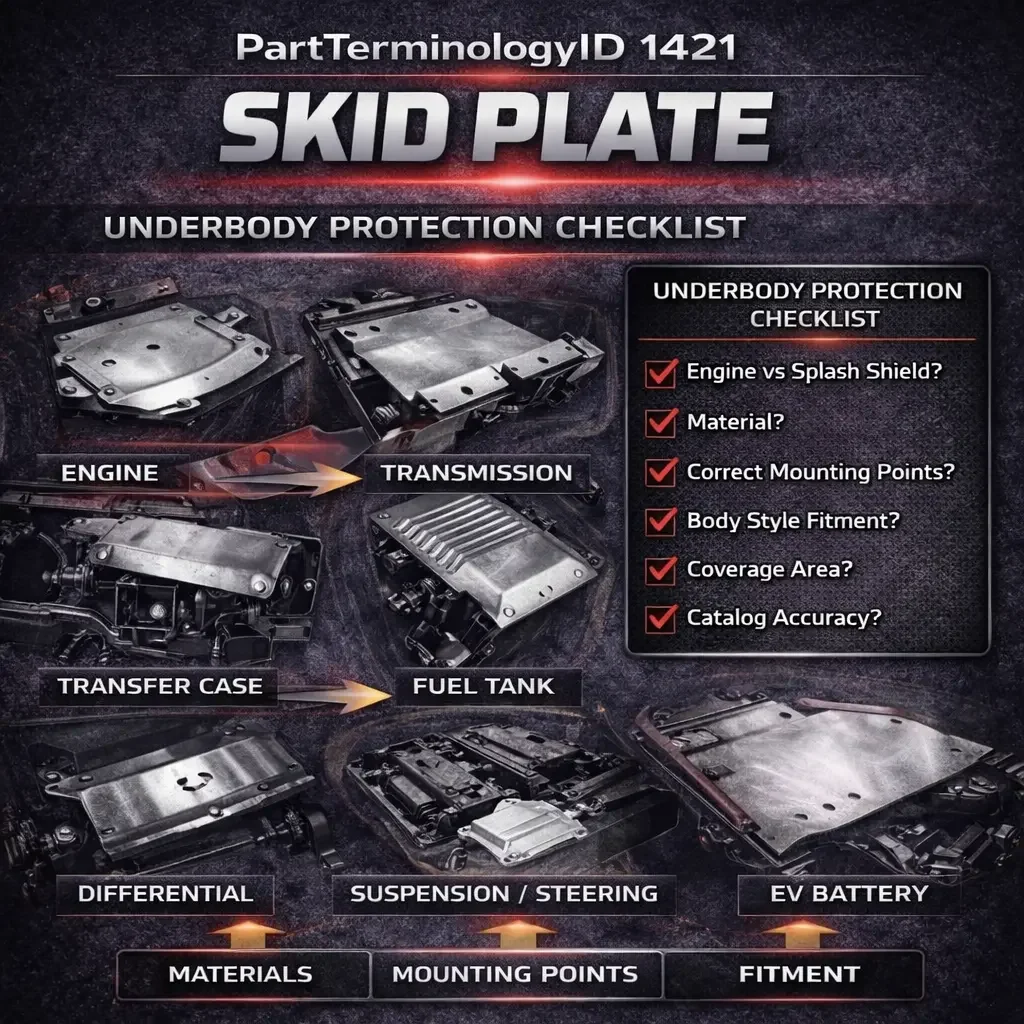
Skid Plate (PartTerminologyID 1421) refers to a rigid protective plate mounted to the underside of a vehicle to shield underbody components from impact damage. In catalog reality, this name covers a range of products organized by what they protect and where they mount:
Engine/oil pan skid plate. Mounted forward under the engine to protect the oil pan and the front of the engine block. This is the most common skid plate position. On trucks and SUVs with off-road packages, this is typically stamped steel or cast aluminum. On passenger cars, this position may overlap with the engine splash shield or belly pan (a lighter plastic piece designed primarily for aerodynamics rather than impact protection).
Transmission skid plate. Mounted behind the engine skid plate to protect the transmission case. Common on 4WD trucks and SUVs. The transmission pan on an automatic transmission is vulnerable to rock strikes because it hangs below the frame rails on many vehicles.
Transfer case skid plate. On 4WD and AWD vehicles, the transfer case often sits low in the drivetrain. A dedicated skid plate protects it from impact. This is a separate plate from the engine and transmission skid plates.
Fuel tank skid plate. Protects the fuel tank from puncture. Particularly important on trucks and SUVs where the fuel tank is mounted between the frame rails and exposed to road debris and off-road hazards. A punctured fuel tank is both a safety emergency and an expensive repair.
Differential skid plate. Protects the front or rear differential housing from rock strikes. Common on vehicles with low-hanging differentials in off-road configurations.
Steering/suspension skid plate. Protects front steering components (tie rods, drag links) and front suspension components from impact. Common on serious off-road packages.
EV battery skid plate / battery shield. On electric vehicles, a large protective plate (often aluminum or composite) shields the battery pack mounted in the floor of the vehicle. This is one of the most critical skid plate applications because battery puncture can cause thermal runaway and fire. EV battery shields are engineered as safety components with specific material and thickness requirements.
What this part does NOT cover (but gets confused with)
Engine splash shield / belly pan / undertray. A lightweight plastic (typically HDPE or polypropylene) panel that covers the underside of the engine bay. Its primary function is aerodynamic (reducing drag by smoothing airflow under the vehicle) and secondary function is protecting the engine bay from road spray and minor debris. It is NOT designed to withstand rock impacts or off-road abuse. Splash shields are thinner, lighter, and cheaper than skid plates. They are also one of the most commonly replaced underbody parts because they crack, break, or fall off from curb strikes, speed bumps, and road debris. Splash shields have their own PartTerminologyID.
Mud flap / splash guard. Mounted behind the wheels to block mud and debris from spraying onto the vehicle body and following vehicles. Different function, different location, different PartTerminologyID.
The most common catalog confusion is between skid plates and engine splash shields. A buyer searching "skid plate" for a Honda Civic likely needs a $30 plastic splash shield, not a $200 aluminum armor plate. A buyer searching "skid plate" for a Toyota 4Runner TRD Off-Road likely needs the actual aluminum skid plate, not a flimsy plastic undertray. The catalog must distinguish between these products by material, function, and vehicle application.
Materials and Why They Matter
Steel (stamped or formed)
The traditional OEM skid plate material on trucks and SUVs. Heavy but strong. Stamped steel skid plates are inexpensive to manufacture and provide good impact protection. The downside is weight (a full set of steel skid plates can add 40 to 80+ pounds to the vehicle) and corrosion susceptibility, especially in salt-belt states where road salt accelerates rust on the underside of the vehicle. Rusted-out steel skid plates are a common replacement driver.
Aluminum
The premium OEM and aftermarket material. Aluminum skid plates offer impact protection comparable to steel at roughly 40% to 50% less weight. They do not rust (though they can corrode in salt environments, the corrosion is superficial rather than structural). Aluminum skid plates cost more than steel. They are the standard on most factory off-road packages from Toyota (TRD), Jeep (Rubicon), Ford (Tremor, Raptor), and Chevrolet (ZR2, Trail Boss).
UHMW polyethylene (Ultra-High Molecular Weight Polyethylene)
A dense, slippery plastic used in some aftermarket skid plates, particularly for UTV and ATV applications. UHMW slides over rocks and obstacles rather than catching on them, which reduces the risk of getting hung up. It is lighter than aluminum, does not corrode, and absorbs impact energy rather than denting. The downside is lower puncture resistance than metal for sharp rock impacts.
Composite / carbon fiber
Used on some high-end aftermarket and EV applications. Lightweight and strong but expensive. Carbon fiber skid plates and battery shields are engineered for specific impact and puncture resistance ratings.
Plastic (HDPE, polypropylene)
Used for engine splash shields and aero trays. NOT adequate for skid plate duty. Plastic underbody panels crack and shatter on impact. They are aerodynamic covers, not protective armor. When a listing uses "skid plate" for a plastic underbody panel, it is misleading.
Fitment Variables That Drive Returns
Position on the vehicle
A vehicle may have 3 to 6 or more skid plate positions (engine, transmission, transfer case, fuel tank, differential, steering). Each position is a different part with different dimensions, different mounting points, and different bolt patterns. The listing must specify which component the skid plate protects: "Engine Skid Plate" or "Transfer Case Skid Plate" or "Fuel Tank Skid Plate."
Drivetrain configuration
2WD versus 4WD vehicles often have different underbody layouts. The 4WD version has a transfer case and front differential that the 2WD version does not. Skid plates designed for 4WD vehicles may not mount on 2WD vehicles (and vice versa) because the frame crossmembers, mounting points, and component positions are different.
Trim level and package
Skid plates are package-dependent. A Toyota Tacoma TRD Off-Road comes with aluminum skid plates from the factory. A Tacoma SR5 does not. The mounting points may or may not be pre-drilled on the SR5's frame. An aftermarket skid plate designed for the TRD Off-Road may bolt directly onto the SR5 if the frame holes exist, or may require drilling if they do not. The listing must specify: "Direct fit for vehicles with factory skid plate mounting points" or "Requires drilling for vehicles without factory provisions."
Cab and bed configuration (trucks)
On trucks, the fuel tank location and size may differ between regular cab, extended cab, and crew cab configurations, and between short bed and long bed. A fuel tank skid plate for a crew cab short bed may not fit a regular cab long bed because the tank position is different.
Engine option
Different engines sit at different heights and have different oil pan configurations. A skid plate designed to clear a 4-cylinder engine may contact a V6 or diesel engine's oil pan. The listing must account for engine option where the engine affects underbody clearance.
Model year and generation
Frame and underbody layout change with vehicle generations. Skid plate mounting points, frame crossmember locations, and component positions change. A skid plate for a 2015 Jeep Wrangler JK does not fit a 2018 Wrangler JL.
Exhaust routing
On some vehicles, the exhaust system routes differently based on engine option or emissions package. A skid plate must have the correct cutouts or clearance for the exhaust pipes. A plate without the correct exhaust clearance will either not mount or will contact the exhaust, creating heat damage and noise.
Top Return Causes
1) Skid plate versus splash shield confusion
Buyer needs a plastic splash shield and orders an aluminum skid plate, or needs a skid plate and receives a plastic splash shield.
Prevention: Material and function in the title: "Aluminum Engine Skid Plate (Off-Road Protection)" versus "Plastic Engine Splash Shield (Aerodynamic Undertray)." Never list a plastic splash shield as a "skid plate."
2) Wrong position
Buyer orders an engine skid plate and needs a transmission or fuel tank skid plate.
Prevention: Protected component in the title: "Engine/Oil Pan Skid Plate" or "Fuel Tank Skid Plate" or "Transfer Case Skid Plate."
3) Wrong drivetrain (2WD versus 4WD)
Skid plate mounting points do not exist or are in different locations on the buyer's drivetrain configuration.
Prevention: Drivetrain as a fitment qualifier: "For 4WD models" or "For 2WD and 4WD."
4) Wrong cab/bed configuration
Fuel tank skid plate does not align with the buyer's tank position because the cab and bed combination is different.
Prevention: Cab and bed configuration as fitment qualifiers for fuel tank skid plates on trucks.
5) Mounting holes do not align (no factory provisions)
Buyer's vehicle did not come with factory skid plates and the frame does not have pre-drilled mounting holes.
Prevention: Specify: "Direct bolt-on for vehicles with factory skid plate mounting provisions" or "Universal fit, drilling required." Include a mounting template or installation instructions.
Compatibility Checklist for Buyers
1) Identify which underbody component you need to protect. Engine/oil pan, transmission, transfer case, fuel tank, differential, or steering. Each is a different skid plate.
2) Confirm you need a skid plate (rigid protection), not a splash shield (lightweight aero cover). If your vehicle is a passenger car and you are replacing a broken plastic underbody panel, you likely need a splash shield, not a skid plate.
3) Confirm drivetrain. 2WD or 4WD. This affects mounting points and which skid plates apply.
4) Confirm trim level and package. Did your vehicle come with factory skid plates? If yes, a direct replacement will bolt on. If no, verify that your frame has mounting provisions or that the aftermarket plate includes a drilling template.
5) Confirm cab and bed configuration (trucks). Regular cab, extended cab, crew cab. Short bed, standard bed, long bed. Fuel tank and transfer case positions vary.
6) Confirm engine option. Oil pan and exhaust clearance may differ between engine options.
7) Confirm generation. Frame layout and mounting points change with vehicle generations.
Catalog Checklist for Attributes
Core taxonomy: Protected component (engine/oil pan, transmission, transfer case, fuel tank, front differential, rear differential, steering, EV battery). Separate from Engine Splash Shield, Belly Pan, Mud Flap, and Fender Liner.
Fitment: Year, make, model, submodel, trim level, package (off-road package, tow package, etc.). Drivetrain: 2WD/4WD/AWD. Cab configuration. Bed length (trucks). Engine option. Generation.
Material: Steel, aluminum, UHMW polyethylene, composite, or plastic (specify if the product is actually a splash shield rather than a true skid plate).
Physical specs: Dimensions (length, width, thickness). Weight. Mounting hardware included (yes/no). Pre-drilled for factory mounting points (yes/no). Drilling required (yes/no). Exhaust cutout locations.
Quality and certification: OEM, aftermarket brand, recycled/salvage.
Images: Bottom view showing plate coverage area and mounting holes, top view showing reinforcement ribs or structural features, installed view showing position relative to the protected component, exhaust cutout locations, and mounting hardware.
FAQ
Is a skid plate the same as a splash shield?
No. A skid plate is a rigid metal or composite plate designed to protect underbody components from rock impacts and off-road hazards. A splash shield (also called a belly pan or undertray) is a lightweight plastic panel designed primarily for aerodynamics and road spray protection. A splash shield will crack on a rock impact. A skid plate is designed to take that hit.
Does my vehicle need a skid plate?
If you drive off-road, on unpaved roads, or in areas with significant road debris, a skid plate protects expensive underbody components (oil pan, transmission, fuel tank) from damage. If you drive exclusively on paved roads, the factory splash shield is typically sufficient.
Can I add skid plates to a vehicle that did not come with them?
Yes, but you may need to drill mounting holes in the frame if your vehicle does not have factory skid plate provisions. Many aftermarket skid plate manufacturers offer kits with mounting hardware and drilling templates for specific vehicles. Check whether your frame has pre-existing mounting points before ordering.
How much weight do skid plates add?
A full set of steel skid plates (engine, transmission, transfer case, fuel tank) can add 40 to 80+ pounds. Aluminum reduces that by roughly 40% to 50%. UHMW polyethylene is lighter still. For most trucks and SUVs, the weight penalty is minimal relative to the vehicle's total weight.
Final Take for Aftermarket Teams
Skid Plate (PartTerminologyID 1421) is a category where the primary catalog challenge is separating true skid plates from splash shields and ensuring the buyer gets the correct product for the correct underbody position. The fitment variables are extensive: protected component, drivetrain, trim level, package, cab and bed configuration, engine option, and generation. The material distinction (steel, aluminum, UHMW, plastic) is both a product quality indicator and a functional differentiator that must be stated prominently. The teams that win here put the protected component and the material in the title of every listing, separate skid plates from splash shields at the taxonomy level, and use drivetrain and trim level as mandatory fitment qualifiers. The part exists to protect what is underneath. The catalog exists to make sure the buyer gets the right shield for the right spot.