
Door Open Warning Sensor (PartTerminologyID 1420): The Switch Nobody Sees That Controls Everything the Vehicle Does When a Door Opens
Written by Arthur Simitian | PartsAdvisory
The Door Open Warning Sensor is a small switch or sensor that detects whether a vehicle door is open or closed. It is one of the simplest electrical components on the vehicle: a mechanical plunger switch, a magnetic reed switch, or a Hall effect sensor that sends a signal to the body control module (BCM) indicating the door's position. Open or closed. On or off.
What makes this part important is not what it is, but what it triggers. When the BCM receives a "door open" signal, it initiates a cascade of vehicle responses:
Interior dome lights turn on
Dashboard "door ajar" warning light illuminates
Door ajar chime sounds if the key is in the ignition or the vehicle is running
Automatic transmission shift lock may engage (preventing the vehicle from being shifted out of park with a door open on some vehicles)
Power liftgate or sliding door operation may be inhibited
Vehicle speed-sensitive auto-lock is affected
Some vehicles disable the engine start if a door is detected as open
Keyless entry and push-button start logic uses door position to determine when to lock or unlock
On newer vehicles, ADAS systems reference door position (blind spot monitoring may alert differently, exit warning systems use door position to detect opening into traffic)
A single failed door open warning sensor can cause phantom door ajar warnings on the dashboard, dome lights that stay on and drain the battery, chimes that will not stop, automatic locks that malfunction, and on some vehicles, a no-start condition. The driver sees a "door ajar" warning when every door is closed. The dome light stays on all night and the battery is dead in the morning. The vehicle beeps continuously while driving. All from a switch that costs $5 to $30.
This post is built for aftermarket catalog teams, marketplace sellers, and buyers who want fewer mistakes and fewer returns.
Status in New Databases
Status in New Databases
Current: PIES 7.2 + PCdb Future: PIES 8.0 + PCdb 2.0 Status: No change
What Door Open Warning Sensor Means in the Aftermarket
Door Open Warning Sensor refers to the switch or sensor that detects door position (open versus closed) and sends that signal to the vehicle's BCM or instrument cluster. Different manufacturers use different names for this part: door jamb switch, door ajar switch, courtesy light switch, door pin switch, door contact switch, or door position sensor. They are all the same functional part.
In catalog reality, this covers several designs:
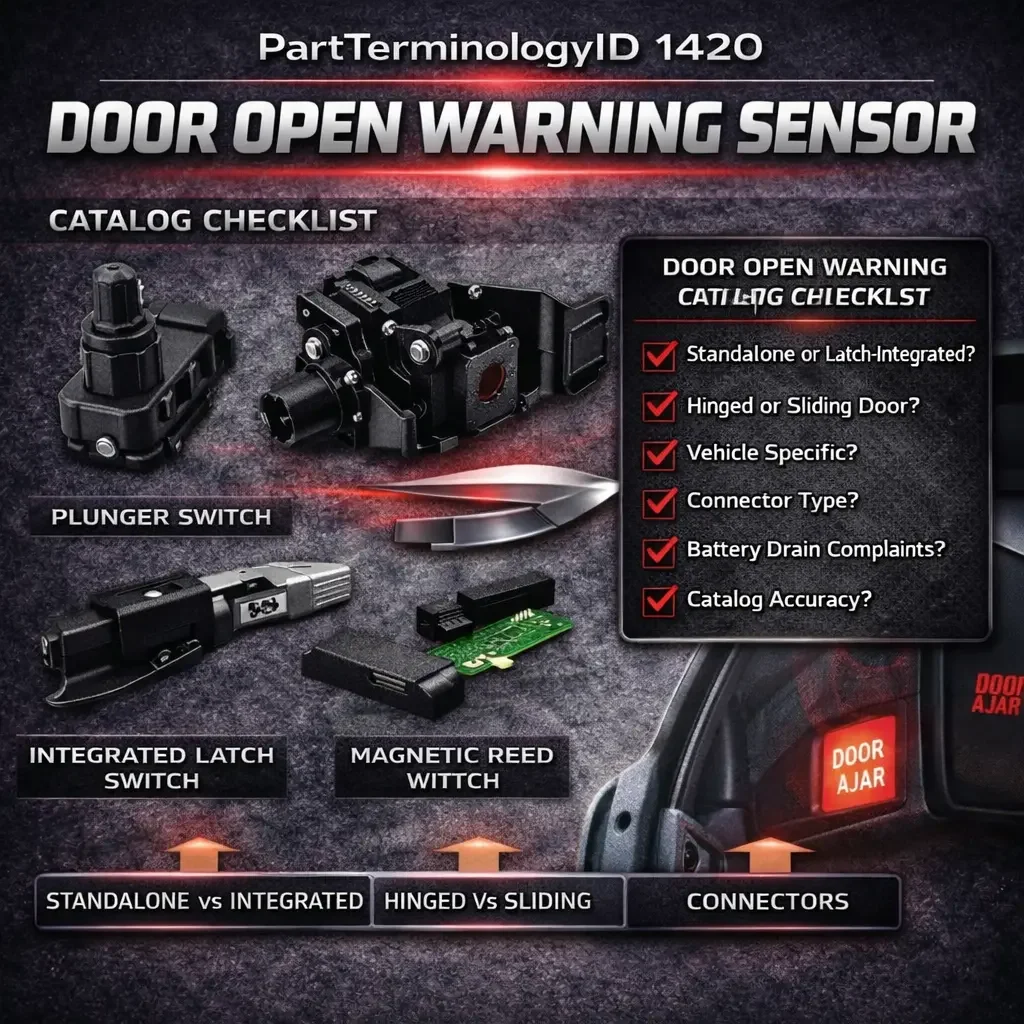
Plunger switch (pin switch). The most common type on older and mid-range vehicles. A spring-loaded plunger mounted in the door jamb (the B-pillar for front doors, C-pillar for rear doors). When the door is closed, the door presses the plunger in, completing or breaking a circuit. When the door opens, the spring pushes the plunger out, changing the circuit state. This is a purely mechanical switch with an electrical contact inside.
Integrated latch switch. On many modern vehicles, the door position sensor is integrated into the door latch mechanism rather than being a separate switch in the door jamb. The latch itself has an internal micro-switch that detects whether the latch is in the closed (engaged with striker) or open position. When the sensor is integrated into the latch, PartTerminologyID 1420 as a standalone part does not exist for that vehicle. The buyer needs a door latch assembly with the integrated switch.
Magnetic reed switch. A sealed switch that responds to a magnet mounted on the door or door frame. When the door is closed, the magnet is near the switch, holding it in one state. When the door opens, the magnet moves away and the switch changes state. Used on some luxury and European vehicles where a visible plunger switch in the door jamb is not desired for aesthetic reasons.
Hall effect sensor. An electronic sensor that detects the position of a magnet, similar to a reed switch but solid-state with no moving parts. Used on some newer vehicles for improved reliability and integration with digital BCM systems.
Sliding door position sensor. On minivans and vans with sliding doors, the door position sensor may be a different design than the hinged door sensors because the sliding door travels along a track rather than pivoting on a hinge. The sensor must detect position along the full travel range, not just open/closed.
What this part does NOT cover
Door latch (the mechanism that secures the door to the striker). Different PartTerminologyID, though the door open sensor may be integrated into the latch on some vehicles.
Door lock actuator (the electric motor that locks and unlocks the door). Different function, different PartTerminologyID.
Hood open sensor / trunk open sensor. Same function (detecting open/closed position) but for different vehicle openings and different PartTerminologyIDs.
Door handle switch (the touch sensor on keyless entry handles). Different function.
Why This Category Creates Fitment Problems
Standalone switch versus integrated latch sensor
This is the primary fitment confusion. On vehicles where the door open sensor is integrated into the latch assembly, the buyer searches for a "door ajar switch" and either finds nothing (because it does not exist as a standalone part) or finds a plunger switch from a different vehicle that does not apply. The catalog must clearly indicate whether the vehicle uses a standalone jamb switch or an integrated latch sensor, and if integrated, direct the buyer to the correct latch assembly.
Position-specific on some vehicles
On some vehicles, the door jamb switch is the same for all four doors. On others, the front door switches are different from the rear door switches due to different pillar geometry, different wiring connector locations, or different mounting depths. The listing must specify: Front, Rear, or Universal (fits all positions).
Left versus right
On many vehicles, the left and right switches are identical because the plunger design is symmetrical. On some vehicles, particularly those with integrated latch sensors or position-specific wiring, left and right are different. The listing must specify or indicate "fits left and right."
Connector type and wiring
The switch connects to the vehicle's wiring harness via a plug connector. Different model years may use different connector types even on the same vehicle platform. A switch with the wrong connector will not plug in. The buyer then faces splicing wires (which works but is not ideal) or returning the part for the correct connector version.
Hinged door versus sliding door
Minivans have both hinged front doors and sliding rear doors. The door position sensors for hinged doors and sliding doors are different parts with different mounting methods and different detection mechanisms. A hinged door plunger switch will not work on a sliding door track.
Aftermarket quality and switch life
Plunger switches are mechanical devices that cycle thousands of times over the life of the vehicle. Low-quality aftermarket switches may use weaker springs, lower-grade electrical contacts, or less durable plunger seals. A cheap switch that fails within months creates a repeat complaint and a repeat purchase. Switch quality is difficult to assess from catalog data, which makes OEM cross-reference and brand reputation important attributes.
Common Symptoms of a Failed Door Open Warning Sensor
Understanding what the buyer is experiencing helps catalog teams write better descriptions and helps buyers confirm they are ordering the correct part:
"Door ajar" light stays on with all doors closed. The most common symptom. One switch is stuck in the "open" position (plunger not returning, corroded contacts, or failed latch sensor).
Dome light stays on constantly. The BCM keeps the interior lights on because it believes a door is open. This drains the battery overnight.
Continuous chime while driving. The door ajar chime sounds because the BCM reads a door as open. Extremely annoying and distracting.
Dome light never turns on when opening the door. The switch is stuck in the "closed" position and never signals the BCM that the door has opened.
Intermittent warnings. The door ajar light flickers on and off, or the dome light turns on and off randomly. This indicates a switch with corroded or worn contacts making intermittent connection.
Auto-lock malfunction. Speed-sensitive auto-lock may not engage because the BCM believes a door is open.
Top Return Causes
1) Standalone switch ordered for vehicle with integrated latch sensor
The buyer's vehicle does not use a separate jamb switch. The sensor is inside the door latch.
Prevention: Fitment data must note: "For vehicles with standalone door jamb switch only. Vehicles with door position sensor integrated into the door latch assembly use a different part. See Door Latch Assembly."
2) Wrong connector type
Switch is correct physically but has the wrong electrical connector for the model year.
Prevention: Specify connector type. Include a photo of the connector. Note production date splits where the connector changed.
3) Wrong position (hinged door switch used on sliding door)
Buyer has a minivan and orders a front door switch for the sliding rear door.
Prevention: Specify door type: "For Hinged Doors" or "For Sliding Doors." Separate listings for each.
4) Switch does not match mounting depth
Plunger switches mount in a hole in the door jamb. The hole depth, diameter, and the plunger extension length vary by vehicle. A switch that is too short does not get depressed when the door closes. A switch that is too long stays depressed when the door is open.
Prevention: Specify plunger extension length and mounting hole diameter. OEM part number cross-reference.
5) Poor quality switch fails quickly
Aftermarket switch works initially but fails within weeks or months due to weak spring or corroded contacts.
Prevention: This is a quality issue rather than a fitment issue. Include brand reputation and OEM cross-reference as trust signals. Note warranty terms.
Compatibility Checklist for Buyers
1) Determine if your vehicle uses a standalone switch or an integrated latch sensor. Check the door jamb (the pillar the door closes against). If you see a small rubber-booted plunger button, your vehicle uses a standalone switch. If there is no visible switch in the jamb, your sensor is likely integrated into the door latch.
2) Identify which door is causing the problem. The dashboard "door ajar" warning does not always specify which door on all vehicles. Open and close each door individually while watching the dashboard to identify the faulty sensor.
3) Confirm the door type. Hinged or sliding. Sliding doors use a different sensor.
4) Confirm position. Front, Rear, or Universal. Check whether your vehicle uses the same switch for all doors or different switches by position.
5) Check the connector. If you can access the old switch, note the connector type and pin count. Compare to the listing photo.
6) Confirm full vehicle details. Year, make, model, submodel.
Catalog Checklist for Attributes
Core taxonomy: Product form (plunger switch, magnetic reed switch, Hall effect sensor, sliding door position sensor). Note if the sensor is integrated into the door latch on specific vehicles. Separate from Door Latch, Door Lock Actuator, Hood Open Sensor, and Trunk Open Sensor.
Fitment: Year, make, model, submodel. Position: Front/Rear/All. Side: Left/Right/Universal. Door type: Hinged/Sliding. Standalone switch versus integrated latch sensor (note vehicle applications where integrated). OEM part number cross-reference.
Physical specs: Switch type (plunger, reed, Hall effect). Plunger extension length. Mounting hole diameter. Connector type and pin count.
Package contents: Number of switches per package (single, pair, or set of four). Mounting hardware, rubber boot/seal (if included).
Images: Switch from multiple angles showing plunger and connector, connector close-up, mounting area close-up, and a reference image showing installed position in the door jamb.
FAQ
My "door ajar" light stays on with all doors closed. Is it the switch?
Most likely. A stuck or failed door open warning sensor is the most common cause of a persistent door ajar warning. Identify which door is triggering the warning by opening and closing each door individually while watching the dashboard.
Can I just disconnect the switch to stop the warning?
Disconnecting the switch will stop the dome light and chime, but the BCM will still read the door as open, which may cause other system malfunctions (auto-lock disabled, possible start inhibit on some vehicles). Replacing the switch is the proper fix.
My vehicle does not have a visible switch in the door jamb. Where is it?
Your vehicle likely uses a door position sensor integrated into the door latch mechanism. The sensor is inside the latch assembly, not visible as a separate component. Replacing the sensor requires replacing the door latch assembly.
Why does my dome light drain my battery?
A failed door open warning sensor in the "open" position tells the BCM a door is open, keeping the dome light on indefinitely. If the vehicle is parked long enough, the dome light drains the battery. Some vehicles have a timed dome light shutoff (typically 10 to 20 minutes) that mitigates this, but not all.
Final Take for Aftermarket Teams
Door Open Warning Sensor (PartTerminologyID 1420) is a low-cost, high-impact part where the primary catalog challenge is determining whether the vehicle uses a standalone jamb switch or an integrated latch sensor. Get that distinction right, and the rest of the fitment is straightforward: position, side, door type (hinged vs. sliding), connector type, and plunger dimensions. Get it wrong, and the buyer receives a switch that has no place to install on their vehicle. The secondary challenge is helping the buyer diagnose which door is triggering the problem, which is a description and content opportunity rather than a data problem. A well-written listing that explains the symptoms and the diagnostic process sells more switches and generates fewer returns than a listing that just shows a photo and a part number.