
Deck Lid Release Solenoid (PartTerminologyID 1424): The Electric Replacement for the Cable You Read About Earlier
Written by Arthur Simitian | PartsAdvisory
In the Trunk Lid Release Cable post (PartTerminologyID 1368), we covered the mechanical cable that connects a cabin lever to the trunk latch. We noted that most sedans built after roughly 2005 to 2010 eliminated that cable entirely and switched to electric trunk release. The Deck Lid Release Solenoid is the electric component that replaced it.
When the driver presses the trunk release button on the key fob, the dashboard, or the trunk lid itself, the body control module (BCM) sends an electrical signal to the deck lid release solenoid. The solenoid actuates a plunger or lever that releases the trunk latch, allowing the trunk to pop open. No cable. No mechanical lever in the cabin. Just a button, a signal, and an electric actuator.
The term "deck lid" is the industry name for the trunk lid on a sedan. Some manufacturers and catalogs use "trunk lid," others use "deck lid." They mean the same thing. The solenoid may also be called a trunk release actuator, trunk latch actuator, trunk pop actuator, or trunk lid release motor depending on the manufacturer and the catalog source. This naming inconsistency is one of the catalog challenges in this category.
This post is built for aftermarket catalog teams, marketplace sellers, and buyers who want fewer mistakes and fewer returns.
Status in New Databases
Status in New Databases
Current: PIES 7.2 + PCdb Future: PIES 8.0 + PCdb 2.0 Status: No change
What Deck Lid Release Solenoid Means in the Aftermarket
Deck Lid Release Solenoid (PartTerminologyID 1424) refers to the electrically actuated device that releases the trunk (deck lid) latch when it receives a signal from the BCM. The solenoid is mounted on or near the trunk latch mechanism, typically inside the trunk lid or on the trunk latch assembly itself.
In catalog reality, this covers:
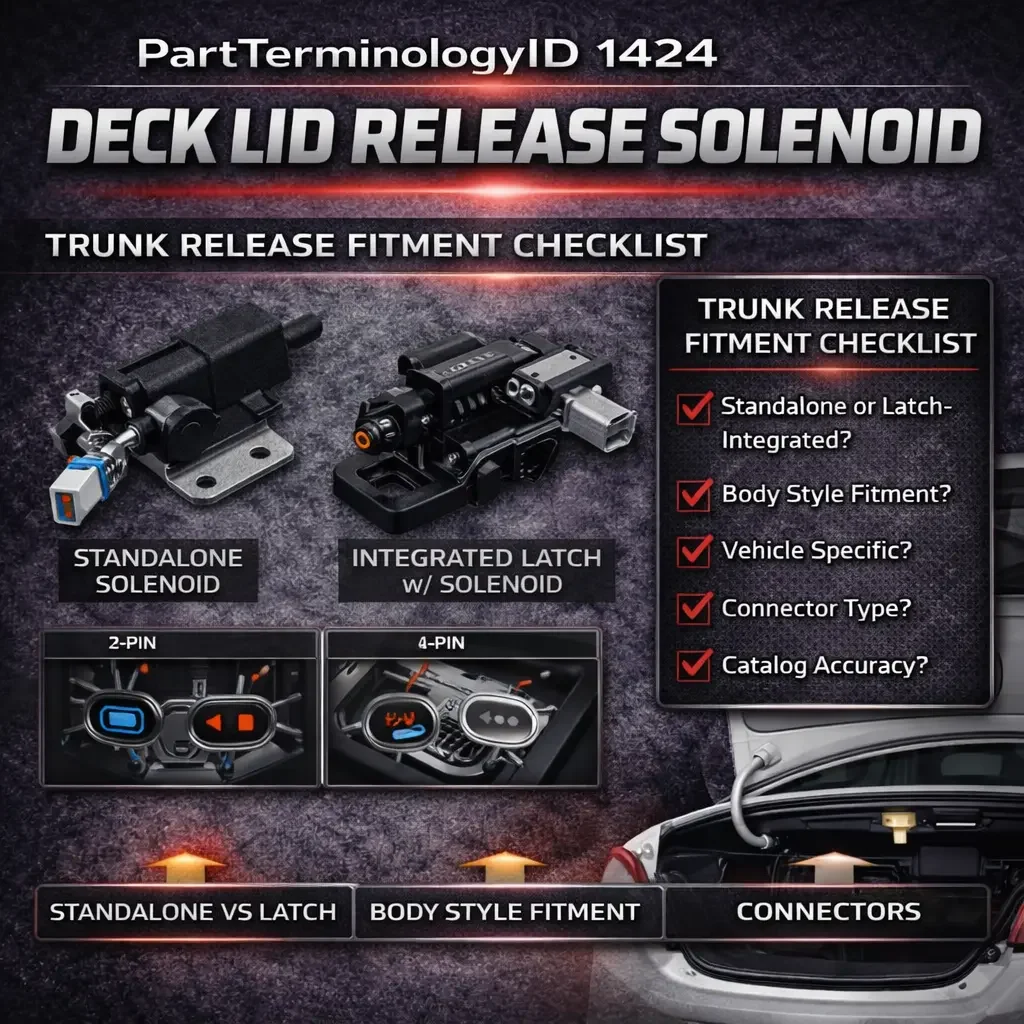
Standalone solenoid. A separate electric actuator that mounts adjacent to the trunk latch and connects to it via a short linkage rod or cable. The solenoid pulls or pushes the linkage to release the latch. This is the most common product form for PartTerminologyID 1424. The solenoid can be replaced independently of the latch.
Integrated latch with solenoid. On some vehicles, the release solenoid is integrated into the trunk latch assembly as a single unit. The solenoid cannot be replaced separately. If the solenoid fails, the entire latch assembly must be replaced. For these vehicles, PartTerminologyID 1424 as a standalone part does not apply. The buyer needs the trunk latch assembly under a different PartTerminologyID.
Trunk release actuator motor. Some vehicles use a small DC motor with a gear drive rather than a solenoid (which uses electromagnetic plunger action). The functional result is the same: an electrical signal releases the latch. The distinction between solenoid and motor matters for the catalog because they are different internal mechanisms, but for the buyer, they are the same functional part.
Power trunk lift motor. On vehicles with a power trunk (the trunk lid opens and closes automatically via electric struts or a motor), the system includes both a release mechanism and a lift mechanism. The release solenoid unlatches the trunk. The power lift motor opens it. These are different components. PartTerminologyID 1424 covers only the release solenoid, not the power lift motor.
What this part does NOT cover
Trunk latch assembly (the mechanical latch that the solenoid releases). Different PartTerminologyID, though the solenoid may be integrated into it on some vehicles.
Trunk lid release cable (PartTerminologyID 1368). The mechanical cable on vehicles that use cable-operated trunk release. If the vehicle has a cable, it does not have a solenoid (and vice versa).
Power trunk lift motor / power trunk strut. The motor that physically opens and closes the trunk lid on vehicles with automatic trunk operation.
Trunk lock actuator. The electric motor that locks and unlocks the trunk latch. Locking and releasing are different functions handled by different actuators on many vehicles.
Liftgate release actuator. The equivalent part for SUVs and hatchbacks with liftgates rather than trunk lids. May be a different PartTerminologyID.
Why This Category Creates Fitment Problems
Standalone solenoid versus integrated latch
This is the same pattern seen with the Door Open Warning Sensor (PartTerminologyID 1420). On vehicles where the solenoid is integrated into the latch, a standalone solenoid does not exist as a replacement part. The buyer who searches for a "trunk release solenoid" and has a vehicle with an integrated latch will order a part that has no place to install. The catalog must indicate which vehicles use standalone solenoids and which use integrated latch assemblies.
Release solenoid versus lock actuator
The trunk has two electric functions: releasing (unlatching to open) and locking (securing the latch so it cannot be opened). These are sometimes handled by the same actuator and sometimes by separate actuators. On vehicles with separate actuators, the release solenoid and the lock actuator are different parts with different electrical connections and different mounting positions within the latch area. The buyer who cannot open their trunk may have a failed release solenoid. The buyer whose trunk will not lock may have a failed lock actuator. Ordering the wrong one is a common return cause.
Connector type and pin count
The solenoid connects to the vehicle wiring harness via a plug connector. Different model years and different trim levels may use different connector configurations. A solenoid with the wrong connector will not plug in.
Voltage and actuation type
Most solenoids are 12V. Some are momentary (they pull the plunger when energized and release it when the signal stops). Others are latching (they hold position until a reverse signal is sent). The replacement must match the vehicle's actuation type. A momentary solenoid in a latching application will not hold the latch in the released position long enough for the trunk spring to push the lid open.
Sedan versus coupe versus convertible
On the same vehicle platform, the trunk latch area and solenoid mounting may differ between body styles. A sedan trunk and a coupe trunk may use different latch assemblies because the trunk opening size and hinge geometry are different. Convertibles with folding roofs have a completely different trunk area. The solenoid, even if electrically identical, may have a different mounting bracket or linkage for each body style.
Common Symptoms of a Failed Deck Lid Release Solenoid
Trunk does not open from the key fob or button. The most common symptom. The driver presses the release button and nothing happens. The trunk remains latched.
Clicking sound but trunk does not open. The solenoid is receiving the signal and attempting to actuate, but is not pulling with enough force to release the latch. This may indicate a weak solenoid, a binding linkage, or a misadjusted latch.
Trunk opens intermittently. The solenoid works sometimes and fails other times. This usually indicates corroded electrical contacts, a failing solenoid coil, or a loose wiring connector.
Trunk opens only from the emergency interior release. The FMVSS 401 interior emergency release (the glow-in-the-dark T-handle) works because it is a mechanical connection to the latch, bypassing the solenoid entirely. If the emergency release works but the electric release does not, the solenoid or its wiring is the likely failure.
Top Return Causes
1) Standalone solenoid ordered for vehicle with integrated latch
The solenoid is built into the latch assembly. No standalone part exists.
Prevention: Fitment data must note: "For vehicles with standalone trunk release solenoid. Vehicles with solenoid integrated into the trunk latch assembly require a complete latch replacement."
2) Release solenoid confused with lock actuator
Buyer has a trunk that will not lock and orders a release solenoid. Or buyer has a trunk that will not open and orders a lock actuator.
Prevention: Clear function in the title: "Trunk Lid Release Solenoid (Opens Trunk)" versus "Trunk Lock Actuator (Locks/Unlocks Trunk)."
3) Wrong connector type
Solenoid connector does not match the vehicle's harness.
Prevention: Specify connector type and pin count. Include a connector photo. Note model year splits where the connector changed.
4) Wrong body style
Sedan solenoid ordered for a coupe or convertible, which uses a different mounting configuration.
Prevention: Body style as a fitment qualifier: sedan, coupe, convertible.
5) Problem is not the solenoid
The trunk will not open, but the actual failure is the BCM signal, a blown fuse, a broken wire, or a mechanical latch jam. The solenoid itself is fine.
Prevention: This is a diagnostic issue rather than a catalog issue, but a description note helps: "Before replacing the solenoid, check the trunk release fuse and verify that the BCM is sending a signal to the solenoid connector. If the solenoid receives power and clicks but does not release the latch, the linkage between the solenoid and the latch may be binding or disconnected."
Compatibility Checklist for Buyers
1) Confirm your vehicle uses an electric trunk release. If your vehicle has a manual pull lever in the cabin connected to the trunk by a cable, you have a cable-operated system and do not use a solenoid. See Trunk Lid Release Cable (PartTerminologyID 1368).
2) Confirm standalone solenoid versus integrated latch. Look at the trunk latch area. If you can see a separate electric actuator mounted next to the latch with its own wiring connector, it is a standalone solenoid. If the latch appears to be one self-contained unit with no separate actuator, the solenoid is integrated.
3) Confirm you need a release solenoid, not a lock actuator. Release = opens the trunk. Lock = prevents the trunk from being opened.
4) Confirm body style. Sedan, coupe, or convertible. The trunk area differs between body styles.
5) Check the connector. If accessible, note the connector type and pin count on the existing solenoid. Compare to the listing.
6) Confirm full vehicle details. Year, make, model, submodel, body style.
Catalog Checklist for Attributes
Core taxonomy: Product form (standalone solenoid, solenoid with bracket, solenoid with linkage). Actuation type: solenoid (electromagnetic plunger) or motor (DC gear motor). Separate from Trunk Latch Assembly, Trunk Lock Actuator, Trunk Lid Release Cable, Power Trunk Lift Motor, and Liftgate Release Actuator.
Fitment: Year, make, model, submodel. Body style: sedan, coupe, convertible. Standalone solenoid versus integrated latch (note which vehicles use which). OEM part number cross-reference.
Physical specs: Voltage (12V), connector type and pin count, actuation type (momentary or latching), mounting method (bolt-on, clip-on).
Package contents: Solenoid, mounting bracket (if included), linkage rod (if included), wiring pigtail (if included), mounting hardware.
Images: Solenoid assembly from multiple angles, connector close-up, mounting bracket detail, and a reference image showing installed position relative to the trunk latch.
FAQ
My trunk will not open from the key fob. Is it the solenoid?
Possibly. First check the trunk release fuse. Then check whether you hear a click from the trunk area when pressing the release button. If you hear a click but the trunk does not open, the solenoid may be weak or the linkage may be binding. If you hear nothing, the solenoid, wiring, or BCM signal may be at fault.
Is a deck lid release solenoid the same as a trunk release actuator?
Yes, functionally. Different manufacturers and catalogs use different names: deck lid release solenoid, trunk release actuator, trunk pop solenoid, trunk latch release actuator. They all refer to the electric device that unlatches the trunk when you press the release button.
Can I still open the trunk if the solenoid fails?
Yes. Use the physical key in the trunk lock cylinder (if equipped) or the FMVSS 401 emergency interior release handle inside the trunk (the glow-in-the-dark T-handle). Both bypass the electric solenoid entirely.
Does this part also lock the trunk?
No. The release solenoid only unlatches the trunk to open it. The lock function (preventing the trunk from being opened) is handled by a separate lock actuator on most vehicles. Some vehicles combine both functions in the latch assembly.
Final Take for Aftermarket Teams
Deck Lid Release Solenoid (PartTerminologyID 1424) is the electric successor to the Trunk Lid Release Cable (1368) and sits at the boundary between two catalog challenges: standalone solenoid versus integrated latch (determining whether the part even exists as a standalone replacement for the vehicle), and release solenoid versus lock actuator (two different electric devices serving two different functions at the same trunk latch). The teams that catalog this correctly specify the function (release, not lock), specify standalone versus integrated, include the connector photo, and tie back to the cable alternative for vehicles that still use mechanical release. It is a simple part with a simple job, but the naming inconsistency and the integrated-versus-standalone split make it a catalog problem that requires attention.