
Quarter Panel (PartTerminologyID 1416): The Body Panel You Cannot Unbolt, and the Reason Vehicles Get Totaled
Written by Arthur Simitian | PartsAdvisory
In the Fender post (PartTerminologyID 1380), we noted that buyers frequently confuse "fender" and "quarter panel." The fender is the bolt-on panel over the front wheel. The quarter panel is the panel over the rear wheel. They look similar in function, but they are fundamentally different in how they attach to the vehicle, and that difference changes everything about how they are repaired, replaced, cataloged, and priced.
A fender unbolts. A quarter panel does not.
On virtually every modern unibody vehicle, the quarter panel is welded to the vehicle's body structure. It is not a bolt-on panel. It is a structural component that is spot-welded, seam-welded, or adhesive-bonded to the roof panel, the rear floor pan, the trunk/cargo area, the rear body panel, the C-pillar (or D-pillar on SUVs), and the rocker panel underneath. Replacing a quarter panel requires cutting the old panel off the vehicle, preparing the mating surfaces, fitting the new panel, and welding it in place. This is one of the most labor-intensive and skill-demanding procedures in collision repair.
This labor intensity is why quarter panel damage is one of the primary reasons vehicles get totaled by insurance companies. When the cost of cutting, fitting, welding, sealing, priming, and painting a quarter panel replacement, combined with the cost of the panel itself and any adjacent structural repairs, exceeds a threshold percentage of the vehicle's value (typically 70% to 80% depending on the state and insurer), the vehicle is declared a total loss. A fender replacement is a 2 to 3 hour bolt-on job. A quarter panel replacement is a 15 to 25+ hour welded structural repair. That labor difference is often the line between a repairable vehicle and a total.
This post is built for aftermarket catalog teams, marketplace sellers, and buyers who want fewer mistakes and fewer returns.
Status in New Databases
Status in New Databases
Current: PIES 7.2 + PCdb Future: PIES 8.0 + PCdb 2.0 Status: No change
What Quarter Panel Means in the Aftermarket
Quarter Panel (PartTerminologyID 1416) refers to the exterior body panel that covers the rear wheel well area and extends from the rear door opening (on four-door vehicles) or from the B-pillar area (on two-door vehicles) rearward to the tail of the vehicle, including the area around the taillights, the trunk/liftgate opening, and the rear bumper junction.
In catalog reality, this covers several product forms:
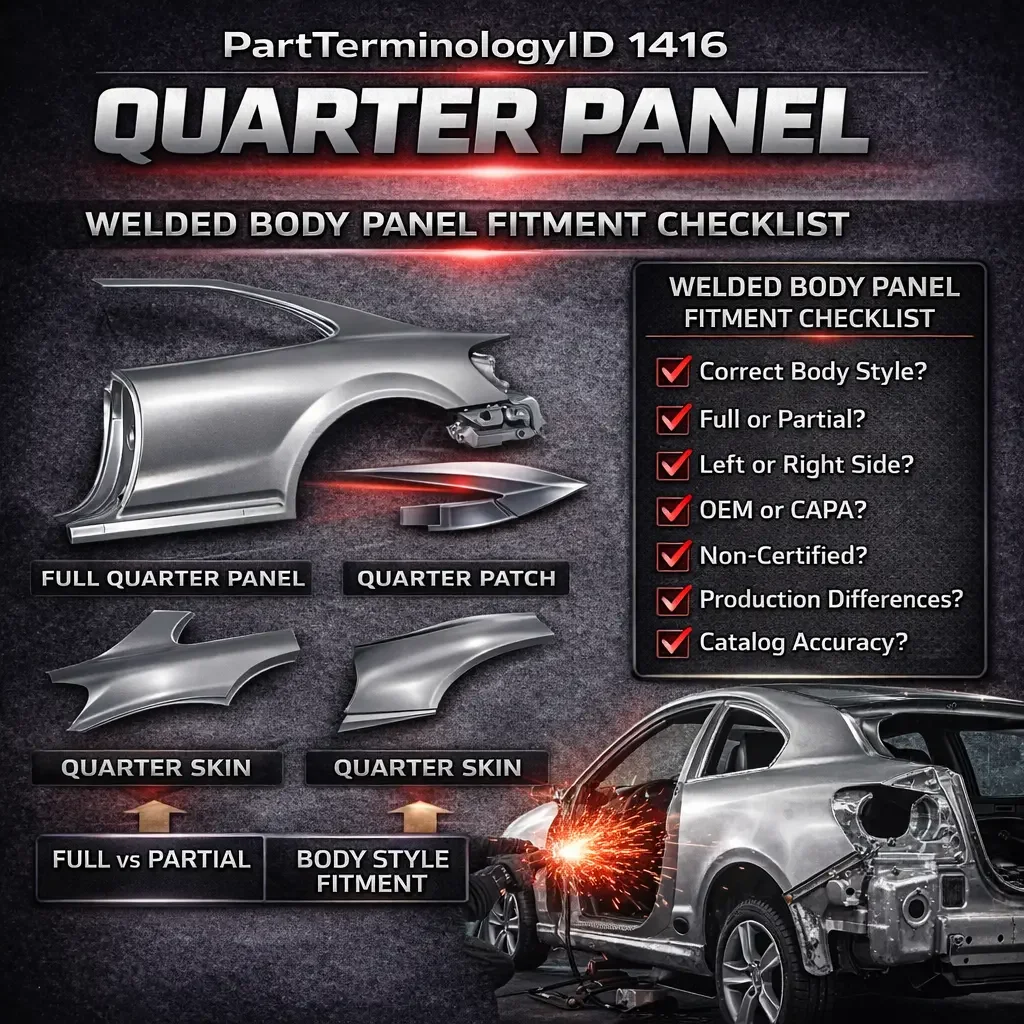
Full quarter panel. The complete panel from the roof line to the rocker panel, from the rear door opening to the rear of the vehicle. This is the most expensive and most labor-intensive replacement option. Used when the damage extends across a large area of the quarter.
Quarter panel patch or partial quarter. A section of the quarter panel rather than the full panel. Common patches include the lower quarter (the area below the body line and around the wheel arch, where road debris and parking lot damage most commonly occur), the wheel arch section only, or the upper quarter near the tail light. Partial panels reduce labor because the technician only cuts and welds a section rather than the entire panel.
Quarter panel skin. The outer skin only, without the inner structure. Used when the inner wheelhouse and structural reinforcements are intact but the outer skin is damaged. The old skin is cut away and the new skin is welded or bonded to the existing inner structure.
Bolt-on quarter panel (truck beds). On body-on-frame trucks with separate beds (Ford F-150, Chevy Silverado, Ram 1500, Toyota Tundra), the "quarter panel" equivalent is the truck bed side panel, which is part of the bed assembly. On some older trucks and certain designs, bed sides can be unbolted as part of the bed structure. This is a different repair scenario from unibody quarter panels.
Quarter panel extension. A small panel section at the front or rear edge of the quarter panel that bridges the gap to an adjacent panel (typically the rear bumper or the tail light area). This is a separate part from the main quarter panel and has its own fitment.
What this part does NOT cover
Fender (PartTerminologyID 1380). The bolt-on front wheel well panel. Different part, different attachment method.
Rocker panel. The panel below the doors between the front and rear wheel arches. Different PartTerminologyID.
Rear body panel. The panel between the taillights at the rear of the vehicle. Different PartTerminologyID.
Inner wheelhouse. The inner sheet metal structure inside the quarter panel that forms the rear wheel well. Different PartTerminologyID.
Truck bed side panel. On body-on-frame trucks, this may overlap with quarter panel function but is cataloged differently.
Why Quarter Panel Is One of the Most Complex Collision Categories
Welded attachment requires structural repair skills
Replacing a quarter panel is not a parts swap. It is a structural body repair. The technician must:
Remove interior trim, taillights, fuel filler components, and any other items attached to the quarter area
Mark cut lines on the old panel based on the replacement panel's overlap zones
Cut the old panel off using a spot weld cutter, reciprocating saw, or plasma cutter
Remove the remaining spot weld nuggets and clean the mating flanges on the body structure
Test-fit the new panel and verify alignment with the roof, door, rear body panel, and rocker panel
Clamp the new panel in position and begin welding (plug welds to replicate spot welds, and seam welds at critical joints)
Apply seam sealer, anti-corrosion treatment, and primer to all welded areas
Prepare the panel for paint and blend into adjacent panels
This process requires I-CAR or manufacturer-specific training, MIG or squeeze-type resistance spot welding equipment, and a thorough understanding of the vehicle's body structure. Incorrect welding can compromise the vehicle's crash performance.
Panel fit is critical and unforgiving
Because the quarter panel is welded in place, there is no adjustment after installation. A bolt-on fender can be shimmed, shifted, or re-bolted to fine-tune gaps. A welded quarter panel is permanent. If the panel is 2mm off when it is welded, it stays 2mm off. The gap to the door, the gap to the trunk lid or liftgate, the gap to the rear bumper, and the alignment with the roof line are all set during the welding process and cannot be changed afterward without cutting and re-welding.
This means the replacement panel must be dimensionally accurate, and the technician must be skilled at test-fitting and clamping before committing to the weld. Aftermarket quarter panels that are dimensionally off create significant problems because the error is permanent once welded.
Full panel versus partial determines labor hours
A full quarter panel replacement typically requires 15 to 25+ labor hours for the structural work alone, before paint. A partial quarter (lower section or wheel arch) may require 8 to 15 hours. The decision between full and partial depends on the extent of the damage and whether the undamaged portions of the original panel are in good enough condition to retain.
Insurance estimates factor this labor heavily. The labor cost on a quarter panel replacement often exceeds the cost of the panel itself. This is why the panel source (OEM, CAPA certified, non-certified aftermarket) matters so much: a panel that requires extra fitting and adjustment labor because it is dimensionally off can add 2 to 5 hours of labor to an already expensive repair.
Body style drives completely different panels
A sedan quarter panel is different from a coupe quarter panel, which is different from a wagon quarter panel, which is different from an SUV quarter panel. The quarter panel shape follows the roof line, the window line, and the rear body design. A sedan has a trunk opening that the quarter panel wraps around. A hatchback has a liftgate opening. An SUV has a D-pillar and a different roof height. A coupe has a longer quarter panel because there is no rear door opening.
On vehicles offered in multiple body styles (Honda Civic sedan, coupe, and hatchback, for example), the quarter panels are completely different parts for each body style.
Fuel filler door location
The fuel filler door is typically located on the quarter panel. The filler door opening, the fuel filler neck mounting, and the filler door hinge provisions are integrated into the quarter panel. Left-side filler versus right-side filler is a critical fitment variable, though most manufacturers are consistent within a model.
Antenna, sensor, and trim provisions
Quarter panels may include provisions for:
Rear antenna (shark fin or mast, mounted on the rear quarter or roof-to-quarter transition)
Side marker or reflector cutouts
Wheel arch molding or flare mounting
Body side molding clip locations
Parking sensor locations (rear corner sensors)
Blind spot monitoring radar mounting (on some vehicles, the radar module is mounted behind the rear bumper cover but adjacent to the quarter panel area)
The OEM vs. Aftermarket Decision
OEM quarter panels
Exact fit. Correct material, correct weld flange geometry, correct overlap zones. The most expensive option, but on a repair where the panel is permanently welded to the vehicle, dimensional accuracy is worth every dollar. OEM panels minimize the fitting labor and eliminate the risk of a dimensionally off panel being permanently attached to the vehicle.
CAPA-certified aftermarket quarter panels
Independently tested for dimensional accuracy. Available for some high-volume applications. A reliable aftermarket option for quarter panels because CAPA tests the weld flange locations and panel contours that are critical for a welded repair.
Non-certified aftermarket quarter panels
Lower cost, but dimensional accuracy is not independently verified. On a bolt-on part like a fender, minor dimensional variance can be adjusted during installation. On a welded quarter panel, dimensional variance becomes a permanent problem. Non-certified quarter panels carry higher risk in this category than in any other body panel category because of the permanence of the installation.
Recycled (salvage) quarter panels
Cutting a quarter panel off a donor vehicle and welding it onto the repair vehicle is a legitimate repair method. The advantage is OEM material and dimensions. The disadvantage is that cutting the panel off the donor introduces the same dimensional risk as cutting the old panel off the repair vehicle: the cut lines must be precise, and the panel must not be distorted during removal. Recycled quarter panels also carry potential corrosion, prior repair history, and paint condition issues.
Top Return Causes
1) Fender ordered when quarter panel was needed (or vice versa)
The most basic confusion. Fender = front, bolt-on. Quarter panel = rear, welded.
Prevention: Clear terminology in every listing. "Rear Quarter Panel (Welded, Non-Bolt-On)" versus "Front Fender (Bolt-On)."
2) Wrong body style
Sedan quarter panel ordered for a hatchback, or coupe panel ordered for a sedan.
Prevention: Body style as a mandatory fitment qualifier: sedan, coupe, hatchback, wagon, SUV, convertible.
3) Full panel ordered when partial was needed (or vice versa)
Buyer orders a full quarter panel when only the lower section or wheel arch is damaged. Or the buyer orders a partial and the damage extends beyond the patch area.
Prevention: Specify product form in the title: "Full Quarter Panel" or "Lower Quarter Panel Patch" or "Wheel Arch Repair Panel." Include a diagram or photo showing the coverage area of the panel.
4) Dimensional variance on non-certified panel
The panel does not align with the door, roof, or trunk opening after test-fitting. On a welded panel, this is a serious problem that can require returning the panel and ordering a different one, adding days to the repair.
Prevention: Use OEM or CAPA-certified panels for welded structural applications. If listing non-certified, note the quality risk clearly.
5) Wrong side (left versus right)
Prevention: Side in the title: "Left (Driver Side) Quarter Panel" or "Right (Passenger Side) Quarter Panel."
Compatibility Checklist for Buyers
1) Confirm this is a quarter panel job, not a fender job. Quarter panel = rear wheel, welded to the body. Fender = front wheel, bolts on.
2) Confirm side. Left (Driver) or Right (Passenger).
3) Confirm body style. Sedan, coupe, hatchback, wagon, SUV, convertible. The quarter panel is different for each body style.
4) Determine full panel versus partial. Assess the damage extent. A lower quarter patch is less labor than a full panel replacement.
5) Confirm generation and facelift. Quarter panel contours change with generations. The panel must match the roof line, window line, and taillight opening for the specific model year.
6) Confirm quality tier. OEM or CAPA Certified is strongly recommended for welded panels because dimensional accuracy is permanent and unadjustable.
7) Confirm the shop has structural repair capability. Quarter panel replacement requires welding equipment, I-CAR or manufacturer training, and experience with structural body repair. This is not a DIY project.
Catalog Checklist for Attributes
Core taxonomy: Product form (full quarter panel, lower quarter patch, wheel arch repair panel, quarter panel skin, quarter panel extension). Separate from Fender, Rocker Panel, Inner Wheelhouse, Rear Body Panel, and Truck Bed Side Panel.
Fitment: Year, make, model, submodel. Side: Left/Right. Body style (CRITICAL): sedan, coupe, hatchback, wagon, SUV, convertible. Generation and facelift. OEM part number cross-reference.
Material: Steel, aluminum (note vehicles with aluminum body structure), high-strength steel (some quarter panels use UHSS or boron steel in structural areas).
Coverage: Diagram or description of which area of the quarter the panel covers (full, lower, wheel arch, upper).
Provisions: Fuel filler door opening (left or right side), antenna mounting, side marker cutout, body molding clip locations, parking sensor provisions.
Quality and certification: OEM, CAPA Certified (include CAPA seal number), Non-Certified Aftermarket, Recycled/Salvage (donor vehicle details, condition grade, corrosion assessment).
Images: Outer surface showing full panel contour, inner surface showing weld flanges and overlap zones, fuel filler area, wheel arch area, upper roof-line transition area, and a diagram showing where the panel attaches to the body structure.
FAQ
Why is quarter panel damage so expensive to repair?
Because the quarter panel is welded to the body structure. Replacing it requires cutting, fitting, welding, sealing, and painting, which is 15 to 25+ labor hours of structural work. The labor cost often exceeds the cost of the panel itself.
Can I replace a quarter panel myself?
Quarter panel replacement requires MIG welding equipment, spot weld cutters, structural body repair training, and experience fitting welded panels. It is not recommended as a DIY project. Incorrect welding can compromise the vehicle's crash safety.
Why does quarter panel damage total so many vehicles?
The labor cost of a quarter panel replacement (15 to 25+ hours at $50 to $75/hour shop rate, plus paint) combined with the panel cost and any adjacent structural repairs frequently exceeds the insurer's total loss threshold (typically 70% to 80% of the vehicle's value). On older or lower-value vehicles, even moderate quarter panel damage can trigger a total loss.
Is there a bolt-on quarter panel?
On most modern unibody vehicles, no. The quarter panel is welded. On some older body-on-frame vehicles and some truck bed configurations, sections of the rear body may be bolted. Check your specific vehicle's body construction before assuming bolt-on replacement is possible.
Final Take for Aftermarket Teams
Quarter Panel (PartTerminologyID 1416) is the body panel where the stakes are highest because the installation is permanent. A bolt-on fender that is 2mm off can be adjusted. A welded quarter panel that is 2mm off stays that way. This makes dimensional accuracy more important for quarter panels than for any other exterior body panel in the catalog. It makes the quality tier decision (OEM versus CAPA versus non-certified) more consequential. And it makes the body style fitment qualifier more critical, because a sedan quarter panel welded onto a hatchback body is a catastrophic error that cannot be undone without starting over.
Catalog teams that serve this category well specify body style as a mandatory qualifier, differentiate between full panel and partial coverage areas with diagrams, recommend OEM or CAPA-certified panels for welded structural applications, and clearly separate quarter panels from fenders at the taxonomy level so the most basic confusion in the body parts catalog does not generate returns on one of the most expensive and labor-intensive parts to replace.