
Headlight Lens (PartTerminologyID 1400): The Part Name That Means Two Different Things and Causes Returns Either Way
Written by Arthur Simitian | PartsAdvisory
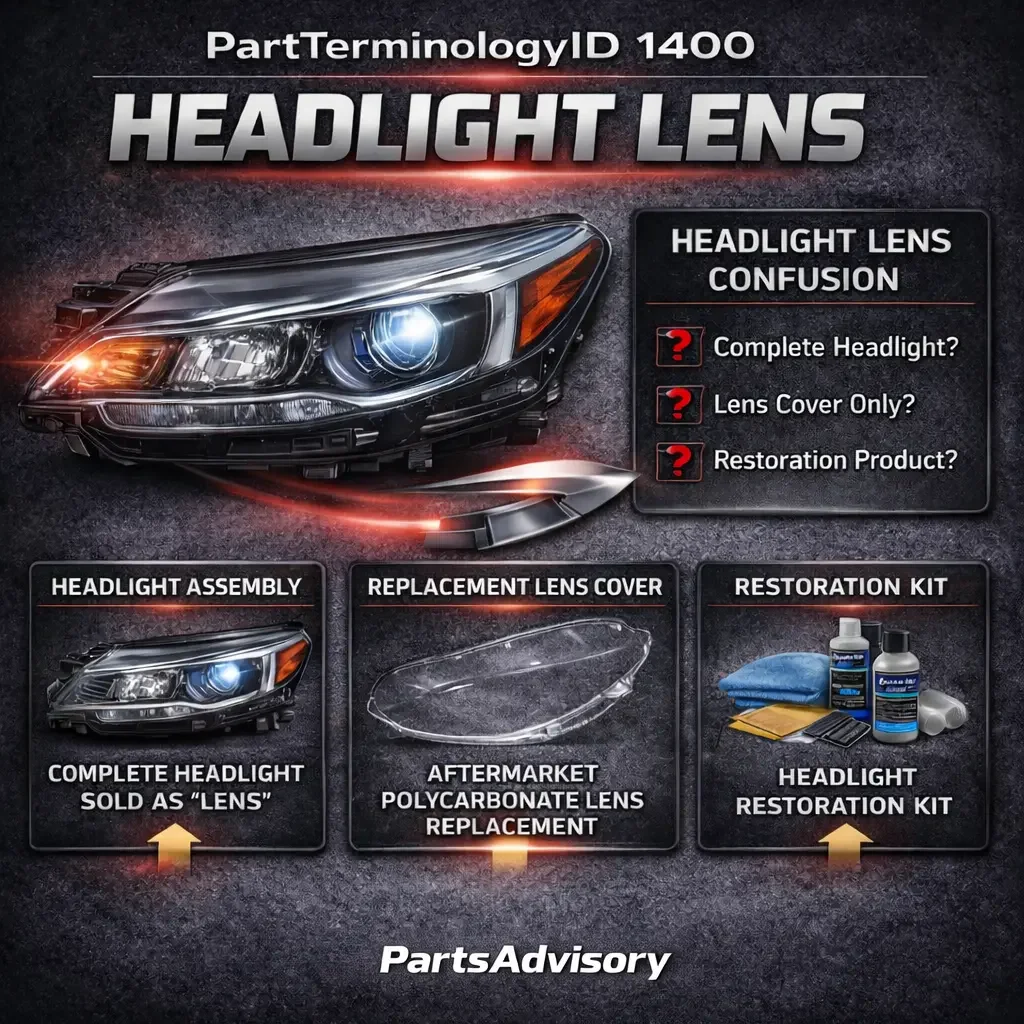
Headlight Lens is one of the biggest part names in the collision and maintenance aftermarket by search volume. It is also one of the most confusing because the term "headlight lens" means different things to different buyers, and the aftermarket has not settled on consistent usage.
To a collision shop technician, "headlight lens" usually means the outer cover of the headlight assembly, the clear or tinted polycarbonate piece that the light shines through. On modern vehicles (roughly 1990 and newer), this lens is permanently bonded to the headlight housing at the factory. It is not a separately replaceable part. If the lens is cracked or broken, the entire headlight assembly is replaced. The lens and the housing are one unit.
To a consumer or a DIY buyer, "headlight lens" often means the headlight assembly itself. They search "headlight lens" when they mean "headlight assembly" because the lens is the visible part they can see and point to. This creates a massive search-versus-catalog mismatch. The buyer searches for "lens," the catalog has the part listed as "headlight assembly," and the buyer either does not find what they need or finds a product that does not match their expectation.
To a third group of buyers, "headlight lens" means a headlight restoration product: a polishing kit, a clear coat spray, or a replacement lens cover designed to restore clarity to oxidized, yellowed, or hazed headlight lenses. This is the maintenance market, not the collision market, and it represents a completely different product type under the same search term.
This three-way naming collision makes Headlight Lens one of the most return-prone and most search-confused part names in the aftermarket. This post unpacks all of it.
This post is built for aftermarket catalog teams, marketplace sellers, and buyers who want fewer mistakes and fewer returns.
Status in New Databases
Status in New Databases
Current: PIES 7.2 + PCdb Future: PIES 8.0 + PCdb 2.0 Status: No change
What Headlight Lens Means in the Aftermarket
Headlight Lens (PartTerminologyID 1400) refers specifically to the outer transparent cover of the headlight assembly. In the ACES/PIES catalog standard, it is the lens component, not the complete headlight assembly. But in marketplace reality, the term gets applied to several different products:
Headlight lens (bonded, non-replaceable). On virtually all modern vehicles (1990 and newer), the headlight lens is a polycarbonate piece that is ultrasonically welded, adhesive-bonded, or solvent-welded to the headlight housing during manufacturing. It cannot be removed and replaced in the field without destroying the seal. If the lens is damaged, the entire headlight assembly must be replaced. For these vehicles, PartTerminologyID 1400 as a standalone replacement part does not exist in practical terms. The part the buyer needs is the complete headlight assembly, which is a different PartTerminologyID.
Headlight lens (replaceable, sealed beam or older composite). On older vehicles (roughly pre-1990, depending on the manufacturer), headlights used glass lenses that were either part of a sealed beam unit (the entire headlight was a single bulb-lens-reflector unit that was replaced as a whole) or part of a composite headlight with a separately replaceable glass lens. For these applications, a replacement lens is a real, available, standalone part. This is the legitimate application for PartTerminologyID 1400.
Headlight lens cover (aftermarket replacement). A small but real aftermarket category of replacement polycarbonate lens covers designed to replace the factory-bonded lens on modern headlights. These require the buyer to cut or remove the original bonded lens, clean and reseal the housing, and bond the new lens in place. This is a specialized repair that requires skill, proper sealant, and a headlight oven or heat gun. It is not a standard collision repair procedure. Shops typically replace the entire assembly instead. But the aftermarket sells these lens covers for specific high-volume applications, particularly when the complete assembly is very expensive (luxury vehicles, late-model trucks).
Headlight restoration product. Lens restoration kits that include sandpaper, polishing compound, UV clear coat, and applicators to restore clarity to oxidized headlight lenses. These are maintenance products, not replacement parts. They do not replace the lens. They resurface the existing lens. These products often appear in search results for "headlight lens" and create confusion.
Headlight assembly (mislabeled as lens). Complete headlight assemblies that sellers title as "headlight lens" to capture search traffic from buyers who search that term. This is the most common listing practice on marketplaces, and it works from a search perspective but creates catalog confusion and undermines data accuracy.
The core catalog problem
The fundamental challenge with this PartTerminologyID is that for most of the modern vehicle population, the headlight lens is not a separately replaceable part. The PartTerminologyID exists in the standard, but the actual standalone product does not exist for the vast majority of vehicles on the road today. The buyer who searches for a "headlight lens" for their 2020 Toyota Camry needs a complete headlight assembly, not a lens. But the search term "headlight lens" pulls more consumer search volume than "headlight assembly" on most marketplaces.
Catalog teams must decide how to handle this:
Option 1: Use PartTerminologyID 1400 only for vehicles where a standalone replacement lens actually exists(older vehicles with glass lenses, and the small number of modern applications with aftermarket replacement lens covers). For all other vehicles, the product is the headlight assembly under its own PartTerminologyID, with "headlight lens" captured as a search keyword or alternate term.
Option 2: List complete headlight assemblies under PartTerminologyID 1400 because that is what the buyer searches for. This is common on marketplaces but creates data integrity problems in structured ACES/PIES environments and makes it impossible to distinguish between an actual lens and a complete assembly in catalog data.
The right answer depends on the sales channel. In structured data environments (ACES/PIES for distribution), Option 1 is correct. In marketplace environments (eBay, Amazon, direct consumer), search behavior drives the decision and the listing title must include "headlight lens" as a keyword regardless of the underlying PartTerminologyID.
Headlight Lens Oxidation and Yellowing: The Maintenance Market
Before diving into the collision replacement side, the maintenance market for headlight lens restoration deserves attention because it represents significant search volume and buyer confusion.
Why headlight lenses yellow and haze
Modern headlight lenses are made of polycarbonate, a lightweight, impact-resistant plastic. Polycarbonate is an excellent lens material because it is strong, lightweight, and can be molded into complex shapes. But it has one significant weakness: it degrades under UV exposure.
When the vehicle is new, the polycarbonate lens is coated with a UV-resistant hard coat applied at the factory. This hard coat protects the polycarbonate from UV damage and keeps the lens clear. Over time (typically 3 to 7 years depending on climate and sun exposure), the UV hard coat breaks down. Once the hard coat fails, the underlying polycarbonate begins to oxidize. The surface becomes yellow, hazy, or cloudy. In severe cases, the lens becomes so opaque that light output is reduced by 50% or more, creating a safety hazard.
This is not a defect. It is an inherent material limitation of polycarbonate lenses that affects virtually every vehicle on the road.
The restoration market
Headlight lens restoration is a massive consumer maintenance market. Products include:
Sandpaper and polish kits. The buyer wet-sands the oxidized surface layer off the lens using progressively finer grits (typically 800, 1500, 2500, 3000), then polishes to clarity with a rubbing compound. This removes the old UV coat and the oxidized layer. Without reapplying a UV protectant, the lens will re-oxidize within 6 to 12 months.
Spray-on UV clear coat kits. These kits include sanding supplies plus a spray-on UV clear coat that replaces the factory hard coat. When properly applied, these extend the restoration for 2 to 4 years. This is the highest-quality consumer restoration method.
Wipe-on restoration products. Single-step or two-step wipe-on products that claim to restore clarity without sanding. Results vary. Most provide temporary improvement that degrades within weeks to months.
Professional restoration services. Body shops, detail shops, and mobile services that sand, polish, and recoat lenses with professional-grade UV clear coat. Results are generally superior to consumer kits.
Catalog implications of the restoration market
The restoration market matters for catalog teams because these products appear in the same search results as replacement lenses and headlight assemblies. A buyer searching "headlight lens" may want a $15 restoration kit, a $50 replacement lens cover, or a $400 headlight assembly. The catalog and the marketplace must help the buyer understand what they are looking at and what they need.
The Collision Replacement Side
When a headlight lens is cracked, broken, or shattered from a collision, the repair procedure depends on the vehicle age and headlight construction:
Modern vehicles (1990 and newer): Replace the assembly
The lens is bonded to the housing. When the lens breaks, the entire headlight assembly is replaced. This is the standard collision repair procedure. The replacement assembly includes the housing, the lens, the reflector, the projector (if applicable), and all internal mounting hardware. The bulbs, ballasts (for HID), and LED driver modules may or may not be included depending on the product form.
The cost of headlight assemblies has increased dramatically over the last decade due to:
LED and projector technology. Modern headlight assemblies with LED modules, projector lenses, LED daytime running lights, and sequential turn signals are complex electro-optical assemblies. OEM prices for a single headlight on a current-model-year vehicle can range from $500 to $2,500 or more.
ADAS integration. On vehicles with adaptive headlights (headlights that swivel to follow steering input) or automatic high beam control (a camera that detects oncoming traffic and switches between high and low beams), the headlight assembly includes motors, sensors, and electronic control modules. These assemblies are among the most expensive individual parts on the vehicle.
Styling and DRL integration. Modern headlight assemblies are not just functional lighting devices. They are primary design elements. LED daytime running light signatures, animated sequential turn signals, and jewel-like projector clusters are key visual identifiers that differentiate trims, generations, and brands. The lens must be optically designed to work with these internal elements. A lens that is the correct shape but does not have the correct internal light-guide channels, Fresnel texturing, or optical diffusion zones will alter the appearance of the DRL signature and the turn signal animation.
Headlight aiming requirements. After replacing a headlight assembly, the headlight must be aimed. On vehicles with automatic leveling (required for HID and many LED headlights), the leveling system must be calibrated. This adds labor cost to the replacement.
Lens Material, Optics, and Regulatory Compliance
Understanding the technical side of headlight lenses helps catalog teams appreciate why lens compatibility is more than just physical fit.
Polycarbonate versus glass
Glass lenses (older vehicles). Used on sealed beam headlights and some early composite headlights. Glass is scratch-resistant, UV-stable, and optically clear over decades. It does not yellow or oxidize. The disadvantage is weight and shatter risk. Glass lenses can break into sharp fragments in a collision. Glass headlights are still found on vehicles from the 1980s and earlier, and on some specialty applications.
Polycarbonate lenses (modern vehicles). Used on virtually all vehicles since the early 1990s. Polycarbonate is lightweight (roughly half the weight of glass), impact-resistant (it absorbs energy rather than shattering), and can be injection-molded into the complex aerodynamic shapes that modern vehicle design demands. The disadvantage is UV sensitivity, which causes the yellowing and hazing problem discussed above. Factory lenses receive a UV hard coat to delay this degradation.
Aftermarket replacement lens covers must be made from optical-grade polycarbonate to maintain light transmission and beam pattern integrity. Low-quality aftermarket lenses made from standard (non-optical) polycarbonate or acrylic may have optical distortion, reduced clarity, or incorrect light refraction that alters the beam pattern and reduces visibility.
Optical properties matter
The headlight lens is not just a protective cover. On many modern headlights, the lens surface includes molded optical features:
Fresnel lenses and prisms. Some headlight designs use textured or prismatic sections in the lens to redirect, spread, or shape the light beam. These optical features are molded into the inner surface of the lens during manufacturing. A replacement lens that does not replicate these optical features will produce a different beam pattern.
Diffusion zones. Areas of the lens that scatter light for wider coverage, particularly for the DRL and turn signal functions. These appear as frosted or textured patches on the lens surface.
Clear zones. Areas that must remain optically clear and undistorted for the primary low-beam and high-beam functions. These correspond to the projector or reflector output areas.
Color-tinted sections. Some headlight lenses include tinted areas for the turn signal (amber tint molded into the lens) or for styling purposes. These tints are not applied coatings; they are colored polycarbonate co-molded into the lens.
Regulatory compliance
Headlight lenses must comply with FMVSS 108 (Federal Motor Vehicle Safety Standard) in the United States and ECE regulations in other markets. These standards govern light output, beam pattern, color, and glare limits. A replacement lens that alters the optical properties of the headlight may cause the vehicle to fail inspection or produce a beam pattern that does not comply with safety standards.
Smoked and tinted aftermarket lenses are particularly problematic from a regulatory perspective. Any tinting reduces light output. A heavily smoked lens can reduce output by 30% to 50%, which may drop the headlight below the minimum candela required by FMVSS 108. Catalog teams should note regulatory implications for tinted lenses: "Tinted lens may reduce light output. Check local regulations before installation."
The OEM vs. Aftermarket Decision for Headlight Assemblies
Since most buyers searching "headlight lens" actually need a complete headlight assembly, the OEM versus aftermarket decision for assemblies is directly relevant to this PartTerminologyID:
OEM headlight assemblies
Exact optical performance, correct beam pattern, correct ADAS compatibility, and correct DRL/turn signal appearance. The most expensive option, often dramatically so. A single OEM LED headlight assembly on a current-model luxury vehicle can cost $1,500 to $3,000. Even on mainstream vehicles, OEM LED assemblies commonly run $800 to $1,500.
CAPA-certified aftermarket headlight assemblies
Independently tested for fit and optical performance. Available for high-volume applications. Generally provide acceptable optical performance for halogen assemblies. For LED and projector assemblies, CAPA certification is less widely available because the optical and electronic complexity makes independent testing more difficult and expensive.
Non-certified aftermarket headlight assemblies
The most common aftermarket headlight product on marketplaces. Available for a wide range of applications at 40% to 70% less than OEM pricing. Quality varies significantly. The most common issues are: lens clarity that is slightly lower than OEM (visible when comparing side by side), beam patterns that are less precise (more scattered light, more glare), DRL signatures that look different from the OEM design (different LED placement, different light-guide geometry), and internal fogging within 6 to 12 months due to inadequate sealing.
Non-certified aftermarket headlight assemblies are the highest-return lighting product category. The most common return reasons are poor optical quality visible when the headlights are on at night, cosmetic differences in the DRL signature visible during the day, and internal moisture/fogging.
Recycled (salvage) headlight assemblies
OEM assemblies from wrecked vehicles. Advantages: OEM optical performance at a lower price. Disadvantages: lens may be oxidized or scratched, internal reflector may be delaminated from heat exposure, ballasts or LED drivers may be failing, and the assembly may have internal moisture from sitting in a salvage yard. Recycled headlights with clean lenses and functional internals are an excellent value. Recycled headlights with oxidized lenses or internal issues are a liability.
For catalog teams, quality tier (OEM, CAPA Certified, Non-Certified Aftermarket, Recycled/Salvage) is critical for headlight products because the quality variance between tiers is more visible and more functionally impactful than for most other body parts.
Older vehicles (pre-1990): Replace the lens or sealed beam
On vehicles with glass lenses, the lens may be separately replaceable. On sealed beam headlights, the entire sealed beam unit (bulb, reflector, and lens as one piece) is replaced. These are the legitimate standalone applications for PartTerminologyID 1400.
The aftermarket lens cover option
For buyers who want to avoid the cost of a complete headlight assembly, aftermarket replacement lens covers exist for some high-volume applications. The process involves:
Removing the headlight assembly from the vehicle
Heating the assembly in an oven or with a heat gun to soften the sealant bond between the lens and housing
Separating the old lens from the housing
Cleaning the housing and sealant channel
Applying new sealant (butyl or silicone)
Pressing the new lens onto the housing
Allowing the sealant to cure
Reinstalling the assembly and aiming the headlights
This procedure is labor-intensive, requires experience, and carries a risk of moisture intrusion if the seal is not perfect. Moisture inside the headlight housing causes internal fogging, which is worse than the original lens damage. Most collision shops do not offer this service because the liability risk and labor cost make it more practical to replace the assembly. But the aftermarket sells these lens covers to DIY buyers and specialty shops that have the skills and tools.
Why This Category Creates Fitment Problems
The naming confusion problem (most returns)
The single biggest return driver in this category is buyers ordering the wrong product type. They search "headlight lens," expecting a complete headlight assembly, and receive either:
An actual lens cover (just the outer polycarbonate shell, no housing)
A restoration kit (sandpaper and polish, no replacement part)
A lens cover for the wrong side (left versus right)
Or they search "headlight lens" for a modern vehicle, find nothing because the standalone lens does not exist for their vehicle, and conclude that the aftermarket does not have their part, when in fact they need to search for the complete headlight assembly.
Left versus right
Every headlight lens is side-specific. Left (driver) and right (passenger) lenses are mirror images. They are not interchangeable.
Halogen versus HID versus LED
On vehicles that were offered with different headlight technologies, the lens shape, curvature, and internal optics may differ between halogen, HID, and LED versions. A lens designed for a halogen reflector headlight may not have the correct optical properties for an HID projector headlight, even if it physically fits.
Clear versus tinted versus smoked
Some aftermarket lens covers are offered in clear (OEM-equivalent), tinted (lightly smoked), or fully smoked finishes. Smoked lenses reduce light output and may not comply with state vehicle inspection requirements. The listing must specify the lens tint.
Headlight assembly generation changes
The headlight assembly design changes with vehicle generations and facelifts. When the assembly changes, the lens shape changes. A pre-facelift lens cover will not fit a post-facelift housing, and vice versa.
Top Return Causes
1) Buyer expected a complete headlight assembly, received only a lens cover
The most common return in the category. The listing said "headlight lens" and the buyer assumed it meant the complete headlight.
Prevention: If the listing is for a lens cover only, state it explicitly in the title and first line: "Headlight Lens Cover Only (Outer Shell). This is NOT a complete headlight assembly. Housing, reflector, bulbs, and wiring are NOT included." If the listing is for a complete assembly, do not use "lens" as the primary title term.
2) Wrong side (left versus right)
Prevention: Side in the title: "Left (Driver Side) Headlight Lens" or "Right (Passenger Side) Headlight Lens."
3) Wrong headlight technology (halogen versus HID versus LED)
The lens cover does not match the buyer's headlight type.
Prevention: Specify headlight type: "For Halogen Headlight" or "For LED Projector Headlight."
4) Wrong generation or facelift
Lens cover from the wrong production year range.
Prevention: Full ACES fitment with production date awareness. "Pre-Facelift (2018-2020)" versus "Post-Facelift (2021-2023)."
5) Smoked or tinted lens ordered expecting clear
Buyer does not realize the lens is tinted, or marketplace photos make a tinted lens look clear.
Prevention: Specify lens tint in the title: "Clear Lens" or "Smoked Lens." Accurate photos showing actual tint level.
6) Moisture intrusion after lens cover installation
Buyer installs an aftermarket lens cover, and the headlight fogs up internally due to a poor seal.
Prevention: This is an installation issue, not a catalog issue. But including a note about proper sealant and cure time in the product description helps set expectations: "Professional installation recommended. Proper butyl sealant application is required to prevent moisture intrusion."
Compatibility Checklist for Buyers
1) Determine what you actually need. Do you need a complete headlight assembly (housing + lens + reflector + optics), a standalone lens cover (outer polycarbonate shell only), or a restoration kit (to restore your existing lens without replacement)?
2) If you need a complete assembly, search for "headlight assembly," not "headlight lens." The complete unit is cataloged under a different PartTerminologyID.
3) Confirm side. Left (Driver) or Right (Passenger).
4) Confirm headlight type. Halogen reflector, halogen projector, HID projector, or LED. The lens may differ between types.
5) Confirm generation and facelift. The lens shape matches the headlight housing, which changes with generations and facelifts.
6) If ordering an aftermarket lens cover for a modern headlight, understand the installation requirements. You will need to disassemble the headlight, remove the old lens, reseal with proper sealant, and reassemble. This is not a plug-and-play replacement.
7) Confirm lens tint. Clear (OEM equivalent) or smoked/tinted. Smoked lenses may not pass state inspection.
Catalog Checklist for Attributes
Core taxonomy: Product form (standalone replacement lens for older vehicles, aftermarket lens cover for modern vehicles, headlight restoration kit, complete headlight assembly mislabeled as lens). Separate from Headlight Assembly, Headlight Bulb, Headlight Bulb Retainer, and Headlight Adjusting Screw.
Fitment: Year, make, model, submodel. Side: Left/Right. Headlight type: halogen, HID, LED. Generation and facelift. OEM part number cross-reference.
Physical specs: Material (glass for older vehicles, polycarbonate for modern). Lens tint (clear, smoked, tinted). UV hard coat (yes/no). Sealant included (yes/no for lens covers).
Package contents: Lens only, lens with sealant, lens with installation hardware.
Images: Front view showing lens shape and tint, back view showing sealant channel or mounting interface, comparison image showing the lens relative to a complete headlight assembly (to visually communicate that this is the lens only, not the full unit).
Common Buyer Scenarios
Scenario 1: Consumer searches "headlight lens" for a 2021 vehicle
A consumer's 2021 Toyota RAV4 has a cracked headlight from a parking lot collision. They search "2021 RAV4 headlight lens" on Amazon. They find listings for headlight restoration kits ($15), aftermarket lens covers ($60), and complete headlight assemblies ($250 to $800). They order the $60 lens cover thinking it is the complete headlight. A polycarbonate shell arrives with no housing, no reflector, no bulbs.
What went wrong: The buyer did not understand the difference between a lens cover and a complete assembly.
What helps: Clear product form in the title: "Lens Cover Only (Outer Shell, Requires Headlight Disassembly)" versus "Complete Headlight Assembly (Ready to Install)." First line of description: "This is a replacement lens cover ONLY. It is not a complete headlight assembly."
Scenario 2: Buyer orders a clear lens, receives smoked
A buyer orders a "headlight lens" for their 2019 Dodge Charger. The marketplace listing photos look clear, but the lens that arrives is lightly smoked. The buyer's vehicle has clear factory lenses, and the smoked lens does not match the other side.
What went wrong: The listing did not specify tint, and the photos were taken in lighting that made the smoked lens appear clear.
What helps: "Clear Lens (OEM Equivalent)" or "Smoked Lens (Tinted)" in the title. Photos taken against a white background or with a white paper behind the lens to accurately show the tint level.
Scenario 3: Restoration kit ordered when the lens is cracked
A buyer's headlight lens is physically cracked from a rock impact. They search "headlight lens" and order a $20 restoration kit thinking it will fix the crack. The restoration kit arrives with sandpaper and polish. It cannot fix a physical crack.
What went wrong: The buyer did not understand the difference between a restoration kit (for oxidation/yellowing) and a replacement (for physical damage). The search term "headlight lens" returned both product types without clear differentiation.
What helps: Restoration kit listings should state: "For headlight yellowing and oxidation only. Does not repair cracks, chips, or physical damage. For damaged lenses, a replacement lens cover or complete headlight assembly is required."
FAQ
Can I replace just the headlight lens on my modern vehicle?
On most vehicles built after 1990, the lens is bonded to the housing and cannot be replaced separately without specialized disassembly. Aftermarket replacement lens covers are available for some applications and require removing the old lens, resealing, and rebonding. For most collision repairs, replacing the complete headlight assembly is the standard and recommended procedure.
Why are my headlights yellow and hazy?
The polycarbonate lens has a factory UV hard coat that degrades over time from sun exposure. Once the hard coat fails, the polycarbonate oxidizes, turning yellow, hazy, or cloudy. This can be restored with a sanding and polishing procedure followed by a UV clear coat application.
Is a headlight restoration worth doing?
Yes, if the lens is oxidized but not physically damaged. A quality restoration kit with a UV clear coat spray can restore clarity for 2 to 4 years at a cost of $15 to $40. Compared to a $300+ headlight assembly replacement, restoration is a fraction of the cost.
Will a smoked headlight lens pass state inspection?
It depends on the state. Many states require headlights to produce a minimum light output measured in candela. A smoked or heavily tinted lens reduces light output and may fail inspection. Check your state's vehicle inspection requirements before installing a non-clear lens.
What is the difference between a headlight lens and a headlight assembly?
The lens is the outer transparent cover. The assembly is the complete unit: housing, lens, reflector, projector (if applicable), and all internal components. On modern vehicles, you cannot buy the lens separately through standard channels because it is bonded to the housing. The complete assembly is the replacement unit.
Final Take for Aftermarket Teams
Headlight Lens (PartTerminologyID 1400) is one of the most searched and most confused part names in the aftermarket. The term means different things to different buyers: a standalone replacement lens for older vehicles, an aftermarket lens cover for modern vehicles, a restoration kit for oxidized lenses, or a complete headlight assembly mislabeled for search purposes. The catalog teams that reduce returns in this category make the product form unmistakably clear in every listing title and first line of description, separate lens covers from complete assemblies at the taxonomy level, specify headlight type and lens tint, and help the buyer understand what they are actually looking at before they order.
The search volume for "headlight lens" is real and valuable. The challenge is directing that search traffic to the correct product for the buyer's actual need, whether that is a $15 restoration kit, a $60 lens cover, or a $400 complete headlight assembly. The teams that solve this matching problem win the category. The ones that rely on ambiguous titles to capture broad search traffic generate returns, negative reviews, and customer distrust.