
Hood (PartTerminologyID 1396): The Largest Single Panel on the Vehicle and the Most Expensive Shipping Damage Problem in the Aftermarket
Written by Arthur Simitian | PartsAdvisory
We have now covered three of the four major body panels in the collision aftermarket: Bumper Cover (PartTerminologyID 1344), Door (PartTerminologyID 1376), and Fender (PartTerminologyID 1380). Each one has its own fitment complexity, and each one has a shipping damage problem that eats into margins and creates returns. Hood is the fourth, and in many ways it is the worst of all of them when it comes to shipping.
The hood is the largest single flat panel on the vehicle. It spans the entire width of the engine bay from fender to fender and the entire depth from the windshield cowl to the front bumper. On a midsize sedan, that is roughly 4 feet wide by 4 feet deep. On a full-size truck, it can be 5 feet wide by 5 feet deep. It is a massive expanse of sheet metal or aluminum with no internal reinforcement on the outer skin, which means every square inch of that surface is vulnerable to denting.
A door has an internal frame and side impact beam that give it some structural rigidity. A fender is smaller and can be packaged with foam sleeves. A bumper cover is flexible plastic. A hood is a large, flat, thin panel that has no forgiveness. A dent in the center of the hood from a strap, a piece of freight, or a forklift bump is visible from every angle and cannot be hidden by gap adjustment or paint blending. It is in the middle of the panel, in the middle of the vehicle, where everyone looks.
This makes Hood one of the highest-cost return categories in the aftermarket body parts business. The part itself is expensive ($200 to $800+ for aftermarket, $500 to $2,000+ for OEM). The shipping is expensive (LTL freight for an oversized, heavy panel). And when it arrives damaged, the round-trip return freight on a hood can exceed the cost of the part for lower-priced aftermarket versions. It is the part where shipping execution and catalog accuracy both have to be excellent, because the cost of failure on either one is severe.
This post is built for aftermarket catalog teams, marketplace sellers, and buyers who want fewer mistakes and fewer returns.
Status in New Databases
Status in New Databases
Current: PIES 7.2 + PCdb Future: PIES 8.0 + PCdb 2.0 Status: No change
What Hood Means in the Aftermarket
Hood (PartTerminologyID 1396) refers to the hinged panel that covers the engine bay (or front trunk on some EVs and mid/rear-engine vehicles). It is hinged at the rear (at the cowl/windshield base) and latched at the front (at the bumper/radiator support area). Opening the hood provides access to the engine, coolant, washer fluid, battery, and other service components.
In catalog reality, this covers several product forms:
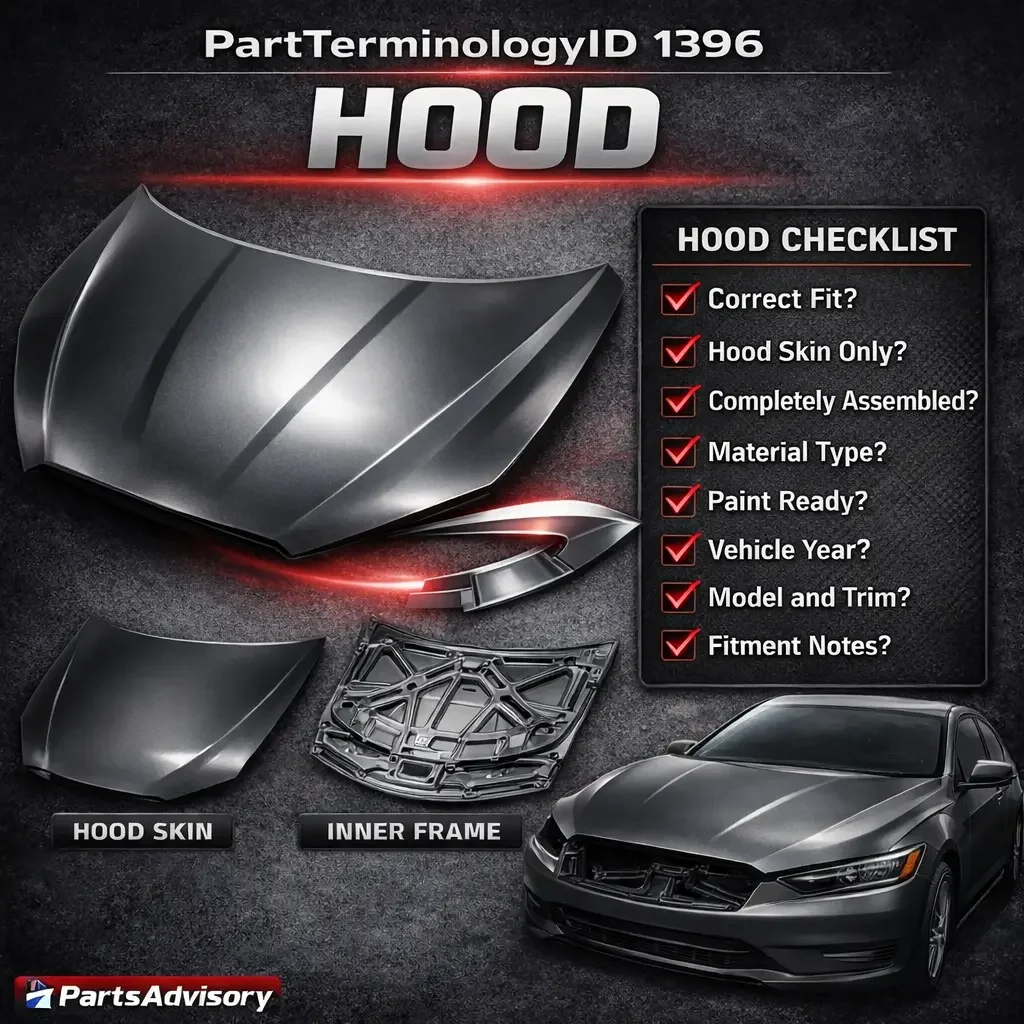
Hood panel (outer skin with inner reinforcement). The standard replacement hood. Consists of the outer skin (the visible surface) bonded, welded, or hemmed to an inner reinforcement panel (the structural skeleton visible when the hood is open). The inner reinforcement provides rigidity and includes the latch mounting area, hinge mounting points, prop rod socket or gas strut mounting, and hood insulator clip locations. This is the most common aftermarket product form.
Hood panel (outer skin only). On some applications, the outer skin can be replaced separately from the inner reinforcement. The old inner panel is retained, and the new outer skin is bonded or hemmed to it. This is less common and requires skilled bodywork.
Hood assembly (complete with hinges, latch, and hardware). Some recycled/salvage hoods are sold as complete assemblies with the hinges, latch, gas struts, and sometimes the hood insulator pad still attached. This is a convenience for the buyer but adds weight and shipping complexity.
Aftermarket performance or styling hoods. Fiberglass, carbon fiber, or modified-design hoods sold as appearance or performance upgrades. These include cowl induction hoods, ram air hoods, vented hoods, and scooped hoods. They are typically lighter than OEM steel hoods but may not include the OEM inner reinforcement structure. They are a niche market but a real catalog category.
What this part does NOT cover
Hood hinge (the pivot mechanism attaching the hood to the body). Different PartTerminologyID.
Hood latch (the mechanism at the front of the hood that secures it to the body). Different PartTerminologyID.
Hood release cable (PartTerminologyID 1360, covered earlier in the release cable series). The cable from the cabin lever to the hood latch.
Hood strut / gas strut / prop rod (the support that holds the hood open). Different PartTerminologyID.
Hood insulator pad (the foam or fiber pad on the underside of the hood for heat and sound insulation). Different PartTerminologyID.
The Shipping and Packaging Challenge
Hood is the most shipping-damage-prone body panel in the aftermarket. The reasons are physics, geometry, and the realities of LTL freight handling.
Why hoods are the hardest panel to ship
Largest flat surface area of any body panel. A hood presents 16 to 25 square feet of exposed surface that must arrive without a single dent, crease, or scratch. For comparison, a fender has roughly 6 to 8 square feet of exposed surface. A door has roughly 8 to 12 square feet, but much of it is protected by the internal frame. The hood's entire outer skin is exposed and vulnerable.
Thin gauge material. Hood outer skins are thin gauge steel (typically 0.7mm to 0.9mm) or aluminum (typically 0.9mm to 1.2mm). This is thin enough to dent from hand pressure in some areas. A hood does not need to be hit hard to be damaged. It needs to be touched wrong once.
Flat geometry amplifies dents. A curved surface (like a fender) distributes minor impacts across its curvature, which can sometimes prevent visible denting. A hood has large flat or gently crowned areas, especially in the center, where even minor pressure creates a visible depression. Body shops call these "oil canning" dents because the metal flexes in and out like the bottom of an oil can. These dents are visible in any lighting condition and cannot be ignored.
Weight. A steel hood weighs 30 to 50 pounds. An aluminum hood weighs 20 to 35 pounds. A truck hood can weigh 40 to 60 pounds or more. This is heavy enough to be awkward to handle and light enough that it gets moved by hand or leaned against things rather than secured to equipment, increasing handling damage risk.
Oversized dimensions require LTL freight. Hoods exceed the size limits for parcel carriers (UPS, FedEx Ground). They must ship via LTL freight, which means multiple handling events at freight terminals between origin and destination. Every loading dock, every forklift transfer, and every co-loading with other freight is an opportunity for damage.
No natural protection. A door can be shipped with the inner panel facing outward, protecting the skin. A fender pair can be shipped skin-to-skin with a separator. A hood has no natural protected side. The outer skin is the widest, flattest surface, and it faces upward or outward in almost any shipping orientation. There is no way to orient a hood on a pallet that does not leave the skin exposed to something.
Common shipping damage patterns
Center dents from stacking. Despite "DO NOT STACK" labels, freight on top of a hood or pressing against it from above at a terminal creates a dent in the center of the panel. This is the most common shipping damage pattern.
Edge and corner creases. The leading edge (front) and the sides where the hood meets the fenders are thin and crease easily from contact with pallet edges, dock bumpers, or adjacent freight.
Hinge mount area distortion. The rear of the hood where the hinges attach is a structural mounting point. Impact to this area can distort the mounting holes or bend the inner reinforcement, which prevents proper hinge alignment and hood closure.
Latch area damage. The front center of the hood where the latch engages the striker is another structural point. Damage here prevents the hood from latching securely.
Surface scratches from packaging materials. Shrink wrap, strapping, and even cardboard can scratch the primed surface if the hood shifts during transit. Scratches through the primer require additional surface preparation before painting.
Shipping best practices for hoods
Flat crating with top protection. The gold standard. Build a flat wooden crate around the hood with internal foam padding on the skin surface, corner protectors, and a rigid top panel that prevents anything from pressing down on the hood surface. The crate must be forklift-compatible and labeled "DO NOT STACK" and "THIS SIDE UP."
Pallet-mounted with foam blanket and rigid cap. Lay the hood skin-up on a flat pallet with a full-coverage foam blanket on the skin surface, then place a rigid board (plywood or thick corrugated) on top of the foam as a protective cap. Secure the entire assembly with strapping around the pallet. The rigid cap distributes any top-loading force across the entire surface instead of creating a point dent.
A-frame vertical shipping. Some high-volume distributors ship hoods vertically on A-frame racks designed for body panels. The hood stands on edge with protective padding at all contact points. This reduces the flat surface exposure but requires specialized racking that most sellers do not have.
Never ship a hood in shrink wrap alone. Shrink wrap provides moisture protection and holds the hood to the pallet, but it provides zero impact protection. A hood shipped in only shrink wrap on a pallet will arrive damaged. There are no exceptions at scale.
The cost of hood shipping damage
A typical aftermarket hood costs $200 to $500. LTL freight for a hood costs $100 to $300 depending on distance. If the hood arrives damaged and must be returned, the seller pays return freight ($100 to $300) plus ships a replacement ($100 to $300 more). A single shipping damage return on a $300 hood can cost $400 to $600 in freight alone. The seller loses money on the transaction.
At volume, hood shipping damage rates of even 5% to 10% can destroy the profitability of a body parts business. Investing $30 to $50 per hood in proper packaging (foam, rigid cap, corner protectors, proper crating) is not a cost. It is margin protection.
Fitment Variables That Drive Returns
Material
Steel. The traditional standard. Most passenger car and older truck hoods are stamped steel. Repairable with standard body shop tools and techniques. Heavier than aluminum.
Aluminum. Used on all Ford F-150 hoods since 2015, many luxury vehicles (BMW, Audi, Mercedes, Jaguar, Range Rover), and some performance vehicles. Aluminum hoods are lighter, which improves fuel efficiency and performance. They require different repair techniques (aluminum-specific welding, no traditional body filler in some cases), different tools, and different paint preparation. An aluminum hood on a steel-body vehicle is standard on some platforms (mixed-material construction), but a steel hood on an aluminum-body vehicle is not compatible.
Fiberglass. Used on some aftermarket performance and styling hoods, and on a small number of OEM applications (Corvette). Lighter than steel, does not dent, but cracks on impact rather than deforming. Fiberglass hoods may not include a metal inner reinforcement, which affects latch and hinge mounting. Not all fiberglass hoods meet the same structural standards as OEM steel or aluminum.
Carbon fiber. The premium aftermarket performance option. Extremely lightweight and strong. Very expensive. Used almost exclusively in the aftermarket upgrade market and on high-end OEM performance vehicles. Carbon fiber hoods may require hood pins (aftermarket latching hardware) rather than the OEM latch system due to different inner reinforcement design.
SMC (Sheet Molding Compound) / composite. Used on some OEM applications, particularly trucks and commercial vehicles. Lighter than steel, does not rust, but repairs differently than metal.
Hood scoop, vent, and functional provisions
Different trim levels and packages on the same vehicle can have different hoods:
Hood scoop. Performance or off-road trims may have a functional or decorative hood scoop that is molded into the hood. The base trim does not have a scoop. These are different hoods with different part numbers.
Heat extraction vents. Some performance vehicles and heavy-duty trucks have functional vents in the hood for engine bay heat extraction. These are structurally integrated into the hood panel and create different part numbers.
Washer nozzle provisions. Some vehicles mount the windshield washer nozzles on the hood. The hood must have mounting holes and hose routing for the nozzles. Other vehicles mount the nozzles on the cowl panel, and the hood has no nozzle provisions. A hood with nozzle holes on a vehicle that mounts nozzles on the cowl has unwanted holes.
Hood insulator clip locations. The underside of the hood has push-in clip locations for the hood insulator pad. These clip locations vary by model year, engine option (the insulator shape changes based on engine bay layout), and trim level. While this does not affect external fitment, it affects whether the insulator pad transfers properly to the replacement hood.
ADAS and sensor integration
An emerging fitment variable that will become more significant over time:
Hood-mounted pedestrian detection sensors. Some vehicles mount pressure sensors or accelerometers under the hood skin as part of a pedestrian detection system. When the system detects a pedestrian impact, it triggers the hood to pop up at the rear (active hood lift) to create a deformation zone that cushions the pedestrian's head impact with the hood surface. Vehicles with this system have different hood inner reinforcement, different hinge mounting (to accommodate the active lift mechanism), and sometimes different hood material or thickness.
Under-hood cameras. Some vehicles with surround-view systems mount a forward-facing camera under the front edge of the hood. The hood must have a provision (cutout or transparent window) for the camera.
Generation and facelift
Hood contours change with vehicle generations and sometimes with facelifts. The hood must match the specific generation for the fender gap line, the headlight interface at the front corners, and the cowl/windshield interface at the rear. A pre-facelift hood on a post-facelift vehicle may not align with changed fender or headlight contours.
Power dome, flat, or sculpted surface
Within the same generation, different engine options may have different hoods. A turbocharged engine may require a power dome (raised area) on the hood for intake or intercooler clearance. A standard naturally aspirated engine may use a flat hood. A diesel engine with a taller engine may require additional under-hood clearance. These are different part numbers.
The Paint and Color Challenge
Like fenders, hoods arrive primed and must be painted to match the vehicle. But hoods have additional paint challenges:
Largest painted surface. The hood is the largest single painted surface on the vehicle. Color match errors that might be subtle on a smaller panel like a fender become glaring on a 4-by-4-foot hood. Metallic flake orientation, pearl effect, and color shift are all more visible across a large flat surface.
Blend panels. When the hood is repainted, the paint shop typically blends into both fenders to ensure a seamless color transition. This means a hood repaint actually involves partial painting of three panels (hood plus both fenders), which adds cost and labor.
Hood underside. The underside of the hood (visible when the hood is open) must be painted or at least coated for corrosion protection and appearance. Some shops paint the underside body color. Others apply a black or semi-gloss coating. The OEM finish on the underside varies by manufacturer.
Clear coat quality on flat surfaces. The hood's large flat surface is the most demanding test of clear coat application. Orange peel (a textured finish that looks like the surface of an orange) is more visible on large flat panels than on curved surfaces. High-quality paint work on a hood requires careful spray technique, proper booth conditions, and thorough surface preparation on the primer.
The OEM vs. Aftermarket vs. Recycled Decision
OEM hoods
Exact fit guaranteed. Correct material, correct inner reinforcement structure, correct hinge mounting geometry, correct latch area, correct insulator clip locations. The most expensive option. OEM hoods arrive primed from most manufacturers. For aluminum hoods, OEM is particularly important because the alloy grade, temper, and thickness are engineered to the vehicle's structural requirements.
CAPA-certified aftermarket hoods
Independently tested for fit, material thickness, and structural dimensions. The most reliable aftermarket option. Available for high-volume applications. Generally fits well with minor adjustment during installation.
Non-certified aftermarket hoods
Lower cost, no independent verification. Fit quality varies. The most common issues are inner reinforcement that does not match OEM geometry (affecting hinge and latch alignment), material that is thinner gauge than OEM (affecting rigidity and dent resistance), and primer quality that varies. Non-certified hoods are the highest-return tier in this category.
Recycled (salvage) hoods
OEM hoods from wrecked or end-of-life vehicles. The advantage is OEM fitment and material at a lower price. The disadvantage is potential prior damage (repainted, minor dents, hail damage), corrosion on the inner reinforcement (especially from salt-belt vehicles), and faded or mismatched paint. Recycled hoods from southern or western states tend to have better exterior condition but may have UV-degraded clear coat. Recycled hoods from northern states may have cleaner surfaces but corroded inner panels.
For catalog teams, quality tier (OEM, CAPA Certified, Non-Certified Aftermarket, Recycled/Salvage) must be a primary attribute on every hood listing.
The Insurance and Collision Repair Ecosystem
Hood replacement is one of the most common line items on front-end collision estimates. The part source decision follows the same pattern as fenders:
Insurance estimates typically specify aftermarket hoods for vehicles older than 2 to 3 years. The price difference between aftermarket and OEM hoods can be $300 to $800 or more, which makes hoods a prime target for cost reduction on insurance estimates.
Supplement requests for OEM are common. When an aftermarket hood does not fit properly (hinge alignment off, latch area misaligned, fender gap uneven), the collision shop submits a supplement to the insurance company requesting authorization to switch to OEM. This adds days to the repair cycle and creates friction. Shops that consistently receive well-fitting aftermarket hoods (CAPA certified) submit fewer supplements.
Aluminum hood repairs are limited. Many collision shops are not equipped to repair aluminum body panels. If an aluminum hood is dented but not creased through, an OEM or recycled replacement may be preferable to repair because aluminum body repair requires specialized training, tools, and a dedicated repair area to prevent galvanic corrosion contamination.
Compatibility Checklist for Buyers
1) Confirm material. Steel, aluminum, fiberglass, carbon fiber, or SMC. Must match the vehicle's original specification or be a deliberate upgrade with known compatibility.
2) Confirm generation and facelift. The hood contour must match the fender and headlight interface for the specific model year.
3) Confirm trim level and engine option. Hood scoop, power dome, heat vents, washer nozzle provisions, and insulator clip locations vary by trim and engine.
4) Confirm pedestrian detection or active hood provisions. If your vehicle has a pedestrian detection system with active hood lift, the replacement hood must be compatible with that system.
5) Confirm product form. Hood panel only, or hood with inner reinforcement included. Virtually all replacement hoods include the inner reinforcement. If purchasing a skin-only replacement, confirm compatibility with the existing inner panel.
6) Confirm quality tier. OEM, CAPA Certified, Non-Certified Aftermarket, or Recycled. Understand the tradeoffs.
7) Budget for paint. Hoods arrive primed. Plan for full paint plus blending into both fenders. Metallic, pearl, and tri-coat colors will cost more.
8) Inspect at delivery. Before signing the freight receipt, inspect the hood outer skin for dents (especially center dents from stacking), creases on edges, and distortion at hinge and latch mounting points. Check the inner reinforcement for bends or shipping damage. Photograph any damage and note it on the delivery receipt before the driver leaves.
Catalog Checklist for Attributes and Structured Data
Core taxonomy and naming
Terminology Name: Hood
Product form: Hood Panel (with inner reinforcement), Hood Skin Only, Hood Assembly (with hinges/latch/hardware), Performance/Aftermarket Styling Hood
Separate from Hood Hinge, Hood Latch, Hood Release Cable, Hood Strut, Hood Insulator, and all other hood components
Fitment structure
Year, make, model, submodel, trim level
Engine option (where engine affects hood clearance: turbo, diesel, hybrid, performance)
Generation and facelift status
Hood scoop (yes/no), heat extraction vents (yes/no), power dome (yes/no)
Washer nozzle provisions (hood-mounted or cowl-mounted)
Pedestrian detection / active hood lift system (yes/no)
Under-hood camera provision (yes/no)
Material and construction
Material: steel, aluminum, fiberglass, carbon fiber, SMC/composite
Gauge/thickness (if specified)
Inner reinforcement: included (yes/no), material
Primer type
Components included
Inner reinforcement panel (yes/no)
Hood insulator pad (yes/no, usually not included)
Hinges (yes/no, usually not included on aftermarket, may be included on recycled)
Latch (yes/no)
Gas struts / prop rod (yes/no)
Washer nozzles (yes/no)
Mounting hardware
Quality and certification
OEM
CAPA Certified (include CAPA seal number)
Non-Certified Aftermarket
Recycled/Salvage (donor vehicle mileage, condition grade, paint condition, inner panel corrosion assessment)
Image requirements
Top view of outer skin (showing overall shape, scoop/vents if applicable, washer nozzle locations)
Underside view showing inner reinforcement structure, hinge mounting points, latch area, insulator clip locations
Front edge close-up (latch engagement area)
Rear edge close-up (hinge mounting area, cowl interface)
Side edges (fender gap interface)
Packaging photo showing how the hood is crated/protected for shipping
Common Buyer Scenarios
Scenario 1: Center dent from shipping damage
A collision shop orders a CAPA-certified steel hood for a 2022 Honda Civic. The hood arrives on a pallet wrapped in shrink wrap with no rigid top protection. There is a 6-inch diameter depression in the center of the hood where a piece of freight was stacked on top of it at a terminal. The dent is shallow but visible from every angle.
What went wrong: No rigid cap or foam blanket on the hood surface. Shrink wrap alone provides zero dent protection. The freight carrier ignored the "DO NOT STACK" label.
What helps: Foam blanket on the entire skin surface plus a rigid plywood or corrugated cap on top, secured with strapping. The rigid cap distributes any top-loading force so a single point cannot dent the surface.
Scenario 2: Flat hood ordered for turbo engine with power dome
A buyer orders a hood for a 2020 Subaru WRX. The listing says "fits 2015 to 2021 WRX" but does not specify engine. The hood that arrives is flat. The buyer's WRX has the turbocharged FA20 engine with a functional hood scoop and power dome for intercooler clearance. The flat hood will not close because it contacts the intercooler.
What went wrong: The listing did not differentiate between the base Impreza hood (flat) and the WRX hood (scoop and dome). The year range was too broad and covered both models without submodel differentiation.
What helps: Submodel as a mandatory fitment qualifier. "WRX Hood with Scoop" versus "Impreza Hood (Flat)." Engine option as an attribute where engine clearance affects hood design.
Scenario 3: Steel hood ordered for aluminum-body vehicle
A buyer orders a hood for a 2019 Ford F-150 from a marketplace listing that does not specify material. A steel hood arrives. The 2019 F-150 uses an aluminum body. The steel hood is the wrong material, significantly heavier, and incompatible with the aluminum body structure at the mounting points.
What went wrong: Material not specified. This is the same scenario covered in the Fender post (PartTerminologyID 1380) because the F-150 aluminum transition affects hoods, fenders, and doors equally.
What helps: Material as a primary attribute. "Aluminum Hood" or "Steel Hood" in the title. Fitment data that does not combine pre-2015 steel F-150 hoods with 2015+ aluminum F-150 hoods under a single listing.
Scenario 4: Recycled hood with hidden inner panel corrosion
A shop orders a recycled OEM aluminum hood for a 2017 BMW 530i. The exterior looks clean in the listing photos. When the hood arrives, the inner reinforcement has significant corrosion at the hinge mounting points where moisture collected and sat. The corrosion has weakened the mounting area enough that the shop does not trust the hinge bolts to hold.
What went wrong: The recycled hood listing showed exterior photos only. The inner reinforcement corrosion was not visible or was not photographed.
What helps: For recycled listings, include underside photos showing the inner reinforcement, especially at hinge and latch mounting areas. Include a corrosion assessment in the condition description. Note the geographic origin of the donor vehicle (salt-belt versus non-salt-belt).
FAQ
Why is the hood the most expensive body panel to ship?
Because it is the largest flat panel on the vehicle, it exceeds parcel carrier size limits, requires LTL freight, and its flat surface dents from even minor contact during transit. Proper packaging (crating, foam, rigid cap) adds cost but is necessary to prevent damage.
Should I order an OEM or aftermarket hood?
For aluminum hoods, OEM is strongly recommended because the alloy grade and structural engineering are critical. For steel hoods on common vehicles, CAPA-certified aftermarket hoods offer good fit at lower cost. Non-certified hoods carry more fitment and material quality risk.
How much does it cost to paint a replacement hood?
The hood is the largest painted surface on the vehicle. A solid-color hood typically costs $400 to $600 to paint with blending into both fenders. Metallic, pearl, and tri-coat colors can cost $500 to $900 or more.
My vehicle has a pedestrian detection system. Does that affect the hood?
Yes. Vehicles with pedestrian detection and active hood lift have different inner reinforcement, different hinge mounting (to accommodate the lift mechanism), and sometimes different material requirements. The replacement hood must be compatible with the active hood system.
Can I upgrade from a steel hood to a carbon fiber hood?
You can, but there are tradeoffs. Carbon fiber is lighter but may not include the OEM inner reinforcement structure, which means the OEM latch may not work (hood pins may be required). The OEM gas struts may be too strong for the lighter hood, causing it to pop open aggressively. And carbon fiber is significantly more expensive. It is primarily a performance and appearance upgrade, not a standard collision replacement.
How should I inspect a hood at delivery?
Run your hand over the entire outer skin surface feeling for dents and depressions, especially in the center. Check all four edges for creases. Check the hinge mounting area at the rear for distortion. Check the latch area at the front for bends. Check the inner reinforcement for shipping damage. Photograph any issues and note them on the freight receipt before the driver leaves.
Final Take for Aftermarket Teams
Hood (PartTerminologyID 1396) is the largest, flattest, and most shipping-vulnerable body panel in the aftermarket. It combines the fitment complexity of trim level variants (scoop, dome, vents, washer nozzles, ADAS provisions) with the material complexity of steel versus aluminum versus composites and the most punishing shipping damage profile of any part in the catalog. A 5% shipping damage rate on hoods can eliminate profitability for a body parts business.
The catalog teams and sellers that win in this category specify material as a primary attribute, differentiate by engine option and trim-level hood design, state product form clearly, include underside photos showing inner reinforcement and mounting points, and invest in proper packaging (foam blanket, rigid cap, corner protectors, proper crating) that treats hood shipping as a margin-protection investment rather than a cost. Hood is the part where everything this blog series has covered about fitment accuracy, quality tier transparency, and shipping execution comes together on the largest and most visible canvas on the vehicle.