
Headlight Bulb Retainer (PartTerminologyID 1392): Another Small Plastic Part That Breaks and Leaves the Headlight Useless
Written by Arthur Simitian | PartsAdvisory
The previous post covered Headlight Adjusting Screw (PartTerminologyID 1388), the two-dollar plastic part that holds up collision repairs when it snaps. Headlight Bulb Retainer is the same type of problem: a small, cheap, vehicle-specific plastic component that nobody thinks about until it breaks, and when it breaks, the headlight does not work.
The bulb retainer is the clip, ring, bracket, or locking mechanism that holds the headlight bulb in position inside the headlight assembly. It secures the bulb in the correct orientation so the filament or LED element sits at the focal point of the reflector or projector lens. If the retainer breaks, the bulb falls out of position. The beam pattern distorts, the bulb may rattle loose, or the bulb may not stay seated at all. The headlight is functionally useless even though the bulb, the wiring, and the headlight assembly are all fine.
Like the adjusting screw, the bulb retainer is a part that breaks during routine service (bulb replacement) rather than from collision damage. A technician or vehicle owner changes a burned-out headlight bulb, twists the retainer to release the old bulb, and the retainer clip snaps because the plastic has become brittle from years of heat exposure behind the headlight lens. Now instead of a five-minute bulb change, the job has become a parts-sourcing problem.
This post is built for aftermarket catalog teams, marketplace sellers, and buyers who want fewer mistakes and fewer returns.
Status in New Databases
Status in New Databases
Current: PIES 7.2 + PCdb Future: PIES 8.0 + PCdb 2.0 Status: No change
What Headlight Bulb Retainer Means in the Aftermarket
Headlight Bulb Retainer refers to the mechanical device that locks the headlight bulb into the correct position within the headlight assembly. The retainer holds the bulb base against the reflector mounting point and keeps it from rotating, vibrating loose, or falling out.
In catalog reality, this covers several distinct designs:
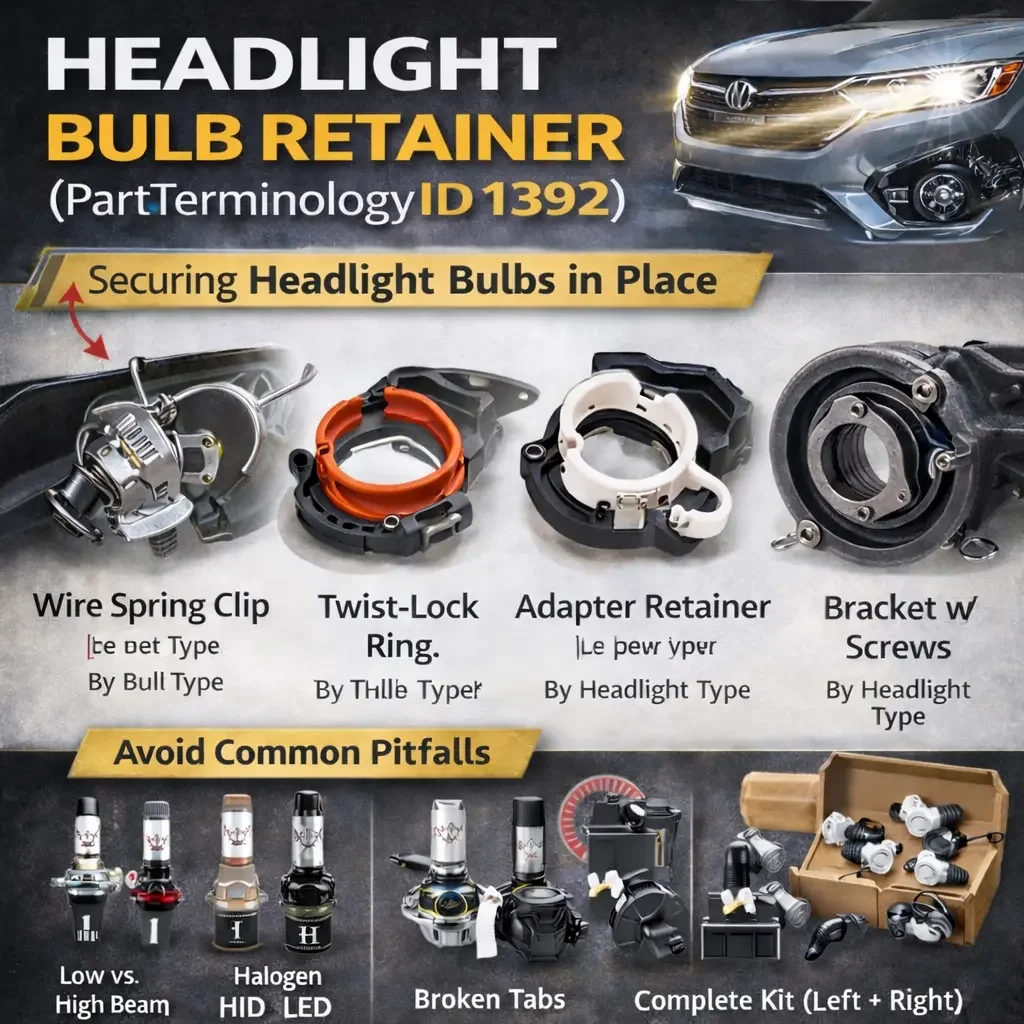
Wire spring clip (bayonet type). A formed wire spring that snaps over the bulb base flange and holds it against the reflector socket. Common on H1, H4, H7, and other halogen bulb types. The wire clip pivots on one end and latches on the other. Over time the spring tension weakens, or the latch point on the plastic housing cracks, and the clip no longer holds the bulb securely.
Twist-lock ring. A plastic or metal ring that threads or twists onto the back of the headlight housing to lock the bulb in place. Common on some H7 and HID/D-series bulb applications. The ring has tabs that engage slots in the housing. The plastic tabs are the failure point.
Plastic clip retainer. A molded plastic clip that snaps over the bulb base and clicks into a detent on the headlight housing. Common on many Asian-market vehicles. The clip is thin, brittle after heat exposure, and snaps during bulb removal.
Adapter ring. Some vehicles (particularly European makes) use an adapter ring that the bulb seats into before the ring is inserted into the headlight housing. The adapter ring sets the bulb orientation and depth. Different bulb types (halogen, HID, LED retrofit) may require different adapter ring configurations.
Retainer bracket with screws. On some older or heavy-duty headlight assemblies, the bulb is held by a small metal bracket secured with one or two screws. The bracket itself rarely fails, but the screw threads in the plastic housing can strip.
What this part does NOT cover
Headlight bulb. The bulb itself. Different PartTerminologyID.
Headlight assembly. The complete housing. Different PartTerminologyID.
Headlight socket or connector. The electrical connector that plugs into the bulb base. Different PartTerminologyID.
Headlight adjusting screw (PartTerminologyID 1388). Controls beam aim, not bulb retention.
Why This Category Creates Fitment Problems
Bulb type determines the retainer
The retainer design is matched to the bulb type. An H7 bulb uses a different retainer than an H1. An H4 uses a different retainer than an H11. An HID D2S uses a different retainer than a halogen H7. The bulb base shape, flange width, and orientation tab positions vary between bulb types, and the retainer must match.
On vehicles that were offered with different headlight options (halogen standard, HID optional, LED optional), the bulb type is different for each option, and the retainer is different for each bulb type. The listing must specify which bulb type the retainer is designed for, or at minimum, which headlight assembly option.
Headlight assembly design determines the retainer
Even for the same bulb type, different headlight assembly designs use different retainer mechanisms. A 2018 Honda Accord with an H11 low beam bulb uses a different retainer design than a 2018 Toyota Camry with an H11 low beam bulb, because the headlight housings are manufactured by different suppliers with different retainer geometry.
This means the retainer is not cataloged by bulb type alone. It must be cataloged by vehicle application (year, make, model, submodel) and headlight type (halogen, HID, LED).
Low beam versus high beam versus fog light
A single headlight assembly may use different bulb types for low beam, high beam, and fog light functions. Each function may use a different retainer. The listing must specify which beam function the retainer serves.
LED headlights may not use a replaceable bulb retainer
On vehicles with factory LED headlights, the LED module is typically integrated into the headlight assembly and is not a replaceable bulb with a separate retainer. The entire LED module or the headlight assembly is replaced as a unit. If a buyer searches for a bulb retainer for an LED headlight vehicle, the part may not exist.
However, the aftermarket LED retrofit market complicates this. Buyers who replace their factory halogen bulbs with aftermarket LED retrofit bulbs may need a different retainer or adapter to accommodate the LED bulb base, which is often a different shape than the original halogen base. Some LED retrofit kits include an adapter retainer. Some do not, and the buyer must source one separately.
Fragility and breakage during service
The retainer breaks during bulb replacement, not during normal driving. This means the buyer searching for a retainer is usually in the middle of a job. They removed the old bulb, the retainer snapped, and now they need the retainer before they can install the new bulb. Speed of availability matters. A retainer that ships in 3 to 5 days is less valuable than one available at a local parts store today.
Top Return Causes
1) Wrong bulb type application
Retainer is for H7 but the vehicle uses H11, or vice versa.
Prevention: Specify bulb type compatibility in the title: "H7 Headlight Bulb Retainer" or "H11 Low Beam Bulb Retainer." Cross-reference to headlight assembly and bulb type.
2) Wrong beam function (low beam versus high beam)
Buyer orders a retainer for the low beam and receives one for the high beam, or vice versa.
Prevention: Specify beam function: "Low Beam Bulb Retainer" or "High Beam Bulb Retainer."
3) Wrong headlight assembly generation
The vehicle had a headlight assembly change between model years (halogen to LED standard, or reflector to projector), and the retainer from the old assembly does not fit the new one.
Prevention: Full ACES fitment data with headlight type qualifier. "For vehicles with halogen headlights" versus "For vehicles with projector HID headlights."
4) LED headlight vehicle, no replaceable retainer exists
Buyer searches for a retainer for a factory LED headlight vehicle where the LED module is integrated and not separately retained.
Prevention: Do not create fitment records for factory LED headlight vehicles that do not use a separate bulb retainer. A note in the description: "For vehicles with replaceable halogen bulbs only. Not for vehicles with factory integrated LED headlight modules."
5) LED retrofit adapter needed, standard retainer ordered
Buyer installed aftermarket LED retrofit bulbs and needs a retainer/adapter for the LED bulb base shape. They order the standard halogen retainer, which does not fit the LED base.
Prevention: Separate listings: "OEM Halogen Bulb Retainer" versus "LED Bulb Adapter Retainer (For LED Retrofit Bulbs)." Note compatibility with specific LED retrofit base types.
Compatibility Checklist for Buyers
1) Identify the bulb type. Check your owner's manual or the markings on the existing bulb (H1, H4, H7, H11, 9005, 9006, D2S, etc.). The retainer must match this bulb type.
2) Identify the beam function. Low beam, high beam, or fog light. Each may use a different retainer.
3) Confirm your headlight type. Halogen reflector, halogen projector, HID projector, or factory LED. Factory LED headlights may not use a separate bulb retainer.
4) If using LED retrofit bulbs, check whether your LED kit includes an adapter. If not, source an adapter retainer specific to the LED bulb base and your headlight housing.
5) Confirm full vehicle details. Year, make, model, submodel, headlight option (halogen, HID, LED).
6) Cross-reference to OEM part number. The dealer parts counter can look this up by VIN and headlight assembly part number. This is the most reliable identification method for this category.
Catalog Checklist for Attributes
Core taxonomy: Product form (wire spring clip, twist-lock ring, plastic clip, adapter ring, retainer bracket, LED retrofit adapter). Separate from Headlight Bulb, Headlight Assembly, Headlight Socket, and Headlight Adjusting Screw.
Fitment: Year, make, model, submodel. Headlight type (halogen, HID, LED). Bulb type (H1, H4, H7, H11, 9005, 9006, D2S, etc.). Beam function (low beam, high beam, fog light). OEM part number cross-reference.
Physical specs: Retainer type (wire clip, twist ring, snap clip, adapter ring). Material (spring steel, stainless steel, plastic/nylon). Dimensions where applicable.
Package contents: Number of retainers per package (single or pair). Any included screws, springs, or adapters.
Images: Retainer from front and back, close-up of locking mechanism (clip, tab, or twist), and a reference image showing the retainer in position on the headlight housing if available.
FAQ
Why did my bulb retainer break when I changed the bulb?
The retainer is made of plastic or thin spring metal that degrades from heat exposure inside the headlight housing. After several years, plastic retainers become brittle and snap during the normal twist or unclip motion of bulb removal. This is extremely common on vehicles older than 5 to 7 years.
Can I use a zip tie or wire to hold the bulb in place?
This is a common field repair when the retainer breaks and no replacement is available. It can work temporarily, but it does not hold the bulb at the correct focal point or in the correct orientation, which distorts the beam pattern. The proper fix is to replace the retainer with the correct part.
My headlight beam pattern looks wrong after a bulb change. Could it be the retainer?
Yes. If the retainer is broken, damaged, or missing, the bulb may sit at the wrong depth or angle inside the reflector. This shifts the beam pattern and can cause glare for oncoming drivers or poor road illumination. Check that the retainer is intact and the bulb is fully seated.
Final Take for Aftermarket Teams
Headlight Bulb Retainer (PartTerminologyID 1392) is the companion to Headlight Adjusting Screw (1388) in the category of small, cheap, vehicle-specific plastic parts that fail from heat degradation and create disproportionate problems. The catalog challenge is identifying the correct retainer for the correct headlight assembly, bulb type, and beam function. The listing must specify all three variables plus the headlight type (halogen, HID, LED) to avoid returns. The emerging complication is the LED retrofit market, which introduces adapter retainers that do not exist in OEM catalogs. The teams that catalog this category well provide the collision shop or DIY buyer with the exact part they need at the moment they need it, which is usually right now, in the middle of a job, with a broken clip in one hand and a new bulb in the other.