
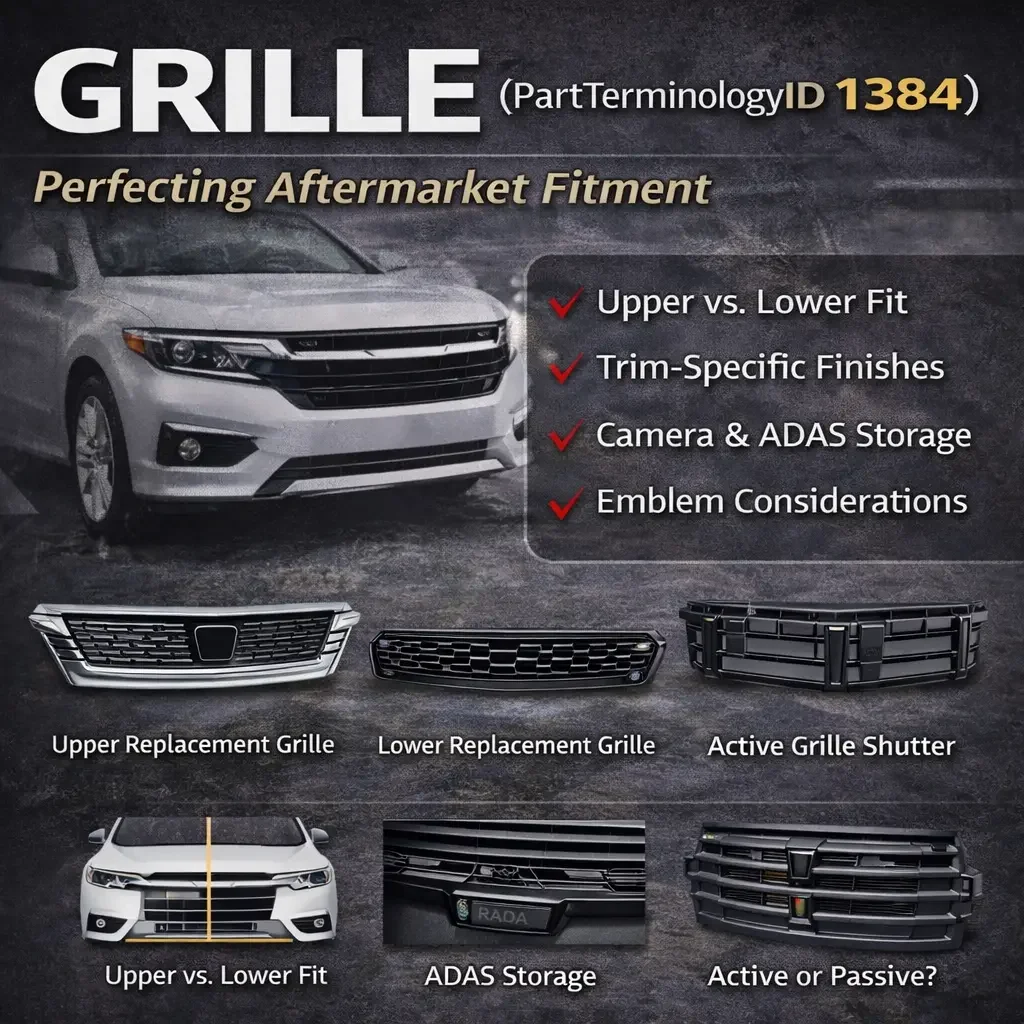
Written by Arthur Simitian | PartsAdvisory
Every vehicle has a face. The grille is it. It is the single most recognizable design element on the front of any car, truck, or SUV, and the part that defines the vehicle's brand identity more than any other exterior component. A BMW kidney grille, a Jeep seven-slot grille, a Ford F-150 three-bar grille, a Toyota Tacoma blacked-out mesh grille, a Mercedes three-pointed star grille. People identify vehicles by their grilles before they read the badge.
This makes Grille (PartTerminologyID 1384) one of the most visually unforgiving parts in the aftermarket. When a bumper cover or fender is slightly off, a body shop can adjust gaps and blend paint. When a grille is wrong, it is wrong in the most visible square footage on the entire vehicle. Wrong color, wrong finish, wrong pattern, wrong texture, wrong emblem provision, wrong sensor opening. The customer sees it every time they walk up to their vehicle. The person behind them at a stoplight sees it. Everyone sees it.
Grille is also one of the most complex catalog categories because of the sheer number of variants that exist for a single vehicle model. Trim levels, appearance packages, special editions, active shutter systems, ADAS sensor integration, and the explosion of color and finish options in the last decade have made grille fitment a cataloging challenge that rivals bumper covers. The number of SKUs required to properly cover a single popular model like the Toyota RAV4 or Ford F-150 across all trim levels and model years can easily exceed 20 grille variants.
This post is built for aftermarket catalog teams, marketplace sellers, and buyers who want fewer mistakes and fewer returns.
Status in New Databases
Status in New Databases
Current: PIES 7.2 + PCdb Future: PIES 8.0 + PCdb 2.0 Status: No change
What Grille Means in the Aftermarket
Grille (PartTerminologyID 1384) refers to the front-facing panel or assembly that covers the opening in the front fascia of the vehicle, typically between or surrounding the headlights. Its original functional purpose was to allow airflow to the radiator and engine cooling system. On modern vehicles, the grille serves that function plus brand identification, aesthetic design, ADAS sensor housing, aerodynamic management, and on some vehicles, active airflow control.
In catalog reality, this covers a wide range of product forms:
Upper grille. The main grille assembly in the upper portion of the front fascia, typically between the headlights. This is what most people mean when they say "grille." It may be a standalone assembly that snaps or bolts into the bumper cover, or it may be integrated into the bumper cover as a molded-in element.
Lower grille. A separate grille or grille insert in the lower portion of the bumper cover, below the upper grille. Often found in the lower air intake area. May be a simple mesh or a styled panel. Some vehicles have multiple lower grilles (center, left, and right).
Grille insert. An inner component that fits inside a grille frame or surround. The grille may consist of an outer frame (the surround or bezel) and an inner insert (the patterned element). These are sometimes sold separately. The insert may snap into the surround, or the surround may snap into the bumper cover with the insert pre-installed.
Grille surround / bezel. The outer frame that borders the grille opening. On some vehicles, the surround is chrome, body-color, or gloss black, and the insert is a different finish. The surround and insert may be separate part numbers.
Active grille shutter assembly. A motorized grille with louvers or vanes that open and close automatically to regulate airflow for aerodynamic efficiency and engine temperature management. Common on many vehicles since approximately 2012. When the shutters are closed at highway speed, aerodynamic drag is reduced, improving fuel efficiency. These are electromechanical assemblies with motors, actuators, and electronic controls. They are significantly more expensive than passive grilles and require electrical connection to the vehicle's powertrain control module.
Grille guard / brush guard. An aftermarket or accessory tubular metal guard that mounts in front of the grille for protection. This is NOT the same as the grille itself and is typically a different PartTerminologyID. However, buyers searching for "grille" sometimes mean "grille guard," creating search confusion.
What this part does NOT cover
Bumper cover (PartTerminologyID 1344). The bumper cover may contain the grille opening, but the grille is the panel or assembly that fills that opening.
Grille guard / brush guard / bull bar. Accessory protective bars mounted in front of the grille.
Hood scoop or air intake. Functional or decorative openings on the hood surface.
Radiator or condenser behind the grille.
The Color, Finish, and Material Matrix
This is what makes grille one of the most complex catalog categories. A single vehicle model can have 8 to 15 or more grille variants based on combinations of color, finish, and material. The permutations are enormous.
Materials
ABS plastic. The most common grille material. Lightweight, moldable into complex shapes, and accepts paint, chrome plating, and various surface finishes. Most aftermarket grilles are ABS.
Polypropylene (PP). Used for some grilles, particularly lower grilles and economy-grade applications. Less rigid than ABS, which can affect snap-fit retention over time.
Thermoplastic polyolefin (TPO). Used on some grilles that are integrated into or closely mated with TPO bumper covers. Paint adhesion on TPO requires specific primer preparation.
Chrome-plated plastic. ABS or other plastic substrate with a chrome plating applied. This is the most common method for producing chrome grilles on modern vehicles. The chrome is a multi-layer electroplated finish (copper, nickel, chrome) over plastic, not solid metal.
Stainless steel or aluminum. Used on some aftermarket billet or mesh grilles, and on certain OEM applications (particularly trucks). These are true metal grilles, not plastic with a metallic finish.
Carbon fiber or carbon fiber look. Used on performance and appearance packages. True carbon fiber is a composite material that is lightweight and rigid. Carbon fiber "look" is a plastic with a printed or hydrographic film that imitates carbon fiber weave pattern.
Colors and finishes
This is where the variant explosion happens. A single vehicle model year may offer grilles in the following finishes, each requiring a different part number:
Chrome. Full chrome plating on the grille bars, surround, or both. The traditional premium finish. Chrome grilles are the most visible and the most demanding in terms of quality. A chrome finish that is cloudy, pitted, peeling, or unevenly plated is immediately obvious.
Gloss black. Painted or molded gloss black. Increasingly popular as manufacturers move toward blacked-out front-end styling. Gloss black shows every fingerprint, scratch, and swirl mark, which makes surface quality critical.
Matte black / textured black. Unpainted textured black plastic. The base-trim finish on many vehicles. Lower cost, more forgiving of minor imperfections than gloss finishes.
Satin / brushed. A metallic finish that is neither mirror-chrome nor matte. Used on some luxury and sport trims. Difficult to replicate consistently in aftermarket production.
Body color (painted). Some vehicles have grilles or grille surrounds that are painted to match the body color. This means the grille must arrive primed for the shop to paint, or pre-painted to a specific color code. Body-color grilles create an additional fitment variable (color code) on top of all the other variables.
Dark chrome / shadow chrome. A tinted chrome finish that is darker than traditional chrome but still metallic. Increasingly popular on sport and appearance packages. Difficult to match between OEM and aftermarket because the tint level varies by manufacturer.
Two-tone combinations. Many grilles combine two or more finishes: chrome surround with gloss black insert, body-color surround with chrome bars, matte black frame with satin silver accents. Each combination is a different part number.
Why the color and finish problem is so acute
The grille sits at the exact center of the vehicle's face, flanked by the headlights and bordered by the bumper cover and hood. Every adjacent panel has its own color and finish. The grille finish must complement all of them. A chrome grille on a vehicle that was built with a gloss black grille looks like an upgrade (or a mistake, depending on the buyer's intent). A gloss black grille on a vehicle that was built with chrome looks like a downgrade or a replacement from the wrong trim level.
For catalog teams, finish is not an optional attribute. It is a primary fitment qualifier on the same level as year, make, and model. A listing that says "Grille, fits 2020 Toyota RAV4" without specifying the finish is guaranteed to generate returns because the 2020 RAV4 had at least five different grille configurations across its trim levels.
Trim Level: The Primary Driver of Grille Variants
On modern vehicles, trim level is the single biggest factor determining which grille the vehicle uses. Here is a representative example of how trim levels create grille variants on a single model:
Consider a popular midsize truck. The base work truck trim may have a simple matte black grille with no chrome. The mid-level trim may have a chrome surround with a painted insert. The sport or trail package may have a unique mesh pattern in gloss black with color-keyed accents. The top luxury trim may have a full chrome grille with a distinct bar pattern. The off-road package may have a completely different grille design with functional air intake provisions and unique branding.
That is five or more distinct grille assemblies for the same vehicle in the same model year. If the vehicle also has a pre-facelift and post-facelift within that generation, the count doubles. If there are left-hand-drive and right-hand-drive market variants (some grilles have asymmetric emblem or sensor placement), it increases further.
This is why grille is one of the highest-SKU categories in the aftermarket body parts catalog. And it is why "fits 2020 to 2023 Model X" without a trim qualifier is not a valid listing. It will generate returns.
ADAS Sensor Integration
Modern grilles are no longer just cosmetic panels. They are increasingly the housing or mounting surface for ADAS (Advanced Driver Assistance Systems) sensors:
Adaptive cruise control (ACC) radar. The forward-facing radar module for adaptive cruise control is typically mounted behind the grille, in the center of the front fascia. On many vehicles, the grille must have a radar-transparent area (a section made from radar-transparent plastic, typically without metallic paint or chrome plating) positioned precisely over the radar module. A grille with chrome bars across the radar zone will block the radar signal.
Front camera. Some vehicles mount a forward-facing camera behind or within the grille for the pre-collision system or front parking camera. The grille must have a lens opening or transparent window at the camera location.
Parking sensors. Ultrasonic parking sensors may be mounted in the grille area rather than (or in addition to) the bumper cover. The grille must have sensor holes at the correct locations.
Active grille shutters with sensor integration. On vehicles with both active grille shutters and front radar, the shutter system and the radar must be positioned to not interfere with each other. The shutter vanes must not block the radar signal when closed.
ADAS integration means that a grille is no longer just a cosmetic choice. It is a functional component that affects the operation of safety systems. A grille without the correct radar-transparent zone will cause adaptive cruise control to malfunction or throw a fault code. A grille without the correct camera opening will disable the front camera. These are not cosmetic annoyances. They are functional failures that affect vehicle safety.
For catalog teams, ADAS provisions must be treated as mandatory fitment qualifiers: "With Adaptive Cruise Control" versus "Without Adaptive Cruise Control," "With Front Camera" versus "Without Front Camera," "With Active Grille Shutters" versus "Without Active Grille Shutters."
Emblem and Badge Integration
Many grilles include the vehicle manufacturer's emblem or badge as an integrated element:
Molded-in emblem. The brand logo is molded directly into the grille as part of the plastic. Cannot be removed or replaced independently.
Snap-in or clip-on emblem. The emblem clips into a provision on the grille. The emblem may or may not be included with the aftermarket grille. If not included, the buyer must transfer the emblem from the original grille or purchase it separately.
Camera-in-emblem. Some vehicles (Toyota, Nissan, and others) integrate a front camera inside or behind the brand emblem on the grille. The emblem flips open to reveal the camera, or the camera lens is visible within the emblem design. This is a specific variant that requires the correct emblem provision and wiring routing.
The listing must specify: "With Emblem" or "Without Emblem (Emblem Sold Separately)" and "With Camera Provision" or "Without Camera Provision."
The Aftermarket Grille Upgrade Market
Unlike bumper covers, fenders, and doors, which are primarily collision replacement parts, grilles have a massive upgrade and customization market. Many buyers purchase aftermarket grilles not because the original is damaged, but because they want a different look:
Chrome delete. Replacing a chrome grille with a gloss black or matte black grille to achieve a blacked-out front end. This is one of the most popular aftermarket grille modifications across all vehicle types.
Chrome upgrade. Replacing a base-trim matte black grille with a chrome grille from a higher trim level or an aftermarket chrome design.
Mesh or billet conversion. Replacing the factory grille pattern with an aftermarket mesh, billet bar, or custom pattern grille. Extremely popular in the truck market.
Performance or sport conversion. Replacing the standard grille with a sport or performance package grille from a higher trim or a different market.
Emblem swap or debadge. Replacing the grille to achieve a different emblem presentation or to remove branding entirely.
This upgrade market creates a catalog challenge: the buyer may want a grille that fits their vehicle's physical mounting points but has a different finish, pattern, or trim-level appearance than what the vehicle came with from the factory. The listing must accommodate both collision replacement (exact match to the original) and upgrade (different appearance, same mounting).
For collision replacement, the listing must be fitment-precise: exact trim level, exact finish, exact ADAS provisions. For upgrades, the listing must clearly state what the grille replaces and whether it fits the buyer's specific mounting, wiring, and sensor configuration.
Top Return Causes
1) Wrong finish (chrome versus gloss black versus matte black versus body color)
The most common return cause in the category. The buyer orders a grille and receives the wrong finish because the listing did not specify finish or the trim level was not differentiated.
Prevention: Finish as a mandatory field in the title: "Upper Grille, Chrome" or "Upper Grille, Gloss Black." Include clear photos showing the actual finish, not a rendering.
2) Wrong trim level (different pattern or design)
The grille has the correct finish but the wrong bar pattern, mesh design, or surround shape for the buyer's trim level.
Prevention: Trim level as a mandatory fitment qualifier. Photos from multiple angles showing the specific pattern.
3) Missing or wrong ADAS sensor provisions
Grille does not have the radar-transparent zone for adaptive cruise control, or does not have the camera opening for the front camera.
Prevention: "With Adaptive Cruise Control" or "Without Adaptive Cruise Control" in the title and fitment data. "With Front Camera" or "Without Front Camera."
4) Emblem not included
Buyer expects the grille to include the manufacturer emblem. It arrives without one. The buyer's original emblem may be damaged (which is why they are replacing the grille) and cannot be transferred.
Prevention: "With Emblem" or "Without Emblem (Emblem Sold Separately)" in the title. State clearly in the description whether the emblem is included.
5) Upper versus lower grille confusion
Buyer orders "grille" and receives only the lower grille when they needed the upper, or vice versa.
Prevention: Position in the title: "Upper Grille" or "Lower Grille" or "Upper and Lower Grille Set."
6) Grille insert versus grille assembly confusion
Buyer orders a grille insert expecting a complete assembly (frame plus insert). Receives only the inner insert without the surround.
Prevention: Specify product form: "Grille Assembly (Surround and Insert)" or "Grille Insert Only (Surround Sold Separately)."
7) Active grille shutter assembly ordered when passive grille was needed (or vice versa)
Active shutter assemblies are significantly more expensive. A buyer who needs a passive grille and receives an active shutter assembly has overpaid. A buyer who needs an active shutter and receives a passive grille has a part that will not function with the vehicle's powertrain control system.
Prevention: "Active Grille Shutter Assembly" or "Passive Grille (Non-Motorized)" as distinct product forms in separate listings.
Compatibility Checklist for Buyers
1) Confirm position. Upper grille, lower grille, or both. Identify which grille is damaged or which grille you want to replace.
2) Confirm product form. Complete assembly, insert only, surround only, or active shutter assembly. Understand what components are included.
3) Confirm finish. Chrome, gloss black, matte black, satin, body color, dark chrome, two-tone. Match to your vehicle's factory finish or specify the desired upgrade finish.
4) Confirm trim level. The grille design and finish are tied to the trim level. Identify your trim level from the door jamb sticker or owner documentation.
5) Confirm ADAS provisions. Does your vehicle have adaptive cruise control with front radar? Does it have a front camera in the grille area? Does it have active grille shutters? The grille must have the correct provisions for all equipped systems.
6) Confirm emblem inclusion. Does the grille include the manufacturer emblem or badge? If not, can you transfer yours, or do you need to purchase one?
7) Confirm generation and facelift. Grille design is one of the most frequently changed elements in mid-cycle facelifts. Verify your specific model year and production date.
8) Confirm full vehicle details. Year, make, model, submodel, trim level, appearance package.
Catalog Checklist for Attributes and Structured Data
Core taxonomy and naming
Terminology Name: Grille
Position: Upper, Lower, Center (if applicable)
Product form: Complete Assembly, Insert Only, Surround/Bezel Only, Active Grille Shutter Assembly
Separate from Bumper Cover, Grille Guard, Hood, and all adjacent components
Fitment structure
Year, make, model, submodel, trim level (CRITICAL)
Appearance package (sport, off-road, luxury, etc.)
Generation and facelift status
ADAS: Adaptive Cruise Control (yes/no), Front Camera (yes/no), Active Grille Shutters (yes/no), Parking Sensors in grille (yes/no)
Material and finish
Material: ABS, polypropylene, TPO, stainless steel, aluminum, carbon fiber, composite
Primary finish: chrome, gloss black, matte black, satin/brushed, body-color (primed), dark chrome, textured
Secondary finish (for two-tone): specify the second finish and where it appears (surround vs. insert vs. bars vs. accents)
Chrome quality: multi-layer electroplated, vacuum metallized, hydrographic film (these produce different appearances and durability)
A note on chrome quality for catalog teams: not all chrome finishes are equal. OEM chrome grilles use a multi-layer electroplating process (copper base layer, semi-bright nickel, bright nickel, and a thin chrome top layer) that produces a deep, mirror-like finish with good durability and corrosion resistance. Some aftermarket grilles use vacuum metallization, which produces a chrome-like appearance but is thinner, less durable, and more prone to peeling and clouding over time. The cheapest aftermarket chrome grilles use a hydrographic film (a printed metallic pattern applied over plastic), which looks passable in photos but is visibly different in person and degrades quickly under UV exposure. These quality differences are not visible in catalog photos but become apparent within months of installation. Sellers should be transparent about the chrome method used.
Shipping and packaging
Grilles are less vulnerable to shipping damage than doors and fenders because they are smaller and lighter, but they have their own fragile points. Chrome grilles scratch easily if they contact other parts or packaging materials during transit. Gloss black grilles show every scuff. The mounting tabs and clips on the back of the grille are thin plastic that snaps off if the grille is dropped or compressed. The emblem area, if the emblem is pre-installed, can be damaged by pressure on the face.
Best practices: wrap chrome and gloss grilles in a soft protective film or foam sleeve before boxing. Use a box that fits the grille closely to prevent shifting. Protect mounting tabs with foam padding on the back. Label "FRAGILE" and "THIS SIDE UP." For active grille shutter assemblies, additional internal packaging is needed to prevent the motorized louvers from opening and catching during transit.
Components included
Grille frame/surround (yes/no)
Grille insert (yes/no)
Manufacturer emblem/badge (yes/no)
Mounting hardware, clips, retainers
Active shutter motor/actuator (for active shutter assemblies)
Wiring harness connector (for active shutter assemblies)
Quality and certification
OEM
CAPA Certified (include CAPA seal number)
Non-Certified Aftermarket
Recycled/Salvage (condition grade, finish condition, emblem condition)
Image requirements
Front-facing view showing full grille pattern and finish
Close-up of finish quality (chrome reflectivity, gloss level, texture)
Rear/back view showing mounting clips, tabs, and wiring connectors
Emblem area close-up (showing emblem if included, or the provision for emblem mounting)
ADAS sensor area close-up (showing radar-transparent zone or camera opening if applicable)
Side angle view showing depth and how the grille sits relative to the bumper cover plane
Comparison photo: if the grille is a specific trim variant, showing it installed or next to the bumper cover opening it fills
Common Buyer Scenarios
Scenario 1: Chrome grille ordered for a vehicle with gloss black from the factory
A buyer with a 2022 Toyota RAV4 XSE orders a grille listed as "fits 2019 to 2024 RAV4." The grille that arrives is chrome. The buyer's XSE came with a gloss black sport grille with a completely different pattern. The chrome grille is the correct physical size but is the wrong finish and the wrong pattern for the XSE trim.
What went wrong: The listing covered all RAV4 trims under a single year range without differentiating by trim level or finish.
What helps: Separate listings per trim group and finish: "2019-2024 RAV4 LE/XLE Upper Grille, Chrome" and "2019-2024 RAV4 XSE/TRD Upper Grille, Gloss Black Mesh."
Scenario 2: Grille blocks adaptive cruise control radar
A collision shop orders an aftermarket upper grille for a 2021 Mazda CX-5 Grand Touring. The shop installs the grille and the vehicle immediately throws an adaptive cruise control fault. The aftermarket grille has chrome bars across the entire surface with no radar-transparent zone. The OEM grille had a specific matte-finished section in the center that allowed radar signal to pass through.
What went wrong: The aftermarket grille was manufactured without the radar-transparent zone because the tooling was copied from a base trim that did not have adaptive cruise control.
What helps: "With Adaptive Cruise Control (Radar-Transparent Center Section)" as a mandatory fitment qualifier. Photos showing the radar-transparent zone clearly differentiated from the rest of the grille finish.
Scenario 3: Upgrade buyer gets wrong mounting configuration
A truck owner wants to upgrade their 2020 Ford F-150 XLT grille to a Raptor-style mesh grille they found on a marketplace listing. The grille arrives and the mounting clips, tabs, and screw locations do not match the XLT bumper cover opening. The Raptor uses a different bumper cover than the XLT, and the grille is designed for the Raptor bumper.
What went wrong: The listing described the grille as "fits 2020 F-150" without specifying which bumper cover configuration it requires.
What helps: For upgrade grilles, clearly state: "Requires Raptor-style bumper cover" or "Direct fit replacement for XLT/Lariat bumper cover." State which bumper cover or fascia the grille is designed to fit.
Scenario 4: Active shutter assembly replaced with passive grille
A shop replaces a damaged grille on a 2019 Chevy Equinox without realizing the vehicle has active grille shutters. They order a passive grille. The vehicle then throws a check engine light or powertrain fault because the ECM expects the shutter system to be operational and is receiving no signal from the shutter motor.
What went wrong: The listing did not differentiate between active shutter and passive grille applications.
What helps: "Active Grille Shutter Assembly (Motorized)" and "Passive Grille (Non-Motorized)" as completely separate listings. Note in the passive listing: "Not for vehicles equipped with active grille shutters."
FAQ
Why are there so many grille variants for one vehicle?
Because trim levels, appearance packages, ADAS equipment, and color/finish options each create a different grille configuration. A vehicle with 5 trim levels and 2 ADAS options could have 10 or more grille variants in a single model year. Facelifts within a generation add even more.
Can I upgrade my grille to a different trim level's design?
Physically, often yes, as long as the bumper cover opening and mounting points are the same across trim levels. However, ADAS provisions must match. If your vehicle has adaptive cruise control and the upgrade grille does not have a radar-transparent zone, the ACC system will malfunction. Always confirm ADAS compatibility before upgrading.
What is a radar-transparent zone on a grille?
It is a section of the grille made from non-metallic material (no chrome plating, no metallic paint) that allows the radar signal from the adaptive cruise control module to pass through. It is usually located in the center of the grille and may appear as a matte-finished or differently-textured section compared to the rest of the grille.
Does the grille include the emblem?
It depends on the listing. Some grilles include the manufacturer emblem pre-installed. Some include the emblem uninstalled in the box. Some do not include the emblem at all. Check the listing carefully and confirm before ordering.
What is an active grille shutter?
An active grille shutter is a motorized system of louvers or vanes behind the grille that open and close automatically. The vehicle's ECM controls the shutters to optimize airflow: open when the engine needs cooling, closed at highway speed to reduce aerodynamic drag and improve fuel economy. Active shutter assemblies are more expensive than passive grilles and require electrical connection to the vehicle.
My aftermarket grille looks slightly different from the OEM. Is that normal?
Minor differences in chrome brightness, gloss level, or texture between aftermarket and OEM grilles are common and generally within acceptable range. Significant differences in bar pattern, overall shape, finish type, or mounting provisions indicate the wrong part or a quality issue.
Final Take for Aftermarket Teams
Grille (PartTerminologyID 1384) is one of the highest-SKU, most visually demanding, and most frequently returned categories in the aftermarket body parts catalog. The variant matrix of trim level, finish, ADAS provisions, emblem inclusion, and product form (assembly vs. insert vs. surround vs. active shutter) creates a fitment challenge that requires disciplined cataloging and precise listing content.
The teams that win in this category treat finish as a primary fitment qualifier on the same level as year, make, and model. They split listings by trim group rather than covering all trims under a single year range. They capture ADAS provisions (radar-transparent zone, camera opening, active shutters) as mandatory attributes. They specify emblem inclusion. They include front-facing photos that show the actual finish and pattern, not generic renderings.
Grille is the face of the vehicle. It is the part where every catalog shortcut shows up the moment the customer looks at their car. Get it right, and the vehicle looks the way it should. Get it wrong, and nobody misses it.