
Written by Arthur Simitian | PartsAdvisory
If Bumper Cover (PartTerminologyID 1344) is the most replaced body part by volume and Door (PartTerminologyID 1376) is the most complex, Fender sits right between them. It is the second most commonly replaced body panel in collision repair, one of the highest-return categories in the aftermarket, and the part that makes or breaks a vehicle's appearance from every angle except straight behind.
The fender is the panel that covers the front wheel well and spans from the headlight area to the front edge of the door. It is the first thing people see when they look at a vehicle from the front quarter. It is also the first panel to get hit in a front corner collision, a parking lot sideswipe, or a minor fender-bender (the origin of the phrase itself). Because of its position, the fender interfaces with more adjacent panels than any other single body part: the bumper cover at the front, the headlight assembly at the corner, the hood at the top, the door at the rear, and the inner fender liner underneath. Every one of those interfaces creates a visible gap line that the human eye evaluates instantly.
When a fender fits well, nobody notices. When it does not, everybody notices. The gap between the fender and the hood is too wide. The gap between the fender and the door is uneven top to bottom. The headlight does not sit flush. The bumper cover line does not flow into the fender line. These are the quality signals that consumers, collision shops, and insurance adjusters all use to judge whether a repair was done well or done cheaply.
Fenders also share the same shipping challenge as doors. They are large, rigid sheet metal panels that dent from light impacts, do not fit in standard boxes, and travel via LTL freight where they get loaded, unloaded, stacked, and bumped at every terminal between the warehouse and the shop. A fender that arrives with a crease, a dent, or a bent mounting flange goes back, and the costs multiply.
This post is built for aftermarket catalog teams, marketplace sellers, and buyers who want fewer mistakes and fewer returns.
Status in New Databases
Status in New Databases
Current: PIES 7.2 + PCdb Future: PIES 8.0 + PCdb 2.0 Status: No change
What Fender Means in the Aftermarket
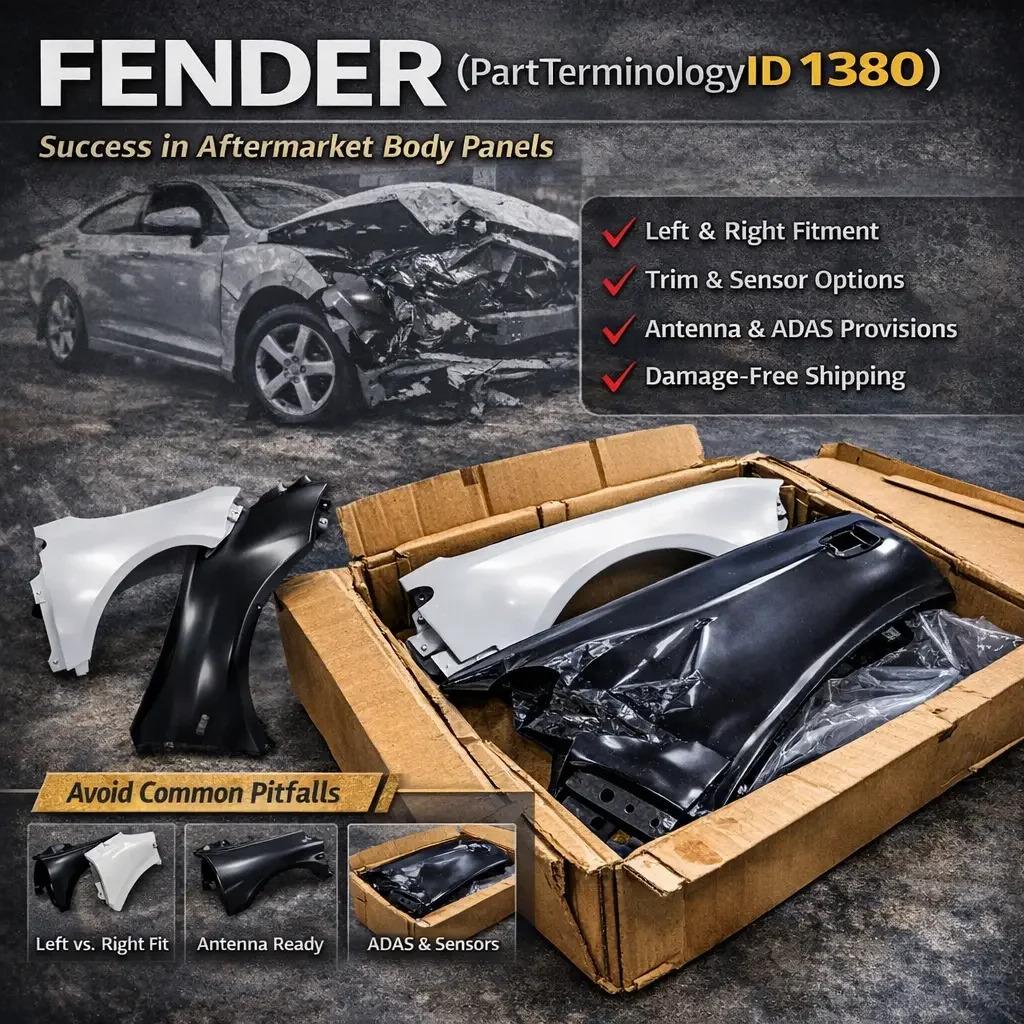
Fender (PartTerminologyID 1380) refers to the exterior body panel that covers the front wheel well area, extending from the front of the vehicle (at the headlight/bumper junction) to the front door opening. Left fender and right fender are mirror images of each other and are not interchangeable.
In catalog reality, "Fender" covers several product forms:
Fender panel (standard replacement). The outer sheet metal or aluminum panel, primed or bare, with all mounting flanges, bolt holes, and factory provisions for antenna, side marker, wheel arch molding, and fender liner clips. This is the most common aftermarket product. It requires painting, and the buyer must transfer or separately purchase the fender liner, antenna (if fender-mounted), side marker light, wheel arch molding, and any other attached components.
Fender panel with liner. Some sellers bundle the fender panel with a matching inner fender liner. This is a convenience package, not a different structural product.
Fender assembly. On some vehicles, the fender is an assembly that includes the inner fender apron or structural support panel as a welded or integrated unit. This is less common but exists on certain vehicle platforms where the inner apron and outer fender are manufactured as one piece.
Rear fender / quarter panel. This is NOT the same as Fender (PartTerminologyID 1380). The rear fender or quarter panel is the body panel over the rear wheel well. On most modern unibody vehicles, the quarter panel is welded to the body structure and is not a bolt-on replacement. It has its own PartTerminologyID. However, buyers frequently search "fender" when they mean "quarter panel," and some older body-on-frame vehicles do have bolt-on rear fenders. Catalog teams must separate front fender from rear quarter panel at the taxonomy level.
What this part does NOT cover
Inner fender liner / splash shield (the plastic or fabric liner inside the wheel well behind the fender). Different PartTerminologyID.
Fender flare (the bolt-on or adhesive extension that widens the fender for wider tires). Different PartTerminologyID.
Quarter panel / rear fender (the panel over the rear wheel well). Different PartTerminologyID.
Bumper cover, headlight assembly, hood, or door (adjacent panels that interface with the fender but are separate parts).
Why Fender Is One of the Most Returned Body Parts
The five gap lines
A fender has more visible gap lines than any other single body panel on the vehicle:
1) Fender-to-hood gap. Runs along the top of the fender from the windshield pillar area to the headlight. This gap is visible from standing height and is the first thing people check after a front-end repair. If this gap is uneven, wider on one end than the other, or different from the opposite side, the repair looks wrong.
2) Fender-to-door gap. Runs vertically along the rear edge of the fender where it meets the front door. This gap must be consistent from top to bottom and match the door-to-rear-door gap for visual continuity. If the fender sticks out further than the door or sits inward, the body line is broken.
3) Fender-to-bumper cover gap. Where the front edge of the fender meets the bumper cover. This junction often includes a visible contour line that must flow smoothly from the bumper into the fender. Misalignment here is visible from directly in front of the vehicle.
4) Fender-to-headlight gap. Where the fender wraps around the headlight opening. The headlight housing must sit flush with the fender surface. If the fender is slightly out of spec, the headlight will appear recessed or protruding, and the gap around the headlight will be uneven.
5) Fender-to-A-pillar / cowl gap. Where the top rear of the fender meets the windshield pillar area and the cowl panel. This is less visible than the other gaps but still matters for weatherstripping and water sealing.
Five gap lines on one panel. That is five opportunities for a fitment problem to be visible to the customer. This is why fender returns are so high in the aftermarket: even a small dimensional variance is immediately apparent at one or more of these interfaces.
Why aftermarket fenders have fitment variance
Aftermarket fenders are manufactured by stamping sheet metal (or forming aluminum) in dies that replicate the OEM panel shape. The accuracy of the die, the material thickness, the stamping pressure, and the quality control process all affect whether the finished fender matches OEM dimensions precisely.
Premium aftermarket fenders from CAPA-certified suppliers are tested against OEM panels for dimensional accuracy, mounting hole locations, and surface contour. They generally fit well, though minor adjustment during installation is standard practice in the collision industry.
Non-certified aftermarket fenders have no independent dimensional verification. Some fit well. Some do not. The most common issues are mounting holes that are slightly mislocated (requiring the installer to elongate holes or re-drill), surface contours that do not match the hood or door line, and the headlight opening being slightly too large or too small.
The collision shop absorbs the cost of these adjustments in labor time. If the adjustment cannot make the panel acceptable, the fender goes back and a different fender is ordered. This cycle is one of the most expensive hidden costs in the aftermarket body parts supply chain.
The Shipping and Packaging Challenge
Like Door (PartTerminologyID 1376), fenders are large, rigid panels that are extremely vulnerable to shipping damage. The shipping challenges are essentially the same as described in the Door post, with a few fender-specific differences:
Fender-specific shipping risks
Thinner gauge metal. Fenders are typically thinner gauge sheet metal than doors because they do not contain the structural frame, side impact beam, or internal reinforcements that a door has. This means fenders dent even more easily. A fender leaning against a piece of freight, a strap pulled too tight, or a bump from a forklift tine creates a dent that may not be repairable without additional bodywork.
Flanges and edges. Fenders have thin mounting flanges along the top (hood gap), the rear (door gap), and the bottom (wheel arch). These flanges bend easily during handling. A bent mounting flange changes the gap dimension at that point and may require straightening or make the fender unusable.
Headlight opening. The headlight opening area is a complex curve that is difficult to protect during shipping. Impact to this area distorts the shape and affects headlight fitment.
Surface area exposure. A fender is essentially one large, curved, exposed surface. Unlike a door, which has a flat inner panel that can face inward on a pallet for protection, a fender's curved outer skin is exposed from nearly every angle.
Shipping best practices for fenders
Skin-to-skin pairing. When shipping two fenders (left and right), placing them skin-to-skin with a foam separator between them protects both outer surfaces and creates a more stable package. This is how many OEM and high-volume aftermarket distributors ship matched pairs.
Cardboard sleeves with foam inserts. Large, custom-sized cardboard sleeves that wrap around the fender with foam pads at the headlight opening, the mounting flanges, and the wheel arch provide good protection for single-fender shipments.
Pallet-mounted with blankets. Similar to door shipping: fender mounted upright on a pallet, wrapped in moving blankets, with foam edge protectors on all flanges and the headlight opening. Shrink-wrapped to the pallet with "FRAGILE" and "DO NOT STACK" labels.
Never ship loose. A fender tossed into the back of a delivery truck without packaging will arrive damaged. There are no exceptions to this.
The cost equation
A typical aftermarket fender costs $80 to $300 depending on the vehicle and quality tier. Shipping damage that requires returning and re-shipping the fender can cost $100 to $300 in round-trip freight. On a $150 fender, a single shipping damage return can cost more in logistics than the part itself. At scale, this is one of the largest margin-destroying problems in the aftermarket body parts business. The sellers who invest in proper packaging spend an extra $15 to $30 per fender on protection and save multiples of that in avoided returns.
Fitment Variables That Drive Returns
Trim level and equipment
Different trim levels on the same vehicle can have different fenders:
Antenna hole. Some trims have a fender-mounted antenna (AM/FM mast or shark fin base). Other trims mount the antenna on the roof. A fender with an antenna hole on a vehicle that does not use a fender antenna has an unwanted hole. A fender without an antenna hole on a vehicle that needs one requires drilling.
Side marker light. Some markets and trims use a side marker light or repeater mounted in the fender. The fender must have the correct cutout for the marker light housing. No cutout means no marker light. Wrong-size cutout means the housing does not fit.
Wheel arch molding provisions. Trucks and SUVs with fender flares or wheel arch moldings may have additional mounting holes, clips, or adhesive pads on the fender. Base trims without flares do not have these provisions.
Parking sensor holes. On some vehicles, front parking sensors are mounted in the fender rather than (or in addition to) the bumper cover. The fender must have sensor holes in the correct locations.
Badge or emblem mounting. Some trims have fender-mounted badges (turbo badges, hybrid badges, trim-level emblems). The fender may have mounting holes or locator pins for these badges.
Generation and facelift
Fender contours change with vehicle generations. A facelift within a generation may also change the fender shape if the headlight design changes, because the fender-to-headlight interface must match the new headlight contour. The fender may carry over dimensionally from pre-facelift to post-facelift on some vehicles, but on many it does not.
Material
Most fenders are stamped steel. Some vehicles use aluminum fenders (Ford F-150 2015+, many luxury vehicles, performance cars). A small number of vehicles use composite or plastic fenders (some Corvette generations, Saturn, certain commercial vehicles). The material must match the vehicle's original specification for weight, repair compatibility, and structural mounting.
Steel fenders cannot be used on aluminum-body vehicles without creating galvanic corrosion concerns at the mounting points where dissimilar metals contact each other. Aluminum fenders on steel-body vehicles may not have the same rigidity or mounting compatibility.
ADAS sensor integration
An emerging fitment variable. Some newer vehicles mount ADAS components in or near the front fender:
Blind spot monitoring radar. On some vehicles, the front radar sensors for blind spot or cross-traffic detection are mounted behind or within the front fender. The fender must have the correct provisions (sensor pockets, brackets, or transparent areas) for the radar to function.
Side-facing cameras. Surround-view camera systems may include a side-facing camera mounted in the fender or the fender-mounted mirror area. Camera provisions affect the fender design.
These ADAS integrations are becoming more common and will be a significant fitment variable going forward. Catalog teams should begin capturing ADAS provisions as fitment qualifiers now.
Left versus right
Obvious but worth stating because it is still a common return cause. Left fender and right fender are mirror images. They cannot be swapped. The listing must specify: Left (Driver Side) or Right (Passenger Side).
The Insurance and Collision Repair Ecosystem
Fender replacement is one of the most common line items on collision repair estimates, and the part source decision (OEM vs. aftermarket) is driven as much by the insurance company's estimate as by the shop's preference.
Insurance estimates typically specify aftermarket fenders. On vehicles older than 2 to 3 years, most insurance estimates will specify an aftermarket fender to reduce claim cost. The estimate may reference a specific aftermarket price that is 40% to 60% less than OEM.
Supplement requests are common. When a collision shop receives an aftermarket fender that does not fit, they submit a supplement to the insurance company requesting additional labor for adjustment or requesting authorization to switch to an OEM fender. This supplement process adds days to the repair cycle and creates friction between the shop, the insurer, and the customer. Shops that consistently receive well-fitting aftermarket fenders (CAPA certified) submit fewer supplements and maintain faster cycle times.
The customer rarely chooses. Unlike mechanical parts where the vehicle owner may have a preference, most collision repair customers accept whatever the insurance estimate specifies. They only become aware of the part source if the repair outcome is visibly poor (uneven gaps, paint mismatch) or if the shop proactively explains the options. This means the catalog accuracy and part quality directly affect the end customer's experience even though the end customer never sees the catalog or chooses the part.
Diminished value claims. In some states, a vehicle repaired with aftermarket parts may have a lower resale value than one repaired with OEM parts. This creates a downstream financial impact for the vehicle owner that they may not be aware of at the time of repair. Some insurance policies offer an OEM parts endorsement for an additional premium. Collision shops that educate their customers about these options build trust and referral business.
The OEM vs. Aftermarket vs. Recycled Decision
OEM fenders
Exact fit guaranteed. Correct material, correct thickness, correct mounting hole locations, correct surface contour. The most expensive option but eliminates fitment risk. OEM fenders arrive primed from most manufacturers. Insurance estimates may not cover OEM pricing unless the policy includes an OEM parts endorsement or the vehicle is new enough to fall under manufacturer warranty provisions.
CAPA-certified aftermarket fenders
Independently tested for fit and finish against OEM dimensions. The most reliable aftermarket option. Generally fits well with minor adjustment standard to installation. Available for high-volume applications. Less available for niche, luxury, or very new model year vehicles.
Non-certified aftermarket fenders
The lowest cost option. No independent dimensional verification. Fit quality varies significantly by manufacturer. Some non-certified fenders fit acceptably. Others have mounting holes that are 3 to 5mm off, surface contours that do not match adjacent panels, or headlight openings that are the wrong size. The collision shop bears the cost of making these panels work, and when they cannot be made to work, they go back.
Recycled (salvage) fenders
OEM panels from wrecked or end-of-life vehicles. The advantage is OEM fitment at a lower price. The disadvantage is potential prior damage (repaired, repainted, minor dents), rust or corrosion (especially on the inner surface and mounting flanges), and inconsistent availability. Recycled fenders from different geographic regions may have different corrosion profiles: a fender from a salt-belt vehicle may have hidden rust on the inner flanges that is not visible in listing photos.
For catalog teams, quality tier (OEM, CAPA Certified, Non-Certified Aftermarket, Recycled/Salvage) must be a primary attribute on every fender listing.
The Paint and Color Challenge
Fenders arrive primed (not painted) in virtually all aftermarket and OEM replacement scenarios. The collision shop or buyer must paint the fender to match the vehicle. This creates several issues:
Color matching. Matching the body color on a single panel (the fender) to the adjacent panels (hood, door, bumper cover) is standard collision repair procedure. Metallic, pearl, and tri-coat colors are harder to match than solid colors. The paint shop blends the color into adjacent panels for a seamless match.
Primer quality. The primer on the fender must be compatible with the paint system the shop uses. OEM primers are generally compatible with all major paint systems. Some low-cost aftermarket fenders use a primer that does not adhere well to certain paint topcoats, causing peeling or orange peel texture.
Edge and jamb painting. The inner edges of the fender (visible when the hood is open) must be painted to match or at least coated for corrosion protection. Some shops paint the entire inner surface for corrosion prevention. This is not a fitment issue, but it is a workmanship standard that affects long-term quality.
Pre-painted fenders. A small but growing market segment offers pre-painted fenders matched to the vehicle's OEM color code. These eliminate the paint step and reduce cycle time. However, pre-painted panels carry color match risk because the paint was applied in a factory setting that may not match the vehicle's actual body color after years of UV exposure and weathering.
Compatibility Checklist for Buyers
1) Confirm side. Left (Driver) or Right (Passenger). They are mirror images and not interchangeable.
2) Confirm generation and facelift. The fender contour must match the headlight design for your specific model year and facelift status.
3) Confirm trim level. Antenna hole or no antenna hole. Side marker light cutout or no cutout. Wheel arch molding provisions. Parking sensor holes. Badge mounting holes.
4) Confirm material. Steel, aluminum, or composite. Must match the vehicle's original material.
5) Confirm ADAS provisions. Does your vehicle have fender-mounted sensors (blind spot radar, side camera)? If so, the fender must have the correct sensor provisions.
6) Confirm quality tier. OEM, CAPA Certified, Non-Certified Aftermarket, or Recycled. Understand the tradeoffs in fitment accuracy, cost, and paint compatibility.
7) Budget for paint. Aftermarket and OEM fenders arrive primed. Plan for paint and blending into adjacent panels.
8) Inspect at delivery. Before signing the freight receipt, inspect the fender for dents, creases, bent flanges, and headlight opening distortion. Photograph any damage and note it on the delivery receipt.
Catalog Checklist for Attributes and Structured Data
Core taxonomy and naming
Terminology Name: Fender
Side: Left (Driver), Right (Passenger)
Position: Front (this PartTerminologyID). Separate from Quarter Panel / Rear Fender.
Product form: Fender Panel, Fender with Liner, Fender Assembly (with inner apron)
Separate from Inner Fender Liner, Fender Flare, and all adjacent panels
Fitment structure
Year, make, model, submodel, trim level
Body style (sedan, coupe, hatchback, wagon, truck, SUV)
Generation and facelift status (production date if overlap)
Antenna type: fender-mounted (mast, shark fin) or roof-mounted (no fender antenna hole)
Side marker light: present or absent, marker type and size
Wheel arch molding: provisions present or absent
Parking sensors: fender-mounted (yes/no), number and location
ADAS provisions: blind spot radar, side camera (yes/no)
Material and construction
Material: steel, aluminum, composite
Gauge/thickness (if specified by manufacturer)
Primer type
Components included
Fender panel (always)
Inner fender liner (if bundled)
Side marker light housing (if included)
Antenna base/grommet (if included)
Wheel arch molding clips
Mounting hardware
Quality and certification
OEM
CAPA Certified (include CAPA seal number)
Non-Certified Aftermarket
Recycled/Salvage (donor vehicle mileage, condition grade, color code, prior repair history)
Paint and finish
Primed (standard)
Pre-painted (specify OEM color code and color name)
As-is (recycled, describe existing paint condition and color)
Image requirements
Exterior surface view (showing overall shape, contour, headlight opening)
Inner surface view (showing mounting flanges, bolt holes, antenna provision, liner clip locations)
Headlight opening close-up
Hood-gap flange close-up
Door-gap flange close-up
Wheel arch area
Antenna hole or marker light cutout (if applicable)
ADAS sensor provision area (if applicable)
Common Buyer Scenarios
Scenario 1: Non-certified fender has misaligned headlight opening
A collision shop orders a non-certified aftermarket right fender for a 2020 Honda CR-V. The fender bolts on, but the headlight opening is 4mm too wide on the top edge. The headlight housing sits recessed at the top, creating a visible gap. The shop cannot adjust the gap without bending the fender flange, which distorts the surrounding contour.
What went wrong: The non-certified fender's headlight opening was not dimensionally verified against OEM. The stamping die was slightly out of tolerance.
What helps: CAPA certification, which tests headlight opening dimensions against OEM specifications. If using non-certified, include headlight opening dimensions in the listing and allow shops to compare before ordering.
Scenario 2: Fender arrives with antenna hole, vehicle has roof antenna
A buyer orders a left fender for a 2019 Toyota Camry LE. The fender arrives with a pre-punched antenna hole near the top rear. The buyer's Camry LE has a roof-mounted shark fin antenna and does not use a fender antenna. There is now an unwanted hole in the fender that must be filled and painted.
What went wrong: The listing did not differentiate between antenna-hole and no-antenna-hole fender variants.
What helps: "With Antenna Hole" or "Without Antenna Hole" as a mandatory fitment qualifier in the title and structured data. Photos showing the antenna hole area.
Scenario 3: Aluminum fender ordered for steel-body vehicle
A marketplace seller lists a fender for a 2022 Ford F-150 without specifying material. The buyer has a base XL model. The seller ships an aluminum fender. The buyer's XL has aluminum body panels (all F-150s since 2015 use aluminum), so the material matches. But a different buyer with a 2014 F-150 (steel body) orders the same listing because the year range was too broad, and receives an aluminum panel that does not match.
What went wrong: The listing did not account for the 2015 material changeover on the F-150 platform.
What helps: Year range accuracy. The 2015+ F-150 aluminum fender is a different part from the 2014 and earlier steel fender. Material as a primary attribute prevents this confusion.
Scenario 4: Shipping damage on wheel arch flange
A CAPA-certified left fender for a 2021 Chevy Silverado arrives wrapped in shrink wrap on a pallet. The fender outer surface is clean, but the bottom wheel arch flange is bent inward from contact with the pallet edge during transit. The shop cannot straighten the flange without leaving a crease mark. The fender goes back.
What went wrong: No foam edge protector on the wheel arch flange. The shrink wrap held the fender in place but did not protect against pallet contact.
What helps: Foam edge protectors on all flanges (top, rear, bottom, and headlight opening). Corner protectors. The fender should not contact the pallet directly at any point.
FAQ
Is a fender the same as a quarter panel?
No. The fender is the bolt-on panel over the front wheel. The quarter panel is the panel over the rear wheel. On modern unibody vehicles, the quarter panel is welded to the body structure and is not a simple bolt-on replacement. They are different parts with different PartTerminologyIDs.
Why does my aftermarket fender not fit as well as the original?
Aftermarket fenders are manufactured from tooling that replicates the OEM die. Dimensional accuracy depends on the quality of the tooling and the manufacturer's quality control process. CAPA-certified fenders are independently tested for dimensional accuracy and generally fit well with minor adjustment. Non-certified fenders have no independent verification and may have larger dimensional variances.
How much does it cost to paint a replacement fender?
Paint costs vary by market, color complexity, and shop rate. A solid color fender typically costs $300 to $500 to paint and blend. Metallic, pearl, and tri-coat colors can cost $400 to $700 or more due to additional material and blending steps.
Should I order a CAPA-certified or non-certified fender?
CAPA-certified fenders cost more but have verified dimensional accuracy, which reduces installation time and the risk of visible gap problems. Non-certified fenders cost less but carry more fitment risk. For visible, customer-facing repairs on newer vehicles, CAPA certification is worth the cost difference. For older vehicles or budget-sensitive repairs, non-certified may be acceptable if the installer is experienced with adjustment.
Does my fender have ADAS sensor provisions?
Check your vehicle's equipment list. If your vehicle has blind spot monitoring, cross-traffic alert, or a surround-view camera system, check whether the sensors are mounted in or behind the front fender. If so, the replacement fender must have the correct sensor provisions (mounting brackets, sensor pockets, or radar-transparent areas).
Can I use a steel fender on an aluminum-body vehicle?
No. Steel and aluminum in direct contact create galvanic corrosion, which accelerates rust at every mounting point. Beyond corrosion, the weight difference affects the body balance and may affect panel alignment over time. Always match the replacement material to the vehicle's original specification.
Final Take for Aftermarket Teams
Fender (PartTerminologyID 1380) is one of the most visible, most replaced, and most returned body panels in the collision aftermarket. It interfaces with five adjacent panels, creating five visible gap lines that expose every dimensional shortcut. The fitment variables are extensive: side, generation, facelift, trim level, antenna provision, side marker, wheel arch molding, ADAS sensor provisions, and material. The shipping challenge mirrors Door: large, thin sheet metal that dents easily, travels via LTL freight, and arrives damaged when packaging is inadequate.
The catalog teams and sellers that win in this category are the ones that specify every fitment variable that affects the panel shape (particularly antenna hole, side marker cutout, and ADAS provisions), clearly state the quality tier, include inner surface images showing bolt hole locations and mounting flanges, package fenders with foam edge protectors on every flange, and instruct buyers to inspect at delivery. Fender is the panel where the gap between a well-run parts business and a poorly-run one is visible to the naked eye, both on the vehicle and on the balance sheet.