
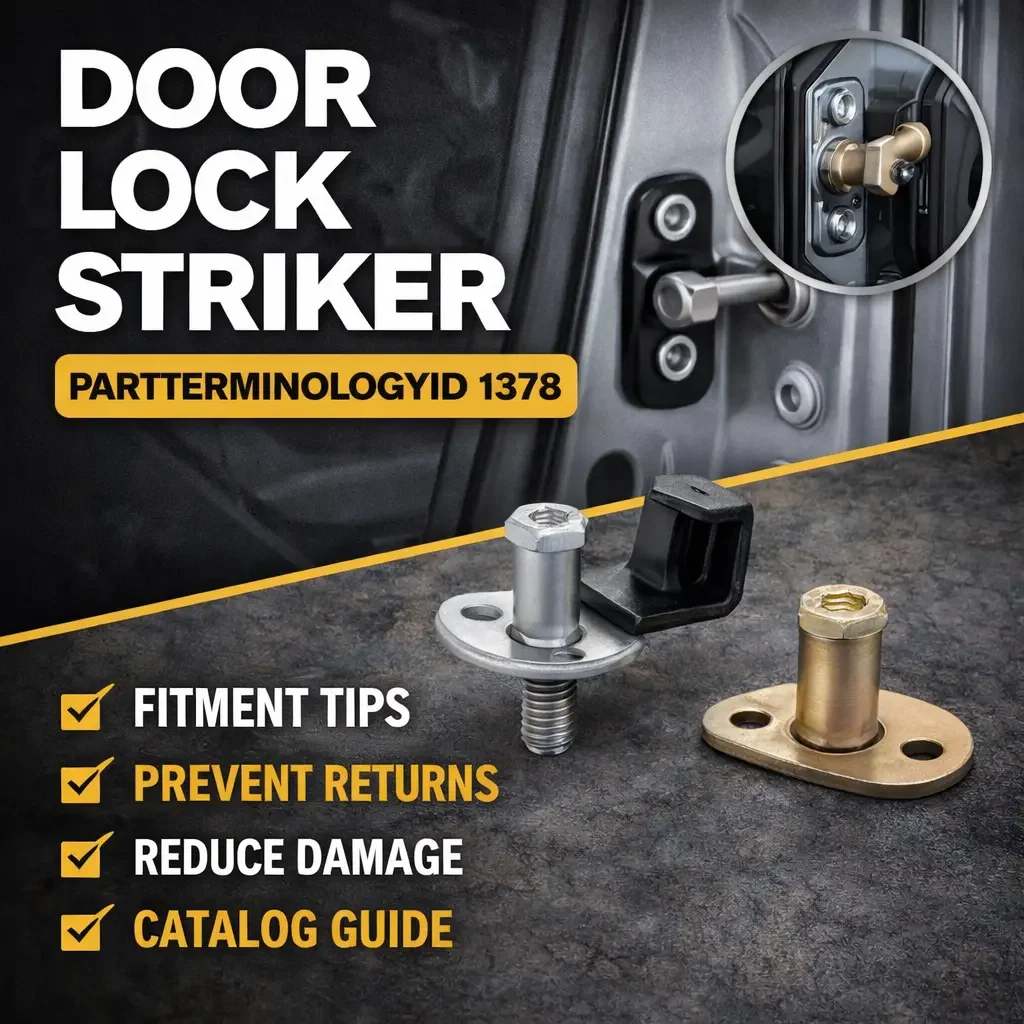
Door Lock Striker (PartTerminologyID 1378): The Small Part on the Body That the Entire Door Latches To
Written by Arthur Simitian | PartsAdvisory
This is the third post in the door components series, following Door (PartTerminologyID 1376) and Door Hinge (PartTerminologyID 1377). The hinge holds the door to the body on the pivot side. The Door Lock Striker is what the door grabs onto when it closes on the latch side.
The striker is a small, simple-looking part bolted to the door jamb on the B-pillar (for front doors), C-pillar (for rear doors), or A-pillar (for rear-hinged doors). It is typically a U-shaped or loop-shaped metal post or bolt that the door latch mechanism engages when the door is pushed closed. When the latch wraps around the striker and locks into position, the door is secured.
It looks like nothing. A metal loop on a mounting plate with two or three bolts. But the striker is a safety-critical component that affects door closure, door alignment, latch engagement, weatherstrip compression, wind noise, and water sealing. It is also one of the most commonly adjusted parts during collision repair, and one of the most commonly misunderstood parts when it comes to replacement versus adjustment.
This post is built for aftermarket catalog teams, marketplace sellers, and buyers who want fewer mistakes and fewer returns.
Status in New Databases
Status in New Databases
Current: PIES 7.2 + PCdb Future: PIES 8.0 + PCdb 2.0 Status: No change
What Door Lock Striker Means in the Aftermarket
Door Lock Striker refers to the stationary loop, post, or bolt mounted on the vehicle body (door jamb) that the door latch mechanism engages when the door is closed. The latch is on the door. The striker is on the body. They are two halves of the same closure system.
In catalog reality, this covers:
Striker bolt (U-bolt type). The most common type. A U-shaped metal post mounted on a backing plate and bolted to the door jamb. The door latch wraps around the U-bolt and locks. Found on the vast majority of passenger vehicles.
Striker pin (post type). A single vertical or horizontal pin that the latch engages. Used on some vehicles, particularly sliding doors on vans and some older designs.
Striker plate. On some vehicles, particularly older models, the striker is a plate with a slot or opening that the latch bolt slides into. This design is less common on modern vehicles.
Striker with integrated shim plate. Some strikers include a shim or adjustment plate that allows fine-tuning of the striker position to achieve proper door alignment and latch engagement. Shims may be separate or built into the mounting.
Striker and reinforcement plate. On some vehicles, the striker mounts to a reinforcement plate welded or bolted behind the pillar sheet metal. The reinforcement distributes the closure load across a larger area. In collision repair, if the reinforcement is damaged, the striker alone will not solve the problem.
What this part does NOT cover
Door latch (the mechanism on the door side that engages the striker). Different PartTerminologyID.
Door lock actuator (the electric motor that locks and unlocks the latch). Different PartTerminologyID.
Hood latch striker, trunk latch striker, liftgate striker, or tailgate striker. Each vehicle opening has its own striker, and each is a different PartTerminologyID.
Why Striker Problems Usually Start with a Collision Repair
Most Door Lock Striker replacements are not because the striker itself failed. Strikers are hardened steel or reinforced metal and rarely wear out on their own. The typical reason a striker needs attention is one of three situations:
1) The door was replaced after a collision. When a new or recycled door is hung on the vehicle, the latch position on the new door may not align perfectly with the existing striker on the body. The striker must be adjusted (loosened, repositioned, re-tightened) to achieve proper latch engagement. If the striker bolt holes in the pillar are wallowed out from the collision impact, the striker cannot be adjusted properly and must be replaced along with repair to the pillar mounting area.
2) The B-pillar or door jamb was damaged. In a side impact collision, the pillar that the striker mounts to may be bent or deformed. Even after pillar repair, the striker mounting surface may not be in its original position. A new striker with shims may be needed to compensate. In severe cases, the pillar reinforcement behind the striker must also be repaired or replaced.
3) Long-term wear and door sag. On high-mileage vehicles, door sag from worn hinges changes the position where the latch meets the striker. The door drops slightly, which means the latch hits the striker at a different point. This causes hard closing, incomplete latching, or the door bouncing back open. Adjusting the striker down to match the sagged door is a common field fix, but the real solution is usually to fix the hinges (PartTerminologyID 1377) and then re-adjust the striker to the corrected door position.
Understanding this context matters for catalog teams because it explains why strikers are almost always sold in conjunction with other door components. The buyer ordering a striker is almost always in the middle of a larger door repair.
Why This Category Creates Fitment Problems
Position and side
Every door has its own striker. A four-door vehicle has four strikers. Front left, front right, rear left, rear right. The strikers are position-specific because the pillar geometry, the mounting angle, and the latch engagement point vary by door position. On many vehicles, the front door strikers and rear door strikers are different part numbers. On some vehicles, left and right strikers are mirror images. On others, they are the same part for both sides. The listing must specify position and side.
Striker bolt geometry
The U-bolt width (the distance between the two legs of the U), the bolt diameter, the post height, and the mounting hole spacing are all vehicle-specific dimensions. A striker that is 2mm wider or narrower than the original will not engage the latch properly. The door may not close, may not latch securely, or may rattle.
Mounting bolt pattern and thread
Strikers mount with two or three bolts. The bolt diameter, thread pitch, and spacing vary by vehicle. Metric versus standard thread is a common issue, particularly when aftermarket strikers are sourced from suppliers that do not match the OEM thread specification. A striker with the wrong thread will cross-thread into the pillar and strip the mounting holes.
Coating and corrosion resistance
OEM strikers are typically zinc-plated, chrome-plated, or e-coated for corrosion resistance. The latch engagement surface is often specially hardened to resist wear from the latch fork repeatedly engaging and disengaging. Aftermarket strikers that lack this hardening or coating will wear prematurely, develop play, and create door rattle.
Striker versus striker bolt versus striker plate
Different vehicles use different striker designs (U-bolt, pin, plate). The listing must match the vehicle's latch type. A U-bolt striker will not work with a latch designed for a pin striker. The catalog must correctly identify which design the vehicle uses.
Shim thickness and adjustment
Some strikers come with specific shim thicknesses. OEM strikers may include a pre-set shim stack matched to the factory door gap specification. Aftermarket strikers may not include shims, or may include a generic shim that does not match the OEM stack height. This affects door alignment and the effort required to close the door.
Top Return Causes
1) Wrong position (front versus rear, left versus right)
The buyer orders a striker for the wrong door.
Prevention: Specify position in the title: "Front Left Door Lock Striker" or "Rear Right Door Lock Striker." If the striker fits both left and right, state: "Fits Left or Right."
2) Wrong striker design for the vehicle
U-bolt striker ordered for a vehicle that uses a pin-type striker, or vice versa.
Prevention: Include the striker type in the listing: "U-Bolt Type" or "Pin Type." Include an image showing the striker design.
3) Mounting bolt thread mismatch
Aftermarket striker has metric bolts, vehicle has standard threads (or vice versa).
Prevention: Specify mounting bolt thread size and pitch. Cross-reference to OEM part number.
4) Missing or incorrect shims
Striker does not include shims that are needed for proper adjustment. Or included shims are the wrong thickness.
Prevention: Specify: "Includes shim plate" or "Shims not included (sold separately)." State shim thickness if included.
5) Striker ordered as a standalone fix when the real problem is hinge sag or pillar damage
The buyer thinks the striker is the problem, but the underlying issue is worn hinges or a bent pillar. The new striker does not solve the door closure issue.
Prevention: This is not strictly a catalog problem, but a description note can help: "If the door does not close properly, check door hinge condition and B-pillar alignment before replacing the striker. A striker adjustment or replacement alone may not correct door closure issues caused by hinge wear or collision damage to the door jamb."
Compatibility Checklist for Buyers
1) Confirm position. Front or Rear. Left or Right. Each door has its own striker.
2) Confirm the striker type. U-bolt, pin, or plate. Look at the existing striker on the vehicle to confirm the design before ordering.
3) Confirm mounting bolt pattern. Count the mounting bolts (typically 2 or 3) and confirm the thread size. Match to the replacement.
4) Confirm whether shims are needed. If the existing striker has shims between the striker plate and the pillar, note the shim thickness. Order shims separately if the replacement does not include them.
5) Diagnose the actual problem before ordering. If the door is hard to close or does not latch, check the hinges for sag and the pillar for collision damage before assuming the striker is the issue.
6) Confirm full vehicle details. Year, make, model, submodel.
Catalog Checklist for Attributes
Core taxonomy: Product form (striker bolt assembly, striker pin assembly, striker plate, striker with shim, shim only). Separate from Door Latch, Door Lock Actuator, Hood Striker, Trunk Striker, Liftgate Striker, and Tailgate Striker.
Fitment: Year, make, model, submodel. Position: Front/Rear. Side: Left/Right or Universal (fits either side). OEM part number cross-reference.
Physical specs: Striker type (U-bolt, pin, plate). U-bolt width (distance between legs). Post height. Mounting bolt count, diameter, thread pitch, and spacing. Shim thickness (if included). Material (steel, hardened steel, stainless steel). Coating/finish (zinc-plated, chrome-plated, e-coated, black oxide).
Package contents: Striker assembly, shim plate(s), mounting bolts (if included), lock washers.
Images: Striker assembly top view showing U-bolt or pin profile, side view showing post height, mounting plate showing bolt holes and shim, and a reference image showing installed position on door jamb.
FAQ
What does a door lock striker do?
The striker is the fixed loop or post on the door jamb that the door latch grabs onto when the door closes. It is one half of the door closure system. The latch (on the door) wraps around or engages the striker (on the body) to hold the door shut.
Can I just adjust the striker instead of replacing it?
In most cases, yes. The striker mounting bolts sit in slotted or oversized holes that allow the striker to be moved up, down, in, or out by a few millimeters. This is the standard adjustment procedure after hanging a new door. Replacement is only needed when the striker is damaged, the mounting holes are stripped or wallowed out, or the striker surface is excessively worn.
My door does not close properly. Is it the striker?
Maybe, but not necessarily. A door that does not close properly can be caused by worn hinges (door sag), a bent door frame, a damaged pillar, a misadjusted striker, a faulty latch, or a combination of these. Check the hinges and overall door alignment before blaming the striker. Adjusting or replacing the striker will not fix a door that sags due to worn hinge pins.
Are front and rear door strikers the same?
On many vehicles, no. The pillar mounting geometry and the latch engagement point are different between front and rear doors. Always verify position-specific part numbers before ordering.
Final Take for Aftermarket Teams
Door Lock Striker (PartTerminologyID 1378) is a small, inexpensive part with outsized consequences for door closure, alignment, and customer satisfaction. The catalog challenges are straightforward but must be executed precisely: specify position and side, specify striker type (U-bolt, pin, plate), include mounting bolt thread specifications, note whether shims are included, and provide clear images showing the striker profile. The biggest service you can provide to the buyer is context: a striker replacement is almost always part of a larger door repair involving a new door (1376), hinge work (1377), or pillar repair. The striker is the final adjustment point that makes the whole system close correctly. Get the specs right, and the door shuts the way it should.