
Written by Arthur Simitian | PartsAdvisory
The previous post in this series covered Door (PartTerminologyID 1376), one of the most complex and highest-return body parts in the aftermarket. This post covers the part that holds the door to the vehicle: the Door Hinge.
Door hinges are structural components that carry the full weight of the door and allow it to swing open and closed thousands of times over the life of the vehicle. They are bolted or welded to the A-pillar (front doors) or B-pillar (rear doors) on the body side and to the door frame on the door side. When they wear out, the door sags. When they corrode, they seize. When they are damaged in a collision, the door will not open or close correctly no matter how perfect the replacement door is.
This is a part that buyers almost never search for on its own. It comes up when a collision shop is replacing a door and discovers the hinges on the body side are bent or corroded, when an older vehicle's door has sagged to the point where it does not latch properly, or when a restorer is rebuilding a classic car and finds the original hinges are worn beyond adjustment. It is a low-volume, high-specificity part where catalog accuracy directly determines whether the buyer gets a part that works or a part that goes back.
This post is built for aftermarket catalog teams, marketplace sellers, and buyers who want fewer mistakes and fewer returns.
Status in New Databases
Status in New Databases
Current: PIES 7.2 + PCdb Future: PIES 8.0 + PCdb 2.0 Status: No change
What Door Hinge Means in the Aftermarket
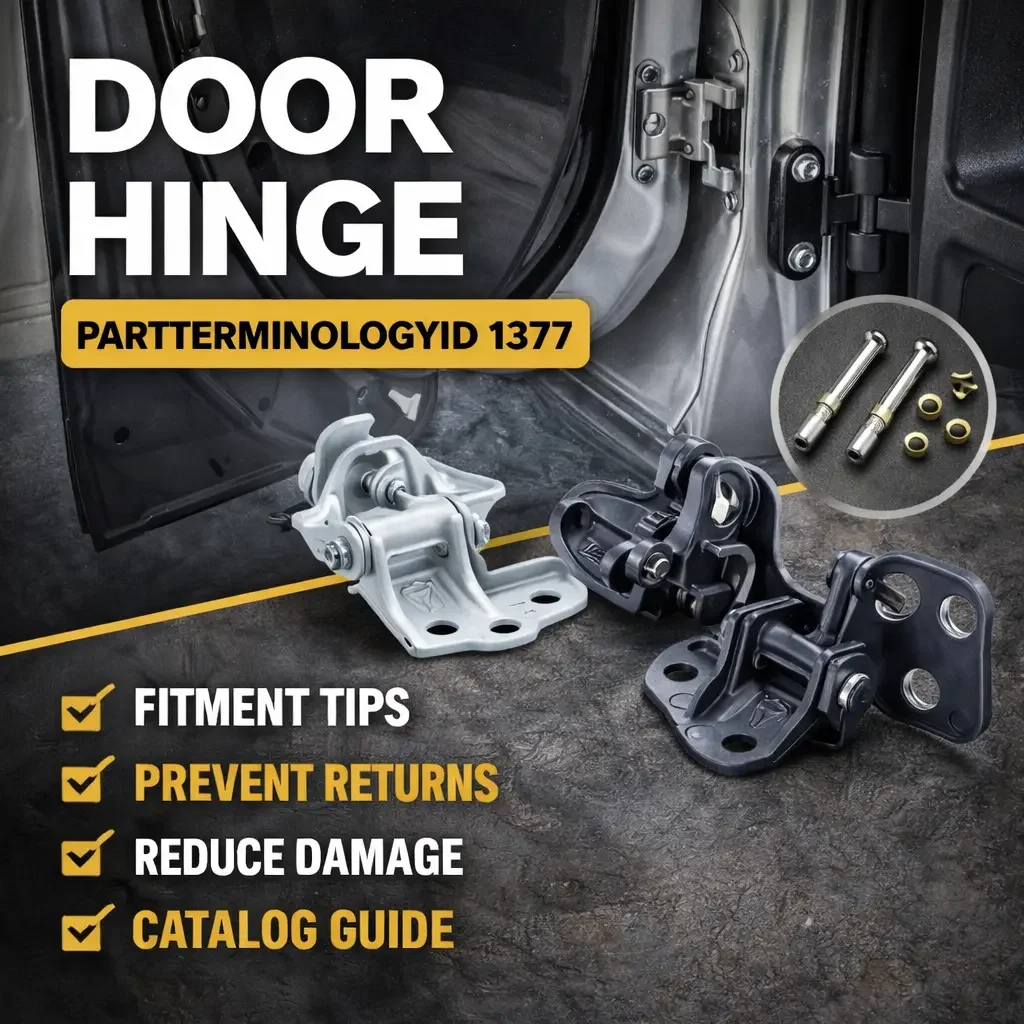
Door Hinge refers to the mechanical pivot assembly that attaches the door to the vehicle body and allows it to swing open and closed. Each door typically has two hinges: an upper hinge and a lower hinge. Both must work together to carry the door weight and maintain alignment.
In catalog reality, this covers:
Individual hinges. A single upper or lower hinge sold separately. The buyer must confirm which position they need. Upper and lower hinges are often different in size, shape, and mounting bolt pattern because the load distribution is different between the two positions.
Hinge pairs. An upper and lower hinge sold as a set for one door. This is the preferred configuration for replacement because replacing a single hinge without replacing its partner often results in uneven wear and misalignment.
Hinge pins and bushings only. On many vehicles, the hinge body itself does not fail. The hinge pin and the bushings that the pin rides in wear out, causing the door to sag. Hinge pin and bushing kits are a low-cost repair option that restores the original hinge without replacing the entire assembly. These kits are extremely vehicle-specific in pin diameter, pin length, and bushing dimensions.
Hinge assemblies with integrated door check. Some vehicles combine the door hinge with the door check (the mechanism that holds the door at specific open positions, like partially open or fully open). On these vehicles, the hinge and check are one integrated unit. Replacing the hinge means replacing the check as well, and the listing must reflect this.
Spring-loaded hinges. Some vehicles use spring-loaded hinges that assist with closing the door or holding it open, particularly on vans with heavy sliding or swinging doors. The spring tension is matched to the door weight.
What this part does NOT cover
Door check straps or door detents (the separate mechanism that holds the door at specific open positions on vehicles where the check is not integrated into the hinge). These are a different PartTerminologyID.
Door lock and latch mechanisms (the hardware that secures the closed door to the body striker).
Hood hinges, trunk hinges, tailgate hinges, or liftgate hinges (all different PartTerminologyIDs for different vehicle openings).
Why This Category Creates Fitment Problems
Upper versus lower are different parts
The upper hinge and the lower hinge on the same door are usually not interchangeable. They have different shapes, different bolt patterns, and different load-bearing geometry. Some vehicles use the same hinge for both positions, but most do not. The listing must specify: Upper, Lower, or Set (Upper and Lower).
Left versus right are often different
On many vehicles, the left (driver) side hinges are mirror images of the right (passenger) side hinges. They cannot be swapped side to side. The bolt holes, the pivot axis, and the mounting flanges are oriented for one side only. However, on some vehicles, particularly trucks and commercial vehicles, the left and right hinges may be identical. The listing must specify side or indicate "fits left or right."
Front doors versus rear doors
Front door hinges mount to the A-pillar. Rear door hinges mount to the B-pillar. The pillar geometry, the door weight, and the hinge mounting angle are different between front and rear. These are different parts.
Hinge pin diameter and length
Hinge pin and bushing kits are the most fitment-sensitive products in this category. The pin diameter is specific to the vehicle, typically ranging from 5/16 inch to 1/2 inch. The pin length must match the hinge body thickness. The bushing inner diameter must match the pin, and the bushing outer diameter must match the hinge bore. A pin that is 1/32 inch too small will be loose and the door will still sag. A pin that is 1/16 inch too large will not fit into the hinge bore.
Welded versus bolted hinges
On some vehicles, particularly newer unibody construction, the body-side hinge bracket is welded to the A-pillar or B-pillar at the factory. It cannot be removed without cutting. On these vehicles, only the door-side portion of the hinge is replaceable as a bolt-on part. On vehicles with bolted body-side hinges, the entire hinge assembly is replaceable.
This is a critical distinction. A buyer who orders a complete hinge assembly for a vehicle with welded body-side mounts cannot install it. They need either a door-side hinge only, or a hinge pin and bushing kit. The listing must specify whether the hinge is the body-side bracket, the door-side bracket, or the complete assembly, and whether the vehicle application uses welded or bolted body-side mounting.
Door weight and material
Heavier doors require heavier-duty hinges. The transition from steel to aluminum doors on some vehicles (Ford F-150 2015+, various luxury vehicles) also changed the hinge specifications. Aluminum doors are lighter, which may change the hinge spring tension or the door check resistance. The hinge material itself may also differ (steel hinges on steel doors, sometimes mixed materials on aluminum-body vehicles).
Classic car and restoration market
The classic car market is a significant buyer for door hinges because original hinges on 40+ year old vehicles are worn, corroded, or broken. Reproduction hinges for classic cars must match the original bolt pattern, pin size, and mounting geometry precisely. Many classic cars use riveted or spot-welded hinges that require specific installation techniques. The classic car buyer expects period-correct appearance and function.
Top Return Causes
1) Upper versus lower mismatch
Buyer orders a hinge and receives the wrong position (upper when they needed lower, or vice versa).
Prevention: Specify position in the title: "Upper Door Hinge" or "Lower Door Hinge" or "Door Hinge Set (Upper and Lower)."
2) Left versus right mismatch
Buyer orders a hinge for the wrong side.
Prevention: Specify side in the title: "Front Left Upper Door Hinge" or "Rear Right Lower Door Hinge."
3) Hinge pin and bushing kit does not fit
Pin diameter or bushing dimensions do not match the vehicle's hinge bore.
Prevention: List pin diameter, pin length, bushing inner diameter, and bushing outer diameter as specifications. Cross-reference to OEM part number.
4) Complete hinge ordered for vehicle with welded body-side mount
The buyer cannot install a complete hinge because the body side is welded and cannot be unbolted.
Prevention: Specify: "Door-Side Hinge Bracket" versus "Body-Side Hinge Bracket" versus "Complete Hinge Assembly (Both Brackets with Pin)." Note in the fitment data whether the application uses welded or bolted body-side mounting.
5) Hinge does not include integrated door check
The buyer's vehicle has an integrated hinge/door check assembly. The replacement hinge does not include the check mechanism. The door will not hold at open positions.
Prevention: Specify: "Hinge with Integrated Door Check" versus "Hinge Only (Door Check Sold Separately)."
Compatibility Checklist for Buyers
1) Confirm position. Front or Rear. Upper or Lower. Left or Right. A single vehicle can have up to 8 hinges (4 doors x 2 hinges each), and most of them are different parts.
2) Determine what you are replacing. Complete hinge assembly, door-side bracket only, body-side bracket only, or hinge pin and bushing kit. Check whether your vehicle's body-side hinge is welded or bolted before ordering a complete assembly.
3) Confirm full vehicle details. Year, make, model, submodel, body style, cab configuration (for trucks).
4) If ordering a pin and bushing kit, measure the existing pin. Confirm pin diameter and length. Compare to the kit specifications.
5) Check if the hinge includes an integrated door check. If your vehicle has a combined hinge/check unit, make sure the replacement includes the check mechanism.
6) Note the door material. Steel or aluminum body vehicles may use different hinge specifications for the same model.
Catalog Checklist for Attributes
Core taxonomy: Product form (complete hinge assembly, door-side bracket, body-side bracket, hinge pin and bushing kit, hinge pair set). Separate from Door Check Strap, Hood Hinge, Trunk Hinge, Tailgate Hinge, and Liftgate Hinge.
Fitment: Year, make, model, submodel, body style, cab configuration. Position: Front/Rear, Upper/Lower, Left/Right. Welded versus bolted body-side mount. OEM part number cross-reference.
Physical specs: Pin diameter, pin length, bushing inner diameter, bushing outer diameter (for pin and bushing kits). Hinge material (steel, cast iron, aluminum). Spring-loaded (yes/no). Integrated door check (yes/no).
Package contents: Hinge body, pin, bushings, mounting bolts, spacers, door check mechanism (if integrated). Number of hinges in package (single or pair).
Images: Hinge assembly showing both brackets and pin, close-up of mounting bolt pattern, close-up of pin and bushing area, installed view showing position on vehicle.
FAQ
Why does my door sag?
The most common cause of door sag on older vehicles is worn hinge pins and bushings. The pin rides in bushings that act as bearings. Over time, these bushings wear, creating play in the hinge that allows the door to drop. A hinge pin and bushing kit is usually the most cost-effective fix. If the hinge body itself is cracked or bent (common after a collision), the entire hinge must be replaced.
Can I replace just the hinge pins without replacing the full hinge?
Yes, on most vehicles. Hinge pin and bushing kits are designed for this repair. The old pin is driven out, new bushings are pressed in, and a new pin is installed. This restores the hinge to factory tightness at a fraction of the cost of a complete hinge replacement.
Are upper and lower door hinges the same?
Usually no. On most vehicles, the upper and lower hinges have different shapes, different mounting bolt patterns, and different load-bearing geometry. Always confirm which position you need before ordering.
My vehicle has welded hinges. Can I still replace them?
The welded portion (typically the body-side bracket) cannot be easily replaced without cutting and re-welding, which is a specialized body shop procedure. However, you can replace the door-side portion of the hinge and the pin and bushings without disturbing the welded body-side bracket.
Final Take for Aftermarket Teams
Door Hinge (PartTerminologyID 1377) is a low-volume, high-specificity part where every fitment variable matters: position (front/rear), height (upper/lower), side (left/right), product form (complete assembly vs. door-side bracket vs. pin and bushing kit), and mounting type (welded vs. bolted). The catalog teams that avoid returns in this category are the ones that specify all five of those variables in every listing, include pin and bushing dimensions for repair kits, note whether the hinge includes an integrated door check, and clearly distinguish this part from door checks, hood hinges, and all other hinge types at the taxonomy level. It is a small category, but the precision it demands is the same as any safety-critical structural component connecting a 60-pound door to a vehicle body.