
Door (PartTerminologyID 1376): The Part That Is Hardest to Ship and Hardest to Get Right
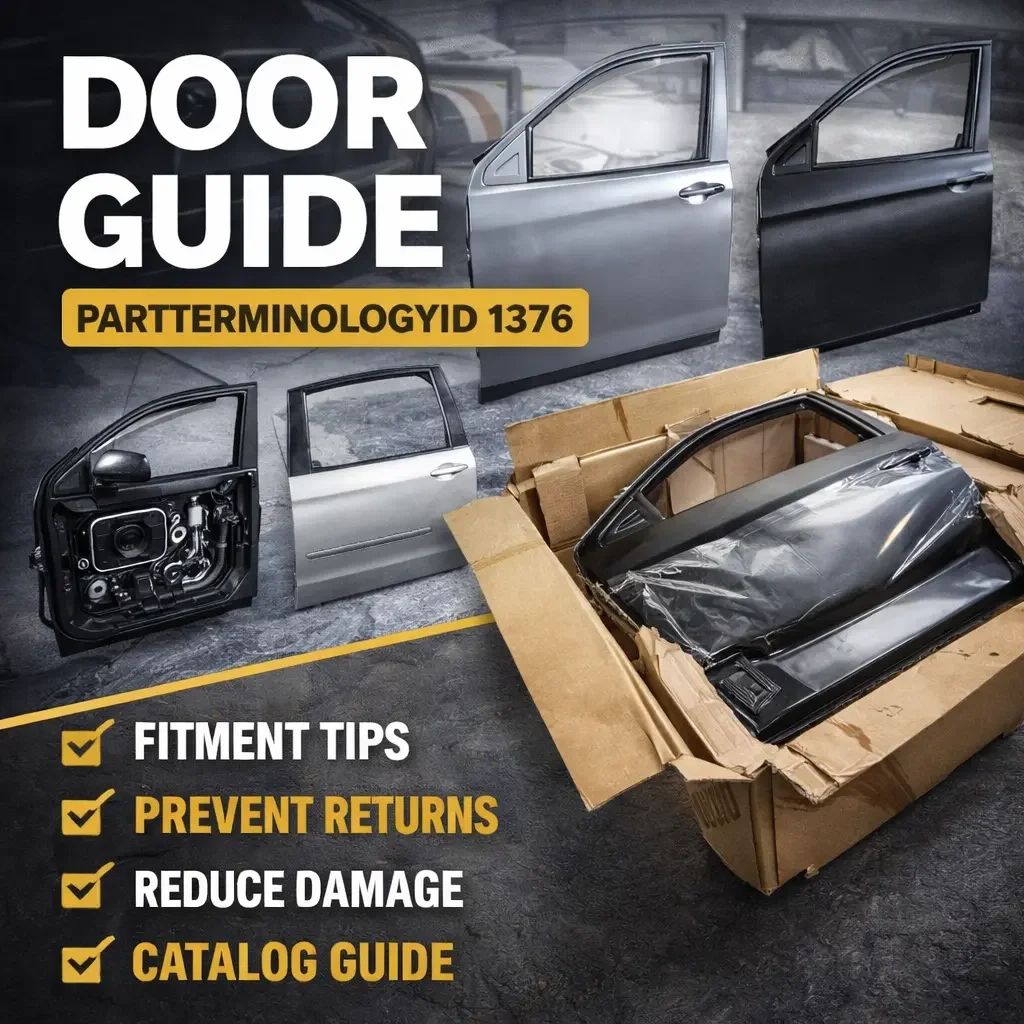
Written by Arthur Simitian | PartsAdvisory
Door is one of the biggest part names in the collision repair aftermarket by volume, by dollar value, and by the sheer number of things that can go wrong between the warehouse and the vehicle. It is also the single most difficult body panel to pack, ship, and deliver without damage.
A bumper cover is flexible plastic that can absorb some handling. A fender is a single panel with a simple shape. A hood is flat and stackable. A door is none of those things. It is a large, heavy, multi-layered assembly with sheet metal skin, an internal structural frame, window regulators, lock mechanisms, wiring harnesses, speakers, mirror mounting provisions, and in many cases side impact beams designed to protect occupants in a crash. It is rigid enough to dent permanently from a single impact in transit but too large to fit in a standard shipping box. It has edges, corners, and protruding hardware that catch on everything around it. And when it arrives at the collision shop or the buyer's garage with a dent, a crease, or a bent hinge mount from shipping, it goes back.
This combination of fitment complexity and shipping fragility makes Door one of the highest-return, highest-cost part names in the aftermarket body parts category. If your catalog and logistics teams get Door right, they are solving one of the hardest problems in the business.
This post is built for aftermarket catalog teams, marketplace sellers, and buyers who want fewer mistakes and fewer returns.
Status in New Databases
Status in New Databases
Current: PIES 7.2 + PCdb Future: PIES 8.0 + PCdb 2.0 Status: No change
What Door Means in the Aftermarket
Door (PartTerminologyID 1376) refers to the complete door assembly or the door shell (outer skin and structural frame) for a vehicle. In catalog reality, this part name covers a wide range of product forms:
Complete door assembly (loaded). The full door with all components installed: outer skin, inner frame, window regulator, window glass, door lock and latch mechanism, interior door panel (trim), exterior door handle, interior door handle, mirror mounting bracket, wiring harness, speaker(s), side impact beam, weatherstripping, and all clips and fasteners. This is the most expensive and most complex configuration. It is also the easiest for the installer because it bolts on as a unit.
Door shell (unloaded). The outer skin welded or bonded to the internal structural frame, with the side impact beam installed but no other components. The window regulator, glass, lock, handles, wiring, mirror, speaker, trim panel, and weatherstripping must be transferred from the damaged door or purchased separately. This is the most common aftermarket and recycled door product. It requires significant labor to transfer components.
Door skin only. The outer sheet metal panel without the internal frame. Used when the door frame is intact but the outer skin is dented or damaged beyond repair. The old skin is cut or unbolted, and the new skin is bonded, welded, or crimped onto the existing frame. This is the least expensive option but requires skilled bodywork.
Door assembly (partially loaded). A door with some components installed (typically the side impact beam and possibly the window regulator) but not all. Common in recycled/salvage doors where some components were harvested before the door was resold.
Each of these product forms has different pricing, different installation requirements, and different buyer expectations. A buyer who orders a "door" expecting a complete loaded assembly and receives a bare shell will be confused and dissatisfied. A collision shop that orders a shell expecting to transfer components and receives a loaded assembly will have paid more than necessary.
Why Door Is One of the Most Complex Fitment Categories
Trim level drives different doors
On the same vehicle model, different trim levels can have different doors. The differences may include:
Power windows versus manual windows (different inner door frame cutouts for regulator mounting)
Power mirrors versus manual mirrors (different wiring provisions and mirror mounting brackets)
Keyless entry versus keyed entry (different lock mechanisms and wiring)
Premium audio versus standard audio (different speaker sizes and mounting locations)
Side curtain airbags versus no side airbags (different internal structure and wiring)
Puddle lights, ambient lighting, or illuminated door handles (additional wiring and cutouts)
Power folding mirrors versus fixed mirrors (different mirror mounting and wiring)
A door from the base trim with manual windows and manual mirrors will not accept the components from a premium trim with power everything without modification. The inner frame cutouts, wiring harness routing, and mounting points are different.
Body style matters within the same model
A sedan has four doors. A coupe has two. On vehicles offered in both body styles, the doors are completely different. A sedan door is shorter (front to back) because the door opening is shared with a B-pillar and a rear door. A coupe door is longer because it must provide access to the full cabin without a rear door. The window shape, the hinge locations, the structural frame, and the skin dimensions are all different.
Additionally, some vehicles are offered as a regular cab, extended cab (with small rear-hinged half-doors), and crew cab (with full rear doors). Each cab configuration has different door dimensions, hinge geometry, and structural requirements.
Front versus rear doors are completely different parts
This seems obvious, but it is a common catalog error. Front and rear doors on the same vehicle are different in shape, size, hinge location, lock mechanism, window shape, and structural design. They are not interchangeable. The listing must specify position: Front Left (Driver), Front Right (Passenger), Rear Left, Rear Right.
Generation and facelift changes
Door designs change with vehicle generations and sometimes with mid-cycle facelifts. A facelift may change the door skin contour, the mirror mounting style, the exterior handle design, or the weatherstripping profile. Even if the basic door frame carries over between pre-facelift and post-facelift, the skin or the component mounting may be different.
Material differences
Modern vehicles use a variety of door materials:
Stamped steel (the traditional standard, still the most common)
Aluminum (used on trucks like the Ford F-150 since 2015, and on many luxury and performance vehicles)
Composite or mixed-material (some vehicles use aluminum skins over steel frames, or composite inner panels)
The material affects weight, repair procedures, welding compatibility, and pricing. An aluminum door cannot be repaired with the same tools and techniques as a steel door. A steel replacement door on a vehicle designed for aluminum will affect the weight balance and potentially the hinge alignment.
Side impact beam and structural integrity
Doors contain side impact beams (also called intrusion bars or guard beams) that are designed to protect occupants in a side collision. These beams are part of the vehicle's engineered crash structure. On OEM doors, the beam is welded or bolted inside the door frame to specific engineering tolerances.
Aftermarket door shells must include the correct side impact beam for the application. A door without a beam, or with a beam that does not meet the vehicle's crash engineering specifications, is a safety concern. CAPA certification for doors includes testing of the side impact beam.
Wiring harness compatibility
Modern doors contain extensive wiring harnesses that connect to the vehicle's body control module (BCM) for:
Power window motors
Power door lock actuators
Mirror controls (power adjust, power fold, heat, turn signal repeaters, blind spot monitoring indicators)
Speakers and tweeters
Door ajar switches
Courtesy/puddle lights
Side curtain airbag deployment sensors
Blind spot monitoring radar modules (on some vehicles, mounted inside the door)
Window auto-up/auto-down modules
Child safety lock actuators (rear doors)
The wiring harness connector must match the vehicle's body harness. Different trim levels, equipment packages, and model years can have different connector pinouts. A door with the wrong wiring harness will not plug in, or worse, will plug in but not function correctly.
The Shipping and Packaging Challenge
This is what sets Door apart from every other body panel in the aftermarket. Doors are uniquely difficult to ship without damage, and shipping damage is one of the top return causes in this category.
Why doors are hard to ship
Size and shape. A typical car door is 3 to 4 feet tall, 3 to 4 feet wide, and 6 to 10 inches thick. It does not fit in a standard shipping box. It is too large for parcel carriers like UPS or FedEx Ground (which cap at 150 pounds and have size limits). Most doors ship via LTL (less-than-truckload) freight, which means they travel with cargo from other shippers, get loaded and unloaded multiple times, and stop at distribution terminals where they are handled by forklifts and dock workers.
Weight. A steel door shell weighs 40 to 80 pounds depending on the vehicle. A loaded door assembly can weigh 80 to 120 pounds or more. This is heavy enough to be awkward for a single person to handle and light enough that it gets moved by hand rather than by equipment, increasing the chance of drops and impacts.
Damage vulnerability. Sheet metal dents from surprisingly light impacts. A door leaning against another piece of freight, a strap cinched too tight, a forklift tine brushing the surface, or a fall from a few inches onto a dock edge can create a dent or crease that makes the door unusable without additional bodywork. Edges and corners are particularly vulnerable. The window opening edge can bend. The hinge mount points can distort.
No good way to box it. Unlike a bumper cover (which can be wrapped in plastic and foam) or a headlight (which fits in a cardboard box), a door is an awkward shape that is difficult to crate economically. Custom crating provides the best protection but adds significant cost and weight. Many sellers ship doors wrapped in furniture blankets, shrink wrap, or foam padding secured to a pallet. This provides some protection but leaves the door exposed to impacts from adjacent freight.
LTL freight handling. LTL shipments are loaded and unloaded at every terminal between origin and destination. Each handling event is an opportunity for damage. The door may be stacked, shifted, or pressed against other freight. Overhanging edges are especially at risk. Freight carriers that specialize in automotive parts are more careful, but not all LTL carriers have experience handling body panels.
The cost of shipping damage
When a door arrives damaged, the costs multiply:
The buyer or shop refuses delivery or files a damage claim
The seller pays return freight (another LTL shipment for a large, heavy part)
The seller ships a replacement (another LTL shipment)
The repair timeline extends, potentially requiring a rental car extension
The customer and the collision shop lose trust in the seller
A single damaged door return can cost the seller $200 to $500 or more in freight alone, not counting the cost of the replacement door. At scale, shipping damage on doors is one of the largest controllable costs in the aftermarket body parts business.
Best practices for shipping doors
Custom crating. The gold standard. Build a wooden crate around the door with internal padding and corner protection. Expensive but nearly eliminates transit damage. Used by OEM parts distributors and premium aftermarket sellers.
Pallet and blanket. Secure the door upright on a pallet with the skin facing inward (protected). Wrap in moving blankets and shrink wrap. Add corner protectors on all four corners. Band the door to the pallet. Mark "FRAGILE" and "DO NOT STACK."
Cardboard sleeve or box. Some sellers use oversized telescoping cardboard boxes with foam inserts. Good protection for the cost if the box is the right size. A box that is too large allows the door to shift.
Foam edge protectors. Regardless of the shipping method, foam edge protectors on the window opening, the bottom edge, and the hinge mount area reduce the most common damage points.
Inspect on receipt. Collision shops and buyers should inspect the door at the time of delivery before signing the delivery receipt. Document any damage with photos before the freight driver leaves. Signing a delivery receipt without noting damage can forfeit the right to file a freight claim.
The OEM vs. Aftermarket vs. Recycled Decision
Door is one of the part categories where the OEM vs. aftermarket vs. recycled decision has the most impact on the repair outcome.
OEM doors
Exact fit, correct side impact beam, correct wiring provisions, correct material. The most expensive option. OEM doors from the dealer arrive primed or in the vehicle's body color, depending on the manufacturer. Fitment is guaranteed. The downside is cost and sometimes availability, especially for less common vehicles.
CAPA-certified aftermarket doors
Independently tested for fit, form, and function including side impact beam performance. Generally less expensive than OEM. Fit is good but may require minor adjustment during installation. Available for high-volume applications (popular sedans, trucks, SUVs). Less available for niche or luxury vehicles.
Non-certified aftermarket doors
Lower cost, but fit and structural quality are not independently verified. Panel gaps, hinge alignment, and side impact beam quality may vary. Higher risk of returns due to fitment issues.
Recycled (salvage) doors
OEM doors removed from wrecked or end-of-life vehicles. The advantage is that they are genuine OEM parts at a lower price point. The disadvantage is that they may have prior damage (repainted, minor dents, worn components), the wiring harness may have been cut rather than properly disconnected, and availability is inconsistent. Recycled doors often arrive partially loaded (some components removed) and may or may not include the glass, regulator, or mirror.
Recycled doors also carry a unique identification challenge. A salvage yard may list a door by the donor vehicle's year, make, and model, but if the donor vehicle was a different trim level than the buyer's vehicle, the internal mounting points may not match. Additionally, recycled doors may have been repainted, making it difficult to determine the original color code. Some recycled doors arrive with the VIN sticker on the door jamb from the donor vehicle, which creates a mismatch with the buyer's vehicle VIN and can raise questions during inspections or title transfers in some states.
For catalog teams listing recycled doors, the minimum required information includes: donor vehicle year, make, model, trim level, mileage of donor vehicle, condition grade (A/B/C), color code, list of components included, and any known damage or repair history.
The Color and Paint Challenge
Like bumper covers, doors must visually match the rest of the vehicle. But doors present additional paint challenges that bumper covers do not:
Door jamb color. When the door is open, the door jamb (the inner edge facing the body) is visible. On many vehicles, the jamb is painted the body color. On some vehicles, particularly trucks and commercial vehicles, the jamb may be a different color (black, primer, or a base color). A replacement door must match both the exterior skin color and the jamb color, or the mismatch will be visible every time the door is opened.
Blend panels. When a door is repainted, the paint shop often "blends" the color into the adjacent panels (front fender and rear quarter panel or rear door) to ensure a seamless color match. This blending is standard practice in collision repair but adds cost and labor beyond just painting the replacement door itself.
Two-tone and accent colors. Some vehicles have two-tone paint, body-side molding in a contrasting color, or matte/gloss accent panels on the door. The replacement door must match these accent treatments or they must be transferred from the original door.
Recycled door color matching. A recycled door in the buyer's exact color code is the ideal scenario, as it may not need repainting. However, the recycled door's paint will have aged differently than the buyer's vehicle depending on sun exposure, care, and geography. A recycled door from Arizona may be more faded than the buyer's vehicle in the Northeast. A fresh paint job on the replacement door with blending is often still required even when the color code matches.
For catalog teams, the quality tier (OEM, CAPA Certified, Non-Certified Aftermarket, Recycled/Salvage) must be a primary attribute on every door listing.
Compatibility Checklist for Buyers
1) Confirm position. Front Left (Driver), Front Right (Passenger), Rear Left, Rear Right. This is the most basic fitment variable and the most common error.
2) Confirm body style and cab configuration. Sedan, coupe, hatchback, wagon, regular cab, extended cab, crew cab. Doors are different for each configuration.
3) Confirm trim level and equipment package. Power or manual windows, power or manual mirrors, keyless entry or keyed, premium audio or standard, side curtain airbags or none. These determine the internal structure and wiring provisions.
4) Confirm product form. Complete loaded assembly, unloaded shell, or door skin only. Understand what components are included and what must be transferred or purchased separately.
5) Confirm material. Steel or aluminum. This affects repair procedures and the tools needed for installation.
6) Confirm generation and facelift status. Pre-facelift or post-facelift within your model generation. Check production date if the generation transition overlaps model years.
7) Confirm paint condition. Primed, pre-painted (color code), or as-is (recycled). Budget for paint if ordering a primed door.
8) Confirm quality tier. OEM, CAPA Certified, Non-Certified Aftermarket, or Recycled/Salvage. Understand the tradeoffs.
9) Inspect the door at delivery. Before signing the freight delivery receipt, inspect the door for shipping damage: dents, creases, bent edges, cracked glass (if included), distorted hinge mounts. Photograph any damage and note it on the delivery receipt.
10) Plan for component transfer. If ordering an unloaded shell, identify which components must be transferred from the damaged door: window regulator, glass, lock and latch, interior and exterior handles, mirror, wiring harness, speaker(s), interior trim panel, weatherstripping. Some of these components may be damaged and need separate replacement.
Catalog Checklist for Attributes and Structured Data
Core taxonomy and naming
Terminology Name: Door
Position: Front, Rear
Side: Left (Driver), Right (Passenger) for LHD markets
Product form: Complete Assembly (Loaded), Shell (Unloaded), Skin Only, Partially Loaded
Separate from Door Glass, Door Handle, Door Lock, Door Mirror, Door Trim Panel, Door Hinge, Window Regulator, and all other door components that have their own PartTerminologyIDs
Fitment structure
Year, make, model, submodel, trim level (CRITICAL)
Body style: sedan, coupe, hatchback, wagon, convertible
Cab configuration: regular cab, extended cab, crew cab (trucks)
Equipment package: power windows, power mirrors, keyless entry, premium audio, side curtain airbags, blind spot monitoring, puddle lights
Production date (facelift vs. pre-facelift)
Engine (where engine choice affects door structure, e.g., hybrid with different door-mounted battery cooling provisions)
Structural and material
Material: steel, aluminum, composite, mixed
Side impact beam: included (yes/no), type, CAPA certified
Weight (shipped weight for freight classification)
Components included
Window regulator: included or not
Window glass: included or not
Door lock and latch: included or not
Exterior handle: included or not
Interior handle: included or not
Mirror mounting bracket: included or not
Wiring harness: included or not
Speaker(s): included or not
Interior trim panel: included or not
Weatherstripping: included or not
Hinge(s): included or not
Paint and finish
Primed
Pre-painted (specify OEM color code and color name)
As-is (recycled, describe existing paint condition)
Note: door jamb color may differ from exterior color on some vehicles
Quality and certification
OEM
CAPA Certified (include CAPA seal number)
Non-Certified Aftermarket
Recycled/Salvage (include mileage of donor vehicle, condition grade)
Image requirements
Exterior skin view (showing overall shape, contours, handle area)
Interior frame view (showing structural frame, beam, wiring routing, component mounting points)
Hinge mount area close-up
Window opening edge
Lock and latch area
Mirror mounting area
Bottom edge (showing drain holes, weatherstrip groove)
Any included components shown
Packaging/crating for shipped condition (helps set buyer expectations for delivery)
Common Buyer Scenarios
Scenario 1: DIY buyer orders a door expecting a loaded assembly
The buyer's 2018 Honda Accord was hit in a parking lot. The driver's front door is badly dented. They search "2018 Honda Accord front door" and order the first result. A bare door shell arrives on a pallet, wrapped in blankets. No window, no glass, no handle, no mirror bracket, no wiring.
What went wrong: The listing said "Door" without specifying the product form. The buyer assumed "door" meant the complete unit.
What helps: Product form in the title: "Front Left Door Shell (Unloaded, Primed)" or "Front Left Door Assembly (Complete, Loaded)." First line of description: "This is a door shell only. Window regulator, glass, lock, handles, mirror, wiring harness, speakers, and interior trim panel are NOT included and must be transferred from the original door or purchased separately."
Scenario 2: Collision shop receives a door with shipping damage
The shop orders a CAPA-certified front right door shell for a 2021 Toyota Camry. The door arrives on a pallet wrapped in shrink wrap. When they unwrap it, there is a 4-inch crease along the bottom edge where the door contacted the pallet edge during transit.
What went wrong: The door was not adequately protected during LTL freight shipping. No edge protectors were used on the bottom, and the shrink wrap alone did not prevent the door from shifting against the pallet.
What helps: Foam edge protectors on all four edges, corner protectors, and a "DO NOT STACK" label. The shop should have inspected the door before signing the delivery receipt, but the seller's packaging should have prevented the damage in the first place.
Scenario 3: Wrong trim level, power versus manual windows
The shop orders a door shell for a 2019 Chevy Silverado LT and receives a door shell for the WT (base work truck) trim. The inner frame has manual window regulator mounting provisions instead of power window provisions. The power window regulator from the damaged LT door will not bolt into the WT shell.
What went wrong: Trim level was not specified in the listing, or the listing was not split by trim group.
What helps: Trim level as a mandatory fitment qualifier. "For vehicles with power windows" or "For vehicles with manual windows" in the title. Inner frame photo showing regulator mounting points.
Scenario 4: Steel door ordered for aluminum-body vehicle
The buyer orders a front door for a 2017 Ford F-150 and receives a steel door. The 2017 F-150 uses an aluminum body. The steel door is the wrong material, wrong weight, and incompatible with the aluminum body structure.
What went wrong: The listing did not specify material, or the aftermarket supplier offers the door in steel because it is cheaper to manufacture.
What helps: Material as a primary attribute: "Aluminum Door Shell" or "Steel Door Shell." Fitment data that accounts for the material change in the F-150 starting with the 2015 model year.
FAQ
What is the difference between a door shell and a complete door assembly?
A door shell is the outer skin and internal structural frame with the side impact beam, but no other components. A complete door assembly includes all components: glass, regulator, lock, handles, mirror bracket, wiring, speakers, and trim panel. The shell is less expensive but requires significant labor to transfer components from the original door.
How much does it cost to ship a door?
LTL freight shipping for a single door typically costs $75 to $250 depending on distance, carrier, and packaging. Custom crating adds $50 to $150 to the shipping cost but significantly reduces the risk of transit damage.
Should I order an OEM or aftermarket door?
For newer vehicles, vehicles under warranty, or vehicles with complex wiring and ADAS integration, OEM doors provide the best fit and the least installation complexity. For older vehicles or budget-sensitive repairs, CAPA-certified aftermarket doors offer good fit at lower cost. Non-certified aftermarket doors carry more fitment risk.
Why does trim level matter for a door?
Different trim levels have different internal structures, wiring provisions, and component mounting points. A door designed for manual windows will not accept power window components without modification. A door without side curtain airbag provisions cannot be used on a vehicle equipped with side airbags.
How should I inspect a door when it arrives?
Inspect before signing the delivery receipt. Check the outer skin for dents, creases, and scratches. Check the edges, especially the bottom edge and window opening, for bends or distortion. Check the hinge mount points for alignment. Check the lock and latch area. If glass is included, check for cracks. Photograph any damage and note it on the delivery receipt before the freight driver leaves.
Can I install a door from a different trim level?
It depends on the specific differences. If the only difference is cosmetic (exterior handle chrome versus body-color), it may work with a handle swap. If the structural differences involve window regulator mounting, mirror wiring, or airbag provisions, the door shell is not compatible and should not be used.
What is a side impact beam and why does it matter?
The side impact beam is a structural bar or reinforcement inside the door that protects occupants in a side collision. It is part of the vehicle's engineered crash safety system. OEM and CAPA-certified doors include a beam that meets the vehicle's crash performance specifications. Non-certified aftermarket doors may use a beam that has not been independently tested. Using a door without the correct beam compromises occupant safety.
Final Take for Aftermarket Teams
Door (PartTerminologyID 1376) is one of the most complex and most returned body parts in the aftermarket. The fitment variables are extensive: position, body style, cab configuration, trim level, equipment package, material, generation, and facelift status. The product form must be clearly stated: loaded assembly, unloaded shell, or skin only. The quality tier (OEM, CAPA, non-certified, recycled) is a primary buying decision. And the shipping challenge is unique to this category: doors are large, heavy, fragile, and difficult to package for LTL freight transit without damage.
The catalog teams and sellers that win in this category are the ones that:
Specify position, side, and body style in every title
Use trim level and equipment package as mandatory fitment qualifiers
State product form (loaded, unloaded, skin) clearly in the title and first line
List every included component explicitly
Specify material (steel vs. aluminum) as a primary attribute
Include interior frame images showing regulator mounting and wiring routing
Package doors with edge protectors, corner protectors, and adequate crating for LTL freight
Instruct buyers to inspect at delivery and note damage on the freight receipt
Separate Door from Door Glass, Door Handle, Door Lock, and every other door component at the taxonomy level
Door is a category where catalog accuracy and shipping execution must both be excellent. One without the other still results in returns. Getting both right is what separates the businesses that scale from the ones that bleed money on every door they ship.