
Coded Door Lock Set (PartTerminologyID 1372): The Matched Set That Gives You One Key for Everything Again
Written by Arthur Simitian | PartsAdvisory
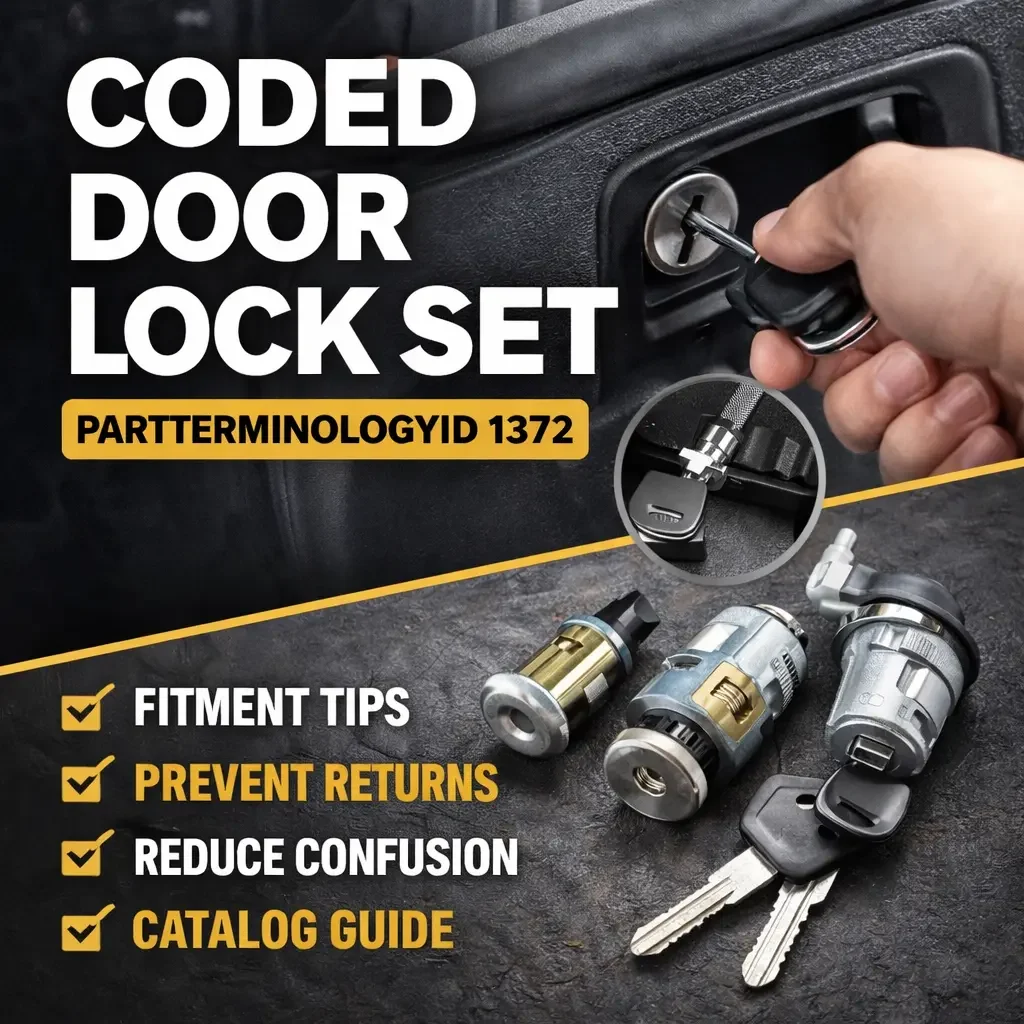
Coded Door Lock Set is a matched set of lock cylinders that are all keyed alike so one key operates every lock on the vehicle. When a vehicle ages, lock cylinders wear out at different rates. The ignition gets used the most and wears first. The driver's door lock gets used second most. The passenger door, trunk, and glovebox cylinders may still work fine. The result is a vehicle where the owner carries two or three different keys, or where some locks barely work with a badly worn key, or where the ignition turns without a key at all.
A coded door lock set solves this by replacing all the lock cylinders at once with a matched set that shares a single new key. One key, every lock, back to the way it was from the factory.
This is a restoration and maintenance part, not a collision repair part. The primary buyers are classic car restorers, fleet maintenance shops, and owners of older vehicles who are tired of juggling mismatched keys or dealing with worn-out lock cylinders that are becoming a security problem.
This post is built for aftermarket catalog teams, marketplace sellers, and buyers who want fewer mistakes and fewer returns.
Status in New Databases
Status in New Databases
Current: PIES 7.2 + PCdb Future: PIES 8.0 + PCdb 2.0 Status: No change
What Coded Door Lock Set Means in the Aftermarket
Coded Door Lock Set refers to a kit of lock cylinders that are pre-keyed (coded) to work with the same key. The word "coded" means the tumblers inside each cylinder are set to the same key cut pattern. You get new cylinders and new matching keys in one package.
In catalog reality, the contents of a coded door lock set vary significantly depending on the vehicle and the manufacturer. Common configurations include:
Doors only set. Two door lock cylinders (driver and passenger) keyed alike with matching keys. The most basic configuration.
Doors and ignition set. Two door lock cylinders plus the ignition lock cylinder, all keyed alike. This is the most common configuration because the ignition is usually the first cylinder to wear out and the primary reason for replacing the set.
Doors, ignition, and trunk set. Two door lock cylinders, ignition lock cylinder, and trunk lock cylinder, all keyed alike. Common for sedan applications. One key operates everything.
Full vehicle set. All lock cylinders on the vehicle: doors, ignition, trunk, glovebox, console, rear hatch, tailgate, and/or fuel filler door lock, all keyed alike. Most common in classic car restoration kits.
Single door lock cylinder (coded). A single replacement cylinder that is pre-cut to a specific key code. This is not a set, but it is sometimes cataloged adjacent to sets. The buyer provides a key code and receives a cylinder cut to that code so it matches their existing key.
Coded versus uncoded
This is the critical distinction in this category:
Coded (keyed): The lock cylinder arrives with the tumblers already set and matching keys included. It is ready to install. The buyer uses the new keys that come with the set. The downside is that the new keys will not match the vehicle's existing key, which means the buyer cannot use their old key for anything in the set. Transponder key programming may also be required for the ignition cylinder on vehicles with immobilizer systems.
Uncoded (unkeyed): The lock cylinder arrives with no tumblers installed or with blank tumblers. A locksmith must pin the cylinder to match either a new key or the buyer's existing key. This is the option for buyers who want to keep using their current key. It requires a locksmith visit.
A coded door lock set is specifically the coded version: pre-keyed, matching keys included, ready to install. Catalog listings must clearly state whether the set is coded or uncoded, because the buyer's expectation and installation process are completely different.
Why This Category Creates Fitment Problems
Vehicle-specific lock cylinder geometry
Lock cylinders are not universal. The physical shape, diameter, length, mounting method, face cap design, and tumbler type are specific to the vehicle manufacturer and model. A Ford lock cylinder will not fit a GM vehicle. A 1965 Mustang cylinder will not fit a 1970 Mustang. The external housing that the cylinder sits in (the door handle, the ignition switch housing, the trunk latch) determines the cylinder dimensions.
Key blank type and cut pattern
Different manufacturers and different model years use different key blank profiles. Ford 10-cut keys are different from Ford 8-cut keys. GM VATS (Vehicle Anti-Theft System) keys have a resistor pellet. Modern vehicles use transponder keys with embedded chips. High-security keys use sidewinder or laser-cut profiles. The lock set must match the key type the vehicle uses.
Transponder and immobilizer compatibility
On vehicles with transponder-based immobilizer systems (most vehicles from the late 1990s forward), replacing the ignition lock cylinder means the new key's transponder chip must be programmed to the vehicle's immobilizer module. A coded door lock set that includes an ignition cylinder will come with new mechanical keys, but those keys may not start the vehicle until the transponder is programmed. Some aftermarket sets include transponder keys. Some include only mechanical keys. This must be clearly stated in the listing.
Set contents vary by listing
One listing may include doors and ignition. Another may include doors, ignition, and trunk. Another may include only the doors. The buyer who expects a full set and receives a doors-only set will be disappointed. The buyer who needs only door cylinders and receives a set with an ignition cylinder they do not need is paying for parts they will not use.
Classic car versus modern vehicle
The classic car restoration market and the modern vehicle maintenance market are two different buyer populations with different expectations. Classic car buyers want sets that look period-correct, use the correct key blank profile for the year, and include all lock positions on the vehicle. Modern vehicle buyers are more likely to need a doors-and-ignition set to replace worn cylinders and may need transponder key compatibility.
Color and finish of the lock face cap
Lock cylinders have a visible face cap (the round face you see on the door or trunk). These come in chrome, black, brushed, or color-matched finishes depending on the vehicle. A chrome face cap on a vehicle that originally had black looks wrong, and vice versa. The set must match the vehicle's original finish, or the listing must specify what finish is included.
Top Return Causes
1) Set contents do not match buyer expectations
Buyer expected doors, ignition, and trunk. Received doors only.
Prevention: List every cylinder included in the set by position: "Includes: Driver Door, Passenger Door, Ignition, Trunk" or "Includes: Driver Door, Passenger Door only." Make set contents the first line of the description.
2) Coded set does not match existing key
Buyer expected the new set to work with their existing key. A coded set comes with new keys. The old keys will not work.
Prevention: Clear statement: "This is a coded set. New matching keys are included. This set will NOT work with your existing vehicle key. To match your existing key, purchase an uncoded set and have a locksmith pin the cylinders."
3) Transponder key not included or not programmed
Buyer replaces the ignition cylinder, installs the new mechanical key, and the vehicle will not start because the key has no transponder chip or the chip is not programmed.
Prevention: State whether transponder keys are included. If only mechanical keys are included, note: "Mechanical keys only. Transponder key programming required for vehicle start. Consult a locksmith or dealer for programming."
4) Wrong vehicle application
Lock cylinder geometry does not match the vehicle's door handle, ignition housing, or trunk latch.
Prevention: Full ACES fitment data. Year, make, model, submodel. Key blank type and cut pattern as attributes.
5) Wrong face cap color or finish
Chrome cylinders on a vehicle that uses black, or vice versa.
Prevention: Specify face cap finish: chrome, black, brushed, body-color. Include a photo showing the face cap.
Compatibility Checklist for Buyers
1) Confirm which lock positions you need replaced. Doors only, doors and ignition, doors and trunk, or full vehicle set. Buy only what you need, or buy the full set if you want one key for everything.
2) Decide: coded or uncoded. Coded means new keys are included and you will use the new keys going forward. Uncoded means a locksmith will pin the cylinders to match your existing key. Both are valid options with different installation requirements.
3) Confirm your vehicle's key type. Standard mechanical key, VATS key (GM with resistor pellet), transponder key, high-security sidewinder key. The set must match.
4) If your vehicle has a transponder immobilizer, plan for key programming. A coded set with an ignition cylinder will require transponder programming before the vehicle will start. Budget for a locksmith or dealer visit.
5) Confirm face cap finish. Chrome, black, or other. Match your vehicle's original appearance.
6) Confirm full vehicle details. Year, make, model, submodel. Lock cylinder geometry is completely vehicle-specific.
Catalog Checklist for Attributes
Core taxonomy: Product form (door lock set only, door and ignition set, door ignition and trunk set, full vehicle set, single coded cylinder). Coded versus uncoded as a primary attribute.
Fitment: Year, make, model, submodel. Key blank type (manufacturer key profile). OEM part number cross-reference.
Set contents: List every cylinder by position (driver door, passenger door, ignition, trunk, glovebox, etc.). Number of keys included.
Key and security: Key blank profile, transponder key included (yes/no), VATS resistor value (GM), mechanical key only notation, programming required notation.
Finish: Face cap color/finish (chrome, black, brushed, body-color).
Images: All cylinders laid out with keys, face cap close-up showing finish, key close-up showing profile and any transponder chip.
FAQ
What does "coded" mean?
Coded means the lock cylinders are pre-keyed at the factory so they all work with the same key. New matching keys are included in the set. You will use the new keys going forward. Your old keys will not work with the new cylinders.
Will my existing key work with a coded door lock set?
No. A coded set comes with new keys cut to a new pattern. If you want to keep using your existing key, purchase an uncoded set and have a locksmith repin the cylinders to match your key.
Do I need to program the key after installing a coded ignition lock cylinder?
If your vehicle has a transponder-based immobilizer system (most vehicles from the late 1990s forward), yes. The new key must be programmed to the vehicle's immobilizer before it will start the engine. A locksmith or dealer can perform this programming.
Can I buy a single cylinder coded to match my existing set?
Some suppliers offer single coded cylinders cut to a specific key code. You provide the key code (usually stamped on the original key or lock) and receive a cylinder cut to that code. This allows you to replace one worn cylinder without replacing the entire set.
Final Take for Aftermarket Teams
Coded Door Lock Set (PartTerminologyID 1372) is a kit-based product where the most common return causes are mismatched expectations about what is in the box. Catalog teams that win here list every cylinder position included in the set, clearly state coded versus uncoded, specify whether transponder keys are included or only mechanical keys, note when programming is required, and show the face cap finish. The vehicle-specific fitment is straightforward ACES data. The buyer confusion is about set contents, key type, and the coded versus uncoded distinction. Get those three things right in every listing and the returns drop significantly.