
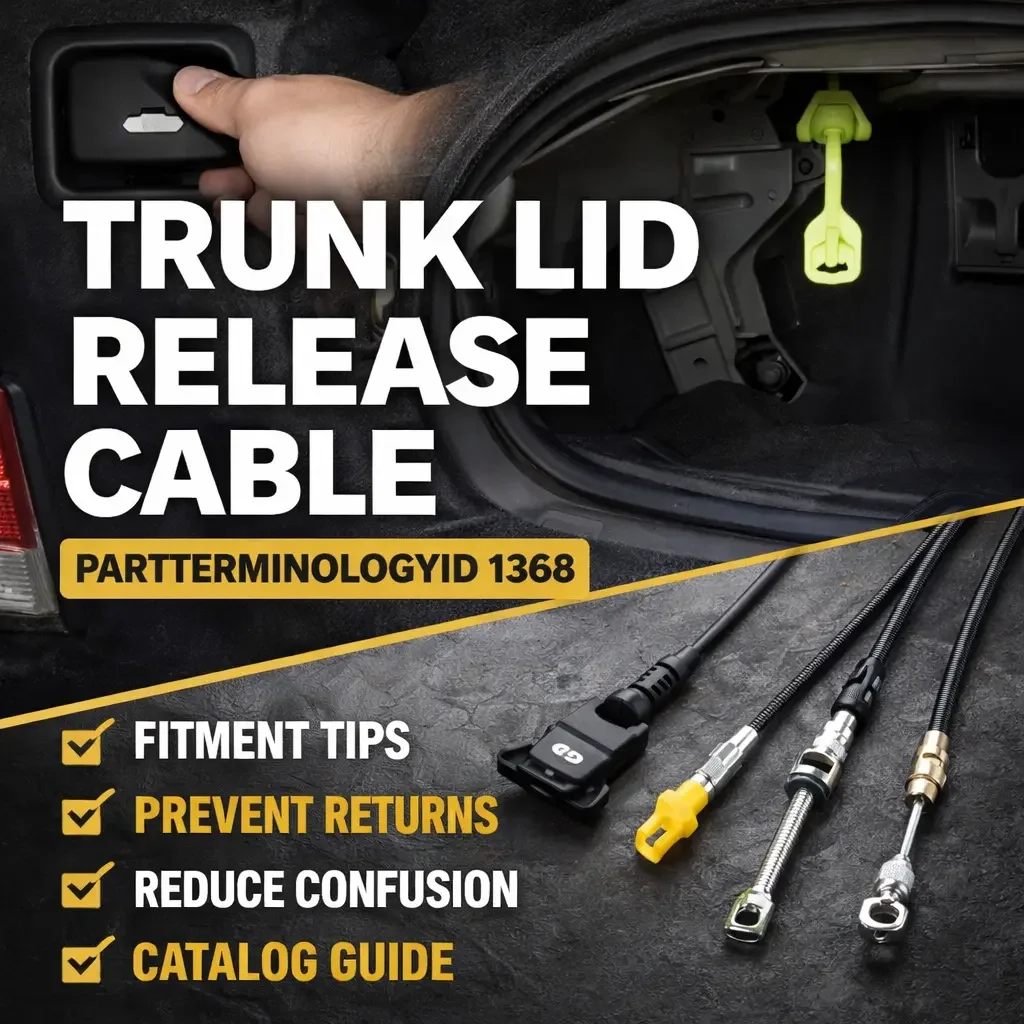
Written by Arthur Simitian | PartsAdvisory
This is the sixth and final release cable post in this series. We have covered Cruise Control Cable (PartTerminologyID 1348), Fuel Filler Door Release Cable (PartTerminologyID 1352), Liftgate Latch Release Cable (PartTerminologyID 1356), Hood Release Cable (PartTerminologyID 1360), and Tailgate Release Cable (PartTerminologyID 1364). The pattern across all of them is the same: vehicle-specific cable, vehicle-specific routing, vehicle-specific end fittings, and constant confusion between cables that look similar but are not interchangeable.
Trunk Lid Release Cable fits that pattern, but it also represents the category where the transition from mechanical to electric release has gone the furthest. On most sedans built after roughly 2005 to 2010, the trunk release is fully electric. There is no cable. The driver presses a button on the key fob, the dash, or the trunk lid, and an electric actuator releases the latch. The cable-operated trunk release lever on the driver's floor or kick panel has largely disappeared from new vehicles.
That makes this a shrinking category with a specific, aging vehicle population. The vehicles that still need this cable are getting older, failures are becoming more common as cables corrode and stretch, and OEM parts are being discontinued. Catalog accuracy matters more as the part becomes harder to source.
This post is built for aftermarket catalog teams, marketplace sellers, and buyers who want fewer mistakes and fewer returns.
Status in New Databases
Status in New Databases
Current: PIES 7.2 + PCdb Future: PIES 8.0 + PCdb 2.0 Status: No change
What Trunk Lid Release Cable Means in the Aftermarket
Trunk Lid Release Cable refers to the mechanical cable that connects an interior release lever (typically on the driver's side floor, kick panel, or lower dash) to the trunk latch mechanism. Pulling the lever transfers cable motion to unlatch the trunk so it can be opened.
In catalog reality, this covers:
Full cable assemblies from interior lever to trunk latch
Cable and lever assemblies (replacement includes the interior pull lever)
Cable and latch assemblies (replacement includes the trunk latch mechanism)
Lock cylinder to latch cables (a separate cable that connects the exterior key lock cylinder on the trunk lid to the latch, allowing the trunk to be opened with a key)
Emergency interior release cables (the glow-in-the-dark T-handle inside the trunk required by FMVSS 401 on all vehicles since September 2001, which allows someone trapped inside the trunk to release the latch from the interior)
Each of these is a different cable. They have different lengths, different routing, and different end fittings. The interior release cable, the lock cylinder cable, and the emergency release cable are three distinct parts that all connect to the same trunk latch but from different directions.
What this part does NOT cover
Electric trunk release actuators. On vehicles with push-button electric trunk release, the latch is opened by a solenoid or electric motor. There is no cable from the cabin. The actuator is a different PartTerminologyID.
Trunk struts or lift supports. These are the gas-charged cylinders that hold the trunk lid open after it has been unlatched. Different part, different function.
Hood release cables (PartTerminologyID 1360), fuel filler door release cables (PartTerminologyID 1352), or any other release cable. Same concept, different parts.
The Electric Transition and the FMVSS 401 Emergency Release
Two things define this category:
First, the electric transition. Most modern sedans have eliminated the mechanical interior trunk release lever entirely. The trunk is released by an electric button or the key fob. If the trunk will not open, the problem is the electric actuator, the wiring, or the body control module, not a cable. Catalog teams must not create fitment records for cable-operated trunk release on vehicles that use electric release. There is no cable to replace.
Second, the FMVSS 401 emergency release. Since September 2001, all new vehicles sold in the United States with a trunk must have an internal trunk release mechanism that allows a person trapped inside the trunk to open it from the inside. This is the glow-in-the-dark T-handle or pull lever visible when the trunk is open. On vehicles with a cable-operated trunk, this emergency release may share the same latch mechanism but use a separate dedicated cable. On vehicles with electric trunk release, the emergency release is often a simple mechanical lever directly connected to the latch with a very short cable or rod.
The emergency release cable is a separate part from the interior cabin release cable. Catalog listings must distinguish between them.
Why This Category Creates Fitment Problems
Sedan-specific body routing
The cable routes from the driver's area, under or along the rear seat area, through the trunk floor or rear body panel, to the trunk latch. This routing is specific to the sedan's body structure. A cable from the same model in a different body style (coupe, hatchback, wagon) will not fit because the body architecture is different.
Multiple cables per trunk latch
As with every other release cable category, a single trunk latch may be served by two or three cables: the interior release cable from the cabin lever, the exterior lock cylinder cable from the key lock on the trunk lid, and the emergency interior release cable inside the trunk. These are different parts.
Convertible versus hardtop
On vehicles offered as both a coupe/sedan and a convertible, the trunk area is significantly different. The convertible must accommodate the folding roof mechanism, which changes the trunk latch location, cable routing, and available space. Convertible trunk release cables are different part numbers from their hardtop counterparts.
Lock cylinder cable versus interior release cable
The lock cylinder cable runs from the key lock on the outside of the trunk lid to the latch. The interior release cable runs from the cabin lever through the body to the latch. They are different cables serving different functions at the same latch. If the catalog does not specify which cable, the buyer may order the wrong one.
Discontinuation
This is a shrinking category. OEM manufacturers are discontinuing trunk release cables as the vehicle population ages out and electric release becomes standard. Aftermarket availability is also declining. Cross-reference accuracy is critical when the OEM part is no longer available and the buyer is relying on aftermarket substitutes.
Top Return Causes
1) Wrong cable type (interior release versus lock cylinder versus emergency release)
The buyer orders a trunk release cable and receives the wrong one of the three cables that serve the trunk latch.
Prevention: Specify which cable in the title: "Trunk Interior Release Cable (Cabin Lever to Latch)" versus "Trunk Lock Cylinder Cable (Key Lock to Latch)" versus "Trunk Emergency Release Cable (Interior T-Handle to Latch)."
2) Vehicle uses electric trunk release (no cable exists)
The buyer searches for a trunk release cable on a vehicle that uses electric release. There is no cable to replace.
Prevention: Do not create fitment records for vehicles with electric trunk release. Include a note: "For vehicles with cable-operated trunk release only. Vehicles with push-button or key fob electric trunk release do not use this cable."
3) Wrong body style (sedan versus coupe versus convertible)
The cable for the sedan does not fit the convertible, or vice versa.
Prevention: Body style as a mandatory fitment qualifier.
4) Confusion with hood, fuel door, or other release cables
The buyer orders the wrong release cable because the levers are clustered in the same area of the driver's footwell.
Prevention: Full function name in the title. Never list as simply "Release Cable."
5) Cable length mismatch from incorrect cross-reference
Particularly common as OEM parts are discontinued and aftermarket cross-references fill the gap with varying accuracy.
Prevention: List cable length. Cross-reference to OEM part number. Note when the OEM part is discontinued.
Compatibility Checklist for Buyers
1) Confirm your vehicle uses a cable-operated trunk release. If your trunk opens with a button on the key fob, dash, or trunk lid and there is no pull lever in the cabin, your vehicle uses electric release and there is no cable to replace.
2) Identify which cable you need. Interior cabin release, exterior lock cylinder, or emergency interior release. Trace the failed cable to confirm.
3) Confirm full vehicle details. Year, make, model, submodel, body style (sedan, coupe, convertible).
4) Check end fittings on the old cable. Match lever-side and latch-side fittings to the replacement.
5) Check what is included. Cable only, cable with lever, cable with latch, cable with lock cylinder. Determine which components you need.
Catalog Checklist for Attributes
Core taxonomy: Product form (interior release cable, lock cylinder cable, emergency release cable, cable with lever, cable with latch, cable only). Separate from Hood Release Cable, Fuel Filler Door Release Cable, Liftgate Latch Release Cable, and Tailgate Release Cable.
Fitment: Year, make, model, submodel, body style (sedan, coupe, convertible), cable-operated versus electric trunk release. OEM part number cross-reference.
Physical specs: Cable length, fitting type at lever/handle end, fitting type at latch end.
Package contents: Cable, lever (if included), latch (if included), lock cylinder (if included), mounting clips.
Images: Full cable with both ends visible, end fitting close-ups, routing diagram if available.
FAQ
Does my vehicle have a trunk release cable?
If your vehicle has an interior pull lever in the cabin that mechanically opens the trunk via a cable, yes. If your trunk opens only via a push button or key fob, you have an electric release and there is no cable. Most sedans built after 2005 to 2010 use electric release.
What is the glow-in-the-dark handle inside my trunk?
That is the FMVSS 401 emergency interior trunk release, required on all vehicles with trunks sold in the U.S. since September 2001. It allows a person trapped inside the trunk to open it from the inside. It connects to the trunk latch via a short cable or rod and is a separate part from the cabin interior release cable.
Is the trunk release cable the same as the hood release cable?
No. They are different cables with different lengths, different routing, and different end fittings. The trunk release cable runs from the cabin to the rear trunk latch. The hood release cable runs from the cabin to the front hood latch. The levers may be near each other on the driver's kick panel.
Final Take for Aftermarket Teams
Trunk Lid Release Cable (PartTerminologyID 1368) closes out the release cable series. The pattern is consistent across all six posts: vehicle-specific cable, multiple cables per latch, naming confusion between cable types, and a technology transition from mechanical to electric that is shrinking the addressable vehicle population. Trunk Lid Release Cable is the category where that electric transition has gone the furthest. Catalog teams that serve the remaining mechanical trunk release population need to specify which cable (interior, lock cylinder, emergency), never create fitment for electric release vehicles, use body style as a mandatory qualifier (sedan versus coupe versus convertible), and clearly separate this cable from every other release cable at the taxonomy level.
The discipline built across this six-post release cable series applies to every cable in the catalog. If you can get the naming, fitment qualification, and taxonomy separation right for release cables, you can get it right for anything.