
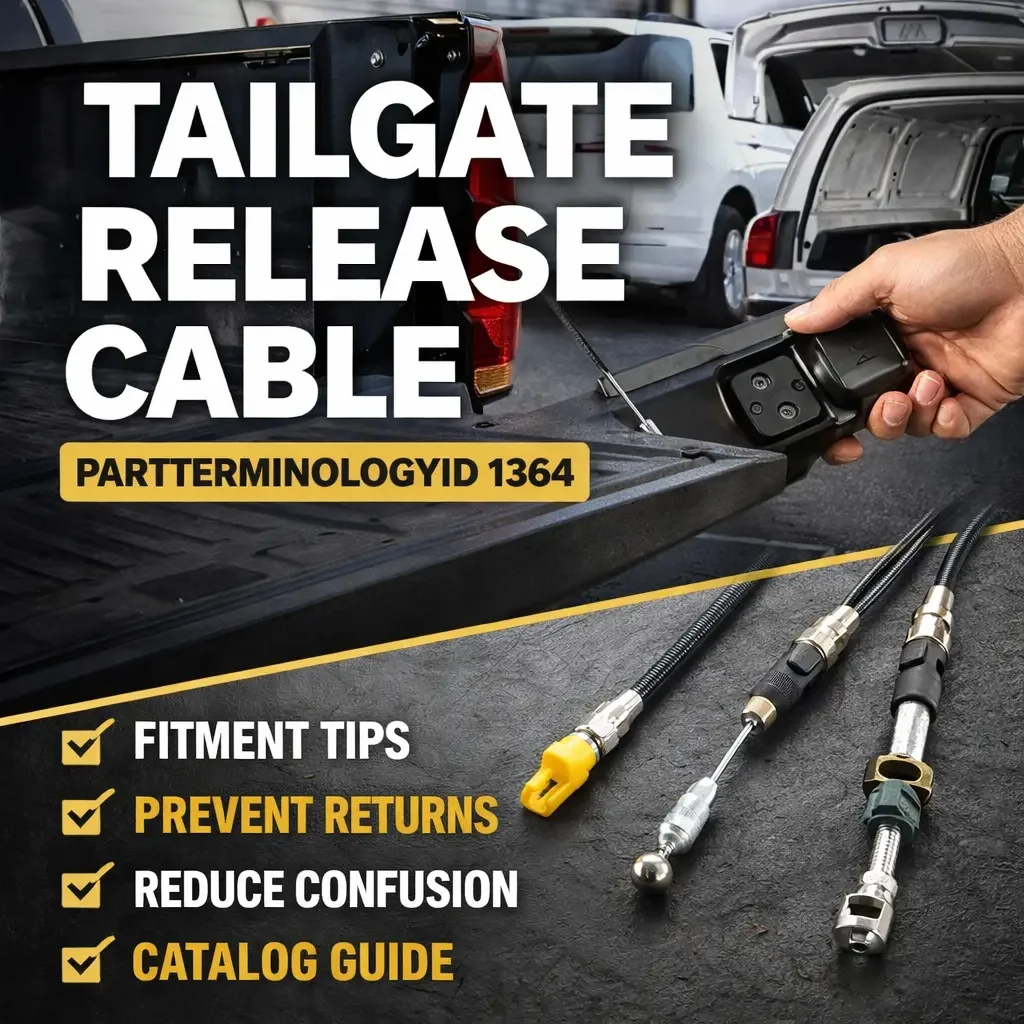
Tailgate Release Cable (PartTerminologyID 1364): The Fifth Release Cable, and the One Where "Tailgate" Means Three Different Things
Written by Arthur Simitian | PartsAdvisory
This is the fifth release cable post in this series. We have covered Fuel Filler Door Release Cable (PartTerminologyID 1352), Liftgate Latch Release Cable (PartTerminologyID 1356), Hood Release Cable (PartTerminologyID 1360), and Cruise Control Cable (PartTerminologyID 1348). The fitment problems are the same across all of them: vehicle-specific routing, vehicle-specific end fittings, vehicle-specific cable length, and constant confusion between cables that look alike but are not interchangeable.
Tailgate Release Cable has all of those problems plus one that the others do not: the word "tailgate" means different things on different vehicles, and the catalog world has not settled on consistent usage.
This post is built for aftermarket catalog teams, marketplace sellers, and buyers who want fewer mistakes and fewer returns.
Status in New Databases
Status in New Databases
Current: PIES 7.2 + PCdb Future: PIES 8.0 + PCdb 2.0 Status: No change
What Tailgate Release Cable Means in the Aftermarket
Tailgate Release Cable refers to the mechanical cable that connects a release mechanism (interior lever, exterior handle, or lock cylinder) to the tailgate latch. Pulling or pressing the release transfers cable motion to unlatch the tailgate so it can open.
The problem starts with the word "tailgate." In aftermarket catalogs, it gets applied to three different vehicle configurations:
Pickup truck tailgate. This is the traditional meaning. The tailgate is the bottom-hinged rear panel on a pickup truck bed that folds down. The release cable connects the exterior handle (and sometimes an interior cab-mounted release) to the tailgate latch. This is the highest-volume application for this PartTerminologyID.
SUV/crossover rear liftgate. Some catalogs use "tailgate" interchangeably with "liftgate" for the top-hinged rear door on SUVs and crossovers. This creates direct overlap with Liftgate Latch Release Cable (PartTerminologyID 1356). The same cable may appear under both PartTerminologyIDs depending on the data source.
Van rear doors. On vans with side-hinged rear barn doors, the release cable for those doors is sometimes cataloged under "tailgate" even though the doors are not tailgates in the traditional sense.
This naming inconsistency is the single biggest catalog problem in this category. A buyer searching "tailgate release cable" for their Ford F-150 pickup and a buyer searching "tailgate release cable" for their Ford Explorer SUV are looking for completely different parts on completely different vehicle types, but they are searching the same term.
How the Pickup Truck Tailgate Cable Works
On a pickup truck, the tailgate cable system typically includes:
Exterior handle cable. The tailgate handle on the outside of the tailgate connects to the latch via a cable. Pulling or pressing the handle pulls the cable, which releases the latch, allowing the tailgate to fold down. This is the most commonly replaced cable in the category.
Lock cylinder cable. If the tailgate has a keyed lock cylinder, a separate cable connects the lock cylinder to the latch mechanism. Turning the key pulls this cable to lock or unlock the tailgate. This is a different cable from the handle cable.
Interior release cable. Some newer trucks have a cab-mounted tailgate release button or lever. On vehicles where this is a mechanical system rather than electronic, a cable runs from the cab to the tailgate latch. This is a third distinct cable.
Tailgate support cables. These are NOT release cables. Tailgate support cables (sometimes called tailgate check cables or limit cables) are the cables on each side of the tailgate that catch the tailgate when it folds down and hold it in the horizontal position. They limit how far the tailgate opens. These are a different PartTerminologyID and a different function entirely, but they are frequently confused with tailgate release cables in search results because they share the words "tailgate" and "cable."
This distinction matters. A buyer who searches "tailgate cable" may receive a support/check cable when they needed a release cable, or vice versa. The catalog must separate these clearly.
Why This Category Creates Fitment Problems
Multiple cables per tailgate
Just like the liftgate (covered in PartTerminologyID 1356), a single tailgate can use two or three different cables: the handle cable, the lock cylinder cable, and the interior release cable. These are different lengths, different routings within the tailgate panel, and different end fittings. The listing must specify which cable.
Tailgate handle design changes
Pickup truck tailgates have gone through significant design changes, especially on popular models like the Ford F-150, Chevy Silverado, Ram 1500, and Toyota Tacoma. Handle designs, latch mechanisms, and cable routing change with model generations and sometimes with mid-cycle refreshes. The cable for a 2014 Silverado may not fit a 2015 if a generation change occurred that year.
Power tailgate lock versus manual
Many modern trucks offer a power tailgate lock actuator that locks and unlocks the tailgate electrically via the key fob or cab-mounted button. On these vehicles, the lock cylinder cable may not exist (replaced by the electric actuator), but the mechanical handle release cable still does. Listing a lock cylinder cable for a vehicle with a power lock actuator creates a false fitment.
Integrated backup camera and tailgate handle
On trucks equipped with a backup camera integrated into the tailgate handle, the handle assembly is different from non-camera versions. The release cable may be the same, but the handle it connects to is not. If the cable is sold as a cable-and-handle assembly, the camera versus no-camera distinction becomes a fitment qualifier.
Tailgate support cable confusion
As noted above, tailgate support cables and tailgate release cables are different products. They are the most commonly confused cable pair in the pickup truck category. Catalog taxonomy must separate them, and search results must not intermingle them.
Top Return Causes
1) Support cable ordered instead of release cable (or vice versa)
The buyer searches "tailgate cable" and receives the wrong type.
Prevention: Clear titles: "Tailgate Release Cable (Handle to Latch)" versus "Tailgate Support Cable (Check Cable)." Never title a listing simply "Tailgate Cable."
2) Wrong cable within the tailgate (handle versus lock cylinder versus interior release)
The buyer orders one tailgate release cable and receives a different one.
Prevention: Specify which cable in the title: "Tailgate Handle Release Cable" versus "Tailgate Lock Cylinder Cable" versus "Tailgate Interior Release Cable."
3) Tailgate versus liftgate naming confusion
The buyer has an SUV liftgate but searches "tailgate" and receives a pickup truck tailgate cable, or the catalog has the SUV cable listed under the wrong PartTerminologyID.
Prevention: Use vehicle type to separate applications. Pickup truck tailgate cables belong under PartTerminologyID 1364. SUV and crossover liftgate cables belong under PartTerminologyID 1356. Include alternate search terms in metadata but keep the primary classification consistent.
4) Generation or facelift mismatch
Cable from the wrong generation does not fit due to a different latch, handle, or routing design.
Prevention: Full ACES fitment data with generation and production date awareness.
5) Power tailgate lock vehicle receives manual lock cable
The cable includes a lock cylinder connection that the vehicle does not use because it has an electric lock actuator.
Prevention: "For vehicles with manual tailgate lock" versus "For vehicles with power tailgate lock" as a fitment qualifier.
Compatibility Checklist for Buyers
1) Confirm you need a release cable, not a support cable. The release cable unlatches the tailgate. The support cables hold the tailgate in the open (horizontal) position. These are different parts.
2) Identify which release cable you need. Handle to latch, lock cylinder to latch, or interior release to latch. Trace the failed cable to confirm which one broke.
3) Confirm full vehicle details. Year, make, model, submodel, cab configuration (regular, extended, crew), and bed length if applicable.
4) Confirm manual versus power tailgate lock. If your tailgate locks and unlocks with the key fob or a cab button, you have a power lock actuator and may not have a lock cylinder cable.
5) Check end fittings on the old cable if accessible. Match the handle-side and latch-side fittings to the replacement.
6) Check what is included. Cable only, cable with handle, cable with lock cylinder. Determine which components you need.
Catalog Checklist for Attributes
Core taxonomy: Product form (handle release cable, lock cylinder cable, interior release cable, cable with handle, cable only). Separate from Tailgate Support Cable / Check Cable and Liftgate Latch Release Cable (PartTerminologyID 1356).
Fitment: Year, make, model, submodel, cab configuration, bed length (if relevant), manual versus power tailgate lock, backup camera in handle (yes/no for cable-and-handle assemblies). OEM part number cross-reference.
Physical specs: Cable length, fitting type at handle/lever end, fitting type at latch end.
Package contents: Cable, handle (if included), lock cylinder (if included), mounting clips, retainers.
Images: Full cable with both ends visible, end fitting close-ups, installed view showing cable position within tailgate panel if available.
FAQ
Is a tailgate release cable the same as a tailgate support cable?
No. The release cable connects the handle to the latch and unlatches the tailgate. The support cables (check cables) are the side cables that catch the tailgate when it folds down and hold it horizontal. They are different parts with different functions and different part numbers.
My truck has a backup camera in the tailgate handle. Does that affect the release cable?
The release cable itself may be the same regardless of the camera. But if you are purchasing a cable-and-handle assembly, the handle version with the camera provision is different from the one without. Confirm whether your replacement includes the handle and whether it matches your camera configuration.
Is a tailgate cable the same as a liftgate cable?
They are the same type of part (a mechanical release cable) but for different vehicle types. Tailgate cables are for pickup trucks with a bottom-hinged rear panel. Liftgate cables are for SUVs and crossovers with a top-hinged rear door. They are different cables with different part numbers cataloged under different PartTerminologyIDs.
Final Take for Aftermarket Teams
Tailgate Release Cable (PartTerminologyID 1364) has every fitment challenge of the other release cables in this series plus the added confusion of "tailgate" meaning different things on different vehicles and the persistent mix-up between release cables and support cables. Catalog teams that win here use unambiguous titles that specify the cable function (handle release, lock cylinder, interior release), separate release cables from support cables at the taxonomy level, keep pickup truck tailgate cables under this PartTerminologyID while routing SUV liftgate cables to PartTerminologyID 1356, and specify manual versus power tailgate lock as a fitment qualifier. The naming discipline built across this release cable series pays off most in this category, where the vocabulary is the least consistent and the confusion is the most common.