
Hood Release Cable (PartTerminologyID 1360): The Cable You Pull a Thousand Times and Never Think About Until It Snaps
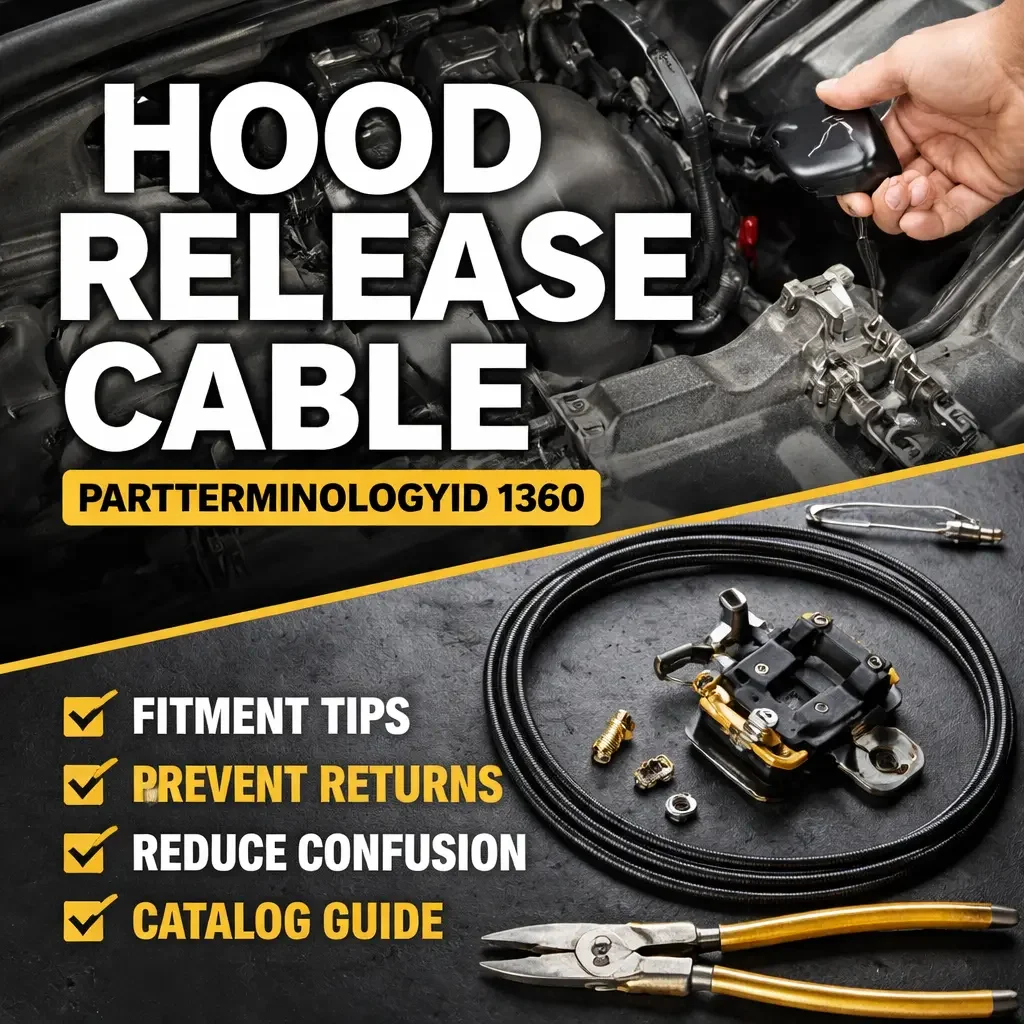
Written by Arthur Simitian | PartsAdvisory
Hood Release Cable is one of the most taken-for-granted parts on a vehicle. The driver pulls the interior hood release lever, the hood pops, and they walk around front to lift it. This happens hundreds or thousands of times over the life of the vehicle without a thought. Then one day the lever pulls with no resistance, or it pulls tight and nothing happens, and the driver realizes they cannot open the hood of their own vehicle.
The cable itself is simple. It runs from the interior release lever (typically on the driver's side lower dash, kick panel, or floor area) through the firewall and engine bay to the hood latch at the front of the vehicle. When it fails, the most common causes are corrosion inside the sheath (especially in northern climates where road salt accelerates it), cable stretching from age and repeated use, fraying at a bend point, or a clean break at one of the end fittings.
The part is inexpensive, usually $15 to $60. The catalog challenge is the same one that applies to every other release cable in the aftermarket: it is completely vehicle-specific, frequently confused with other cables, and the listings are often missing the details that prevent a return.
This is the fourth release cable post in this series, following Fuel Filler Door Release Cable (PartTerminologyID 1352) and Liftgate Latch Release Cable (PartTerminologyID 1356). The fitment problems are familiar, but the hood release cable has a few unique wrinkles.
This post is built for aftermarket catalog teams, marketplace sellers, and buyers who want fewer mistakes and fewer returns.
Status in New Databases
Status in New Databases
Current: PIES 7.2 + PCdb Future: PIES 8.0 + PCdb 2.0 Status: No change
What Hood Release Cable Means in the Aftermarket
Hood Release Cable refers to the mechanical cable assembly that connects the interior hood release lever to the hood latch mechanism. Pulling the lever transfers cable motion to the latch, releasing the hood so it can be opened.
In catalog reality, this covers:
Full cable assemblies (the complete cable from interior lever to hood latch, including sheath, inner cable, and end fittings)
Cable and lever assemblies (some replacements include the interior pull lever as a unit with the cable)
Cable and latch assemblies (less common, but some kits include the latch mechanism at the hood end)
Secondary safety catch cables (some vehicles have a two-stage hood release where the interior cable releases the primary latch and a secondary safety catch under the hood front edge must be released by hand, but on certain vehicles a separate cable connects to that secondary catch)
On most vehicles, the hood release is a two-stage system. The interior cable releases the primary latch, popping the hood up about an inch. The driver then reaches under the front edge of the hood and manually releases the secondary safety catch. The interior cable is the part covered by this PartTerminologyID. The secondary safety catch is typically a mechanical lever, not a cable, but catalog teams should be aware that some vehicles use a cable for both stages.
Why This Category Creates Fitment Problems
Cable routing through the firewall and engine bay
The cable runs from inside the cabin, through a grommet in the firewall, and across the engine bay to the hood latch. The routing path follows the vehicle's body structure, using clips and guides specific to the make, model, and body style. Cable length, sheath curvature, and attachment points are all unique to the vehicle. A cable from a similar but different vehicle will not route correctly even if the end fittings happen to match.
Engine option can change routing
On vehicles with significantly different engine options (inline 4 versus V6 versus V8), the engine bay layout may differ enough to change the cable routing path. In some cases the hood latch location remains the same but the cable must route around a different intake manifold, battery location, or coolant reservoir. This can change the required cable length by several inches.
Left-hand drive versus right-hand drive
The interior release lever is on the driver's side. On left-hand drive vehicles (North America, most of Europe), the lever is on the left and the cable routes accordingly. On right-hand drive export models (UK, Japan, Australia), the lever is on the right side and the cable is a mirror-image routing with different length and different attachment points. These are different part numbers.
Confusion with other release cables
This is the recurring theme across all release cable categories. The interior of a vehicle may have release cables for the hood, trunk, fuel filler door, and liftgate, all originating from levers clustered on or near the driver's kick panel. They look similar. They are different parts.
The hood release cable is the most commonly confused with the trunk release cable on sedans, because both levers are often side by side on the driver's lower left dash area.
Generation and facelift changes
Like all body-related parts, the hood release cable changes when the vehicle body is redesigned. Even within a generation, a facelift that changes the front fascia, grille, or hood latch location can change the cable. Production date qualifiers may be necessary.
Corrosion-driven replacement means the old cable may be damaged
Unlike many parts where the buyer removes the old part and compares it to the new one, a corroded or broken hood release cable often cannot be fully inspected because the hood is stuck shut. The buyer may be ordering blind, without being able to see the full cable routing or confirm end fittings on the latch end. This increases the chance of ordering the wrong part because the buyer cannot verify details they normally would.
Top Return Causes
1) Wrong release cable (hood versus trunk versus fuel door)
The buyer orders the wrong cable because the listing did not specify which release cable it was, or because the buyer confused the two levers.
Prevention: Full identification in the title: "Hood Release Cable" not "Release Cable." Include the cable's function and connection points in the first line of the description.
2) Wrong engine option routing
Cable is the correct vehicle but wrong engine option, resulting in a length or routing mismatch.
Prevention: Engine option as a fitment qualifier where cable routing differs between engines.
3) Cable length mismatch from incorrect cross-reference
The cable is close but not the right length, resulting in too much slack (cable does not pull the latch fully) or too little length (cable does not reach).
Prevention: List cable length as a specification. Cross-reference to OEM part number.
4) End fitting incompatibility
The lever end or latch end fittings do not match the vehicle's hardware.
Prevention: Describe and photograph both end fittings. Specify fitting type at each end.
5) Left-hand drive versus right-hand drive mismatch
Buyer in a right-hand drive market receives a left-hand drive cable, or vice versa.
Prevention: Specify drive side in the fitment data for vehicles sold in both configurations.
Compatibility Checklist for Buyers
1) Confirm you need the hood release cable, not the trunk, fuel door, or liftgate release cable. Trace the cable from your hood release lever to confirm it is the one that has failed.
2) Confirm full vehicle details. Year, make, model, submodel, engine option. The cable routing may differ by engine.
3) Check both end fittings on the old cable if accessible. The lever side is usually accessible from inside the cabin. The latch side may only be accessible if you can get the hood open. Match fitting types to the replacement.
4) Measure the cable length if possible. If the OEM part number is unavailable, measure the old cable end to end and compare to the replacement specification.
5) Confirm left-hand drive or right-hand drive. If your vehicle was built for a right-hand drive market, make sure the replacement cable matches.
6) Check what is included. Cable only, cable with lever, cable with latch. Determine which components you need and which you can reuse.
Catalog Checklist for Attributes
Core taxonomy: Product form (cable assembly, cable with lever, cable with latch, cable only). Separate from Trunk Release Cable, Fuel Filler Door Release Cable, and Liftgate Latch Release Cable.
Fitment: Year, make, model, submodel, engine option (where routing differs), body style, left-hand drive versus right-hand drive. OEM part number cross-reference.
Physical specs: Cable length (inches or mm), fitting type at lever end, fitting type at latch end, sheath material, inner cable material.
Package contents: Cable, lever (if included), latch (if included), mounting clips, firewall grommet.
Images: Full cable with both ends visible, close-up of lever-side fitting, close-up of latch-side fitting, routing path through engine bay if available.
FAQ
How do I open my hood if the release cable is broken?
This depends on the vehicle. Common methods include reaching under the front bumper or grille area to manually trip the hood latch with a long tool, accessing the cable from underneath the vehicle and pulling it with pliers, or removing the interior trim around the lever to access the cable stub. Some vehicles have an emergency release accessible from underneath. Check your owner's manual or a model-specific repair forum for your vehicle's method before attempting.
Is the hood release cable the same as the trunk release cable?
No. They are different cables with different lengths, different routing, and different end fittings. The levers may be located near each other on the driver's kick panel, which is why they are confused.
Why did my hood release cable corrode?
Road salt, moisture, and age are the primary causes. The cable sheath can trap moisture inside, especially where it passes through the firewall grommet. In salt-belt regions, this is one of the most common failure modes. Preventive lubrication of the cable (light oil or silicone spray into the sheath) can extend its life.
Final Take for Aftermarket Teams
Hood Release Cable (PartTerminologyID 1360) follows the same pattern as every other release cable in this series: low cost, high vehicle specificity, constant confusion with adjacent cables, and avoidable returns when catalog data is incomplete. The unique factor here is corrosion-driven replacement where the buyer often cannot inspect the old cable because the hood is stuck shut, making accurate fitment data even more critical. Catalog teams that clearly identify this cable by its full function name, specify engine option where routing differs, list cable length and end fitting types, and separate it from trunk, fuel door, and liftgate cables at the taxonomy level will eliminate the most common return causes in this category.