
Liftgate Latch Release Cable (PartTerminologyID 1356): Another Release Cable, Another Naming Confusion Problem
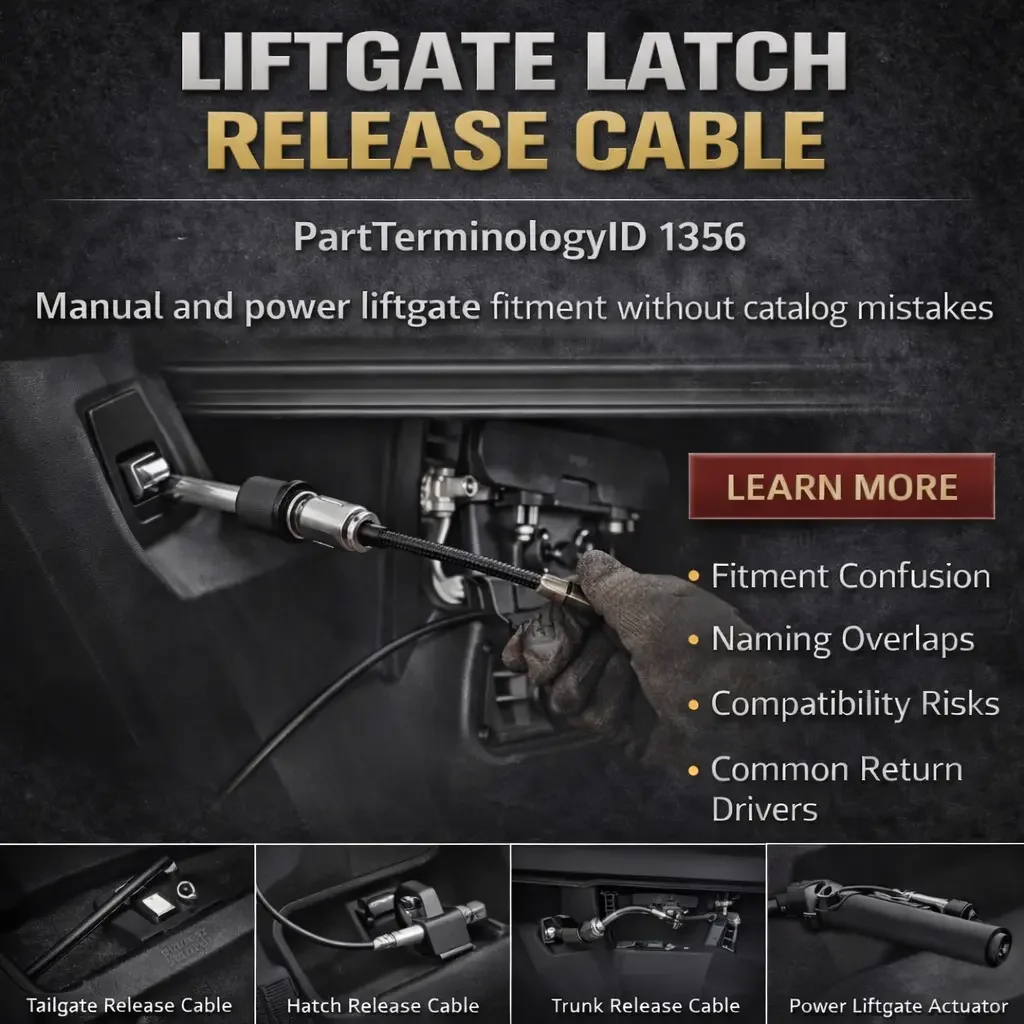
Liftgate Latch Release Cable is the third release cable in this blog series, and it follows the same pattern as Fuel Filler Door Release Cable (PartTerminologyID 1352): a low-cost mechanical cable that is invisible until it fails, highly vehicle-specific, and constantly confused with other cables in the catalog.
This cable connects the interior or exterior liftgate release mechanism to the latch assembly on the liftgate (also called the tailgate, rear hatch, or rear door depending on the vehicle type). When the cable stretches, corrodes, or breaks, the liftgate will not open from the release handle. The driver is stuck trying to pry the liftgate open, reaching through the interior to manually trip the latch, or calling a locksmith.
Like every other release cable, Liftgate Latch Release Cable is vehicle-specific in length, routing, and end fittings. And like every other release cable, it is routinely confused with adjacent cables and misidentified in catalog data.
This post is built for aftermarket catalog teams, marketplace sellers, and buyers who want fewer mistakes and fewer returns.
Status in New Databases
Status in New Databases
Current: PIES 7.2 + PCdb Future: PIES 8.0 + PCdb 2.0 Status: No change
What Liftgate Latch Release Cable Means in the Aftermarket
Liftgate Latch Release Cable refers to the mechanical cable that connects a release lever, handle, or button to the liftgate latch mechanism. Pulling or pressing the release transfers cable motion to the latch, unlatching the liftgate so it can swing or lift open.
In catalog reality, this covers:
Exterior handle-to-latch cables (the cable from the exterior liftgate handle to the latch mechanism, allowing the liftgate to open from outside)
Interior release-to-latch cables (on vehicles with an interior cabin release for the liftgate, the cable runs from the interior lever to the latch)
Latch-to-lock actuator cables (on some vehicles, a short cable connects the latch to the lock actuator within the liftgate panel)
Emergency release cables (some vehicles have a manual emergency release inside the cargo area)
Cable and handle assemblies (some replacements include the exterior handle or interior lever with the cable)
Cable and latch assemblies (some replacements include the latch mechanism with the cable attached)
What this part does NOT cover
Many modern vehicles (roughly 2010+) use electric liftgate release with no mechanical cable:
Power liftgate systems: The liftgate is opened and closed by electric struts activated by a button, key fob, or foot sensor. There is no release cable. The latch is electrically actuated.
Electric latch release: Even on non-power liftgates, some vehicles use a solenoid to release the latch when the exterior button is pressed or the doors are unlocked. No cable involved.
Push-button electronic release: The exterior handle or button sends an electronic signal to the latch actuator. No cable.
Only vehicles with a mechanical cable connection between the release handle and the latch use this part.
Why This Category Creates Fitment Problems
Naming inconsistency across vehicle types
The rear opening on a vehicle goes by many names depending on the body type, and the cable name follows:
Liftgate: SUVs and crossovers with a top-hinged rear door that swings up
Tailgate: Pickup trucks with a bottom-hinged rear panel that folds down
Rear hatch / hatchback door: Hatchback and wagon rear doors
Rear door: Vans and some SUVs with side-hinged or split rear doors
Trunk lid: Sedans (trunk release cables are a different PartTerminologyID)
A "liftgate latch release cable" on a Ford Explorer is functionally the same type of part as a "tailgate latch release cable" on a Ford F-150, but they are different cables for different vehicles. Some catalogs use "liftgate" for all of these. Some use "tailgate." Some use "rear door." The inconsistent naming means buyers may not find the part under the term they search, or may order a cable labeled "liftgate" when their vehicle's cable is cataloged under "tailgate."
Multiple cables per liftgate
A single liftgate may use more than one cable:
An exterior handle cable (from the outside handle to the latch)
An interior release cable (from the interior lever to the latch)
A lock cylinder cable (from the key lock cylinder to the latch)
These are different cables with different lengths, different routing within the liftgate panel, and different end fittings. A buyer who orders the "liftgate release cable" may receive the exterior handle cable when they needed the interior release cable, or vice versa.
Catalog best practice: Always specify which cable: "Exterior Handle to Latch Cable" vs. "Interior Release to Latch Cable" vs. "Lock Cylinder to Latch Cable."
Vehicle generation and facelift changes
Like all body-related parts, the liftgate latch release cable changes when the vehicle body is redesigned. A cable for a 2015 model may not fit the 2016 if a generation change occurred. Even within a generation, facelift changes to the liftgate handle design or latch mechanism can change the cable.
Cable routing within the liftgate panel
The cable routes through the liftgate panel between the outer skin and the inner trim. The routing path includes clips, guides, and bends specific to the panel shape. A cable from a different vehicle or generation may be the correct length end-to-end but may not follow the routing path correctly, causing binding, kinking, or interference with the window mechanism (on liftgates with glass).
Power liftgate conversion confusion
Some vehicles were offered with both manual and power liftgate options. The manual liftgate uses mechanical cables. The power liftgate uses electric actuators. These are different parts. A cable designed for the manual liftgate will not fit or function on the power liftgate version, and vice versa. This is a critical fitment split.
Top Return Causes
1) Wrong cable within the liftgate (exterior vs. interior vs. lock cylinder)
Buyer orders a liftgate cable and receives the wrong one of the multiple cables used in the liftgate.
Prevention: Specify which cable in the title: exterior handle, interior release, or lock cylinder. Include a diagram showing all cables in the liftgate assembly.
2) Manual liftgate vs. power liftgate mismatch
Buyer orders a cable for a manual liftgate on a vehicle equipped with a power liftgate, or vice versa.
Prevention: "For vehicles with manual liftgate only" or "For vehicles with power liftgate" as a fitment qualifier.
3) Naming mismatch (liftgate vs. tailgate vs. trunk)
Buyer searches "tailgate release cable" and the catalog has it listed as "liftgate release cable," or the buyer orders a trunk release cable when they needed a liftgate cable.
Prevention: Include common alternate names in searchable fields. Cross-reference liftgate, tailgate, hatch, and rear door terminology.
4) Vehicle generation mismatch
Cable from the wrong generation does not fit due to different latch, handle, or routing.
Prevention: Full ACES fitment data with generation awareness. Production date qualifiers where generation transitions overlap model years.
5) Vehicle uses electric release (no cable exists)
Buyer orders a cable for a vehicle with electric latch release. There is no cable to replace.
Prevention: Do not create fitment records for vehicles with electric liftgate release. Note: "For vehicles with cable-operated liftgate release only."
Compatibility Checklist for Buyers
1) Confirm your liftgate uses a mechanical cable release. If your liftgate opens with a power motor or releases electrically via button/key fob with no physical handle action, there may be no cable.
2) Identify which cable you need. Exterior handle to latch, interior release to latch, or lock cylinder to latch. Trace the failed cable from the handle or lever to confirm which one broke.
3) Confirm manual vs. power liftgate. These use different mechanisms. The cable for one will not work on the other.
4) Confirm full vehicle details. Year, make, model, submodel, body style, and equipment package (manual vs. power liftgate).
5) Check end fittings on the old cable. Match the handle-side and latch-side fittings to the replacement.
6) Check what is included. Cable only, cable with handle, cable with latch, or complete assembly. Determine which components you can reuse.
Catalog Checklist for Attributes
Core taxonomy: Product form (exterior handle cable, interior release cable, lock cylinder cable, cable with handle, cable with latch). Separate from Trunk Release Cable, Hood Release Cable, and Fuel Filler Door Release Cable.
Fitment: Year, make, model, submodel, body style, manual vs. power liftgate. OEM part number cross-reference.
Physical specs: Cable length, fitting type at handle/lever end, fitting type at latch end.
Package contents: Cable, handle (if included), latch (if included), routing clips.
Images: Full cable with both ends visible, end fitting close-ups, routing path diagram within liftgate panel.
FAQ
Is a liftgate cable the same as a tailgate cable or trunk cable?
They are the same type of part (a mechanical release cable) but for different vehicle configurations. A liftgate cable is for SUVs and crossovers. A tailgate cable is for trucks. A trunk cable is for sedans. They are different cables with different part numbers.
My liftgate has a power motor. Does it still use a release cable?
Power liftgates may or may not use a mechanical release cable. Some power liftgates retain a mechanical exterior handle cable as a backup. Others are fully electric. Check your vehicle's specific configuration.
How do I open my liftgate if the cable is broken?
Most vehicles have an emergency latch release accessible from inside the cargo area, often behind a trim panel or accessed through the interior. Check your owner's manual for the location. Some liftgates can also be opened by reaching through the interior and manually tripping the latch mechanism.
Final Take for Aftermarket Teams
Liftgate Latch Release Cable (PartTerminologyID 1356) shares the same catalog challenges as every other release cable: naming inconsistency, confusion between multiple cables on the same assembly, and fitment errors from manual vs. electric mechanism mismatches. Catalog teams that win here specify which cable (exterior, interior, lock cylinder) in every title, use manual vs. power liftgate as a mandatory fitment qualifier, cross-reference liftgate/tailgate/hatch naming variations, and never create fitment for electrically released liftgates that have no cable. It is a small category, but the discipline carries over to every other cable and release mechanism in the catalog.