
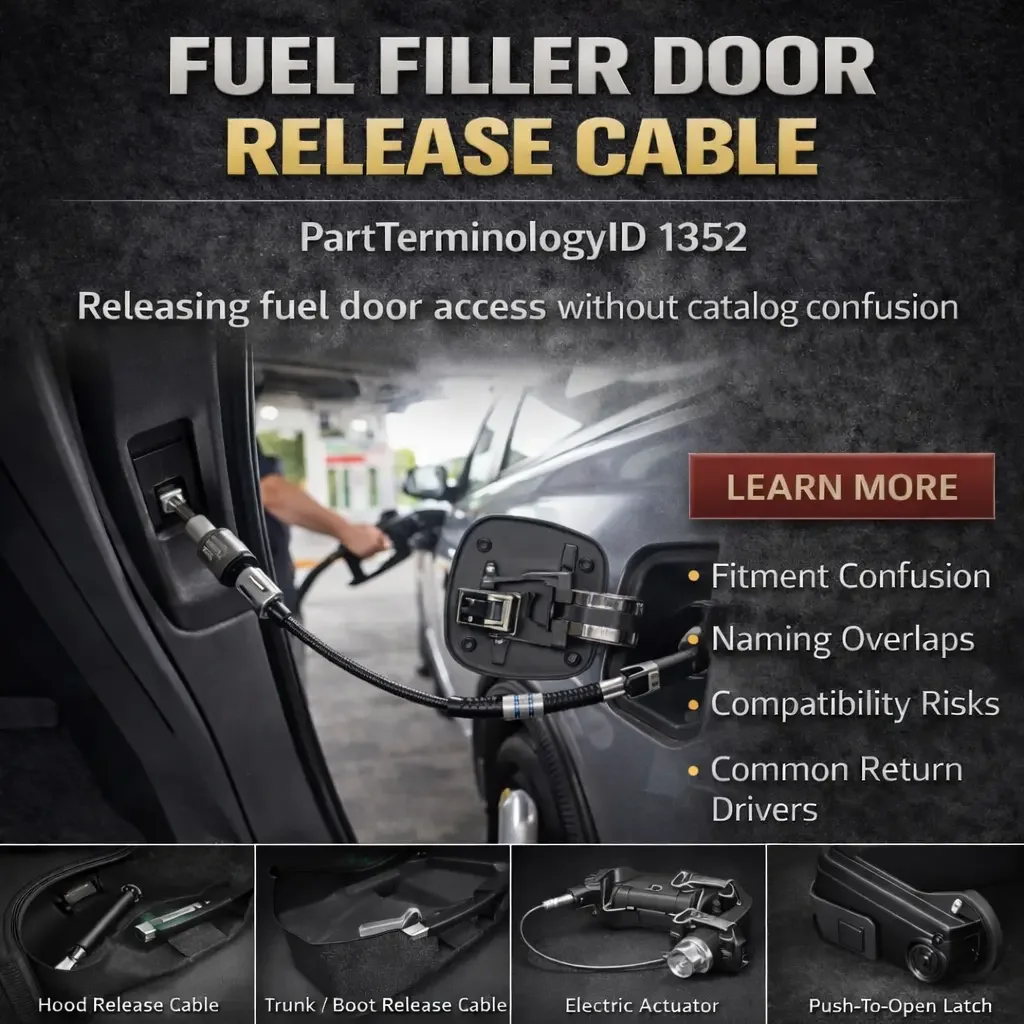
Fuel Filler Door Release Cable is one of those parts that does not exist in anyone's mind until it fails. The driver pulls the fuel door release lever inside the cabin. Nothing happens. The fuel door stays shut. They are standing at the gas pump unable to fuel their vehicle.
It is a simple mechanical cable that connects the interior release lever (usually on the driver's side floor, kick panel, or lower dash) to the fuel filler door latch on the rear quarter panel. When the cable stretches, corrodes, seizes, or snaps, the fuel door will not open from the interior lever. The driver is left prying the door open manually, jamming a screwdriver behind the trim, or asking a second person to push on the fuel door while they pull the lever.
The part itself is inexpensive, typically $15 to $50. But it is extremely vehicle-specific, routed through the body structure along a unique path for each model, and when buyers go searching for one, they encounter a catalog landscape where this part is frequently missing, poorly described, or confused with other release cables.
This post is built for aftermarket catalog teams, marketplace sellers, and buyers who want fewer mistakes and fewer returns.
Status in New Databases
Status in New Databases
Current: PIES 7.2 + PCdb Future: PIES 8.0 + PCdb 2.0 Status: No change
What Fuel Filler Door Release Cable Means in the Aftermarket
Fuel Filler Door Release Cable refers to the mechanical cable assembly that connects the interior release lever or handle to the fuel filler door latch mechanism. When the lever is pulled, the cable transfers the motion to unlatch the fuel door so it can swing open.
In catalog reality, this covers:
Cable assemblies (the full cable from lever to latch, including sheath, inner cable, and end fittings)
Lever and cable assemblies (some replacements include the interior pull lever as a unit with the cable)
Fuel door latch and cable assemblies (some replacements include the latch mechanism at the fuel door end)
Cable only (the inner cable and sheath without lever or latch, for vehicles where the cable is a separate replaceable component)
This part does NOT apply to all vehicles. Some vehicles use different fuel door release mechanisms:
Electric/solenoid release: Many modern vehicles (2010+) use an electrically actuated fuel door release triggered by a button or central locking system. These vehicles have no release cable. The fuel door is unlocked by a solenoid and opened by pushing on the door.
Push-to-open spring latch: Some vehicles use a simple spring-loaded latch with no cable and no interior lever. The driver pushes on the fuel door and it pops open.
Central locking integration: Some vehicles unlock the fuel door when the doors are unlocked, with no separate release lever or cable.
Only vehicles with a mechanical cable-operated fuel door release use this part. If the vehicle has a push-to-open or electric release, there is no cable to replace.
Why This Category Creates Fitment Problems
Cable routing is completely vehicle-specific
The cable routes from the interior release lever through the vehicle's body structure, along the floor pan, through the rear quarter panel, to the fuel filler door latch. This routing path is different for every vehicle model and often different between body styles (sedan vs. hatchback vs. SUV) of the same model. The cable length, sheath curvature, and bracket clip locations are all specific to the vehicle's body architecture. A cable that is 4 inches too short will not reach the latch. A cable that is 4 inches too long will kink or bind in the routing channel.
End fittings vary by vehicle
The lever end of the cable may use a hook, a ball-and-socket, a clip, or a threaded connection. The latch end uses a similar variety of fittings. Both must match the vehicle's lever and latch. A cable with the correct length but wrong end fittings cannot be installed.
Left-hand vs. right-hand drive
On left-hand drive vehicles, the fuel filler is typically on the left (driver) side and the release lever is on the driver's left. On right-hand drive export models, the fuel filler may be on the opposite side, requiring a different cable length and routing. This is a fitment split that matters for vehicles sold in multiple markets.
Body style differences within the same model
A sedan and a wagon or hatchback of the same model have different rear body structures. The cable routing through the rear quarter panel differs because the body panels are different shapes. A cable for the sedan will not fit the wagon, even though the interior lever and the fuel door latch may be the same design.
Confusion with other release cables
Vehicles have multiple internal release cables that look similar:
Hood release cable: Connects the hood release lever to the hood latch. Different routing, different length, different end fittings.
Trunk release cable: Connects the trunk release lever to the trunk latch. Similar concept but different part.
Parking brake cable: Completely different system.
If the catalog does not clearly identify which release cable is in the listing, buyers may order the hood release cable when they need the fuel filler door cable, or vice versa. On some vehicles, the interior release levers for the hood and fuel door are located next to each other on the driver's kick panel, making the confusion worse.
Discontinuation
Like Cruise Control Cable (PartTerminologyID 1348), many OEM fuel filler door release cables are being discontinued as the vehicle population ages and newer vehicles transition to electric or push-to-open fuel door mechanisms. When the OEM part is unavailable, buyers turn to aftermarket sources where cross-reference accuracy varies.
Top Return Causes
1) Wrong release cable (hood vs. fuel door vs. trunk)
Buyer orders a release cable and receives the wrong one because the listing did not specify which release cable it was.
Prevention: Full identification in the title: "Fuel Filler Door Release Cable" not just "Release Cable." Include the cable's function and routing in the description.
2) Wrong body style
Cable for the sedan does not fit the wagon or hatchback.
Prevention: Body style as a fitment qualifier. Year, make, model, body style.
3) Cable length mismatch
Cable is the wrong length due to incorrect cross-reference or wrong model year within a generation.
Prevention: List cable length. Cross-reference to OEM part number.
4) End fitting incompatibility
Cable ends do not match the vehicle's lever or latch mechanism.
Prevention: Describe and photograph both end fittings. Specify fitting type.
5) Vehicle uses electric or push-to-open release
Buyer orders a cable for a vehicle that has no cable. The vehicle uses a solenoid or push-to-open mechanism.
Prevention: Do not create fitment records for vehicles with electric or push-to-open fuel door release. Include a note on relevant listings: "For vehicles with cable-operated fuel filler door release only."
Compatibility Checklist for Buyers
1) Confirm your vehicle uses a cable-operated fuel door release. If your fuel door opens by pushing on it, or if it unlocks electrically with the door locks, there is no cable. This part only applies to vehicles with an interior pull lever that mechanically releases the fuel door via cable.
2) Confirm you need the fuel filler door cable, not the hood or trunk release cable. Trace the cable from the fuel door area back toward the cabin to confirm which cable has failed.
3) Confirm full vehicle details. Year, make, model, submodel, body style (sedan, wagon, hatchback, SUV).
4) Check both end fittings on the old cable. Lever side and latch side. Match the fitting type to the replacement.
5) Measure the cable length if possible. Compare to the replacement specification, especially if the OEM part is discontinued and you are using an aftermarket cross-reference.
6) Check what is included. Cable only, cable with lever, cable with latch, or complete assembly. Determine which components you need to reuse from the original.
Catalog Checklist for Attributes
Core taxonomy: Product form (cable assembly, cable with lever, cable with latch, cable only). Separate from Hood Release Cable, Trunk Release Cable, and Parking Brake Cable.
Fitment: Year, make, model, submodel, body style. Left-hand vs. right-hand drive if applicable. OEM part number cross-reference.
Physical specs: Cable length (inches or mm), fitting type at lever end, fitting type at latch end, sheath material, inner cable material.
Package contents: Cable, lever (if included), latch (if included), mounting clips, routing brackets.
Images: Full cable with both ends visible, close-up of lever-side fitting, close-up of latch-side fitting, routing diagram or installed view if available.
FAQ
How do I know if my fuel filler door release cable is broken?
If you pull the interior release lever and feel no resistance (the cable snapped), or if you feel resistance but the fuel door does not open (the cable stretched or the latch is stuck), the cable or latch likely needs replacement.
Is the fuel filler door release cable the same as the hood release cable?
No. They are different cables with different lengths, different routing, and different end fittings. They may be located near each other on the driver's kick panel, which causes confusion.
Does my vehicle have a fuel filler door release cable?
If your vehicle has an interior pull lever that opens the fuel door, it likely has a cable. If your fuel door opens by pushing on it or unlocks electrically with the door locks, there is no cable.
Can I temporarily open the fuel door if the cable is broken?
On most vehicles, yes. There is typically an emergency release access point in the trunk or behind the interior quarter panel trim that allows manual release of the fuel door latch. Check your owner's manual for the location.
Final Take for Aftermarket Teams
Fuel Filler Door Release Cable (PartTerminologyID 1352) is a low-cost, low-glamour part that generates avoidable returns when it is confused with other release cables, when body style fitment is not specified, or when the listing is created for vehicles that do not use a cable at all. Catalog teams that win here clearly identify this cable by its full function name in every title, specify body style as a fitment qualifier, separate it from hood and trunk release cables at the taxonomy level, and never create fitment for vehicles with electric or push-to-open fuel door release mechanisms. It is a $15 part, but the catalog discipline it requires is the same as any vehicle-specific body component.