
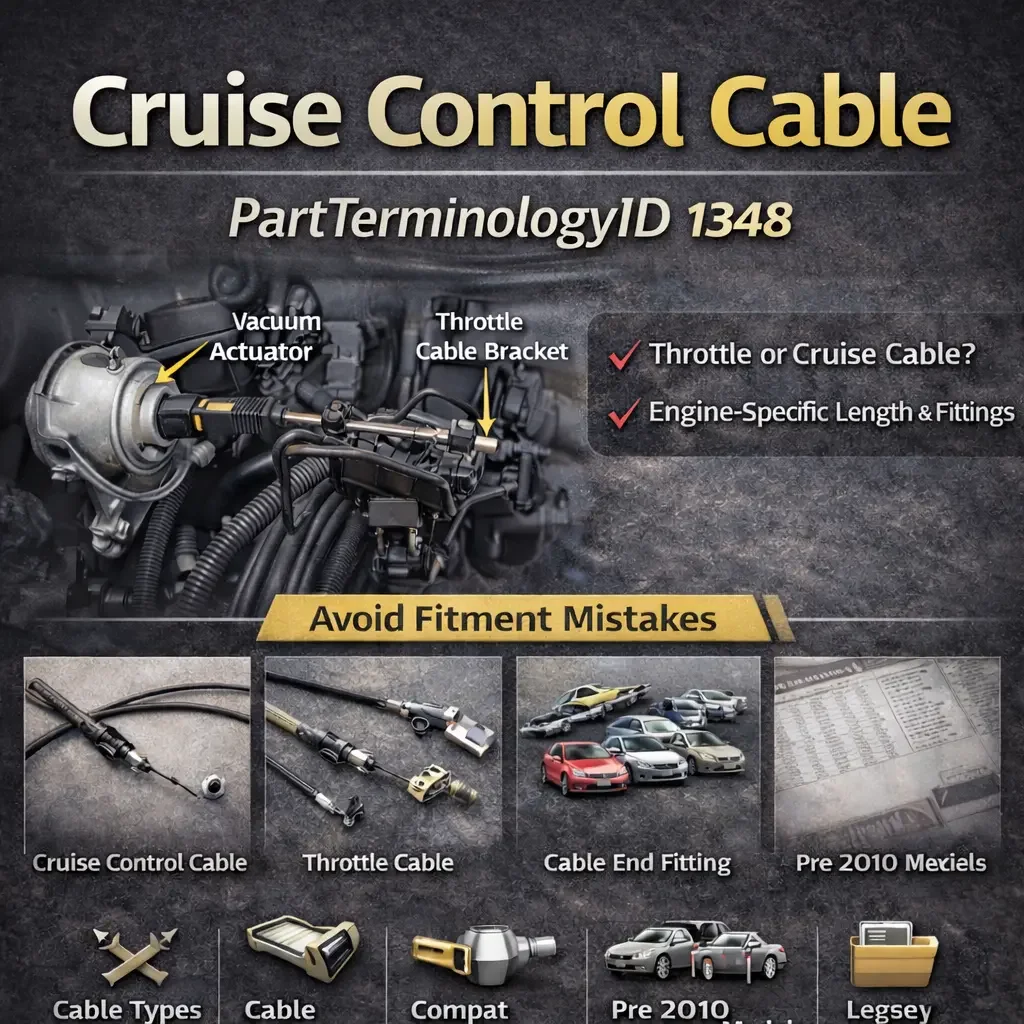
Cruise Control Cable is a part name that is actively disappearing from the aftermarket. On any vehicle built after roughly 2005 to 2010, cruise control is electronic. There is no cable. The throttle is drive-by-wire, and cruise control is managed entirely by the ECU, accelerator pedal position sensor, and electronic throttle body. There is nothing physical to replace except software and sensors.
But for the millions of vehicles still on the road from the 1980s, 1990s, and early 2000s, the cruise control cable is a real mechanical part that wears out, stretches, corrodes, seizes, and breaks. When it fails, cruise control stops working entirely. And when the buyer goes searching for a replacement, they encounter a catalog landscape where this part is poorly documented, frequently confused with the throttle cable (a different part), and often discontinued by the original manufacturer.
This creates a catalog paradox: the part is less relevant every year but the vehicles that need it are aging into the sweet spot where failures are most common. Catalog teams that serve the pre-2010 vehicle market need to get this part right.
This post is built for aftermarket catalog teams, marketplace sellers, and buyers who want fewer mistakes and fewer returns.
Status in New Databases
Status in New Databases
Current: PIES 7.2 + PCdb Future: PIES 8.0 + PCdb 2.0 Status: No change
What Cruise Control Cable Means in the Aftermarket
Cruise Control Cable refers to the mechanical cable that connects the cruise control servo (actuator) to the throttle body or throttle linkage. When the driver sets cruise control, the servo pulls the cable, which holds the throttle at a fixed position to maintain the set speed. When the driver taps the brake or presses the cancel button, the servo releases the cable and the throttle returns to idle.
In catalog reality, this covers:
Cruise control cables (the cable assembly from the servo to the throttle body)
Cruise control servo assemblies (the vacuum or electric actuator that pulls the cable, sometimes sold with the cable attached)
Cruise control cable adjustment hardware (clips, brackets, and ferrules used to attach and adjust the cable)
This is a simple mechanical part, but it is frequently confused with other cables under the hood:
Throttle cable (accelerator cable): Connects the accelerator pedal to the throttle body. This is a different part with a different PartTerminologyID. On many vehicles, the throttle cable and cruise control cable attach to the same throttle body bracket, which is why they are confused.
Kickdown cable (transmission detent cable): On vehicles with automatic transmissions, this cable connects the throttle linkage to the transmission for downshift timing. Also a different part.
Speedometer cable: Connects the transmission to the speedometer. Completely different system but sometimes confused in search results on older vehicles.
If the catalog does not clearly distinguish the cruise control cable from the throttle cable, buyers will order the wrong one. On vehicles where both cables route to the same throttle body bracket and look similar, the confusion is understandable but the parts are not interchangeable. They have different lengths, different end fittings, and connect to different components.
Why This Category Creates Fitment Problems
Cable length is vehicle-specific
Cruise control cables are routed from the servo (typically mounted on the firewall or inner fender) through the engine bay to the throttle body. The routing path, and therefore the required cable length, varies by vehicle model, engine option, and whether the vehicle is left-hand or right-hand drive. A cable that is 6 inches too short will not reach the throttle body. A cable that is 6 inches too long will have excessive slack that interferes with proper cruise control operation and may snag on engine components.
End fittings vary by vehicle
The cable ends that attach to the cruise control servo and the throttle body bracket use different fittings depending on the manufacturer. Some use a ball-and-socket end. Some use a threaded barrel. Some use a clip-on hook. Some use a slotted pin. The servo-side fitting must match the servo. The throttle-side fitting must match the throttle body bracket. If either end is wrong, the cable cannot be installed.
Engine option affects routing and length
On vehicles offered with multiple engine options, the cruise control cable may differ between engines. A V6 and a 4-cylinder in the same vehicle may have different throttle body locations, different firewall-to-throttle distances, and therefore different cable lengths and routing. The cable for the V6 will not work on the 4-cylinder, even though the rest of the cruise control system is the same.
Servo type compatibility
The cruise control servo (actuator) comes in two types on older vehicles:
Vacuum servo: Uses engine vacuum to pull the cable. Common on most vehicles through the early 2000s.
Electric servo: Uses an electric motor to pull the cable. Used on some vehicles, particularly those with diesel engines (no intake vacuum) or turbocharged engines (unreliable vacuum at boost).
The cable end fitting at the servo side may differ between vacuum and electric servos, even on the same vehicle model.
Discontinuation and cross-reference confusion
Many OEM cruise control cables have been discontinued by the vehicle manufacturer because the vehicle population is shrinking and the part demand has dropped below production minimums. When the OEM part is discontinued, buyers turn to aftermarket suppliers, salvage yards, or cross-reference databases. Cross-reference errors are common in this category because the cable is so vehicle-specific that a wrong cross-reference may yield a cable that is close but not correct in length or fitting.
The Drive-By-Wire Transition
The single most important thing catalog teams need to understand about Cruise Control Cable is the technology transition that makes this part obsolete on newer vehicles.
Vehicles with mechanical throttle (cruise control cable applies)
On vehicles with a mechanical throttle cable connecting the accelerator pedal to the throttle body, cruise control is managed by a separate mechanical servo that pulls its own cable to hold the throttle open. These vehicles have a cruise control cable. This includes most vehicles built before approximately:
GM: 2003 to 2006 depending on model
Ford: 2002 to 2005 depending on model
Chrysler/Dodge: 2002 to 2007 depending on model
Toyota: 2002 to 2006 depending on model
Honda: 2002 to 2006 depending on model
European manufacturers: generally transitioned earlier, 2000 to 2004
Vehicles with electronic throttle / drive-by-wire (NO cruise control cable)
On vehicles with electronic throttle control (drive-by-wire), there is no physical connection between the accelerator pedal and the throttle body. The pedal sends an electronic signal to the ECU, which controls the throttle electronically. Cruise control on these vehicles is also fully electronic. The ECU simply holds the throttle position through the electronic throttle body. There is no servo, no cable, and no mechanical component to replace.
If a buyer with a 2015 vehicle searches for a "cruise control cable," there is no such part. The issue is either the cruise control switch on the steering wheel, the brake pedal switch (which disengages cruise), the throttle body, or the ECU. Listings must not create false fitment for drive-by-wire vehicles.
Top Return Causes in Cruise Control Cable
1) Buyer ordered the throttle cable instead of the cruise control cable (or vice versa)
The most common confusion. Both cables route to the same throttle body. They look similar. They are different parts.
Prevention: Clear titles: "Cruise Control Cable" vs. "Throttle Cable (Accelerator Cable)." Include a diagram showing both cables and their different connection points.
2) Wrong engine option
The cable for the V6 does not fit the 4-cylinder. The cable for the turbo does not fit the naturally aspirated engine.
Prevention: Engine as a mandatory fitment qualifier. List specific engine codes or displacement where cable length differs.
3) Cable length mismatch from incorrect cross-reference
The buyer receives a cable that is close but not the correct length, resulting in too much or too little slack.
Prevention: List cable length as a specification. Cross-reference to the OEM part number for exact match. Note when the OEM part is discontinued and the aftermarket replacement is a verified match.
4) End fitting incompatibility
The cable arrives with the wrong end fittings for the buyer's servo or throttle body bracket.
Prevention: Describe and photograph both end fittings (servo side and throttle side). Specify fitting type: ball-and-socket, threaded barrel, clip-on hook, slotted pin.
5) Part does not exist for drive-by-wire vehicles
Buyer searches for a cruise control cable on a vehicle that does not use one. They order a cable for a similar but older model.
Prevention: Do not create fitment records for drive-by-wire vehicles. If the vehicle uses electronic throttle control, there is no cruise control cable. Include a note: "This part applies only to vehicles with mechanical throttle cable. Vehicles with electronic throttle control (drive-by-wire) do not use a cruise control cable."
Compatibility Checklist for Buyers
1) Confirm your vehicle uses a mechanical throttle cable. If your vehicle has no physical cable connecting the accelerator pedal to the throttle body, it is drive-by-wire and does not have a cruise control cable. This generally applies to vehicles built after 2002 to 2007 depending on manufacturer.
2) Confirm you need the cruise control cable, not the throttle cable. The throttle cable connects the accelerator pedal to the throttle body. The cruise control cable connects the cruise control servo to the throttle body. They are different parts.
3) Confirm full vehicle details. Year, make, model, submodel, engine (displacement and configuration). The cable length and routing depend on the engine option.
4) Check both end fittings. Inspect the servo-side and throttle-side connections on the old cable before ordering. Match the fitting type to the replacement.
5) Measure the cable length if possible. If the OEM part number is not available, measure the existing cable from end to end and compare to the replacement specification.
6) Check if the OEM part is still available. Many cruise control cables are discontinued. If ordering aftermarket, verify the cross-reference against the OEM part number.
Catalog Checklist for Attributes
Core taxonomy: Product form (cable only, cable with servo assembly, cable adjustment kit). Separate from Throttle Cable, Kickdown Cable, and Speedometer Cable.
Fitment: Year, make, model, submodel, engine (displacement, configuration, fuel type). Transmission type if relevant. Left-hand vs. right-hand drive if applicable.
Physical specs: Overall cable length (inches or mm), fitting type at servo end, fitting type at throttle end, cable sheath material, inner cable material.
Compatibility: Servo type (vacuum, electric). Throttle body bracket type. OEM part number cross-reference.
Package contents: Cable assembly, adjustment clips, ferrules, mounting hardware included yes or no.
Images: Full cable length showing both end fittings, close-up of servo-side fitting, close-up of throttle-side fitting, routing diagram on vehicle if available.
FAQ
Does my vehicle have a cruise control cable?
If your vehicle was built before approximately 2002 to 2007 (varies by manufacturer) and has a mechanical throttle cable from the accelerator pedal to the throttle body, it likely has a cruise control cable. If your vehicle uses electronic throttle control (drive-by-wire), there is no cruise control cable.
Is the cruise control cable the same as the throttle cable?
No. The throttle cable connects the accelerator pedal to the throttle body. The cruise control cable connects the cruise control servo (actuator) to the throttle body. They are different parts with different lengths, fittings, and routing.
Why is my cruise control cable discontinued?
Many OEM cruise control cables have been discontinued because the vehicle population that uses them is shrinking. As vehicles transition to electronic throttle control, demand for mechanical cruise control cables drops below production minimums. Aftermarket replacements and salvage yard parts may still be available.
Can I use a universal cruise control cable?
Some aftermarket suppliers offer adjustable-length universal cables. These can work if the end fittings match your servo and throttle body bracket and the cable length falls within the adjustable range. However, vehicle-specific cables are always preferred for correct routing and length.
What happens when a cruise control cable fails?
The most common failure modes are cable stretching (cruise control loses speed or cannot hold set speed), cable seizure from corrosion (cruise control sticks or does not disengage smoothly), and cable breakage (cruise control stops working entirely). A seized cable is a safety concern because it may prevent the throttle from returning to idle when cruise is disengaged.
Final Take for Aftermarket Teams
Cruise Control Cable (PartTerminologyID 1348) is a disappearing part name that remains critically important for the pre-drive-by-wire vehicle population. Catalog teams that serve this market need to clearly separate cruise control cables from throttle cables in taxonomy and titles, use engine option as a mandatory fitment qualifier, list cable length and end fitting types as primary specifications, and never create fitment records for drive-by-wire vehicles that do not use this part. The vehicle population is shrinking, but the parts that remain in demand are highly vehicle-specific and increasingly hard to source. Getting the catalog data right on these parts is the difference between a sale and a fruitless search that sends the buyer to a salvage yard.