
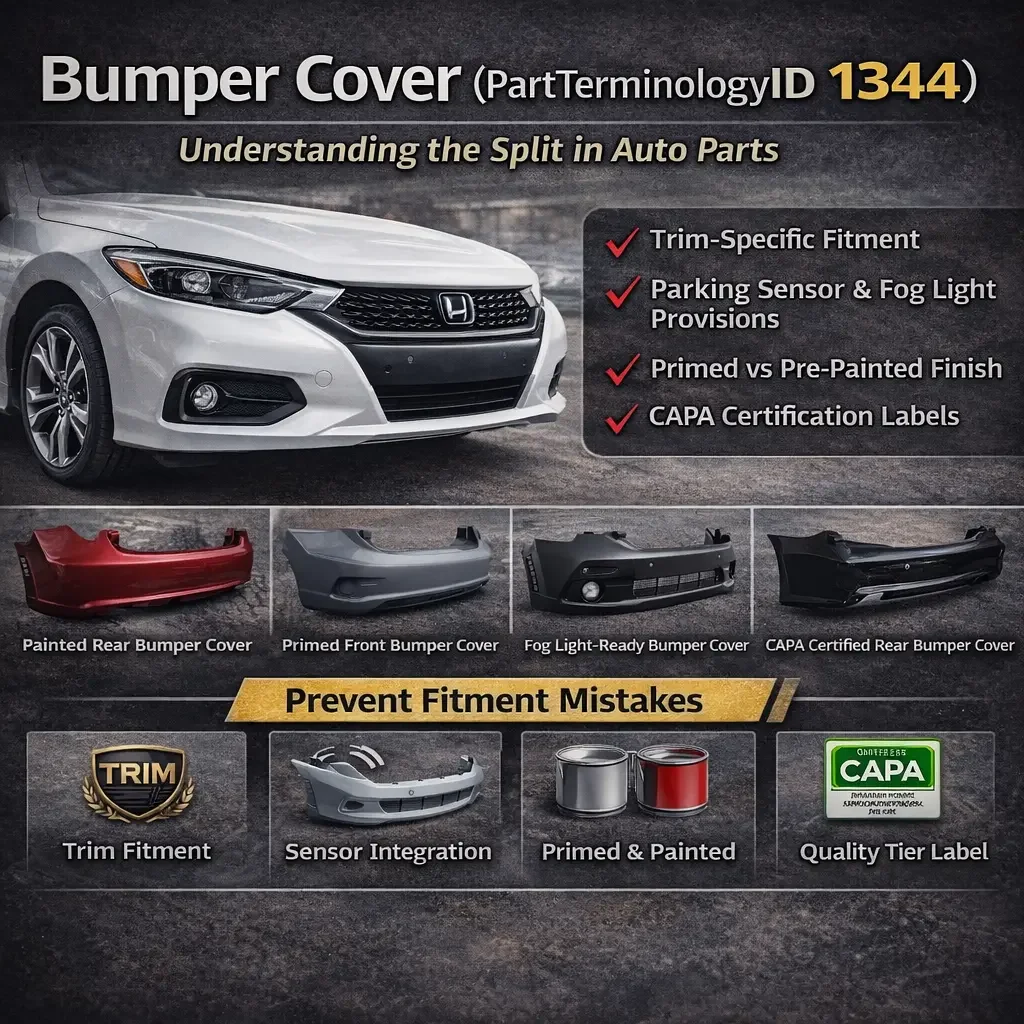
Bumper Cover is the single highest-volume part name in the aftermarket collision repair industry. More bumper covers are sold, shipped, returned, repainted, and argued about than any other body part. Every rear-end collision, every parking lot bump, every backing-into-a-pole incident starts with someone searching "bumper" and landing on a Bumper Cover listing.
And that is where the problems begin.
The previous post in this series covered Bumper (PartTerminologyID 1340), the structural metal component: the reinforcement bar, face bar, or impact bar. This post covers Bumper Cover (PartTerminologyID 1344), which is the outer plastic, fiberglass, or composite cosmetic panel that the buyer can see and touch. It is the painted surface. It is the part with the sensor holes, the fog light openings, the grille integration, the molding clips, and the license plate mounting provisions. It is the part that buyers call "the bumper" even though it is technically only the cover.
If your catalog team gets Bumper Cover right, you are solving the single highest-volume fitment and return problem in the aftermarket body parts category. If you get it wrong, you are bleeding money on returns, reshipments, and customer complaints at a scale that no other part name can match.
Status in New Databases
Status in New Databases
Current: PIES 7.2 + PCdb Future: PIES 8.0 + PCdb 2.0 Status: No change
What Bumper Cover Means in the Aftermarket
Bumper Cover refers to the outer cosmetic panel of the bumper assembly. It is the visible, painted (or textured) surface that defines the vehicle's front or rear appearance. On modern vehicles, the bumper cover is a flexible plastic or composite panel that snaps, clips, and bolts over the structural bumper reinforcement bar, energy absorbers, and brackets underneath.
In catalog reality, Bumper Cover includes:
Front bumper covers (the full front fascia panel, often integrating grille openings, fog light openings, air intakes, and sensor provisions)
Rear bumper covers (the full rear fascia panel, often integrating exhaust cutouts, reflector mounting, diffuser elements, and sensor provisions)
Upper bumper covers (on vehicles where the bumper cover is split into upper and lower sections, the upper is typically the body-colored painted portion)
Lower bumper covers / valances / air dams (the lower textured or painted section below the main bumper cover, sometimes cataloged as a separate PartTerminologyID)
Bumper cover extensions and end caps (corner pieces or extensions that wrap around the bumper ends on trucks and SUVs)
What Bumper Cover is NOT:
The structural reinforcement bar or impact bar (that is Bumper, PartTerminologyID 1340)
The energy absorber or crush material behind the cover
The bumper brackets that connect the reinforcement to the frame
The grille (a separate component that may integrate with or mount into the bumper cover)
Bumper trim, moldings, or chrome appliques (decorative pieces applied to the cover surface)
Bumper guards or bull bars (aftermarket protective accessories mounted in front of the bumper)
Why Bumper Cover Is the #1 Return Part in the Aftermarket
Bumper Cover has more fitment variables per SKU than almost any other body part. Every single one of these variables, when missed in the catalog data, generates a return:
1) Trim level drives completely different bumper covers
This is the most common fitment failure in the category. Within the same model year of the same vehicle, different trim levels have different bumper covers:
Base trim: simple cover with minimal openings, no fog lights, no sensors
Mid trim: cover with fog light openings, basic sensor provisions
Sport trim: aggressive styling, larger air intakes, different lower valance, sport-specific grille integration
Premium/luxury trim: chrome accents, integrated LED fog lights, full sensor suite, different molding attachment points
Performance trim: unique aero elements, larger intakes, splitter integration, model-specific badging provisions
A 2022 Honda Civic LX front bumper cover is a completely different part from a 2022 Honda Civic Sport front bumper cover. The shapes, openings, and mounting points are different. They are NOT interchangeable. But a buyer who searches "2022 Honda Civic front bumper cover" may receive either one if the listing does not specify trim level.
2) Parking sensor holes
Modern vehicles have ultrasonic parking sensors mounted in the bumper cover. The sensor holes are molded into the cover at specific locations. Different equipment packages have different sensor configurations:
No parking sensors (no holes)
Rear parking sensors only (4 holes in rear cover)
Front and rear parking sensors (4 holes in each cover)
360-degree parking sensors (multiple holes in both covers, sometimes 6 or 8 per cover)
A cover with sensor holes where the vehicle has no sensors looks wrong (visible plugged holes or open holes). A cover without sensor holes where the vehicle has sensors requires the buyer to drill holes, which most buyers will not do and most body shops will charge extra for.
3) Fog light openings and provisions
Front bumper covers may have:
No fog light openings (base trim)
Fog light openings with bezels (mid and upper trims)
Integrated LED fog lights (some trims have fog lights built into the bumper cover assembly)
Different fog light shapes and sizes between trims
Ordering a cover with fog light openings for a vehicle without fog lights (or vice versa) is a fitment mismatch.
4) ADAS sensor integration
This is the fastest-growing fitment variable in the bumper cover category. Modern vehicles mount ADAS sensors behind or within the bumper cover:
Adaptive cruise control (ACC) radar: typically mounted behind the front bumper cover, center. The cover must have a radar-transparent area or a specific emblem/badge that the radar reads through. If the cover material, paint, or thickness is wrong, the radar may not function correctly.
Automatic emergency braking (AEB) sensor: may share the radar unit or use a separate sensor
Pedestrian detection: camera or sensor mounted in or behind the front bumper
Surround-view cameras: small cameras in the front and rear bumper covers
Blind spot monitoring: sensors in the rear bumper cover corners
A bumper cover that blocks, misaligns, or does not accommodate these sensors creates a vehicle with non-functional safety systems. This is not just a fitment issue. It is a safety issue. And post-replacement ADAS recalibration is often required, adding cost and complexity.
5) Paint and finish
Bumper covers are the most paint-sensitive parts in the aftermarket. They arrive in one of several conditions:
Primed: Cover is coated with a primer base. Requires professional painting to match the vehicle's body color before installation. This is the most common aftermarket condition.
Unprimed / Raw: Cover is in raw plastic with no coating. Requires adhesion promoter, primer, base coat, and clear coat. More labor and materials than primed. ASA's Collision Division has documented that unprimed covers require 1 to 1.3 additional labor hours and $14 to $23 in additional materials versus primed covers.
Pre-painted: Cover arrives factory-painted in the buyer's vehicle color code. No painting required. This eliminates the paint labor and cost but requires an exact color code match. Some manufacturers (notably Volvo) sell pre-painted OEM covers. Several aftermarket suppliers now offer pre-painted covers.
Textured: Cover has a molded-in textured black or gray finish (common on lower valances, base-trim trucks, and SUV lower covers). Does not require painting.
The paint condition is one of the most important attributes in the listing. A buyer who orders a primed cover expecting a pre-painted cover will be disappointed when they receive a gray/white panel that requires a body shop visit. A collision shop that orders an unprimed cover when they expected primed will have to add labor hours to the repair estimate.
6) Upper vs. lower cover split
Many modern vehicles have a two-piece bumper cover:
Upper cover: body-colored painted section
Lower cover: textured black or body-colored lower valance/air dam
These are separate parts with separate part numbers. A buyer who orders the "front bumper cover" may receive only the upper section and not realize the lower section is a separate purchase. Or they may receive a full one-piece cover when their vehicle has a two-piece design.
7) Facelift and mid-cycle refresh changes
Within a model generation, manufacturers frequently update the bumper cover design during a mid-cycle refresh (facelift). The pre-facelift and post-facelift covers have different shapes, different openings, different mounting points, and different grille integration. They are NOT interchangeable.
Production date qualifiers are critical here. A "2019 model" may have been built in 2018 with the pre-facelift cover or in 2019 with the post-facelift cover. The listing must specify which design generation the cover fits.
8) Material and quality tier
Aftermarket bumper covers are available in multiple quality tiers:
OEM (Original Equipment Manufacturer): Direct from the vehicle manufacturer. Exact fit, highest cost. Arrives primed or pre-painted depending on manufacturer.
CAPA Certified: Aftermarket cover independently tested by the Certified Automotive Parts Association to verify fit, form, and function meet OE standards. Accepted by most insurance companies and collision shops.
Non-Certified Aftermarket: Aftermarket cover without independent certification. Lower cost, but fit and finish are not independently verified. Panel gaps, clip alignment issues, and surface finish problems are more common.
The quality tier dramatically affects buyer satisfaction and return rates. Non-certified aftermarket covers are the most frequently returned bumper cover products due to fitment issues: panel gaps, misaligned bolt holes, clips that do not seat properly, and surface finish that does not accept paint well.
9) Tow hook cover / tow eye provisions
Many front bumper covers include a small removable panel (tow hook cover) that pops out to reveal a threaded tow eye mount. The position and shape of this cover varies by vehicle. Some aftermarket covers do not include the tow hook cover, requiring the buyer to transfer the original or purchase it separately.
10) License plate mounting
Front bumper covers vary in license plate mounting provisions:
With license plate bracket mounting holes (states requiring front plates)
Without license plate bracket mounting holes (states not requiring front plates)
With integrated license plate recess
With relocator bracket provisions
This is a regional fitment variable. A cover designed for a state-requiring-front-plate market may have holes that look wrong on a vehicle registered in a non-front-plate state.
The OEM vs. Aftermarket Quality Debate
Bumper Cover is the part category where the OEM vs. aftermarket quality debate is most visible and most contentious.
The insurance company perspective
Insurance companies routinely specify aftermarket bumper covers in collision repair estimates to reduce claim costs. Industry data suggests that roughly 74% of insurance companies specify aftermarket parts for collision repairs. CAPA-certified aftermarket covers are broadly accepted as equivalent to OEM by insurers.
The collision shop perspective
Collision repair shops have a more nuanced view. Many shops report that CAPA-certified covers fit well and require minimal adjustment. Non-certified covers are more problematic: panel gaps, clip alignment issues, and surface finish inconsistencies add labor time that the estimate may not cover. Some shops report spending additional unbilled hours adjusting non-certified aftermarket covers to achieve acceptable panel alignment.
The vehicle owner perspective
Owners generally want their vehicle to look the way it did before the collision. OEM covers deliver this reliably. CAPA-certified covers usually deliver this. Non-certified aftermarket covers may or may not deliver this, depending on the manufacturer and the specific vehicle application.
The ADAS complication
The OEM vs. aftermarket debate has a new safety dimension with ADAS integration. An aftermarket bumper cover with slightly different material density, thickness, or surface geometry in the radar-transparent zone can affect radar performance. ADAS recalibration after bumper cover replacement is increasingly required regardless of whether OEM or aftermarket parts are used, but some aftermarket covers may not support proper recalibration.
Catalog best practice
List the quality tier (OEM, CAPA Certified, Non-Certified Aftermarket) prominently in every bumper cover listing. This is not just a product attribute. It is a buyer trust signal. CAPA certification seals should be visible in product images.
Color Matching: The Hidden Cost of Bumper Cover Replacement
Paint matching is unique to the bumper cover category. Unlike a brake pad or a headlight, a bumper cover must visually match the rest of the vehicle. This creates challenges:
Factory paint does not always match aftermarket paint
Even with the correct color code, a freshly painted bumper cover may not perfectly match the rest of the vehicle due to paint weathering, UV fading, and slight batch variations in factory paint. Body shops use blending techniques to minimize visible color differences.
Metallic, pearl, and tri-coat colors are harder to match
Solid colors (white, black, red) are relatively easy to match. Metallic colors (silver, gray) require precise flake orientation. Pearl and tri-coat colors (white pearl, some reds) require multiple layers with specific application techniques. These colors add paint cost and matching difficulty.
Pre-painted covers eliminate the paint variable
Some suppliers offer pre-painted covers matched to the vehicle's factory color code. These arrive ready to install with no painting required. The color match is typically very good for newer vehicles, but buyers with older vehicles (5+ years) may notice slight differences between the new paint and the weathered original.
Catalog best practice for paint
List the cover's paint condition clearly: "Primed," "Unprimed/Raw," "Pre-Painted [Color Code]," or "Textured." For pre-painted covers, list the exact OEM color code and color name. Include a note: "Color match may vary slightly from original paint due to factory batch variations and paint aging."
The Mounting and Clip Ecosystem
Bumper covers are not simple bolt-on parts. They attach to the vehicle through a complex system of clips, retainers, push pins, screws, and interlocking tabs that varies by manufacturer, model, and year. Understanding this mounting ecosystem is critical for both catalog accuracy and installation success.
Clip and retainer count
A typical modern bumper cover uses 15 to 30+ individual clips, push pins, and retainers to secure it to the vehicle. These include fender-to-bumper clips at each side, upper retainer clips along the top edge (securing the cover to the header panel or radiator support), lower clips securing the bottom edge, inner fender liner attachment points, and screws at structural mounting locations.
Clip compatibility
Factory clips are specific to the vehicle. Aftermarket bumper covers may or may not include replacement clips. If the original clips are broken during removal (which is common), and the replacement cover does not include new clips, the buyer must purchase them separately. Some aftermarket covers use slightly different clip retention geometry, meaning factory clips may not seat properly.
Fender-to-bumper alignment
The junction between the bumper cover and the front fenders is the most visible panel gap on any vehicle. This is where fit quality is immediately apparent. OEM and CAPA-certified covers are designed to match this junction precisely. Non-certified covers may have slight dimensional differences that create uneven gaps. Body shops can adjust this to a degree with slotted mounting holes and flexible clip locations, but significant misalignment cannot be corrected.
Transfer components
When replacing a bumper cover, several components from the original cover typically need to be transferred to the new cover:
Parking sensor grommets and sensors
Fog light assemblies and bezels
Tow hook cover / tow eye cap
License plate bracket
Bumper moldings and trim pieces
Reflectors
Side marker lights (if mounted in the bumper)
Camera housings (surround-view systems)
Grille components (if integrated with the bumper cover)
Each of these transfer components adds installation time and creates an opportunity for breakage. Catalog listings should clearly state which of these components are included with the new cover and which must be transferred.
The Insurance and Collision Repair Ecosystem
Bumper Cover exists at the center of the insurance-collision repair ecosystem, and understanding this ecosystem is essential for catalog teams serving the collision channel.
How insurance estimates drive part selection
When a vehicle is in a collision, the insurance adjuster writes an estimate that specifies the parts needed. For bumper covers, the estimate typically specifies:
OEM part (highest cost, specified for newer or luxury vehicles, or by policies with OEM endorsements)
CAPA-certified aftermarket part (mid-range cost, specified by most standard policies)
Non-certified aftermarket part (lowest cost, specified for older vehicles or budget estimates)
Recycled/salvage OEM part (OEM quality at aftermarket pricing, but availability is inconsistent)
The collision shop is expected to use the part specified in the estimate. If the shop substitutes a different quality tier, they must adjust the estimate accordingly. This is why quality tier is a critical catalog attribute for bumper covers sold into the collision channel.
Supplement requests
When an aftermarket bumper cover does not fit correctly, the collision shop must file a supplement with the insurance company requesting either additional labor to adjust the cover or authorization to use an OEM part instead. Supplements add time and cost to the repair cycle. High supplement rates on specific aftermarket bumper cover SKUs are a strong signal of fit quality issues.
ADAS recalibration as a repair line item
ADAS recalibration after bumper cover replacement is an increasingly common line item on collision repair estimates. This adds $150 to $500 to the repair cost depending on the vehicle and calibration requirements. Catalog listings that flag ADAS recalibration requirements help collision shops write more accurate initial estimates, reducing supplement frequency.
Compatibility Checklist for Buyers
1) Confirm you need the bumper cover, not the bumper. The cover is the outer plastic panel you can see. The bumper is the structural bar behind it. These are different parts.
2) Confirm full vehicle details. Year, make, model, submodel, trim level, and equipment package. Trim level is the single most important fitment variable for bumper covers.
3) Confirm parking sensor provisions. Count the sensor holes on your existing cover (0, 4, 6, 8). The replacement must match.
4) Confirm fog light provisions. Does your vehicle have fog lights? What shape and size? The cover must have matching openings.
5) Confirm ADAS sensor provisions. Does your vehicle have adaptive cruise control, automatic emergency braking, or surround-view cameras? The cover must accommodate these sensors.
6) Confirm front or rear, upper or lower. If your vehicle has a two-piece bumper, confirm which piece you need.
7) Confirm paint condition. Primed, unprimed, pre-painted (with color code), or textured. Factor in paint cost and body shop labor if ordering a primed or unprimed cover.
8) Confirm facelift status. Pre-facelift or post-facelift within your model generation. Check production date if necessary.
9) Confirm quality tier. OEM, CAPA Certified, or Non-Certified Aftermarket. Understand the tradeoffs.
10) Confirm what is included. Cover only, cover with lower valance, cover with grille, cover with fog light bezels. Most covers are sold as the cover panel only, with all other components sold separately.
11) Confirm tow hook cover. Is the tow hook cover / tow eye cap included, or must it be transferred from the original?
12) Confirm license plate provisions. With or without front license plate bracket holes. Match to your state's requirements and your vehicle's current configuration.
Catalog Checklist for Attributes and Structured Data
Core taxonomy and naming
Terminology Name: Bumper Cover
Position: Front, Rear
Sub-position: Upper, Lower, Full (one-piece)
Separate from Bumper (PartTerminologyID 1340), Energy Absorber, Bumper Bracket, Bumper Trim/Molding, Grille
Fitment structure
Year, make, model, submodel, trim level (CRITICAL)
Equipment package (sensor package, fog lights, ADAS features)
Production date (facelift vs. pre-facelift)
Body style (sedan, coupe, hatchback, wagon, SUV, truck)
Engine (where engine choice affects bumper cover design, e.g., hybrid vs. non-hybrid with different grille openings)
Sensor and ADAS provisions
Parking sensor holes: quantity, position, or "without parking sensors"
Fog light openings: yes or no, shape, size
Adaptive cruise control radar zone: yes or no
Automatic emergency braking sensor provisions: yes or no
Surround-view camera mounting: yes or no
Tow hook cover included: yes or no
License plate bracket holes: yes or no
Paint and finish
Primed (ready for paint)
Unprimed / raw (requires adhesion promoter and primer before paint)
Pre-painted (specify OEM color code and color name)
Textured (specify color: black, gray, body-colored)
Quality and certification
OEM
CAPA Certified (include CAPA seal number)
Non-Certified Aftermarket
Quality line designation (Premium, Standard, Value, etc.)
Material
Thermoplastic polyolefin (TPO) - most common
Polypropylene (PP)
ABS plastic
Fiberglass (FRP)
Polyurethane (PU)
Carbon fiber (performance/aftermarket)
Package contents
Cover only
Cover with lower valance
Cover with fog light bezels
Cover with grille
Cover with tow hook cover
Mounting hardware, clips, and retainers included or not
Energy absorber included or not
Image requirements
Front face showing overall shape, openings, and finish
Rear view showing mounting clips, tabs, and bracket locations
Close-up of sensor hole locations (or absence)
Close-up of fog light openings
Close-up of tow hook cover area
Finish detail (primed surface, textured area, pre-painted)
CAPA certification seal
Installed view on vehicle (showing panel alignment)
Position diagram showing this cover's location in the bumper assembly
All included components laid out
Common Buyer Scenarios
Scenario 1: DIY buyer after a parking lot incident
The buyer backed into a pole and cracked the rear bumper cover on their 2020 Toyota RAV4 XLE. They search "2020 RAV4 rear bumper" on a marketplace.
What goes wrong:
They order the first result, which is a rear bumper reinforcement bar (Bumper, not Bumper Cover)
After returning that and reordering, they receive a bumper cover for the LE trim (no parking sensors) instead of the XLE (with parking sensors)
The cover has no sensor holes and their 4 parking sensors have nowhere to mount
They return again
What helps:
Clear taxonomy separation: Bumper vs. Bumper Cover in title and first line
Trim level as a mandatory fitment qualifier
Parking sensor holes specified: "With 4 Parking Sensor Holes" vs. "Without Parking Sensors"
Product image showing sensor hole locations
Scenario 2: Collision shop orders non-certified cover to save cost
The shop orders a non-certified aftermarket front bumper cover for a 2021 Hyundai Tucson to save $100 over the CAPA-certified version.
What goes wrong:
The cover arrives and the passenger-side mounting tabs do not align with the fender
The fog light opening is 3mm too small, requiring trimming
The panel gap on the driver side is visibly wider than the passenger side
The shop spends 2 extra hours adjusting the cover, eating into their labor margin
The customer notices the uneven gap and complains
What helps:
Quality tier clearly listed: CAPA Certified vs. Non-Certified
Honest representation of fit expectations for each quality tier
Body shop guidance: "CAPA-certified covers are independently tested for OE-equivalent fit. Non-certified covers may require additional fitting and adjustment."
Scenario 3: Buyer orders primed cover expecting pre-painted
The buyer orders a front bumper cover for their 2019 Mazda CX-5 in Soul Red Crystal Metallic. The listing title says "Front Bumper Cover" with no paint condition specified. The cover arrives in gray primer.
What goes wrong:
The buyer expected a ready-to-install painted cover
They now need to find a body shop to paint it, adding $300 to $600 to the cost
They return the cover, citing "wrong color"
What helps:
Paint condition in the title: "Primed Front Bumper Cover" or "Pre-Painted Front Bumper Cover [46V Soul Red Crystal]"
First line of description: "This cover arrives in primer and requires professional painting before installation."
Cost note: "Additional painting cost typically ranges from $200 to $600 depending on color and shop rates."
Scenario 4: ADAS recalibration not communicated
The buyer replaces the front bumper cover on their 2023 Subaru Outback. The cover fits correctly. But after installation, the adaptive cruise control and automatic emergency braking systems display error warnings.
What goes wrong:
The front radar sensor behind the bumper cover requires recalibration after cover replacement
The buyer did not know this and did not have recalibration performed
The ADAS systems are non-functional, creating a safety issue
What helps:
ADAS recalibration note on every front bumper cover listing for ADAS-equipped vehicles: "Vehicles with adaptive cruise control, automatic emergency braking, or lane departure systems may require ADAS sensor recalibration after bumper cover replacement. Recalibration requires specialized equipment and is typically performed by a dealer or certified collision repair facility."
Scenario 5: Upper vs. lower confusion on two-piece bumper
The buyer needs to replace the lower front valance on their 2018 Ford Explorer after scraping a curb. They order the "front bumper cover," which is the upper section.
What goes wrong:
The buyer receives the large upper painted bumper cover when they only needed the small lower textured valance
Return and reorder
What helps:
Position in the title: "Front Upper Bumper Cover (Painted)" vs. "Front Lower Bumper Cover / Valance (Textured)"
Position diagram showing which piece is which
Cross-reference between upper and lower cover part numbers
Scenario 6: Marketplace seller lists bumper covers without trim-level splits
The seller loads 500 bumper cover SKUs with titles like "2020 Toyota Camry Front Bumper Cover Primed" and no trim level qualifier. The Camry has L, LE, SE, TRD, XLE, and XSE trims with at least three distinct front bumper cover designs.
What goes wrong:
Buyers from every trim level order the same listing
The cover fits some trims and not others
Return rate climbs on every Camry bumper SKU
Negative reviews accumulate citing "wrong part" and "does not fit"
The seller cannot identify which trim the cover actually fits
What helps:
Separate listings per trim level group (L/LE share one design, SE/TRD share another, XLE/XSE share a third)
Trim level in the title: "2020 Toyota Camry SE/TRD Front Bumper Cover Primed - With Fog Light Openings, Without Parking Sensors"
Fitment notes specifying which trims are compatible and which are excluded
Product images showing the specific trim's bumper design
FAQ
What is the difference between a bumper cover and a bumper?
The bumper cover (PartTerminologyID 1344) is the outer plastic cosmetic panel that you see. The bumper (PartTerminologyID 1340) is the structural metal bar behind it. On modern cars, these are separate parts. On trucks, the chrome or painted face bar may be the bumper itself with no separate cover.
Do aftermarket bumper covers fit as well as OEM?
CAPA-certified aftermarket covers are independently tested to meet OE fit standards and generally fit well. Non-certified aftermarket covers vary in quality and may require additional adjustment during installation.
Do I need to paint a bumper cover before installing it?
If the cover is primed or unprimed, yes. It requires professional painting to match your vehicle's body color. If the cover is pre-painted in your vehicle's color code, no painting is required. If the cover is textured, no painting is required.
Does my vehicle need ADAS recalibration after bumper cover replacement?
If your vehicle has adaptive cruise control, automatic emergency braking, lane departure warning, or other ADAS features with sensors in or behind the bumper, recalibration is likely required. This requires specialized equipment, typically at a dealer or certified collision facility.
Why does my aftermarket bumper cover have uneven panel gaps?
Panel gap inconsistency is the most common complaint with non-certified aftermarket covers. CAPA-certified and OEM covers are tested for fit. Non-certified covers may require adjustment during installation to achieve acceptable panel alignment.
How much does it cost to paint a primed bumper cover?
Professional painting of a bumper cover typically costs $200 to $600 depending on the paint color (solid vs. metallic vs. pearl/tri-coat), shop rates, and whether blending with adjacent panels is needed.
What is the difference between primed and unprimed?
A primed cover has a primer base coat applied at the factory. It is ready for base coat and clear coat paint. An unprimed cover is raw plastic that requires adhesion promoter, primer, then base coat and clear coat. Unprimed covers add 1 to 1.3 labor hours and $14 to $23 in materials versus primed.
Are parking sensor holes drilled or molded into the cover?
On OEM and CAPA-certified covers, sensor holes are molded in at the factory in the correct locations for the specific trim level and sensor package. On some covers, the sensor holes may be pre-marked but not punched, requiring the installer to push them through. On covers without sensor provisions, holes would need to be drilled, which is not recommended for optimal sensor performance.
Can I install a bumper cover from a higher trim level on my base-trim vehicle?
Sometimes, but not always. Higher trim covers may have different mounting points, different grille integration, or provisions for equipment your vehicle does not have (fog lights, sensors). The mounting hardware, brackets, and wiring may not be compatible. This is a modification project, not a direct replacement.
Final Take for Aftermarket Teams
Bumper Cover (PartTerminologyID 1344) is the #1 part name in the aftermarket by volume, and the #1 body part by return rate when catalog data is incomplete. The fitment variables are numerous: trim level, parking sensors, fog lights, ADAS provisions, paint condition, upper vs. lower position, facelift status, quality tier, tow hook cover, and license plate provisions. Every single variable that is missing from the listing is a potential return.
The catalog teams that win in this category are the ones that:
Treat trim level as the #1 fitment qualifier, not an afterthought
Specify parking sensor hole count and location on every SKU
Specify fog light opening presence and configuration
Flag ADAS sensor compatibility and recalibration requirements
State paint condition (primed, unprimed, pre-painted, textured) in every title
List quality tier (OEM, CAPA, non-certified) prominently
Separate upper and lower covers clearly in titles and images
State what is included (cover only vs. cover with components)
Include position diagrams showing where this part fits in the bumper assembly
Cross-reference to the companion Bumper (PartTerminologyID 1340) reinforcement bar
Bumper Cover is the part name that defines whether your catalog is good or great. Every other body part benefits from the discipline you build here.