
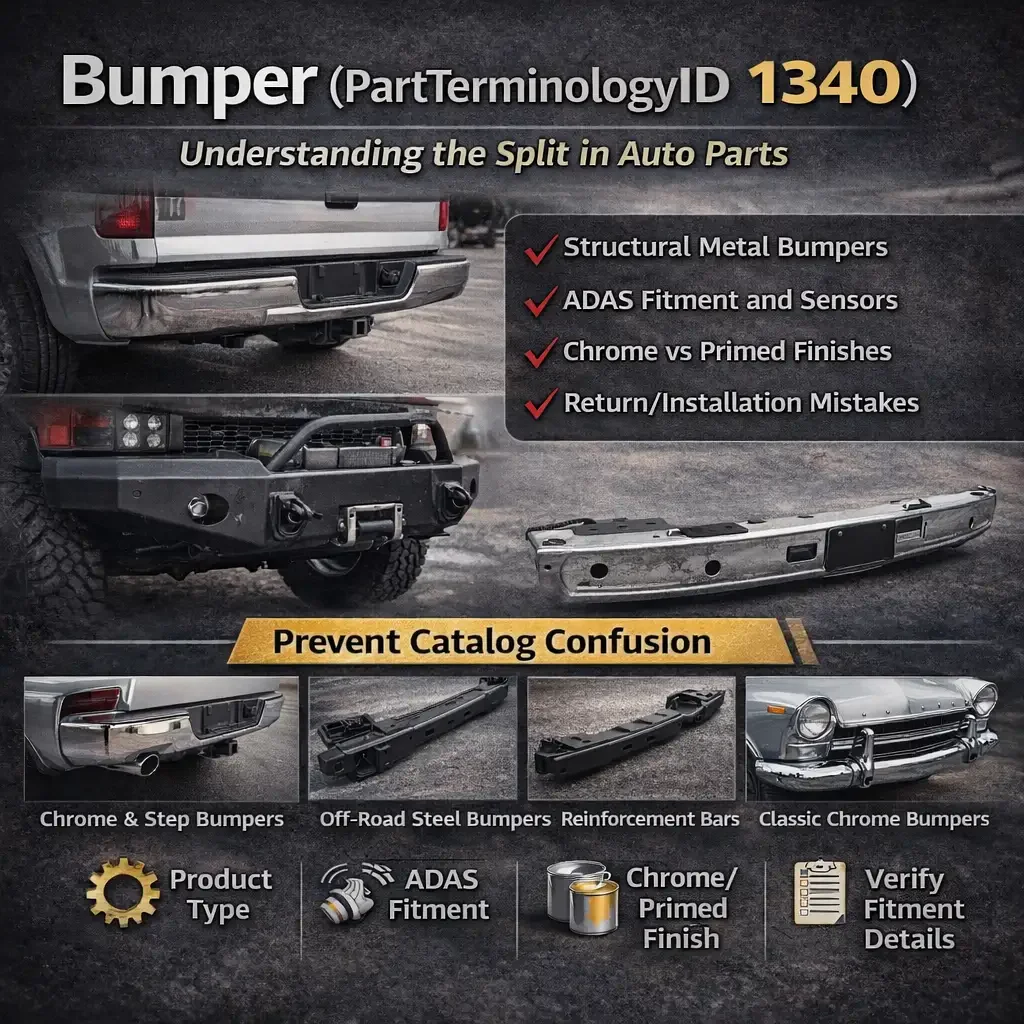
Bumper is the single most misused part name in the aftermarket. Buyers say "bumper" and they mean the painted plastic panel they can see. Collision shops say "bumper" and they mean the steel reinforcement bar hidden behind that panel. Truck owners say "bumper" and they mean the chrome face bar bolted to the frame. Off-road builders say "bumper" and they mean a heavy-duty tubular steel or plate steel replacement that replaces the entire factory assembly. Classic car owners say "bumper" and they mean a chrome-plated stamped steel unit with overriders, guards, and brackets.
Every single one of these buyers is technically correct, and every single one of them will order the wrong part if the catalog does not draw precise lines between the product types that all share this single PartTerminologyID.
PartTerminologyID 1340 is the structural, metal, functional Bumper. It is the face bar, the impact bar, the reinforcement bar, the step bumper, the chrome bumper, the off-road bumper, and every other metal bumper product that is NOT the plastic bumper cover. The next post in this series covers Bumper Cover, which is the outer plastic or composite cosmetic panel. The distinction between Bumper and Bumper Cover is the most important taxonomy split in the entire body parts category, and getting it wrong is the single most common reason for bumper-related returns in the aftermarket.
This post is built for aftermarket catalog teams, marketplace sellers, and buyers who want to understand what Bumper actually means in structured catalog data, and how to stop the confusion that drives returns across every marketplace, every catalog, and every parts counter in the industry.
Status in New Databases
Status in New Databases
Current: PIES 7.2 + PCdb Future: PIES 8.0 + PCdb 2.0 Status: No change
What Bumper Means in the Aftermarket (And What It Does Not Mean)
Bumper (PartTerminologyID 1340) refers to the structural metal component of the bumper assembly. Depending on the vehicle type and era, this is the part that absorbs impact, mounts to the frame or unibody, provides structural protection, and in many cases is the outermost visible component of the bumper.
What Bumper IS:
Chrome face bars (the visible chrome or painted steel bumper on trucks, SUVs, and older vehicles)
Step bumpers (rear bumpers on trucks with a built-in step and hitch receiver provisions)
Bumper reinforcement bars / impact bars (the hidden UHSS or aluminum bar behind the plastic bumper cover on modern unibody vehicles)
Off-road and aftermarket heavy-duty bumpers (tubular steel, plate steel, or hybrid construction replacement bumpers for trucks and SUVs)
Classic car bumpers (chrome-plated stamped steel bumpers with overriders, guards, and brackets)
Commercial and fleet bumpers (heavy-duty steel bumpers for work trucks, vans, and commercial vehicles)
What Bumper is NOT (these belong under other PartTerminologyIDs):
Bumper Cover: the outer plastic, fiberglass, or composite cosmetic panel (separate PartTerminologyID, covered in the next post)
Energy Absorber / Crush Box: the foam or honeycomb material between the cover and the reinforcement bar
Bumper Bracket: the mounting brackets that connect the bumper to the frame rails
Bumper Valance / Air Dam / Lower Spoiler: the lower plastic panels below the bumper cover
Bumper Trim / Molding: decorative chrome or plastic trim pieces applied to the bumper cover
Bumper Guard / Bull Bar / Grille Guard: aftermarket protective bars mounted in front of the bumper
Understanding this taxonomy split is the foundation of getting Bumper right in any catalog.
The Bumper Product Types and Their Fitment Worlds
Chrome Face Bars (Trucks, SUVs, Older Vehicles)
The chrome face bar is the most traditional "bumper" in the aftermarket. On trucks and SUVs, this is the visible chrome or painted steel bar that spans the front or rear of the vehicle. It bolts directly to the frame through bumper brackets or mounting plates.
Chrome face bars are among the highest-volume bumper products in the aftermarket because they are exposed to impact, corrosion, and cosmetic damage. A parking lot ding, a minor fender bender, road salt, and stone chip damage all drive replacement demand.
Fitment complexity:
Year, make, model, submodel, cab configuration (regular cab, extended cab, crew cab)
Front or rear position
2WD vs. 4WD (ride height affects bumper mounting position on some vehicles)
With or without fog light holes (front bumpers)
With or without license plate bracket provisions
With or without tow hook provisions
With or without parking sensor holes (modern trucks with factory parking sensors have sensor cutouts in the chrome face bar)
With or without adaptive cruise control radar provisions (some newer trucks mount the ACC radar behind or in the bumper)
Finish: chrome, painted (body-colored or black), satin/matte, or unfinished (requires plating or painting)
The parking sensor and ACC radar provisions are the newest fitment splits and the ones most commonly missed in catalog data. A 2020 truck with the Technology Package has sensor holes in the bumper. The same truck without the Technology Package does not. These are different part numbers. If the buyer orders the wrong one, the bumper either has holes where it should not, or is missing holes where sensors need to mount.
Step Bumpers (Truck Rear)
Step bumpers are rear bumpers on pickup trucks that include a built-in step pad (usually black plastic or rubber) in the center for easier bed access, plus provisions for a receiver hitch or bumper-mounted hitch ball.
Fitment complexity:
Year, make, model, submodel
With or without hitch receiver cutout
With or without license plate light provisions (some step bumpers include the license plate light, others do not)
With or without parking sensor holes
Finish: chrome, painted black, or unfinished
Single rear wheel (SRW) vs. dual rear wheel (DRW) on heavy-duty trucks (different bumper width)
Fleet/commercial vs. consumer trim (fleet bumpers may omit cosmetic features)
Step bumpers often come as assemblies with the step pad pre-installed, or as the steel bumper only with the step pad sold separately. Catalog listings must clearly state whether the step pad is included.
Bumper Reinforcement Bars / Impact Bars (Modern Unibody Vehicles)
This is where the most significant catalog confusion lives. On virtually every modern car and crossover built since the mid-1990s, the "bumper" is actually a multi-component assembly:
The plastic bumper cover (what the buyer sees) - this is Bumper Cover, not Bumper
The energy absorber (foam or honeycomb) behind the cover
The bumper reinforcement bar (steel or aluminum structural bar) behind the absorber
The bumper brackets or crush boxes that connect the reinforcement to the frame rails
The bumper reinforcement bar is the structural backbone. It is the part that absorbs and distributes collision energy across the frame rails. It is what PartTerminologyID 1340 refers to on these vehicles. But most buyers do not know this part exists. When they say "I need a new bumper," they mean the outer plastic cover. When the collision shop orders a "bumper," they mean the reinforcement bar.
Fitment complexity:
Year, make, model, submodel
Front or rear position
Production date (mid-year changes are common on reinforcement bars)
With or without tow hook mounting provisions
Material: ultra-high-strength steel (UHSS), aluminum, or composite
With or without ADAS sensor mounting brackets (front bumper reinforcements on vehicles with automatic emergency braking, adaptive cruise control, or pedestrian detection may include mounting provisions for radar or camera sensors)
CAPA certified vs. non-certified (collision repair shops often require CAPA certification)
Sedan vs. coupe vs. hatchback within the same model line (different rear reinforcement geometry)
Safety-critical note: OEM manufacturers universally prohibit repair or straightening of bumper reinforcement bars. Honda, Nissan, Toyota, and others have published position statements that damaged reinforcement bars must be replaced, not repaired. They are made of UHSS or heat-treated aluminum that cannot be bent, heated, or welded without compromising their crash energy management properties. Any catalog listing for a bumper reinforcement bar should include this information.
Off-Road and Aftermarket Heavy-Duty Bumpers
This is a completely different product category within the same PartTerminologyID. Off-road and heavy-duty aftermarket bumpers replace the entire factory bumper assembly (cover, absorber, reinforcement, and brackets) with a single heavy-duty structure made of plate steel, tubular steel, or a combination of both.
These products serve a different purpose than factory bumpers. They are designed for trail protection, winch mounting, auxiliary light mounting, and aggressive styling rather than pedestrian safety or low-speed impact absorption.
Fitment complexity:
Year, make, model, submodel, cab configuration
Front or rear position
With or without winch mount (and winch size compatibility: 8,000 lb, 10,000 lb, 12,000 lb)
With or without D-ring/shackle mounts
With or without auxiliary light provisions (LED light bar mount, cube light cutouts, flush-mount light provisions)
With or without bull bar or grille guard integration
Tube vs. plate steel construction
With or without skid plate integration
With or without factory fog light relocation
Approach angle (front bumpers designed for off-road clearance)
Departure angle (rear bumpers designed for off-road clearance)
With or without tire carrier provisions (rear bumpers with swing-out spare tire carrier)
With or without jerry can mount provisions
Finish: raw steel (requires coating), powder-coated (black, textured), bedliner coated
Weight (heavy-duty bumpers can add 100 to 200+ pounds to the vehicle, affecting suspension, braking, and payload capacity)
Off-road bumpers are among the most vehicle-specific aftermarket products because they mount to the frame rails through precise bolt patterns that vary not just by model but by model year and cab configuration. A bumper that fits a 2019 Ford F-150 SuperCrew may not fit a 2019 F-150 SuperCab due to different frame hole patterns or exhaust routing.
Classic Car Bumpers
Classic car bumpers are chrome-plated stamped steel assemblies that were the original "bumper" before plastic covers existed. They are visible, structural, and cosmetic all in one piece.
Fitment complexity:
Year, make, model (exact year matters; bumper designs changed frequently in the classic era)
Front or rear position
With or without bumper guards (vertical rubber or chrome guards that bolt to the bumper face)
With or without overriders (horizontal extensions at the bumper ends)
With or without license plate bracket
Chrome quality (show chrome, driver-quality chrome, triple chrome plating)
Reproduction vs. NOS (new old stock) vs. rechromed original
Inner bumper brackets and mounting hardware (often sold separately and frequently rusted or broken on original vehicles)
Classic bumper fitment is extremely year-specific. A 1967 Camaro front bumper is different from a 1968 Camaro front bumper. A 1969 Mustang bumper is different from a 1970 Mustang bumper. There is very little cross-year compatibility in the classic car bumper space.
Commercial and Fleet Bumpers
Work trucks, vans, and commercial vehicles use heavy-duty steel bumpers designed for durability and function over cosmetics. These may include integrated receiver hitches, step pads, mud flaps mounting points, and provisions for commercial lighting.
Fitment complexity:
Year, make, model, submodel, GVWR class
Cab to axle measurement (affects rear bumper position on chassis-cab configurations)
Wheelbase (affects rear bumper position)
With or without receiver hitch
With or without mud flap mounting
With or without ICC marker lights
Finish: painted black, galvanized, powder-coated, or raw steel
The Front/Rear and Upper/Lower Split
Within the Bumper category, position is a primary fitment qualifier. But it is not always as simple as "front or rear."
Front bumper position splits
Front bumper face bar (the main structural bar or chrome bar)
Front bumper reinforcement bar (the hidden impact bar on modern vehicles)
Front lower bumper bar (some vehicles have a separate lower reinforcement that supports the lower portion of the bumper cover or air dam; this can also be called a lower crossmember or radiator support lower tie bar, depending on design)
Rear bumper position splits
Rear bumper face bar (the main structural bar or chrome bar)
Rear bumper reinforcement bar (the hidden impact bar on modern vehicles)
Rear step bumper (truck-specific, includes step pad)
Upper vs. Lower confusion
On some vehicles, particularly trucks and SUVs, the bumper assembly has both an upper section and a lower section. The upper bumper may be a chrome face bar or body-colored painted bar. The lower bumper may be a textured black plastic valance, air dam, or separate lower bumper bar.
In catalog terminology, the "upper bumper" is typically the structural bar (PartTerminologyID 1340 - Bumper). The "lower bumper" may be a valance or lower cover panel that is actually a Bumper Cover component or a separate PartTerminologyID for Lower Bumper Cover or Valance.
Catalog teams must be precise here. "Upper bumper" and "lower bumper" are not standard catalog terms, but they are common buyer search terms. If a buyer searches "lower front bumper" and receives the reinforcement bar instead of the lower valance, that is a return.
Color, Finish, and Surface Treatment
Bumper finish is one of the most important attributes in this category and one of the most commonly under-specified in catalog data.
Chrome
Chrome bumpers are the most common finish on truck face bars. But "chrome" is not one thing:
Triple chrome plating (OE quality, multi-layer process: copper, nickel, chrome)
Single chrome plating (lower cost, less durable, more prone to peeling)
Chrome-clad (a chrome shell over a steel or plastic core, not the same as plated chrome)
Buyers who order a "chrome bumper" and receive a chrome-clad unit will be disappointed by the finish quality and durability. Catalog listings must specify the chrome process.
Painted / Body-Colored
Some truck and SUV bumpers are painted to match the vehicle body color. These are the same steel bumper as the chrome version but finished in primer or ready for paint. Listings must clearly state:
"Chrome finish" vs. "Primed/paintable" vs. "Paint to match (PTM)" vs. "Pre-painted [specific color code]"
If paintable, is it primed or raw steel?
If pre-painted, what is the color code and is it a factory-match or generic color?
Textured Black
Fleet and work truck bumpers often come in textured black plastic coating or paint. This is a different SKU from chrome and from primed/paintable.
Raw / Unfinished (Off-Road Bumpers)
Many aftermarket off-road bumpers ship in raw steel and require the buyer to apply their preferred coating (powder coat, bedliner, paint, etc.). Buyers who expect a finished product and receive raw steel will be frustrated.
Powder-Coated
Premium off-road bumpers come powder-coated in black or textured finishes. This is a selling point that should be prominently listed.
ADAS Integration: The Newest Fitment Layer
Advanced Driver Assistance Systems (ADAS) have added a critical new fitment dimension to bumpers. Modern vehicles mount sensors behind or within the bumper assembly:
Front-facing radar for adaptive cruise control (ACC) and automatic emergency braking (AEB)
Ultrasonic parking sensors mounted in the bumper face bar (trucks) or bumper cover (cars)
Camera modules for surround-view systems
Pedestrian detection sensors
On modern trucks, the ACC radar module may mount directly behind the chrome face bar. The face bar must have a specific area that is radar-transparent or include a specific mounting bracket. A bumper from the same vehicle without the Technology Package will not have this provision.
On modern cars, the radar mounts behind the bumper cover and in front of the reinforcement bar. The reinforcement bar must have the correct mounting bracket for the radar module. A reinforcement bar without this bracket will not support the ADAS system.
Catalog best practice: ADAS compatibility must be a fitment qualifier. Every bumper and bumper reinforcement listing should specify:
"With adaptive cruise control" vs. "Without adaptive cruise control"
"With parking sensors" vs. "Without parking sensors"
"With automatic emergency braking" vs. "Without automatic emergency braking"
Failure to split on ADAS equipment is increasingly the number one fitment failure in modern bumper replacement, surpassing even the chrome-vs-painted split.
Top Return Causes in Bumper
1) Buyer ordered Bumper Cover when they meant Bumper (or vice versa)
The most common return in the entire bumper category. The buyer says "bumper" and orders the reinforcement bar when they wanted the plastic cover. Or orders the cover when they needed the structural bar.
Prevention: Separate Bumper (PartTerminologyID 1340) and Bumper Cover clearly in taxonomy, titles, and images. First line of every listing: "This is the structural reinforcement bar, not the outer plastic bumper cover" or "This is the outer plastic bumper cover, not the structural reinforcement bar."
2) Wrong finish (chrome vs. painted vs. textured)
Buyer orders a chrome bumper and receives a primed/paintable unit, or vice versa.
Prevention: Finish in the title. "Chrome Front Bumper Face Bar" vs. "Primed Front Bumper Face Bar." Include a finish comparison image.
3) ADAS sensor provision mismatch
Bumper arrives without parking sensor holes, radar bracket, or camera mounting provisions that the vehicle requires. Or bumper arrives with sensor holes the vehicle does not have.
Prevention: ADAS equipment as a fitment qualifier. "With Parking Sensors" vs. "Without Parking Sensors." "With Adaptive Cruise Control" vs. "Without Adaptive Cruise Control."
4) Cab configuration or body style mismatch
Truck bumper does not fit because the buyer ordered the regular cab version for a crew cab, or the SRW version for a DRW truck.
Prevention: Cab configuration and wheel type as fitment qualifiers. Include dimensional images.
5) Off-road bumper does not fit the specific model year
Buyer orders an aftermarket off-road bumper listed as fitting "2015-2020 Toyota Tacoma" but the 2016 model year had a mid-year frame change that affects bolt pattern.
Prevention: Exact model year and production date qualifiers. Cross-reference manufacturer fitment notes.
6) Missing brackets, hardware, or energy absorbers
Buyer orders a bumper reinforcement bar and expects a complete assembly including brackets, crush boxes, and energy absorbers. The listing sold the bar only.
Prevention: State clearly what is included: "Reinforcement bar only" vs. "Complete assembly with brackets and energy absorbers." List compatible bracket and absorber part numbers.
7) Chrome quality disappointment
Buyer orders a "chrome bumper" and receives a chrome-clad or single-plate chrome unit that does not match OE triple-chrome quality.
Prevention: Specify chrome process. "Triple chrome plated" vs. "Chrome clad" vs. "Chrome finish." Manage quality expectations in the listing.
8) Upper vs. lower confusion
Buyer searches "front bumper" and orders the upper reinforcement bar when they needed the lower valance, or vice versa.
Prevention: Position qualifier in every title: "Front Upper Bumper Reinforcement Bar" or "Front Lower Bumper Valance." Include position diagrams.
Compatibility Checklist for Buyers
1) Determine what you actually need. Are you replacing the outer plastic panel you can see (Bumper Cover), or the structural metal bar behind it (Bumper)? Or the complete assembly? This is the most important question in the category.
2) Confirm position. Front or rear. Upper or lower. Left side, right side, or center. On trucks with multi-piece bumper assemblies, confirm the exact component.
3) Confirm full vehicle details. Year, make, model, submodel, cab configuration (trucks), body style (sedan/coupe/hatchback for cars), 2WD or 4WD, engine.
4) Confirm trim level and equipment package. Standard vs. Technology Package. With or without parking sensors. With or without adaptive cruise control. With or without fog lights. With or without tow hooks.
5) Confirm finish. Chrome, primed/paintable, pre-painted (color code), textured black, raw steel, or powder-coated.
6) For truck chrome bumpers, confirm sensor provisions. Count the parking sensor holes on your existing bumper. Confirm whether your vehicle has ACC radar behind the bumper.
7) For off-road bumpers, confirm accessories. Winch mount compatibility (winch size). D-ring/shackle mounts. Light bar provisions. Tire carrier. Jerry can mount. Factory fog light relocation.
8) Confirm what is included. Bar only, bar with brackets, complete assembly, step pad included or sold separately, hardware included or reused from original.
9) For collision repair, confirm certification. CAPA certified or non-certified. Collision shops and insurance companies may require CAPA certification.
10) For classic cars, confirm year-specific fitment. Classic bumper designs changed almost every year. Confirm exact year, not a range.
Catalog Checklist for Attributes and Structured Data
Core taxonomy and naming
Terminology Name: Bumper
Product type attribute required: Face Bar, Step Bumper, Reinforcement Bar, Off-Road Bumper, Classic Bumper, Commercial Bumper
Position: Front, Rear
Sub-position: Upper, Lower, Center, Left, Right (where applicable)
Separate from Bumper Cover, Energy Absorber, Bumper Bracket, Valance, Bumper Guard/Bull Bar
Fitment structure
Year, make, model, submodel
Body style (sedan, coupe, hatchback, wagon, SUV, truck)
Cab configuration (regular, extended/supercab, crew/supercrew) for trucks
Wheel type (SRW, DRW) for heavy-duty trucks
2WD vs. 4WD (where ride height affects bumper position)
Engine (where engine choice affects bumper reinforcement design)
Production date (mid-year changes)
Trim level and equipment package
ADAS and sensor compatibility
Parking sensor holes: quantity and position, or "without parking sensors"
Adaptive cruise control radar mounting bracket: yes or no
Automatic emergency braking sensor mounting: yes or no
Camera mounting provisions: yes or no
Pedestrian detection compatibility: yes or no
Finish and surface treatment
Chrome (triple plated, single plated, chrome-clad)
Primed / paintable
Pre-painted (color code)
Textured black
Raw steel / unfinished
Powder-coated (color)
Galvanized
Material
Mild steel
Ultra-high-strength steel (UHSS)
Aluminum
Composite
Plate steel (off-road)
Tubular steel (off-road)
Stainless steel
Physical specifications
Width (bumper span)
Height (face bar height)
Depth / thickness
Weight (critical for off-road bumpers)
Receiver hitch size (if integrated: 2 inch, 2.5 inch)
Winch compatibility (size and mounting pattern)
Package contents
Bumper bar only
Bar with brackets
Bar with energy absorbers
Bar with step pad
Complete assembly (all components)
Mounting hardware included yes or no
Wiring harness for fog lights or sensors included yes or no
Certification
CAPA certified yes or no
DOT compliant yes or no (commercial bumpers)
FMVSS 581 compliant (federal bumper standard for passenger vehicles)
Image requirements
Front face view showing finish and overall shape
Rear view showing mounting brackets and hardware
Side profile showing depth and height
Dimensional callout diagram
Sensor hole detail (parking sensors, radar mounting)
Installed view on vehicle
All included components laid out
Finish detail close-up (chrome quality, texture, primer)
Position diagram showing where this component fits in the overall bumper assembly
Common Buyer Scenarios
Scenario 1: Truck owner needs chrome front bumper replacement
The buyer has a 2021 Chevy Silverado 1500 with the LTZ trim, parking sensors, and adaptive cruise control. They order a chrome front bumper.
What goes wrong:
The bumper arrives without parking sensor holes because the listing was for the base WT trim
The ACC radar mounting bracket is missing
The buyer cannot install their parking sensors or maintain adaptive cruise control functionality
What helps:
Trim level and ADAS equipment as fitment qualifiers
"With Parking Sensors (4 holes)" vs. "Without Parking Sensors"
"With Adaptive Cruise Control Radar Bracket" vs. "Without"
Scenario 2: Car owner says "I need a new bumper" after a fender bender
The buyer has a 2019 Honda Civic sedan. They search "2019 Honda Civic front bumper" and order the first result, which is a bumper reinforcement bar.
What goes wrong:
The buyer receives a steel bar and has no idea what it is
They wanted the outer plastic bumper cover, not the structural bar
They return the product as "wrong part"
What helps:
Clear taxonomy separation: Bumper (reinforcement bar) vs. Bumper Cover (outer plastic panel)
Product title: "Front Bumper Reinforcement Bar (Impact Bar)" not just "Front Bumper"
First line of description: "This is the structural steel bar behind the plastic bumper cover, not the outer bumper cover panel."
Scenario 3: Off-road builder orders bumper for wrong cab configuration
The buyer has a 2020 Ford F-150 SuperCrew and orders a steel off-road front bumper. The product was designed for the SuperCab.
What goes wrong:
The frame bolt pattern and exhaust routing differ between SuperCab and SuperCrew
The bumper does not align with the mounting points
The buyer returns the product as "does not fit"
What helps:
Cab configuration as a mandatory fitment qualifier
Manufacturer's fitment guide specifying exact model year, cab, and engine compatibility
Weight note: "This bumper adds approximately 150 lbs to the front of the vehicle. Verify suspension, braking, and payload capacity."
Scenario 4: Classic car restoration needs year-specific bumper
The buyer is restoring a 1970 Chevelle and orders a "1970-1972 Chevelle front bumper." The bumper is for 1971 to 1972 and has a different contour than the 1970.
What goes wrong:
The 1970 bumper has a different shape than 1971 to 1972
The part does not fit the 1970 valance panel and mounting brackets
The buyer returns the product
What helps:
Exact year fitment, not year ranges, for classic bumpers
Include known year-specific differences in the listing notes
Cross-reference to OEM part numbers for each year
Scenario 5: Collision shop orders reinforcement bar, missing components
The shop orders a front bumper reinforcement bar for a 2022 Toyota Camry. The bar arrives without crush boxes, mounting brackets, or energy absorber.
What goes wrong:
The shop expected a complete bumper assembly
They now need to order brackets, crush boxes, and absorber separately, delaying the repair
They may return the bar and order from a supplier who offers complete assemblies
What helps:
Clear "bar only" vs. "complete assembly" designation in the title
List what is included and what is sold separately
Cross-reference compatible bracket, crush box, and absorber part numbers
FAQ
What is the difference between a bumper and a bumper cover?
The bumper (PartTerminologyID 1340) is the structural metal component: the reinforcement bar, face bar, or impact bar. The bumper cover is the outer plastic or composite panel that you see. On modern cars, the bumper cover hides the structural bumper. On trucks, the chrome or painted face bar IS the visible bumper.
Can a bumper reinforcement bar be repaired after a collision?
No. OEM manufacturers (Honda, Toyota, Nissan, GM, and others) universally prohibit repair or straightening of bumper reinforcement bars. They are made of UHSS or heat-treated aluminum that loses its crash energy management properties if bent, heated, or welded. Damaged reinforcement bars must be replaced.
Why does my truck bumper have sensor holes that my old one did not?
You likely received a bumper for a different trim level or equipment package. Modern trucks have trim-specific bumpers with different provisions for parking sensors, adaptive cruise control radar, and cameras. Always confirm your vehicle's exact trim level and technology package when ordering.
Do off-road bumpers affect my vehicle's suspension?
Yes. Heavy-duty off-road bumpers can add 100 to 200+ pounds to the front or rear of the vehicle. This additional weight affects ride quality, braking distance, suspension wear, and front-end alignment. Many off-road bumper manufacturers recommend upgrading to heavier springs or adding a leveling kit to compensate.
What is CAPA certification?
CAPA (Certified Automotive Parts Association) is an independent certification program for aftermarket collision repair parts. CAPA-certified parts are tested to verify that they meet OE fit, form, and function standards. Many collision repair shops and insurance companies require CAPA-certified bumper components.
Are classic car bumpers interchangeable between years?
Rarely. Classic car bumper designs changed frequently, sometimes every model year. A 1967 bumper is usually different from a 1968 bumper on the same vehicle. Always confirm exact year fitment, not a year range.
What does "primed" mean on a bumper listing?
Primed means the bumper has been coated with a primer base coat but is not finished. It requires painting to match the vehicle's body color before installation. This is different from "chrome" (finished and ready to install) or "raw steel" (no coating at all).
Do I need the energy absorber and brackets with the reinforcement bar?
Usually yes, if they were damaged in the collision. The energy absorber and crush boxes are one-time-use components designed to collapse on impact. They must be replaced if damaged. Some listings sell the bar only; others sell complete assemblies. Confirm what is included before ordering.
Final Take for Aftermarket Teams
Bumper (PartTerminologyID 1340) is the most misunderstood part name in the aftermarket because the word "bumper" means different things to different buyers, different shops, and different vehicle types. The catalog teams that win in this category are the ones that:
Draw an absolute line between Bumper (structural metal) and Bumper Cover (outer plastic) at the taxonomy, title, and description level
Treat trim level, ADAS equipment, and sensor provisions as mandatory fitment qualifiers, not optional notes
Specify finish clearly in every title (chrome, primed, textured, raw, powder-coated)
Separate product types within the Bumper category (face bar, reinforcement bar, step bumper, off-road bumper, classic bumper)
State what is included in every listing (bar only vs. complete assembly)
Flag safety-critical information (no repair of reinforcement bars, ADAS recalibration requirements, off-road bumper weight impacts)
Use exact year fitment for classic car bumpers, not year ranges
Include CAPA and certification status for collision repair applications
Bumper is a part name that everyone thinks they understand and almost no one catalogs correctly. The next post in this series covers Bumper Cover, where the confusion continues from the other side. Together, these two posts define the most important taxonomy split in the aftermarket body parts category.