
Battery Hold Down (PartTerminologyID 1336): The $8 Part That Fails Inspection and Causes $200 Problems
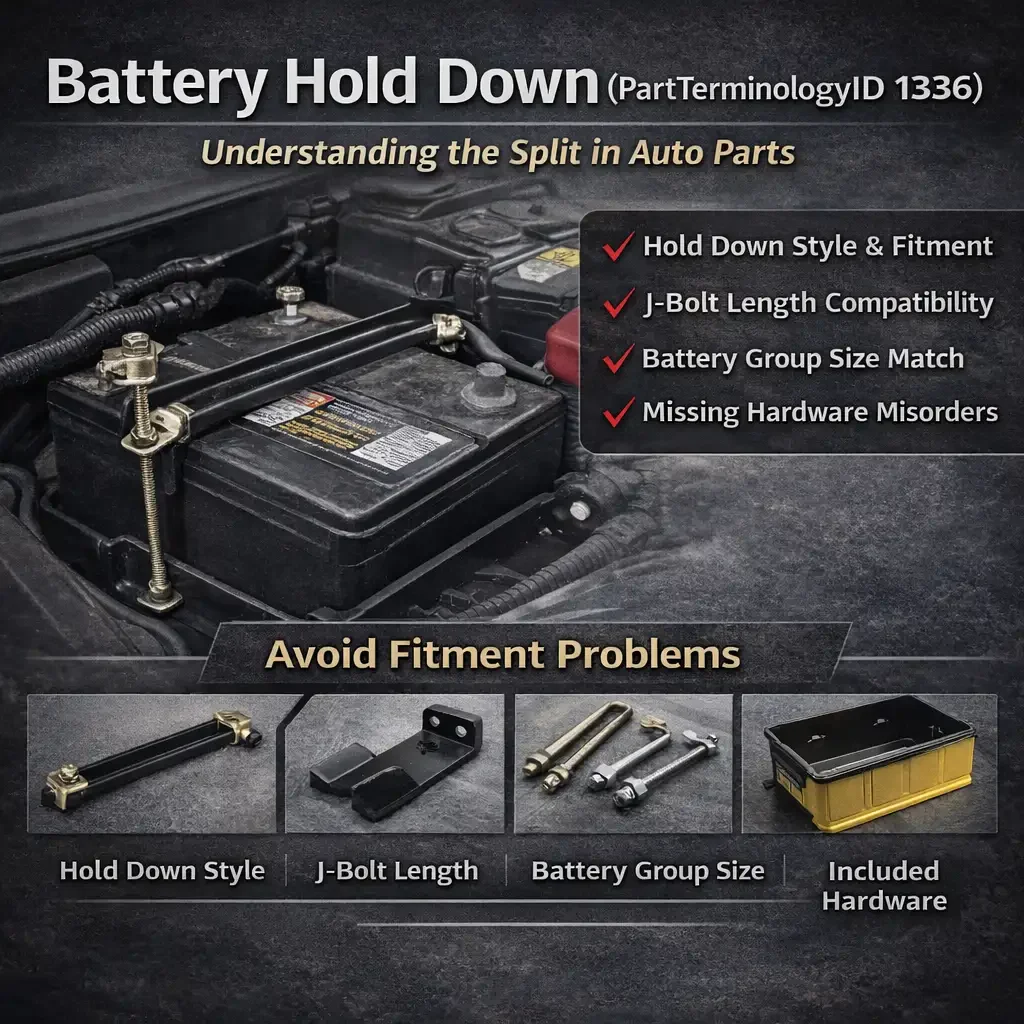
Battery Hold Down is one of the lowest-cost parts in the aftermarket. A bracket, a crossbar, a pair of J-bolts, maybe a rubber cushion. Most sell for under $15. And yet it is one of the most frequently miscataloged, most frequently missing-from-the-box, and most frequently failed-at-inspection parts in the electrical category.
The hold down's job is simple: keep the battery from moving. A battery that shifts during driving or a hard stop can short its terminals against the hood or surrounding metal, crack the battery case and leak acid, pull the cables loose, or in extreme cases cause an under-hood fire. Every state vehicle inspection that checks electrical systems checks for a secure battery hold down. Every collision shop verifies it during reassembly. Every battery installer is supposed to reinstall it. And yet batteries with missing, broken, or wrong hold downs are one of the most common under-hood findings on used vehicles.
The catalog challenge is that Battery Hold Down is a companion part to Battery Box (PartTerminologyID 1334), and the two are frequently confused, bundled inconsistently, or missing fitment data that links them to the correct vehicle and battery group size. Buyers who need just the bracket get a tray. Buyers who order a tray expect the hold down to be included and it is not. Buyers who order a universal hold down find that the J-bolts are too short or too long for their battery tray.
This post is built for aftermarket catalog teams, marketplace sellers, and buyers who want fewer mistakes and fewer returns.
Status in New Databases
Status in New Databases
Current: PIES 7.2 + PCdb Future: PIES 8.0 + PCdb 2.0 Status: No change
What Battery Hold Down Means in the Aftermarket
Battery Hold Down refers specifically to the bracket, clamp, strap, or crossbar assembly that secures the battery from the top or sides. It is NOT the tray that the battery sits on (that is Battery Box, PartTerminologyID 1334). In catalog reality, this covers:
Top-mount crossbar hold downs (a metal bar that spans the top of the battery, secured by J-bolts threaded into the battery tray or vehicle body)
Top-mount clamp brackets (stamped metal brackets with a single bolt or wedge that presses down on the battery's top ledge)
Bottom-mount clamp brackets (L-shaped brackets that grip the battery's bottom ledge, common on many Asian vehicles)
Side-post battery clamps (brackets that secure the battery by its side walls, common on GM vehicles with side-terminal batteries)
Strap-style hold downs (nylon or rubber straps that wrap over the battery, common on marine and powersports applications)
J-bolt and wing nut kits (the threaded rods and fasteners that anchor the crossbar to the tray, often sold separately)
Billet and show-quality hold down brackets (machined aluminum for Optima and specialty batteries in custom builds)
The critical distinction: Battery Hold Down is the securing hardware. Battery Box is the tray underneath. They work together but are different parts with different part numbers. Some OE assemblies include both. Many aftermarket listings sell them separately. This is where buyer confusion begins.
Why This Category Creates Returns
Hold down style does not match vehicle
Vehicles use different hold down methods depending on manufacturer, model, and generation. A Toyota may use a bottom-ledge clamp that hooks under the battery's lower flange. A GM truck may use a top-mount crossbar with J-bolts. A Honda may use a single bolt clamp bracket that presses on the battery's top edge. A hold down designed for top-mount use will not work on a vehicle designed for bottom-ledge clamping, even if the battery group size is correct.
Prevention: List hold down style (top crossbar, top clamp, bottom clamp, side clamp) as a primary attribute. Include vehicle-specific fitment data. Show installation orientation in images.
J-bolt length mismatch
J-bolts are the threaded rods that anchor the crossbar to the battery tray or vehicle body. They come in specific lengths. If the J-bolts are too short, the crossbar cannot reach the battery top and the hold down cannot be tightened. If too long, the excess threaded rod interferes with installation or looks sloppy. J-bolt length depends on the battery height (which varies by group size) and the depth of the tray mounting points.
Prevention: List J-bolt length. List compatible battery group sizes and their typical heights. Note whether J-bolt length is adjustable or fixed.
Battery group size compatibility
Even within the same hold down style, the crossbar width or clamp opening must match the battery's physical dimensions. A crossbar sized for a Group 24 battery may be too narrow for a Group 65. A bottom-ledge clamp designed for a Group 51 may not reach the ledge on a Group 35.
Prevention: List all compatible battery group sizes. For universal hold downs with adjustable crossbars, list the adjustment range and maximum battery width.
Missing hardware
OE hold downs include all necessary hardware: bracket, J-bolts, nuts, washers, and sometimes rubber insulators or cushions. Some aftermarket replacements include only the crossbar or bracket, without J-bolts, nuts, or rubber pads. The buyer receives a bracket they cannot install without additional hardware.
Prevention: List every included component. If J-bolts, nuts, or insulators are not included, state this clearly: "Crossbar only, J-bolts sold separately."
Corrosion-driven replacement with wrong part
Battery hold downs corrode faster than almost any other under-hood part because they sit directly above or adjacent to the battery, exposed to acid fumes. When replacing a corroded hold down, the buyer may not be able to identify the original part because it is too deteriorated to measure or compare. They guess at the replacement and order the wrong style or size.
Prevention: Vehicle-specific fitment data is the solution here. If the buyer enters their year, make, and model, the catalog should return the correct hold down without requiring the buyer to identify the part visually.
Confusion with Battery Box
Buyers searching "battery hold down" may receive a battery tray (PartTerminologyID 1334) or vice versa. Some sellers bundle the tray and hold down as a kit. Some sell them separately. The inconsistency causes confusion.
Prevention: Clearly label: "Hold Down Bracket Only (tray sold separately)" or "Complete Kit: Tray and Hold Down Bracket with Hardware." Separate Battery Hold Down and Battery Box at the taxonomy level.
Compatibility Checklist for Buyers
1) Identify your vehicle's hold down style. Top-mount crossbar, top-mount clamp, bottom-ledge clamp, or side clamp. Look at the existing hold down (even if corroded) or check the factory service manual.
2) Confirm your battery group size. The hold down must be compatible with the physical dimensions of your battery. Group size is printed on the battery label.
3) For OE replacement, use full vehicle details. Year, make, model, submodel, engine. The hold down style and dimensions can vary by engine option within the same vehicle model.
4) Measure J-bolt length if replacing separately. Measure from the hook end to the top of the threads on the existing J-bolts. Match the replacement length.
5) Confirm what is included. Bracket only, bracket with J-bolts and hardware, or complete kit with tray.
6) For universal or aftermarket hold downs, confirm adjustment range. Adjustable crossbars and clamps have a minimum and maximum width. Confirm your battery's width falls within this range.
Catalog Checklist for Attributes
Core taxonomy: Product form (crossbar, clamp bracket, bottom-ledge clamp, side clamp, strap, J-bolt kit, complete kit with tray). Separate from Battery Box (PartTerminologyID 1334).
Fitment (OE): Year, make, model, submodel, engine. OEM part number cross-reference.
Battery compatibility: Compatible BCI group sizes. Battery dimension range (width, height). Hold down style (top, bottom, side).
Hardware specs: J-bolt length, J-bolt thread size, nut type (wing nut, hex nut), washer included yes or no, rubber insulator/cushion included yes or no.
Material: Steel, stainless steel, aluminum, billet aluminum, nylon/rubber (straps). Finish (powder-coated, zinc-plated, chrome, raw, anodized).
Package contents: Bracket/crossbar, J-bolts, nuts, washers, rubber insulators, mounting hardware. State explicitly what is and is not included.
Dimensions: Crossbar length, clamp opening width, J-bolt length, overall height clearance.
Images: Hold down installed on battery showing orientation, all included hardware laid out, J-bolt length detail, close-up of mounting interface.
FAQ
Is a battery hold down the same as a battery tray?
No. The battery tray (Battery Box, PartTerminologyID 1334) is the platform the battery sits on. The battery hold down (PartTerminologyID 1336) is the bracket, crossbar, or clamp that secures the battery from the top or sides. They are different parts.
Do I need a battery hold down?
Yes. A battery that is not secured can shift during driving, short against metal components, leak acid, or pull cables loose. Most state vehicle inspections require a secure battery hold down. Most insurance and warranty claims require it.
How do I know which hold down style my vehicle uses?
Check the existing hold down (even if damaged), consult the factory service manual, or search by year, make, and model on a parts database. Different manufacturers use different styles: top crossbar, top clamp, bottom-ledge clamp, or side clamp.
Can I use a universal hold down instead of an OE replacement?
Yes, if the universal hold down matches your hold down style, fits your battery group size, and the J-bolt length works with your battery tray depth. However, OE replacement hold downs are designed for direct bolt-in fitment with no modification.
Final Take for Aftermarket Teams
Battery Hold Down (PartTerminologyID 1336) is a low-cost, high-confusion category where the primary catalog failures are hold down style mismatch, J-bolt length mismatch, missing hardware, and confusion with Battery Box (PartTerminologyID 1334). Catalog teams that win here clearly separate Battery Hold Down from Battery Box at the taxonomy level, list hold down style and J-bolt length as primary attributes, specify every included component, and apply full vehicle-specific fitment data so the buyer does not have to identify a corroded part by sight. It is an $8 part, but getting it wrong costs the seller far more in return shipping and lost credibility than the part is worth.