
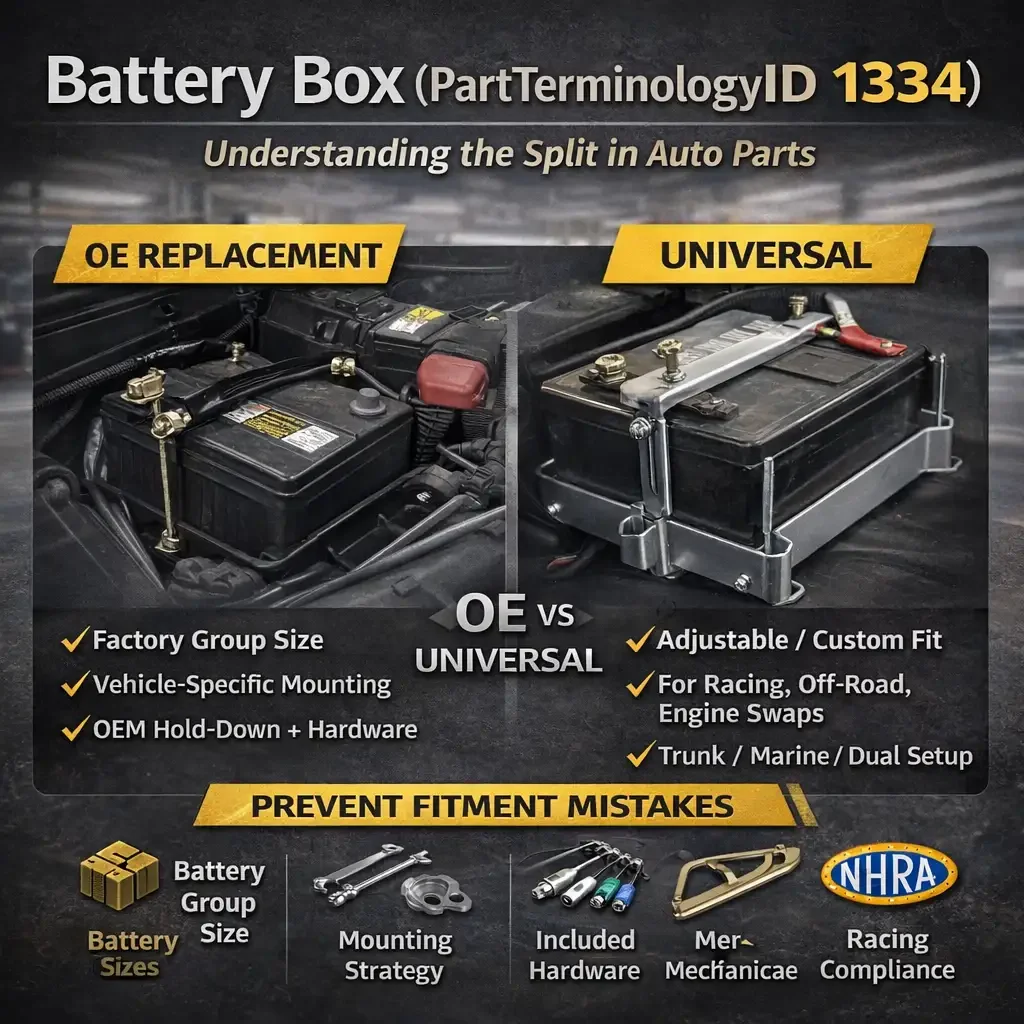
Battery Box is a category that lives in two completely different worlds. On one side: OE replacement battery trays that mount in the factory location and hold the factory-specified battery group size. These are vehicle-specific body parts with exact-match fitment. On the other side: universal battery boxes, trays, and relocation kits designed for racing, off-road, engine swaps, and custom builds where the battery is being moved to a new location entirely.
Both product types share the same PartTerminologyID but serve different buyers with different fitment requirements and different expectations. When catalogs do not clearly separate these two worlds, buyers order a universal relocation tray when they need an OE replacement, or order a vehicle-specific tray expecting it to work for a trunk relocation. Both scenarios generate returns.
The connecting thread across all Battery Box products is battery group size. Every automotive battery in North America is assigned a BCI (Battery Council International) group size that defines its physical dimensions, terminal position, and terminal type. Group 24, Group 34, Group 35, Group 51, Group 65, Group 78 - these designations determine which battery fits in which box. If the battery box does not match the battery group size, the battery does not fit, does not mount securely, or rattles loose in operation.
This post is built for aftermarket catalog teams, marketplace sellers, and buyers who want fewer mistakes and fewer returns.
Status in New Databases
Status in New Databases
Current: PIES 7.2 + PCdb Future: PIES 8.0 + PCdb 2.0 Status: No change
What Battery Box Means in the Aftermarket
Battery Box in the aftermarket refers to the tray, enclosure, or mounting assembly that secures the battery in position. In catalog reality, this covers:
OE replacement battery trays (vehicle-specific molded trays that sit in the factory battery location in the engine bay)
OE replacement battery hold-down brackets and clamps (the crossbar, J-bolt, or clamp assembly that secures the battery in the tray)
Universal battery mounting trays (adjustable steel or aluminum trays for mounting a battery in any location)
Battery relocation kits (complete kits including tray, hold-down, cables, and hardware for moving the battery to the trunk or other location)
Sealed battery boxes (enclosed boxes with venting, required by NHRA and other sanctioning bodies for racing applications with trunk-mounted batteries)
Marine battery boxes (sealed or semi-sealed enclosures designed for boat and marine use, with strap hold-downs and corrosion resistance)
Specialty battery trays for dual-battery setups (vehicle-specific or semi-universal trays for adding a second battery, common in off-road and overland builds)
Billet and show-quality battery trays (machined aluminum trays for Optima and other specialty batteries in show cars and custom builds)
Why This Category Creates Returns
Battery group size mismatch
This is the most fundamental fitment issue. A battery tray designed for a Group 24 battery will not properly secure a Group 34 battery because they have different dimensions. OE replacement trays are designed for the factory-specified group size. Universal trays may accommodate multiple group sizes through adjustable hold-downs, but the buyer must still verify that their battery's physical dimensions fit within the tray's capacity.
The confusion compounds because some group sizes are close in dimensions but not identical. A Group 35 and a Group 51 have different widths. A Group 24 and a Group 24F have the same dimensions but reversed terminal positions. The "F" designation (front terminal) matters for cable routing and clearance but not for tray fit. However, an "R" designation (reversed terminals) on some group sizes can affect the hold-down hardware orientation.
Prevention: List compatible battery group sizes for every Battery Box listing. For universal trays, list maximum internal dimensions and all compatible group sizes. For OE replacement trays, list the factory-specified group size.
OE replacement tray does not match vehicle
OE battery trays are molded to fit specific mounting points in the engine bay. They attach to the vehicle's unibody or frame through specific bolt holes and locating tabs. A tray from the same manufacturer but a different model year may have different mounting points if the engine bay changed between generations. Some vehicles have different battery trays for different engine options because the battery location shifts to accommodate different engine packages.
Prevention: Full ACES fitment data: year, make, model, submodel, engine. Cross-reference OEM part number.
Universal tray does not fit the intended location
A buyer purchasing a universal battery tray for a trunk relocation may find that the tray is too large for the intended mounting area, the bolt pattern does not align with available mounting points, or the tray does not include sufficient mounting hardware for their specific application. "Universal" means the tray is not vehicle-specific, but it does not mean it will fit any location without modification.
Prevention: List tray dimensions clearly (internal and external). State whether mounting hardware is included. Note that drilling or fabrication may be required for custom mounting locations.
Missing hold-down hardware
The battery tray and the battery hold-down are often separate products. Some OE replacement trays include the hold-down bracket, J-bolts, and clamp. Many do not. Buyers who order a tray expecting a complete mounting solution may receive just the bottom tray with no hold-down hardware.
Prevention: State clearly what is included: "Tray only" vs. "Tray with hold-down bracket and hardware." List compatible hold-down part numbers if sold separately.
Corrosion and material expectations
OE battery trays are often made of molded plastic or coated steel. Battery acid exposure causes corrosion over time, which is usually why the tray is being replaced in the first place. Aftermarket replacement trays vary in material quality and corrosion resistance. Some are bare steel that will rust quickly without coating. Some are powder-coated. Some are plastic.
Prevention: List material and finish. State corrosion resistance. For bare steel products, note that coating or painting is recommended.
Racing and sanctioning body requirements
For competition vehicles, sanctioning bodies like NHRA require trunk-mounted batteries to be enclosed in a sealed battery box with external venting. A simple open tray does not meet these requirements. Buyers building competition vehicles who order an open tray instead of a sealed box will fail tech inspection.
Prevention: If the product is designed for racing, state which sanctioning body requirements it meets (NHRA, SCCA, etc.). If it is an open tray that does NOT meet sealed-box requirements, note this clearly.
Compatibility Checklist for Buyers
1) Confirm your battery group size. Check the battery currently in your vehicle or the owner's manual for the factory-specified group size (Group 24, 34, 35, 51, 65, 78, etc.). The battery box must accommodate this group size.
2) Determine if you need an OE replacement or a universal/relocation product. OE replacement trays mount in the factory location with no modification. Universal trays and relocation kits require custom mounting.
3) For OE replacement, confirm full vehicle details. Year, make, model, submodel, and engine. Battery tray mounting points can differ by engine option within the same model.
4) Confirm what is included. Tray only, tray with hold-down, or complete relocation kit (tray, hold-down, cables, disconnect switch, hardware).
5) For relocation kits, confirm cable length and gauge. The kit must include sufficient cable length to route from the new battery location to the starter and ground. Cable gauge must match the vehicle's electrical demands (typically 2-gauge or 1/0-gauge for performance applications).
6) For racing applications, confirm sanctioning body compliance. If your sanctioning body requires a sealed battery box with external venting, an open tray will not pass tech.
7) Confirm mounting hardware. Does the kit include J-bolts, crossbar, mounting bolts, and brackets? Or is the tray only, requiring separate hardware?
Catalog Checklist for Attributes
Core taxonomy: Product form (OE replacement tray, hold-down bracket, universal tray, relocation kit, sealed race box, marine box, dual-battery tray, billet/show tray).
Fitment (OE): Year, make, model, submodel, engine. OEM part number cross-reference.
Battery compatibility: Compatible BCI group sizes. Maximum internal dimensions (L x W x H). Terminal position compatibility if relevant.
Material: Steel, stainless steel, aluminum, billet aluminum, plastic, composite. Finish (powder-coated, painted, raw, chrome, anodized).
Package contents: Tray, hold-down bracket, J-bolts, crossbar, mounting hardware, cables (length and gauge), disconnect switch, terminal guards, vent hose (sealed boxes).
Compliance: NHRA-approved yes or no. Sealed and vented yes or no. Marine-rated yes or no.
Dimensions: Internal tray dimensions, external dimensions, height clearance, mounting hole pattern.
Images: Tray with battery installed (showing fit), tray empty (showing dimensions), hold-down hardware detail, mounting point detail, all included components laid out.
FAQ
What is a battery group size?
A BCI (Battery Council International) group size is a standardized designation that defines a battery's physical dimensions, terminal position, and terminal type. Common automotive group sizes include 24, 34, 35, 51, 65, and 78. The battery box must match the battery's group size.
Do I need a sealed battery box for racing?
Most sanctioning bodies (NHRA, SCCA, NASA, etc.) require trunk-mounted batteries to be enclosed in a sealed box with an external vent hose to route battery gases outside the vehicle. Check your specific sanctioning body's rules.
Can I use a universal battery tray as an OE replacement?
Potentially, but universal trays are not designed to match factory mounting points. You may need to drill new holes and fabricate mounting brackets. An OE replacement tray is designed to bolt directly into the factory location.
Why is my OE battery tray corroded?
Battery acid vapors and occasional overflow cause corrosion on the tray, hold-down, and surrounding metal. This is normal wear over the life of the vehicle and is the primary reason battery trays need replacement.
Final Take for Aftermarket Teams
Battery Box (PartTerminologyID 1334) is a category defined by the OE-versus-universal split and the battery group size compatibility requirement. Catalog teams that win here clearly separate OE replacement trays from universal/relocation products, list compatible battery group sizes on every SKU, specify what is included (tray only vs. complete kit), and flag racing compliance where applicable. The product is not glamorous, but the fitment discipline required is the same as any vehicle-specific body part.