
Antenna (PartTerminologyID 1332): From Mast to Shark Fin, and Why Modern Antennas Are Multi-System Parts That Catalogs Keep Getting Wrong
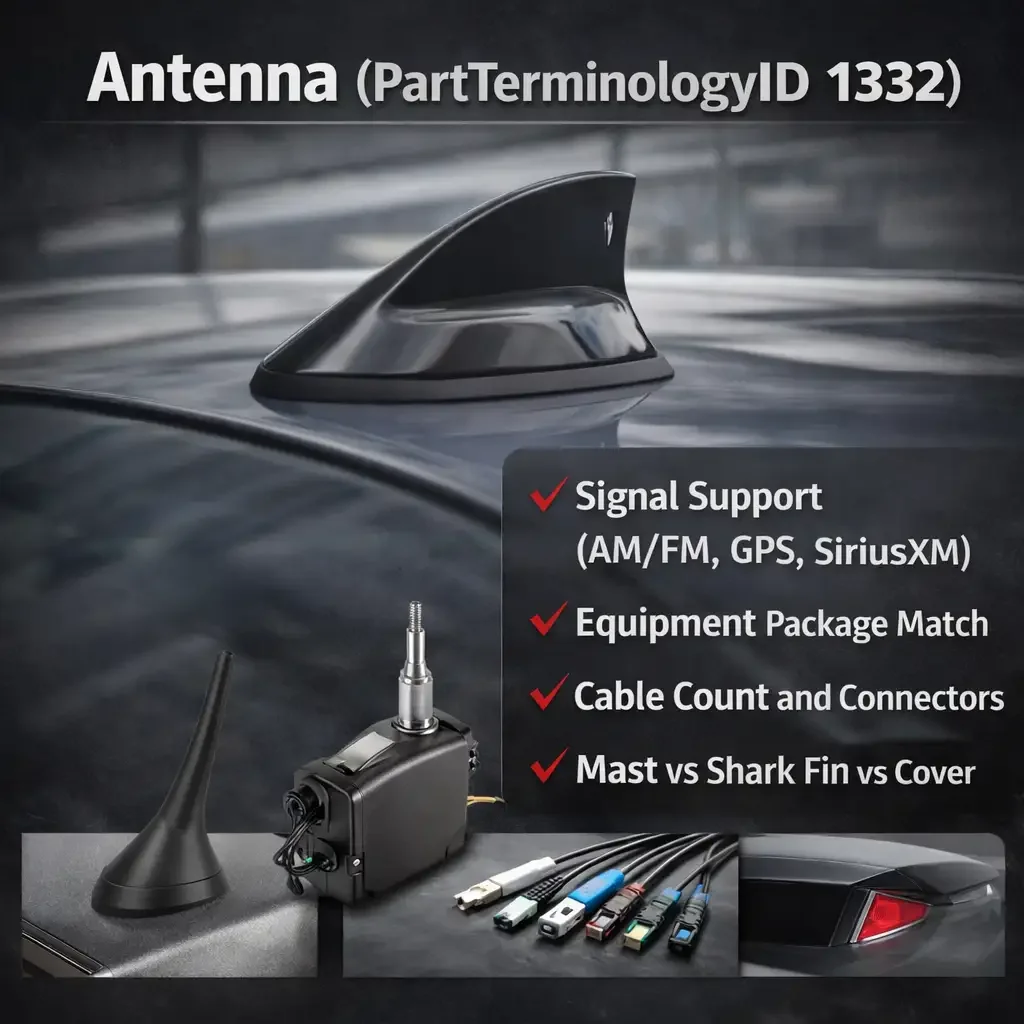
Antenna used to be one of the simplest parts on a vehicle. A metal mast screwed into a base on the fender. It received AM/FM radio. If it broke, you unscrewed it and screwed on a new one. Five minutes, no tools, no confusion.
That era is over. A modern vehicle antenna is a multi-system communications hub that handles AM/FM radio, satellite radio (SiriusXM), GPS navigation, cellular connectivity (OnStar, BMW Assist, Volvo On Call), WiFi hotspot, Bluetooth, emergency call (eCall), toll transponder communication, and in some cases V2X (vehicle-to-everything) signals for connected driving features. All of this is packaged inside a single roof-mounted shark fin enclosure, connected to the vehicle by multiple coaxial cables of different impedances, and integrated with the head unit, telematics module, navigation module, and body control module.
When a shark fin antenna breaks in a car wash, gets damaged in a collision, or fails internally, the replacement is no longer a $12 screw-on mast. It is a $75 to $300 vehicle-specific electronic assembly with multiple internal antennas, amplifiers, and cable connections that must match the vehicle's exact equipment configuration.
This is why PartTerminologyID 1332 needs a PartsAdvisory approach. Antenna is not one product. It is an entire family of products spanning five decades of technology, from simple passive masts to complex active multi-band assemblies, all sharing the same part name and frequently miscataloged.
This post is built for aftermarket catalog teams, marketplace sellers, and buyers who want fewer mistakes and fewer returns.
Status in New Databases
Status in New Databases
Current: PIES 7.2 + PCdb Future: PIES 8.0 + PCdb 2.0 Status: No change
What Antenna Means in the Aftermarket
Antenna in the aftermarket covers an enormous range of products under one PartTerminologyID:
Replacement mast antennas (screw-on metal or rubber masts for AM/FM reception)
Stubby or short replacement masts (shorter aftermarket masts for cosmetic upgrade, 3 to 7 inches)
Power/motorized antenna assemblies (retractable masts with electric motors, common on 1980s and 1990s vehicles)
Shark fin antenna assemblies (roof-mounted multi-band enclosures integrating AM/FM, satellite radio, GPS, cellular, and WiFi)
Shark fin antenna covers (cosmetic covers that fit over an existing mast base, do not replace the antenna function)
Satellite radio antennas (standalone SiriusXM antennas, magnetic or adhesive mount)
GPS antennas (standalone navigation antennas)
Cellular and telematics antennas (for OnStar, eCall, connected services)
CB and two-way radio antennas (commercial and off-road communication)
In-glass antennas (antenna elements printed or embedded in the rear window glass, not serviceable as a separate part)
Antenna amplifiers and signal boosters (inline electronic amplifiers for weak-signal areas)
Antenna adapters (connectors that convert between factory and aftermarket cable types)
Antenna base assemblies (the mounting base on the vehicle body, separate from the mast)
This is where catalogs fail first. "Antenna" means something completely different to a buyer replacing a broken mast on a 2005 truck than it does to a buyer replacing a shark fin on a 2022 SUV. The first buyer needs a $10 screw-on part. The second buyer needs a $200 vehicle-specific electronic assembly. If the catalog does not clearly separate these product types, both buyers end up on the wrong listing.
The Technology Evolution That Drives Catalog Complexity
Understanding why Antenna is so complex requires understanding how vehicle antenna technology evolved:
Era 1: Passive mast (pre-2000s, still common on trucks)
A simple metal rod mounted on the fender or roof. It receives AM/FM radio signals passively. No electronics. One coaxial cable connects it to the head unit. Replacement is universal by thread size. This is the simplest antenna product and still has volume in the truck and fleet segment.
Era 2: Motorized/power antenna (1980s to early 2000s)
An electric motor-driven retractable mast that extends when the radio is turned on and retracts when turned off. The assembly includes the motor, mast, base, and wiring. These are vehicle-specific because the mounting base, cable routing, and electrical connection vary by vehicle. When the motor fails (the most common failure), the entire assembly typically requires replacement.
Era 3: Shark fin with limited function (mid-2000s to early 2010s)
Early shark fin designs housed the AM/FM antenna element (replacing the mast), and sometimes a satellite radio antenna. One or two coaxial cables. The AM/FM element inside the shark fin is often a smaller, amplified design that compensates for the reduced size with an active amplifier circuit. These are vehicle-specific by mounting base dimensions, cable count, and amplifier specifications.
Era 4: Multi-band shark fin (2010s to present)
Modern shark fin antennas are multi-system hubs. A single shark fin on a 2024 vehicle may contain:
AM/FM radio antenna element (amplified)
SiriusXM satellite radio antenna
GPS antenna for navigation
Cellular antenna for telematics (4G LTE, 5G)
WiFi antenna for in-vehicle hotspot
eCall antenna for emergency services
V2X antenna for vehicle-to-everything communication (emerging)
Each of these functions uses a different frequency band, a different internal antenna element, and in many cases a different coaxial cable running through the roof to different modules inside the vehicle. A shark fin from the same vehicle model but with a different equipment package (no satellite radio, no telematics) will have a different internal configuration and fewer cables. These are NOT interchangeable.
This is the critical catalog point: two shark fin antennas that look identical on the outside may have completely different internal configurations based on the vehicle's factory equipment. The fitment is not just year, make, model. It is year, make, model, submodel, and equipment package (navigation, satellite radio, telematics, WiFi hotspot).
Why This Category Creates Returns
1) Mast thread size mismatch
The simplest antenna fitment issue. Replacement masts screw into a threaded base. Common thread sizes are M6x1.0, M8x1.25, and various proprietary sizes. If the thread size does not match, the mast will not install. Most aftermarket masts are sold as "universal" but only fit specific thread sizes.
Prevention: List thread size clearly. If the mast is truly universal with multiple adapter fittings, state which thread sizes are included. Show the adapter fittings in product images.
2) Shark fin equipment package mismatch
The buyer orders a shark fin antenna for their vehicle's year, make, and model. The part arrives and looks correct externally. But the vehicle has satellite radio and the replacement antenna does not include the satellite radio element, or the vehicle has cellular telematics and the antenna does not include the cellular element. The buyer loses functionality.
Prevention: Equipment package must be a fitment qualifier. List which signals the antenna supports (AM/FM, SiriusXM, GPS, cellular, WiFi). State clearly: "For vehicles WITH satellite radio" or "For vehicles WITHOUT satellite radio." Use the vehicle's RPO codes or option package designations where available.
3) Cable count and connector mismatch
Modern shark fin antennas connect to the vehicle through multiple coaxial cables that pass through a hole in the roof. Different equipment configurations mean different cable counts and different connector types. A shark fin with three cables will not work on a vehicle that has four cable connections at the roof, even if the external dimensions match.
Prevention: List the number of coaxial connections. Include a connector detail image. Cross-reference to the OEM part number to confirm exact match.
4) Cosmetic shark fin cover vs. functional antenna
Some aftermarket products are shark fin covers that attach over an existing mast antenna base for a cosmetic upgrade. They are not functional antennas. They may include a small passive AM/FM element but do not replace the factory antenna's full functionality. Buyers who order a cosmetic shark fin cover expecting a functional multi-band antenna will lose satellite radio, GPS, and other signals.
Prevention: Separate functional antenna assemblies from cosmetic covers in catalog taxonomy. Title the product clearly: "Shark Fin Antenna Assembly" vs. "Shark Fin Antenna Cover (Cosmetic)." State explicitly which signals are supported.
5) Motorized antenna motor failure vs. mast replacement
For power antennas, the failure mode matters. If the mast is broken but the motor works, only the mast needs replacement. If the motor has failed, the entire assembly needs replacement. Buyers who order only a mast when the motor is dead will not fix the problem. Buyers who order an entire motor assembly when only the mast is broken overspend.
Prevention: Clearly separate mast-only products from complete motor assemblies. Include a diagnostic note: "If the antenna extends and retracts but has a broken mast, the mast-only replacement is sufficient. If the antenna does not move, the complete motor assembly may be required."
6) Short/stubby mast reception loss
Buyers who replace a full-length mast (typically 28 to 31 inches for optimal FM reception) with a short 3 to 7 inch stubby mast for cosmetic reasons will experience reduced AM/FM reception. This is physics, not a defective product. Shorter antennas are less efficient at capturing longer wavelengths used by FM and especially AM radio. In urban areas with strong signals, the difference may be negligible. In rural or fringe signal areas, the difference can be dramatic.
Prevention: Include a note on stubby mast listings: "Shorter antenna length may reduce AM/FM reception compared to factory full-length mast, particularly in rural or weak-signal areas." This sets expectations and reduces returns from buyers who blame the product.
7) Antenna adapter connector incompatibility
Aftermarket head units use different antenna connectors than factory radios. A Motorola connector is different from a European DIN connector, which is different from a Japanese connector. An antenna adapter is required to connect the factory antenna cable to an aftermarket head unit. Buyers who install a new head unit and experience no radio reception often need an antenna adapter, not a new antenna.
Prevention: If selling antenna adapters, specify the conversion clearly: "Factory [connector type] to aftermarket [connector type]." Cross-reference to vehicle application and head unit brand.
The Metallic Window Tint Problem
This deserves a brief mention because it shows up as an antenna performance complaint. Vehicles with metallic window film (covered in PartTerminologyID 1327) may experience reduced antenna performance if the antenna element is in-glass (printed on the rear window) or if the metallic film blocks satellite signals. Catalog teams selling antennas should be aware that this is a common misdiagnosis. The antenna is fine. The window tint is blocking the signal.
Compatibility Checklist for Buyers
1) Identify the antenna type on your vehicle. Screw-on mast, motorized mast, or shark fin. This determines which product category you need.
2) For mast replacement, confirm thread size. Measure the threaded base or check the factory mast specifications. Common sizes are M6x1.0 and M8x1.25 but others exist.
3) For shark fin replacement, confirm your equipment package. Does your vehicle have satellite radio? GPS navigation? Cellular telematics (OnStar, BMW Assist, etc.)? WiFi hotspot? The antenna must match all installed systems.
4) Confirm the cable count. Count the number of coaxial cables at the antenna base. The replacement must have the same number of connections.
5) Cross-reference the OEM part number. This is the most reliable way to confirm exact match for shark fin assemblies. Different option packages use different part numbers on the same vehicle model.
6) For motorized antennas, diagnose the failure. Broken mast only or dead motor. Order accordingly.
7) For stubby or short mast upgrades, understand the reception tradeoff. Shorter mast means reduced reception, especially AM and in weak-signal areas.
8) For aftermarket head unit installations, check if an antenna adapter is needed. Factory antenna cables often use different connectors than aftermarket head units.
Catalog Checklist for Attributes
Core taxonomy: Product form (mast, stubby mast, motorized assembly, shark fin assembly, shark fin cover, satellite antenna, GPS antenna, cellular antenna, CB antenna, antenna adapter, antenna amplifier). Separate functional assemblies from cosmetic covers.
Fitment: Year, make, model, submodel, equipment package (satellite radio Y/N, navigation Y/N, telematics Y/N, WiFi Y/N). OEM part number cross-reference.
Signal support: AM/FM, SiriusXM, GPS, cellular (4G/5G), WiFi, eCall, V2X. List every signal the antenna supports.
Physical specs: Mast length (inches), thread size (mast type), overall dimensions (shark fin), mounting base dimensions, color/finish, cable count, connector types.
Electrical: Active (amplified) vs. passive. Operating voltage if active. Impedance (50 ohm for transmitting/cellular, 75 ohm for receiving/broadcast).
Package contents: Antenna assembly, mounting hardware, gasket/seal, cable(s), adapter fittings (for universal masts).
Images: Product front and rear, mounting base detail, cable and connector detail, thread size callout (mast), installed view on vehicle, internal component view if helpful (shark fin teardown showing multiple antenna elements).
FAQ
Can I replace a shark fin antenna with a simple mast?
Technically you can mount a mast, but you will lose satellite radio, GPS, cellular, and all other signals that the shark fin provided. The mast will only receive AM/FM. This is not recommended for vehicles with factory telematics or satellite radio.
Will a short stubby antenna affect my radio reception?
Yes. Shorter antennas are less efficient at receiving AM/FM signals. In strong signal urban areas, the effect may be minimal. In rural or fringe areas, reception will noticeably decrease.
Are shark fin antennas interchangeable between trim levels?
Not always. Different trim levels and option packages have different equipment (satellite radio, navigation, telematics). The shark fin must match the vehicle's specific equipment configuration. Two shark fins that look identical externally may have different internal antenna elements and cable counts.
Why did I lose satellite radio after replacing my antenna?
The replacement antenna likely does not include a SiriusXM antenna element. Confirm the replacement includes satellite radio support. Check the equipment package qualifier on the listing.
Do I need an antenna adapter for my aftermarket head unit?
Usually yes. Factory antenna cables use connectors specific to the vehicle manufacturer. Aftermarket head units use different connector types. An antenna adapter converts between the two.
What is the difference between a shark fin antenna and a shark fin cover?
A shark fin antenna is a functional multi-band assembly that replaces the factory antenna. A shark fin cover is a cosmetic shell that fits over an existing mast base for appearance only. The cover may include a basic AM/FM element but does not provide satellite radio, GPS, cellular, or other signals.
Final Take for Aftermarket Teams
Antenna (PartTerminologyID 1332) has evolved from the simplest part on the vehicle to one of the most technically complex accessories in the catalog. The part name has not changed, but the product has transformed from a passive metal rod into a multi-system communications hub.
The catalog teams that win in this category are the ones that:
Separate mast, motorized, shark fin assembly, and shark fin cover products clearly in taxonomy and titles
Use equipment package as a mandatory fitment qualifier for shark fin assemblies (satellite radio, GPS, telematics, WiFi)
List signal support explicitly for every antenna SKU
State cable count and connector types for shark fin products
Cross-reference OEM part numbers for exact match confirmation
Set reception expectations on stubby mast products
Separate functional antennas from cosmetic covers at the category level
Include diagnostic guidance (mast vs. motor failure for motorized antennas)
Antenna is a category where the technology outpaced the catalog infrastructure. The part name stayed the same while the product became ten times more complex. Catalog teams that recognize this gap and close it with structured data and clear product content will see fewer returns and fewer confused buyers.