
Steering Wheel (PartTerminologyID 1320): Fitment, Safety, and the Catalog Complexity Behind the Simplest-Looking Part in the Car
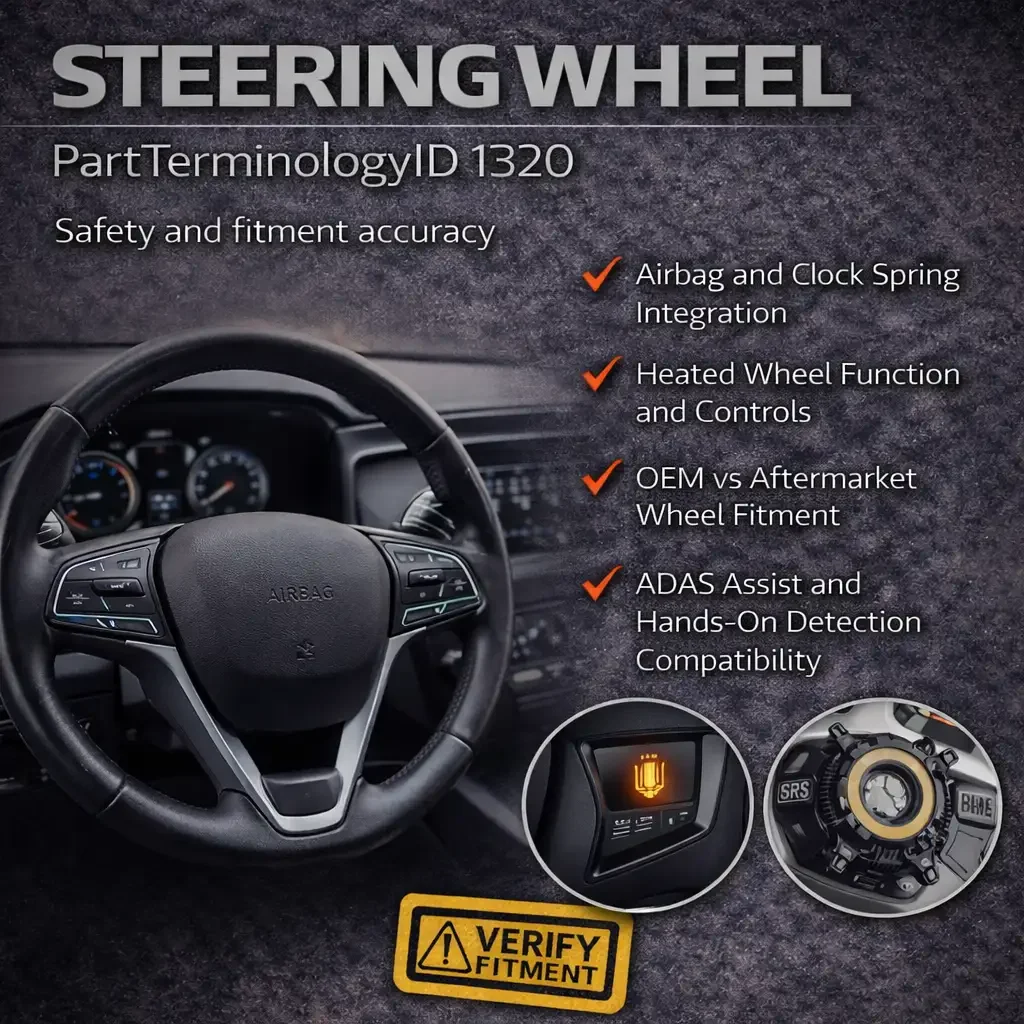
Steering Wheel looks like one of the simplest parts in a vehicle. It is round. It bolts to a column. You turn it. But from a catalog perspective, Steering Wheel is one of the most dangerous part names to get wrong, because fitment errors do not just cause returns. They cause safety failures.
Every steering wheel interfaces with the airbag system, the clock spring (spiral cable), the horn circuit, and increasingly with cruise control, audio controls, driver assistance systems, paddle shifters, heated wheel elements, and capacitive sensors for hands-on-wheel detection. A steering wheel that physically bolts on but does not integrate with these systems creates a vehicle that is unsafe, non-functional, or both.
The aftermarket steering wheel category spans two very different worlds. On one side: OE replacement wheels for collision repair, wear, and recall work, where exact-match fitment is mandatory. On the other side: aftermarket performance and custom wheels (Sparco, MOMO, NRG, Grant, etc.) where the buyer is deliberately removing the factory wheel and accepting responsibility for airbag deletion, hub adapter selection, and wiring integration. These two product categories share the same PartTerminologyID but have almost nothing else in common from a catalog and liability standpoint.
This is exactly why PartTerminologyID 1320 needs a disciplined PartsAdvisory approach. Steering Wheel is not just a body part. It is a safety-critical interface between the driver and the vehicle's SRS, electrical, and driver-assistance systems.
This post is built for aftermarket catalog teams, marketplace sellers, and buyers who want fewer mistakes and fewer returns.
Status in New Databases
Status in New Databases
Current: PIES 7.2 + PCdb Future: PIES 8.0 + PCdb 2.0 Status: No change
What Steering Wheel Means in the Aftermarket
Steering Wheel in the aftermarket refers to the wheel assembly that the driver grips and turns to control vehicle direction. In catalog reality, this single part name covers a surprisingly wide range of products:
OE replacement steering wheels (exact match for factory wheel, includes airbag mounting provisions)
OE-style steering wheels with integrated airbag module
Aftermarket performance steering wheels (smaller diameter, flat-bottom, deep-dish, motorsport-focused)
Custom and show steering wheels (wood, chrome, billet, acrylic)
Steering wheel cores or armatures (the structural frame without leather or covering)
Steering wheel covers (slip-on covers that go over the existing wheel, sometimes miscategorized under this PartTerminologyID)
Marine and off-road steering wheels (boats, UTVs, go-karts)
This is where catalogs go wrong first. Buyers use "steering wheel" to mean very different things:
Some mean an exact OE replacement after a collision or airbag deployment
Some mean a performance aftermarket wheel with a hub adapter for a track car
Some mean a steering wheel cover (a slip-on protector, not a replacement wheel)
Some mean just the airbag module that sits in the center of the wheel
Some mean the clock spring or spiral cable behind the wheel
Some mean a heated steering wheel upgrade
If the listing title and structured data do not clearly define the product type and what is included, buyers will order the wrong product, and in this category the consequences can be severe.
Why This Category Is Safety-Critical
Steering Wheel is different from almost every other interior part because it directly interfaces with the vehicle's Supplemental Restraint System (SRS). The driver-side airbag is housed inside the steering wheel. The clock spring (spiral cable) behind the wheel carries electrical signals for the airbag, horn, and steering wheel-mounted controls. Removing, replacing, or modifying the steering wheel without proper procedures can:
Cause accidental airbag deployment during installation (injury risk)
Disable the driver-side airbag permanently (crash safety risk)
Trigger persistent SRS warning lights on the dashboard
Disable the horn
Disable cruise control, audio controls, or voice command buttons
Disable lane keep assist, adaptive cruise control, or other ADAS functions that rely on steering wheel sensors
Disable heated steering wheel function
Disable hands-on-wheel detection (required for some Level 2 ADAS systems)
For OE replacement work, the steering wheel must be an exact match for the vehicle's year, make, model, trim level, and equipment package. The airbag connector, clock spring interface, button wiring, and mounting spline must all be correct. A steering wheel from the same model but a different trim level may have different button configurations, different airbag modules, or different wiring that makes it incompatible.
For aftermarket performance wheels, the buyer is deliberately removing the factory wheel and all of its integrated safety and control systems. This requires a vehicle-specific hub adapter (boss kit), and typically results in loss of the airbag, horn (unless rewired), and all steering wheel-mounted controls. This is accepted in motorsport and track applications but creates significant legal and safety implications for street-driven vehicles.
Why This Category Creates Fitment Problems
Spline count and shaft diameter
The steering wheel mounts to the steering column via a splined shaft. Different manufacturers use different spline counts and shaft diameters. A GM column from 1969 to 1994 uses a 36-spline shaft. A Ford from the same era uses a different spline count. Japanese manufacturers use yet another specification. The spline interface is the most fundamental fitment point for any steering wheel. If the spline count and shaft diameter do not match, the wheel cannot mount.
For OE replacement, the spline always matches because the wheel is designed for that specific vehicle. For aftermarket performance wheels, a vehicle-specific hub adapter (boss kit) is required to convert the factory spline to the aftermarket wheel's universal bolt pattern (typically 6x70mm or 3-bolt/5-bolt patterns).
Airbag module compatibility
Modern OE steering wheels include an integrated airbag module. The airbag is specific to the vehicle model and often to the model year and trim level. Different airbag modules have different connector types, different mounting hardware, and different deployment characteristics. An airbag from a 2018 model may not be compatible with a 2020 model of the same vehicle even if the steering wheel looks identical.
Clock spring (spiral cable) interface
The clock spring is a coiled ribbon cable behind the steering wheel that maintains electrical connectivity as the wheel rotates. It carries signals for the airbag, horn, and all steering wheel-mounted controls. Different vehicles use different clock springs with different connector configurations. If a replacement steering wheel has a different button layout or different wiring, the clock spring may not be compatible.
Steering wheel-mounted controls
Modern steering wheels are loaded with controls:
Cruise control (set, resume, cancel, distance)
Audio (volume, track, source, mute)
Voice command / phone
Driver information display scrolling
Paddle shifters
Heated steering wheel button
Drive mode selector
ADAS controls (lane keep, adaptive cruise distance)
Each of these controls uses specific wiring through the clock spring to the vehicle's body control module or infotainment system. A replacement steering wheel must have the same button configuration and wiring pinout as the original, or controls will not function.
Trim level and option package differences
Within the same model year of the same vehicle, the steering wheel can differ by trim level:
Base trim: urethane/plastic wheel, no controls or basic controls
Mid trim: leather-wrapped wheel, audio and cruise controls
Sport trim: flat-bottom leather wheel, paddle shifters, contrast stitching
Premium trim: heated leather wheel, wood or metal inserts, full control suite
These are different part numbers with different wiring, different button layouts, and different airbag modules. A steering wheel from the sport trim will not plug in correctly on the base trim vehicle and vice versa.
Heated steering wheel compatibility
Heated steering wheels require a dedicated heating element and additional wiring through the clock spring. If a vehicle was not factory-equipped with a heated wheel, the clock spring may not have the necessary conductors, and the body control module may not support the heated wheel function. Simply installing a heated steering wheel from a higher trim level may not activate heating without additional wiring and module programming.
ADAS and hands-on-wheel detection
Many newer vehicles (2018+) with Level 2 driver assistance systems (lane centering, adaptive cruise, highway assist) use capacitive sensors in the steering wheel rim to detect whether the driver's hands are on the wheel. If a replacement wheel does not include this sensor, or if an aftermarket wheel is installed, the ADAS system may issue constant warnings or disable itself entirely.
Naming Confusion That Causes Buyer Mistakes
Steering Wheel vs. Steering Wheel Cover
This is the most common confusion. A steering wheel is the structural component that bolts to the column. A steering wheel cover is a slip-on accessory that wraps around the existing wheel's rim. Some catalogs and marketplaces incorrectly categorize covers under the Steering Wheel PartTerminologyID, causing buyers to click a cover listing when they need a replacement wheel, or vice versa.
Steering Wheel vs. Airbag Module
Some buyers search "steering wheel" when they actually need just the airbag module (the center pad that deploys in a collision). The airbag module is a separate component that mounts inside the wheel. Replacing the airbag module does not require replacing the entire wheel.
Steering Wheel vs. Clock Spring
The clock spring (spiral cable) sits behind the steering wheel and is often damaged during wheel removal or collision. Buyers searching for a steering wheel replacement may actually need a clock spring. These are completely different parts.
Steering Wheel vs. Hub Adapter (Boss Kit)
A hub adapter converts the factory steering column spline to an aftermarket wheel bolt pattern. It is not a steering wheel. But some listings bundle adapters with wheels, or use titles that conflate the two.
OE Replacement vs. Aftermarket Performance Wheel
These are fundamentally different products with completely different fitment requirements, safety implications, and buyer expectations. An OE replacement integrates with the factory airbag, controls, and wiring. An aftermarket performance wheel deletes the airbag and all factory controls. Listings that do not make this distinction create dangerous confusion.
The Two Product Categories You Must Separate
Unlike most parts where we discuss three fit types (custom, semi-custom, universal), Steering Wheel is best separated into two fundamentally different product categories.
OE and OE-Style Replacement Steering Wheels
These are designed to replace the factory steering wheel with an identical or functionally equivalent unit. They maintain airbag compatibility, control wiring, and all factory functions.
Best for
Collision repair (airbag deployment replacement)
Worn or damaged factory wheel replacement
Recalls and safety-related replacements
Buyers who want to maintain all factory functions and safety systems
Typical fitment needs
Exact year, make, model, submodel, trim level
Equipment package (base controls, full controls, paddle shifters, heated wheel)
Airbag module compatibility (often sold separately)
Clock spring compatibility
Wiring harness and connector match
Color and material match (leather, urethane, wood insert, metal insert)
Common issues
Wrong trim level ordered (different buttons, different wiring)
Airbag module not included (buyer expected complete assembly)
Clock spring damage during installation not addressed
Color or material does not match interior
Heated wheel function does not activate without module programming
Aftermarket Performance and Custom Steering Wheels
These are designed to replace the factory wheel with a motorsport, custom, or show-oriented alternative. They do NOT integrate with the factory airbag, controls, or ADAS systems. They require a vehicle-specific hub adapter.
Best for
Track and competition vehicles
Show cars and custom builds
Drift and motorsport applications
Classic car restoration with period-correct steering wheels
Off-road and UTV applications
Typical fitment needs
Steering column spline count and shaft diameter (determines hub adapter required)
Hub adapter bolt pattern (6x70mm, 3-bolt Grant, 5-bolt Grant, etc.)
Steering wheel diameter (320mm to 380mm typical for performance; 350mm most common)
Dish depth (flat, semi-deep, deep dish)
Horn button compatibility (retaining ring size varies by hub adapter)
Quick-release hub compatibility (if used)
Common issues
Buyer does not realize a hub adapter is required (wheel cannot mount without one)
Buyer does not realize the airbag will be permanently removed
Buyer does not realize horn, cruise control, and audio controls will be lost
Airbag warning light stays on permanently
Hub adapter is wrong for the vehicle's spline count
Steering wheel is too close to or too far from the driver
Turn signal cancellation does not work without clock spring modification
Wheel is not legal for road use in some jurisdictions
Top Return Causes in Steering Wheel
1) Wrong trim level or equipment package
The steering wheel physically fits but has the wrong button layout, wrong wiring, or wrong airbag connector for the buyer's specific vehicle configuration.
Prevention: List trim level and equipment package as primary fitment qualifiers. Include button layout images. State clearly which controls are present on the wheel.
2) Airbag module not included
Buyer expected a complete assembly with airbag. The listing sold the wheel only, without the airbag module.
Prevention: State clearly: "Airbag module sold separately" or "Airbag module included." Include a package contents image.
3) Hub adapter not included (aftermarket wheels)
Buyer ordered an aftermarket performance wheel and expected it to bolt directly to their steering column. No hub adapter was included.
Prevention: State clearly: "Hub adapter / boss kit required (sold separately)." Recommend compatible hub adapters by vehicle. Add a first-line note: "This is an aftermarket steering wheel that requires a vehicle-specific hub adapter for installation."
4) Airbag deletion not understood
Buyer installed an aftermarket performance wheel and did not realize the driver airbag would be permanently removed. Airbag warning light stays on.
Prevention: Include a prominent safety notice: "Installing this aftermarket steering wheel removes the factory driver airbag. This may not be legal for road use in all jurisdictions. Buyer assumes all responsibility for safety implications."
5) Color or material mismatch
Buyer received the correct fitment but wrong color leather, wrong stitching, or wrong insert material.
Prevention: Include trim-level-specific color and material callouts. Show interior-matched photos.
6) ADAS or heated wheel function lost
Buyer replaced a steering wheel with a heated or ADAS-equipped wheel from a different trim or year. The function does not activate.
Prevention: Note when heated wheel function or ADAS sensors require specific clock springs, wiring, and module programming. State "heated function requires factory heated wheel option and compatible clock spring."
7) Product type confusion (wheel vs. cover vs. airbag)
Buyer wanted a steering wheel cover and received a replacement wheel, or wanted an airbag module and received a complete wheel.
Prevention: Product type in the first line of every listing. Separate Steering Wheel, Steering Wheel Cover, and Airbag Module clearly in catalog taxonomy.
Compatibility Checklist for Buyers
1) Confirm the exact product type
OE replacement steering wheel (maintains airbag and factory controls)
Aftermarket performance wheel (deletes airbag and factory controls, requires hub adapter)
Steering wheel cover (accessory, not a replacement wheel)
Airbag module only (center pad, not the full wheel)
2) For OE replacement, confirm full vehicle details
Year, make, model, submodel
Trim level (base, mid, sport, premium)
Equipment package (cruise control, audio controls, paddle shifters, heated wheel, ADAS)
Airbag module compatibility
Color and material
3) For aftermarket performance wheels, confirm column compatibility
Steering column spline count and shaft diameter
Hub adapter / boss kit required (specific to vehicle)
Hub adapter bolt pattern matches steering wheel bolt pattern
Quick-release hub compatibility if desired
Horn button and retaining ring compatibility
4) Check what is included
Steering wheel only
Steering wheel plus airbag module
Steering wheel plus hub adapter
Steering wheel plus horn button
Mounting hardware included yes or no
5) Understand what will be lost
For aftermarket wheels: airbag, horn (unless rewired), cruise control, audio controls, voice command, paddle shifters, heated function, ADAS hands-on-wheel detection
For OE replacement from wrong trim: specific controls may not function
6) Check legal and safety implications
Aftermarket wheels that delete the airbag may not be legal for road use
Insurance implications if a collision occurs without a driver airbag
Vehicle inspection or registration implications in some states/countries
7) Confirm color and material
Leather, urethane, suede, Alcantara, wood, carbon fiber
Stitching color
Insert material and color
Match to vehicle interior
Catalog Checklist for Attributes and Structured Data
Core taxonomy and naming
Terminology Name: Steering Wheel
Product type attribute required: OE Replacement, Aftermarket Performance, Custom/Show, Marine/Off-Road
Separate from Steering Wheel Cover and Airbag Module in catalog taxonomy
Fitment structure for OE replacement
Year, make, model, submodel, trim level
Equipment package (controls, heated, ADAS, paddle shifters)
Airbag module included yes or no
Airbag connector type
Clock spring compatibility
Button layout and wiring configuration
Color and material
OEM part number cross-reference
Fitment structure for aftermarket performance
Compatible hub adapter bolt pattern (6x70mm, 3-bolt, 5-bolt)
Steering wheel diameter (mm)
Dish depth (flat, semi-deep, deep-dish)
Horn button included yes or no
Horn button retaining ring size
Quick-release compatible yes or no
Material (leather, suede, Alcantara, carbon fiber, wood, acrylic)
Color
Safety and legal attributes
Airbag compatible yes or no
Airbag module included yes or no
Road-legal disclaimer required for aftermarket performance wheels
SRS warning note
ADAS sensor included yes or no
Physical specifications
Diameter (mm and inches)
Grip thickness
Dish depth
Weight
Bolt pattern
Spline compatibility (if direct-mount, not adapter-based)
Image requirements
Front face showing button layout and material
Rear view showing mounting hub or spline interface
Side profile showing dish depth
Close-up of material and stitching
Button layout detail
Package contents (wheel, airbag, hardware)
Hub adapter compatibility image (aftermarket)
Installed view in vehicle
Common Buyer Scenarios
Scenario 1: Collision repair, airbag deployed
The buyer's vehicle was in a collision. The driver airbag deployed. The steering wheel and airbag need replacement.
What goes wrong:
Buyer orders a steering wheel without the airbag module, expecting a complete assembly
Buyer orders the correct model but wrong trim level, resulting in wrong button layout and wiring
Buyer does not replace the clock spring, which was damaged during airbag deployment
What helps:
Clear listing: "Steering wheel only, airbag module sold separately" or "Complete assembly with airbag"
Trim level as a required fitment qualifier
Note: "Clock spring inspection recommended after airbag deployment"
Scenario 2: Enthusiast installs aftermarket wheel on street car
The buyer wants a flat-bottom racing wheel on their daily driver. They order the wheel but not the hub adapter.
What goes wrong:
The wheel arrives and cannot mount to the steering column without a hub adapter
After purchasing the hub adapter, the buyer discovers the airbag, horn, cruise control, and audio controls no longer function
The airbag warning light stays on permanently
The buyer may face legal issues in states with vehicle safety inspections
What helps:
First line: "This aftermarket steering wheel requires a vehicle-specific hub adapter (sold separately). Installing this wheel permanently removes the factory driver airbag and all steering wheel-mounted controls."
Hub adapter recommendation by vehicle
Safety and legal disclaimer
Scenario 3: Buyer upgrades trim level steering wheel
The buyer has a base-trim vehicle and wants to install a premium-trim steering wheel with heated function and paddle shifters.
What goes wrong:
The wheel physically fits (same spline) but the heated function does not work because the base-trim clock spring does not have the necessary conductors
Paddle shifters do not work because the body control module is not programmed for them
Different button wiring may cause errors or non-functional controls
What helps:
Listing notes: "Heated steering wheel function requires factory heated wheel option, compatible clock spring, and body control module programming"
"Paddle shifter function requires transmission and BCM configuration"
Fitment qualifier: specify which trim levels and option packages are compatible
Scenario 4: Buyer confuses steering wheel with steering wheel cover
The buyer searches "steering wheel" and orders a full replacement wheel when they wanted a slip-on cover, or orders a cover when they needed a replacement wheel after a collision.
What goes wrong:
Complete product type mismatch
What helps:
Category separation in catalog taxonomy and marketplace filters
First line: "This is a replacement steering wheel, not a steering wheel cover"
Product type in the title
Scenario 5: Classic car restoration
The buyer is restoring a 1969 Camaro and wants a period-correct Grant or aftermarket steering wheel.
What goes wrong:
Buyer does not know the spline count for their steering column
Buyer orders a 6x70mm pattern wheel but has a 3-bolt hub adapter
Horn does not work after installation
What helps:
Listing includes spline compatibility notes
Bolt pattern clearly stated
Horn wiring notes included
Hub adapter recommendation by vehicle application
FAQ
Is a steering wheel a safety-critical part?
Yes. The steering wheel houses the driver airbag and connects to the SRS system through the clock spring. Incorrect installation can disable the airbag, trigger SRS warning lights, or cause accidental deployment.
Do I need a hub adapter for an aftermarket steering wheel?
Yes. Every aftermarket performance steering wheel requires a vehicle-specific hub adapter (boss kit) to convert the factory steering column spline to the wheel's universal bolt pattern.
Will I lose my airbag if I install an aftermarket steering wheel?
Yes. Aftermarket performance steering wheels do not include airbag provisions. The factory driver airbag is permanently removed.
Will I lose my cruise control and audio controls?
Yes. Factory steering wheel-mounted controls are wired through the clock spring and are specific to the OE wheel. Aftermarket performance wheels do not include these controls.
Can I install a heated steering wheel from a higher trim level?
Sometimes physically, but the heated function may not activate without a compatible clock spring, wiring harness, and body control module programming.
Are OE steering wheels interchangeable between trim levels?
Not always. Different trim levels have different button layouts, different wiring, and different airbag modules. Even if the spline fits, the electrical integration may not be compatible.
Is it legal to drive without a driver airbag?
Laws vary by jurisdiction. In many US states, removing a factory airbag is not explicitly illegal for the vehicle owner, but it may affect insurance coverage, liability in a collision, and vehicle inspection compliance. Aftermarket steering wheels without airbags are common in motorsport but carry risk on public roads.
What is a clock spring?
The clock spring (spiral cable) is a coiled ribbon cable behind the steering wheel that maintains electrical connectivity for the airbag, horn, and steering wheel-mounted controls as the wheel rotates. It is a critical component for any steering wheel replacement.
Final Take for Aftermarket Teams
Steering Wheel (PartTerminologyID 1320) is a safety-critical part that demands more catalog precision than its simple appearance suggests. The consequences of a fitment error in this category are not just a return. They are a potential safety failure, a legal liability, and a loss of customer trust.
The catalog teams that win in this category are the ones that:
Separate OE replacement and aftermarket performance wheels completely in catalog taxonomy and buyer-facing content
Use trim level and equipment package as mandatory fitment qualifiers for OE replacement
State clearly whether the airbag module is included or sold separately
State clearly that aftermarket performance wheels require a hub adapter and delete the factory airbag
Include safety and legal disclaimers on every aftermarket performance wheel listing
Separate Steering Wheel from Steering Wheel Cover and Airbag Module at the category level
Flag ADAS and heated wheel compatibility requirements where applicable
If your team gets Steering Wheel right, you are building a catalog discipline that prioritizes safety alongside accuracy, and that is the standard every aftermarket category should aspire to.