
Speaker (PartTerminologyID 1319): Size Is Not Fitment, and That Is Where Catalogs Fail
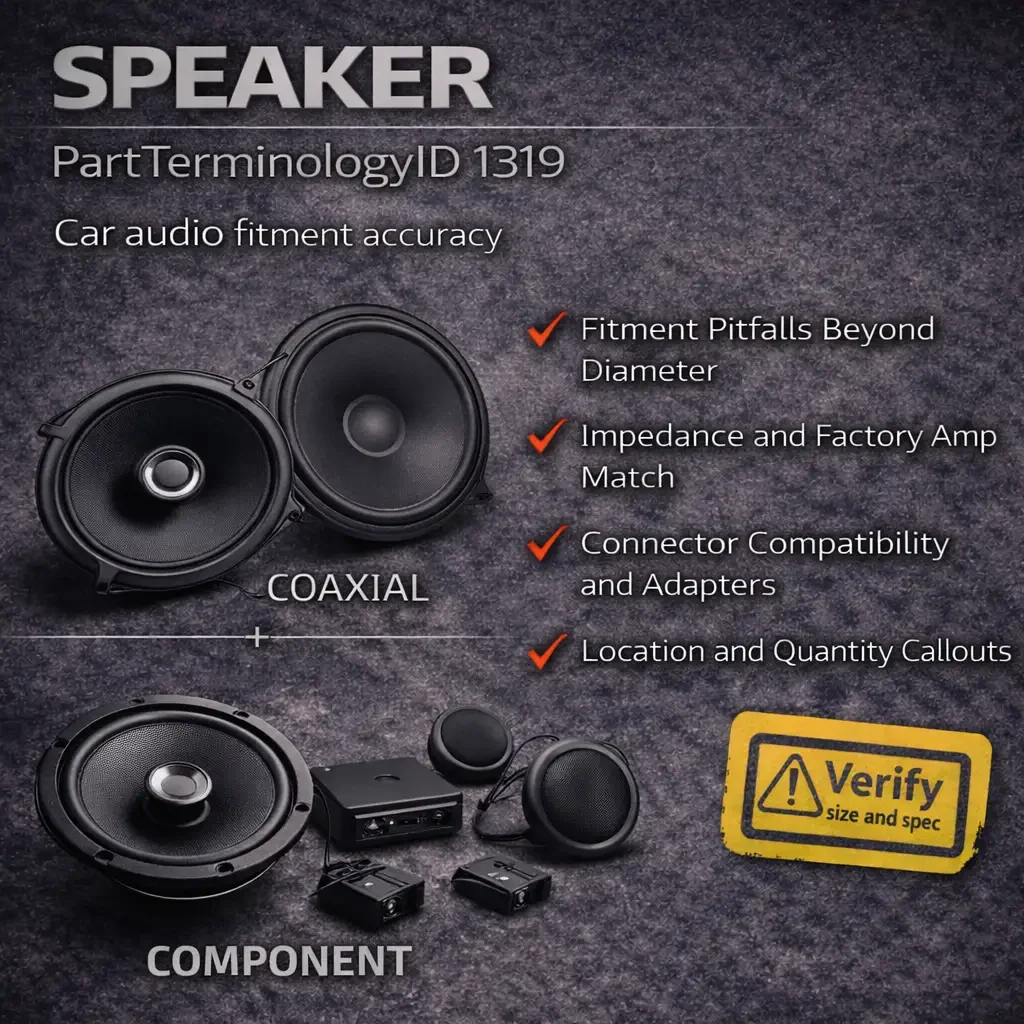
Speaker is one of the highest-volume part names in the aftermarket, and one of the most deceptive from a catalog perspective.
On the surface it looks simple. A 6.5 inch speaker fits a 6.5 inch opening. But anyone who has actually tried to install an aftermarket speaker in a vehicle knows that size alone is not fitment. Mounting depth, bolt pattern, speaker type, impedance, wiring harness compatibility, door panel clearance, window mechanism interference, factory amplifier integration, and audio system architecture all play a role. When any one of these variables is wrong, the speaker either does not physically install, does not sound right, or does not work at all.
The aftermarket speaker market spans everything from a $15 universal coaxial replacement to a $500 component set with external crossovers. The catalog challenge is that all of these products share the same PartTerminologyID, the same basic YMM fitment structure, and often the same vague product descriptions. Buyers cannot tell from most listings whether the speaker will physically fit their vehicle, electrically work with their audio system, and deliver the performance they expect.
This is exactly why PartTerminologyID 1319 needs a disciplined PartsAdvisory approach. Speaker is not just a mobile electronics accessory. It is a fitment, compatibility, and expectation management problem that creates avoidable returns at every level.
This post is built for aftermarket catalog teams, marketplace sellers, and buyers who want fewer mistakes and fewer returns.
Status in New Databases
Status in New Databases
Current: PIES 7.2 + PCdb Future: PIES 8.0 + PCdb 2.0 Status: No change
What Speaker Means in the Aftermarket
Speaker in the aftermarket refers to any audio driver designed for installation in a vehicle. This is an extremely broad product category that includes very different product types under the same part name.
In aftermarket reality, this shows up in many product forms:
Coaxial (full-range) speakers with integrated tweeter and woofer in a single basket
Component speaker systems with separate woofer, tweeter, and external crossover network
Midrange drivers (standalone mid-frequency speakers)
Tweeters (standalone high-frequency speakers)
Midbass drivers (standalone low-mid frequency speakers)
Marine-rated speakers designed for moisture and UV exposure
Powersports speakers for motorcycles, ATVs, and UTVs
Subwoofers (low-frequency speakers, sometimes cataloged separately under their own PartTerminologyID)
This is where catalogs go wrong first. Buyers use "speaker" to mean very different things:
Some mean a direct drop-in replacement for the factory speaker in a specific location
Some mean an upgrade speaker that fits the same opening but delivers better sound
Some mean a component system that requires separate tweeter mounting and crossover wiring
Some mean a subwoofer for bass
Some mean a replacement tweeter only
Some mean a Bluetooth portable speaker (not a vehicle-installed speaker at all)
If the listing title and structured data do not clearly define the speaker type, mounting location, and compatibility requirements, buyers will order the wrong product.
Why This Category Creates Fitment Problems
Speaker fitment is more complex than most catalog teams realize. A speaker that matches the diameter of the factory opening may still not fit or function correctly. Here is what drives the complexity.
Diameter is not enough
The most common aftermarket speaker sizes are 3.5 inch, 4 inch, 5.25 inch, 6 inch, 6.5 inch, 6x8 inch, and 6x9 inch. These refer to the cone diameter (round) or the oval frame dimensions. But two 6.5 inch speakers from different manufacturers can have different overall frame diameters, different mounting hole patterns, and different basket depths. A speaker that is nominally 6.5 inches may have an outer frame of 6.6 or 6.7 inches, which may not clear the factory opening in a tight door panel.
Mounting depth is the hidden killer
This is the number one physical fitment failure in the speaker category. Mounting depth refers to how far the speaker extends behind the mounting surface into the door cavity or dash space. Factory speakers are often very shallow because vehicle manufacturers design around window mechanisms, wiring harnesses, and structural elements in the door. A factory speaker may have a mounting depth of 1.5 inches. An aftermarket replacement may have a mounting depth of 2.5 inches because of a larger magnet assembly. That extra inch can mean the speaker physically hits the window mechanism, preventing the window from rolling down, or contacts the inner door skin, preventing installation entirely.
Bolt pattern and mounting tab configuration
Factory speaker mountings vary widely. Some use 3 screws, some use 4 screws. The screw spacing differs between vehicles. Some factory speakers mount on rivets rather than screws. Some use proprietary plastic clips. Aftermarket speakers typically have standard 4-tab mounting patterns, but these rarely align with factory screw holes. Speaker adapter brackets or mounting rings are often required to bridge the gap between the aftermarket speaker's mounting tabs and the vehicle's factory mounting holes.
Wiring harness and connector
Factory speakers use vehicle-specific wiring connectors. Aftermarket speakers use bare wire leads or generic spade connectors. A wiring harness adapter is required to connect the aftermarket speaker to the factory plug without cutting wires. These adapters are vehicle-specific and are often sold separately. If the listing does not make this clear, the buyer receives a speaker they cannot connect without additional parts or wire splicing.
Impedance mismatch
Factory audio systems are designed for a specific speaker impedance, typically 2 ohm, 4 ohm, or 8 ohm. Most aftermarket speakers are 4 ohm. If the factory system expects a 2 ohm load and the buyer installs a 4 ohm speaker, the volume output will be noticeably lower. If the system expects 8 ohm and the buyer installs 4 ohm, the factory amplifier may overheat or clip. Impedance is rarely mentioned in marketplace listings, but it is a critical electrical compatibility factor.
Factory amplifier and audio system integration
Many modern vehicles have factory-installed amplifiers, often located under a seat, in the trunk, or behind a panel. Some have DSP (digital signal processing) modules that send frequency-filtered signals to specific speaker locations. In these vehicles, the front door speaker may only receive midrange frequencies, with a separate factory tweeter handling highs and a factory subwoofer handling lows. If a buyer installs a full-range coaxial speaker in a location that only receives a filtered frequency band, the speaker will not produce full-range sound. This is not a defective speaker. It is a system architecture mismatch that the listing failed to communicate.
Premium factory audio systems (Bose, Harman Kardon, JBL, Bang & Olufsen, Mark Levinson, Burmester, etc.) add another layer of complexity. These systems use proprietary amplifiers, custom impedance speakers, DSP processing, and non-standard wiring that make aftermarket speaker replacement significantly more complicated than standard audio systems.
Door panel and grille clearance
Even if a speaker physically fits through the mounting hole and the depth is sufficient, the speaker may not clear the door panel when it is reinstalled. The tweeter dome on a coaxial speaker can be taller than the factory speaker's profile, preventing the door panel from seating flush. This requires either a speaker with a lower profile tweeter or a speaker spacer ring that moves the entire speaker forward.
Naming Confusion That Causes Buyer Mistakes
Speaker vs. Subwoofer
A subwoofer is technically a speaker, but in the aftermarket it is a distinct product category. Subwoofers are designed for low-frequency bass reproduction and are typically mounted in enclosures in the trunk or cargo area. Buyers who search "car speaker" and receive a subwoofer (or vice versa) will return the product.
Coaxial vs. Component
This is the most important product type distinction in the speaker category, and it is the one most often missing from marketplace listings. A coaxial speaker is an all-in-one unit with woofer and tweeter in a single basket. It drops into the factory speaker location. A component system includes a separate woofer, a separate tweeter, and an external crossover. The tweeter must be mounted separately (often in the A-pillar, dash, or upper door panel). The crossover must be wired between the source and the speakers. A buyer who expects a drop-in replacement and receives a component set with separate pieces and crossover boxes will be confused or return the product.
Speaker vs. Speaker Kit
Some listings sell individual speakers (single unit). Some sell pairs. Some sell kits that include speakers plus wiring adapters, brackets, and installation hardware. If the listing does not clearly state what is included, buyers may expect a pair and receive a single speaker, or expect installation hardware and receive bare speakers only.
Speaker vs. Speaker Adapter/Bracket
Speaker adapter brackets (also called speaker rings or mounting adapters) are vehicle-specific hardware that allows aftermarket speakers to mount in factory locations. They are not speakers. But some sellers bundle them with speakers or list them with similar titles, causing confusion.
Marine Speaker vs. Car Speaker
Marine-rated speakers are designed for moisture, salt, and UV exposure. They can be used in vehicles but are designed for boats and outdoor applications. Standard car speakers are not rated for marine use. If a listing does not distinguish between marine and automotive ratings, a buyer installing speakers in a boat may receive non-marine-rated units that will fail from moisture exposure.
The Three Fit Types You Need to Separate
Vehicle-Specific (Direct-Fit) Speakers
These are speakers sold with a specific vehicle application. They may come with or include vehicle-specific adapter brackets and wiring harnesses. The listing specifies the exact year, make, model, and speaker location (front door, rear door, rear deck, dash, A-pillar, etc.).
Best for
Factory speaker replacement
Buyers who want a drop-in upgrade with no modification
Non-technical buyers who want the simplest installation
Typical fitment needs
Year, make, model, submodel
Speaker location (front door, rear door, rear deck, dash, pillar tweeter)
Factory audio system type (standard vs. premium: Bose, JBL, Harman Kardon, etc.)
Speaker size that matches factory opening
Mounting depth that clears door cavity
Impedance that matches factory system
Adapter bracket required yes or no
Wiring harness adapter required yes or no
Common issues
Mounting depth too deep for factory cavity
Bolt pattern does not align without adapter bracket
Factory system is DSP-filtered, so full-range speaker sounds wrong
Premium factory system requires specific impedance match
Door panel does not seat flush due to tweeter dome height
Universal-Fit Speakers
Universal speakers are sold by size and specification without a vehicle-specific application. The buyer is responsible for determining whether the speaker fits their vehicle's opening, depth, and electrical requirements. These are the most common aftermarket speakers on the market.
Best for
Buyers who know their vehicle's speaker specifications
Custom audio builds
Replacement of previously installed aftermarket speakers
Professional installers who select speakers by specification
Typical fitment needs
Speaker diameter or oval dimensions
Mounting depth
Mounting hole pattern
Impedance
Power handling (RMS and peak)
Sensitivity rating
Common issues
Buyer assumes the speaker fits because the diameter matches, but mounting depth is too deep
Buyer does not check impedance compatibility with factory system
Buyer does not realize an adapter bracket and wiring harness are needed
Buyer installs a 4 ohm speaker in a 2 ohm factory system and volume is noticeably lower
Component Speaker Systems
Component systems are sold as multi-piece kits: separate woofer, separate tweeter, and external crossover network. They require more complex installation than coaxial speakers.
Best for
Audiophile and enthusiast buyers
Buyers who want superior sound staging and imaging
Custom audio installations with dedicated amplification
Professional installations
Typical fitment needs
Woofer size and mounting depth (same as coaxial considerations)
Tweeter mounting location and method (surface mount, flush mount, A-pillar, dash)
Crossover mounting location and space requirements
Wiring routing from crossover to woofer and tweeter
Power handling matched to amplifier output
Impedance matched to amplifier
Common issues
Buyer expected a single drop-in speaker and received a multi-piece system
Buyer does not know where to mount the tweeter
Buyer does not know how to wire the crossover
Installation complexity exceeds buyer's skill level
Tweeter mounting requires drilling or modification the buyer did not expect
Factory Audio System Type Matters More Than Sellers Realize
This deserves its own section because it is the root cause of a large category of returns that are not physical fitment failures. The speaker fits the hole. It connects to the wiring. But it does not sound right.
Standard factory audio systems
Standard (base) factory audio systems are the simplest to upgrade. They typically send a full-range signal to each speaker location, use standard impedance speakers (usually 4 ohm), and have no external amplifier. Aftermarket coaxial speakers are designed as drop-in replacements for these systems.
Premium factory audio systems
Premium factory audio systems (Bose, JBL, Harman Kardon, Bang & Olufsen, Mark Levinson, Burmester, Fender, Meridian, etc.) are a completely different situation:
They use a dedicated amplifier with multiple channels, sometimes 8, 12, or more
They use DSP processing that sends filtered frequency bands to specific speaker locations
They may use non-standard impedance speakers (2 ohm is common in Bose systems)
They may use proprietary wiring and connectors
Some locations receive only midrange or only high-frequency signals, not full-range audio
Replacing a speaker in a premium system with a standard 4 ohm full-range aftermarket coaxial often results in:
Lower volume (impedance mismatch)
Thin or unbalanced sound (frequency-filtered signal to a full-range speaker)
Distortion at higher volumes (amplifier not matched to new speaker's characteristics)
Total silence in some locations (proprietary amplifier does not recognize the new speaker)
This is not a defective speaker. The listing simply failed to communicate that the buyer's premium audio system requires a different product or additional integration components.
Catalog best practice:
Always include the factory audio system type as a fitment qualifier: "Standard Audio" vs. "Premium Audio (Bose, JBL, etc.)"
If the speaker is designed for premium system replacement, state it clearly
If the speaker is NOT compatible with a premium system, add a fitment exclusion
Note when a DSP adapter or amplifier bypass module is required for proper function
Top Return Causes in Speaker
1) Mounting depth too deep
The speaker physically does not fit because it contacts the window mechanism, inner door skin, or other obstruction behind the mounting surface.
Prevention: List mounting depth clearly. Add a note: "Verify factory mounting cavity depth before ordering." Include a dimensional diagram.
2) Bolt pattern mismatch
The speaker's mounting tabs do not align with the factory screw holes.
Prevention: State whether adapter brackets are included or required. Specify factory bolt pattern compatibility. Include vehicle-specific bracket recommendations.
3) Wiring connector incompatibility
The speaker cannot connect to the factory wiring without an adapter harness.
Prevention: State whether a wiring harness adapter is included. List compatible adapter part numbers. Note if wire splicing is required.
4) Impedance mismatch
The speaker's impedance does not match the factory system, resulting in low volume, distortion, or amplifier issues.
Prevention: List speaker impedance prominently. Note the factory system's expected impedance. Flag premium audio systems that use non-standard impedance.
5) Premium audio system incompatibility
The speaker fits the hole but does not sound right because the factory system sends filtered frequencies or uses proprietary amplification.
Prevention: Add factory audio system type as a fitment qualifier. Include a note about premium system limitations. Recommend integration components where applicable.
6) Product type confusion (coaxial vs. component)
Buyer expected a single drop-in speaker and received a multi-piece component system, or vice versa.
Prevention: State speaker type clearly in the title: "Coaxial" or "Component System." Show all included pieces in product images. Note installation complexity for component systems.
7) Single speaker vs. pair expectation
Buyer expected a pair and received one speaker, or expected installation hardware and received bare speakers.
Prevention: State quantity in the title: "Pair" or "Single." List all included items. Photograph package contents.
Compatibility Checklist for Buyers
1) Confirm the exact speaker location
Front door (left, right, or both)
Rear door (left, right, or both)
Rear deck
Dash
A-pillar or sail panel (tweeter location)
Kick panel
Cargo area or subwoofer location
2) Confirm factory speaker size
Measure the factory speaker diameter or oval dimensions
Do not rely solely on the vehicle manual; measure the actual opening
Common sizes: 3.5, 4, 5.25, 6, 6.5, 6x8, 6x9 inch
3) Measure mounting depth
Measure from the mounting surface to the nearest obstruction behind the speaker (window mechanism, inner door skin, wiring bundle)
Compare to the aftermarket speaker's total depth specification
If the aftermarket speaker is deeper, a spacer ring may be required
4) Check bolt pattern
Count the factory mounting screws and measure their spacing
Determine if an adapter bracket is needed for the aftermarket speaker
5) Check factory audio system type
Standard audio or premium audio (Bose, JBL, Harman Kardon, etc.)
If premium, determine whether the factory amplifier and DSP are compatible with the aftermarket speaker
Determine if a DSP adapter or amplifier bypass is required
6) Confirm impedance
Check factory speaker impedance (usually printed on the factory speaker or in the vehicle service manual)
Match aftermarket speaker impedance to factory system requirements
Most aftermarket speakers are 4 ohm. Many factory systems expect 4 ohm. Some premium systems use 2 ohm.
7) Confirm wiring
Check if a wiring harness adapter is included or required
Determine factory connector type
Confirm positive and negative polarity
8) Confirm what is included
Single speaker or pair
Adapter brackets included yes or no
Wiring harness adapter included yes or no
Grille or cover included yes or no
Crossover included (component systems)
Tweeter included (component systems)
Mounting hardware included yes or no
9) Confirm speaker type
Coaxial (drop-in, single unit, all-in-one)
Component (separate woofer, tweeter, and crossover)
Midrange or midbass driver (single driver, no tweeter)
Tweeter only
10) For marine or powersports applications, confirm environmental rating
Marine-rated (moisture, salt, UV resistant)
Standard automotive (not rated for outdoor or marine use)
Catalog Checklist for Attributes and Structured Data
Core taxonomy and naming
Terminology Name: Speaker
Speaker type attribute required: Coaxial, Component System, Midrange, Tweeter, Midbass, Subwoofer (if not cataloged separately)
Quantity attribute required: Single, Pair, Set
Application environment: Automotive, Marine, Powersports
Fitment structure for vehicle-specific products
Year
Make
Model
Submodel
Speaker location (front door, rear door, rear deck, dash, A-pillar, kick panel)
Factory audio system type (Standard, Bose, JBL, Harman Kardon, etc.)
Factory speaker size in that location
Adapter bracket included or required
Wiring harness adapter included or required
Physical specifications
Speaker diameter or oval dimensions (inches and mm)
Mounting depth (critical: measure from mounting flange to back of magnet)
Cutout diameter (the hole size needed in the mounting surface)
Mounting hole pattern (bolt spacing)
Overall frame diameter (outer edge of basket)
Weight
Electrical specifications
Impedance (ohms)
RMS power handling (watts, continuous)
Peak power handling (watts, maximum)
Sensitivity (dB at 1 watt / 1 meter)
Frequency response range (Hz to kHz)
Construction and material attributes
Woofer cone material (polypropylene, paper, Kevlar, woven fiber, metal, etc.)
Tweeter type (dome, cone, super tweeter)
Tweeter material (silk dome, aluminum dome, titanium dome, Mylar, etc.)
Surround material (rubber, foam, butyl rubber)
Magnet type (ferrite, neodymium)
Basket material (stamped steel, cast aluminum)
Marine-rated yes or no
UV-resistant yes or no
Package content
Quantity (single, pair, set)
Adapter brackets included yes or no
Wiring harness adapters included yes or no
Grilles included yes or no
Crossover network included yes or no (component systems)
Tweeters included yes or no (component systems)
Mounting hardware (screws, clips) included yes or no
Speaker wire included yes or no
Image requirements
Main hero image (speaker front view)
Rear view showing magnet and depth
Side profile showing total depth
Dimensional callout diagram
Mounting hole pattern diagram
All included components laid out (especially for component systems)
Installed view in vehicle (if vehicle-specific)
Crossover and tweeter detail (component systems)
Package contents photo
Common Buyer Scenarios
Scenario 1: Buyer wants a simple factory speaker upgrade
The buyer has a 2019 Honda Civic with standard audio. They search "Honda Civic speakers" and order a 6.5 inch coaxial set.
What goes wrong:
The speakers arrive without adapter brackets or wiring harness adapters
The mounting holes do not align with the factory holes
The buyer cannot connect the bare wire leads to the factory plug
The buyer returns the speakers as "does not fit"
What helps:
Listing clearly states "adapter bracket and wiring harness adapter sold separately" or "included"
Vehicle-specific installation notes
Links to compatible adapter bracket and harness part numbers
Scenario 2: Buyer has a Bose-equipped vehicle
The buyer has a 2021 Chevy Silverado with the Bose premium audio package. They order standard 4 ohm coaxial speakers to replace the factory door speakers.
What goes wrong:
The Bose system uses a dedicated amplifier with DSP processing
The factory door speaker location receives a filtered midrange signal, not full-range audio
The new speakers sound thin and unbalanced
The buyer blames the speakers and returns them
What helps:
Fitment qualifier: "Standard Audio Only. Not recommended for vehicles with Bose, JBL, or other premium factory audio systems without additional integration."
A note explaining that premium systems require impedance matching and possibly a DSP adapter
Separate listings or product lines for premium system replacement speakers
Scenario 3: Buyer confuses coaxial and component
The buyer wants a simple speaker upgrade and orders a "6.5 inch speaker set." The product is a component system with separate woofers, tweeters, and crossovers.
What goes wrong:
The buyer opens the box and sees multiple pieces instead of one speaker unit
They do not know where to mount the tweeters or how to wire the crossovers
They return the product as "too complicated" or "wrong product"
What helps:
Speaker type in the title: "Coaxial Full-Range" or "Component System"
Product images showing all included pieces
Installation complexity note: "Component system requires separate tweeter mounting and crossover wiring. Recommended for experienced installers."
Scenario 4: Mounting depth prevents installation
The buyer orders a 6.5 inch speaker for their front door. The speaker's mounting depth is 2.75 inches. The factory door cavity is only 2 inches deep. The speaker contacts the window mechanism.
What goes wrong:
The speaker cannot be installed without a spacer ring
Even with a spacer, the door panel may not seat flush
The buyer returns the speaker
What helps:
Mounting depth listed prominently in specifications
A note: "Verify factory mounting cavity depth before ordering"
Recommended spacer ring part number if applicable
A vehicle-specific fitment note: "May require spacer ring for [specific vehicles]"
Scenario 5: Marketplace seller publishes speaker data without enrichment
The seller loads hundreds of speaker SKUs with titles like "6.5 Car Speaker" and no vehicle-specific fitment, no impedance specification, no mounting depth, and no speaker type designation.
What goes wrong:
Buyer orders based on size alone
Speaker does not fit, does not sound right, or does not connect
Return rate climbs
Negative reviews citing fitment and compatibility issues
What helps:
Enrichment rules: speaker type, impedance, mounting depth, and RMS power in every listing
Vehicle-specific fitment notes or compatible vehicle list
"What is included" section for every listing
Adapter and harness recommendations
FAQ
What size speakers fit my car?
Speaker size varies by vehicle and location. Front doors commonly use 5.25, 6, or 6.5 inch speakers. Rear doors use similar sizes. Rear decks often use 6x9 inch speakers. Dash locations use 3.5 or 4 inch speakers. Use a vehicle fit guide or measure your factory speakers to confirm.
Do I need adapter brackets to install aftermarket speakers?
In most cases, yes. Factory mounting holes rarely align with aftermarket speaker mounting tabs. Vehicle-specific adapter brackets bridge the gap. Some speaker kits include brackets; many do not.
Do I need a wiring harness adapter?
Usually, yes. Factory speaker connectors are vehicle-specific. Aftermarket speakers use bare wire or generic connectors. A wiring harness adapter connects the two without cutting factory wires.
What is the difference between coaxial and component speakers?
Coaxial speakers combine the woofer and tweeter in one unit for simple installation. Component systems separate the woofer, tweeter, and crossover for better sound quality but require more complex installation.
Will aftermarket speakers work with my Bose or JBL factory system?
Not always. Premium factory systems use proprietary amplifiers, DSP processing, and sometimes non-standard impedance. Replacing speakers without addressing these factors can result in low volume, thin sound, or no output. Check compatibility before ordering.
What is mounting depth and why does it matter?
Mounting depth is how far the speaker extends behind the mounting surface. If the speaker is too deep for the door cavity, it will contact the window mechanism or inner door skin and cannot be installed.
Are car speakers and marine speakers the same?
No. Marine speakers are rated for moisture, salt spray, and UV exposure. Standard car speakers are not designed for these conditions and will fail in marine applications.
Do I need an amplifier for aftermarket speakers?
Not necessarily for coaxial speakers replacing factory units in a standard audio system. Factory head units produce enough power for moderate listening. However, an amplifier will improve clarity, dynamics, and volume, especially for component systems and higher-end speakers.
Final Take for Aftermarket Teams
Speaker (PartTerminologyID 1319) is a massive category where size alone is not fitment. Physical diameter, mounting depth, bolt pattern, impedance, wiring compatibility, and factory audio system type all determine whether a speaker actually works in a given vehicle.
The catalog teams that win in this category are the ones that:
Separate coaxial, component, midrange, and tweeter products clearly in every title
List mounting depth prominently, not buried in a spec table
Include factory audio system type (standard vs. premium) as a fitment qualifier
State impedance clearly for every SKU
Specify what is included (single vs. pair, brackets, harnesses, grilles, crossovers)
Flag premium audio system incompatibilities explicitly
Recommend adapter brackets and wiring harness adapters by vehicle application
If your team gets Speaker right, you are building a catalog discipline that applies to every other mobile electronics category: head units, amplifiers, subwoofers, and integration modules.