
Privacy Curtain (PartTerminologyID 1308): Fitment Precision, Naming Confusion, and Buyer Accuracy
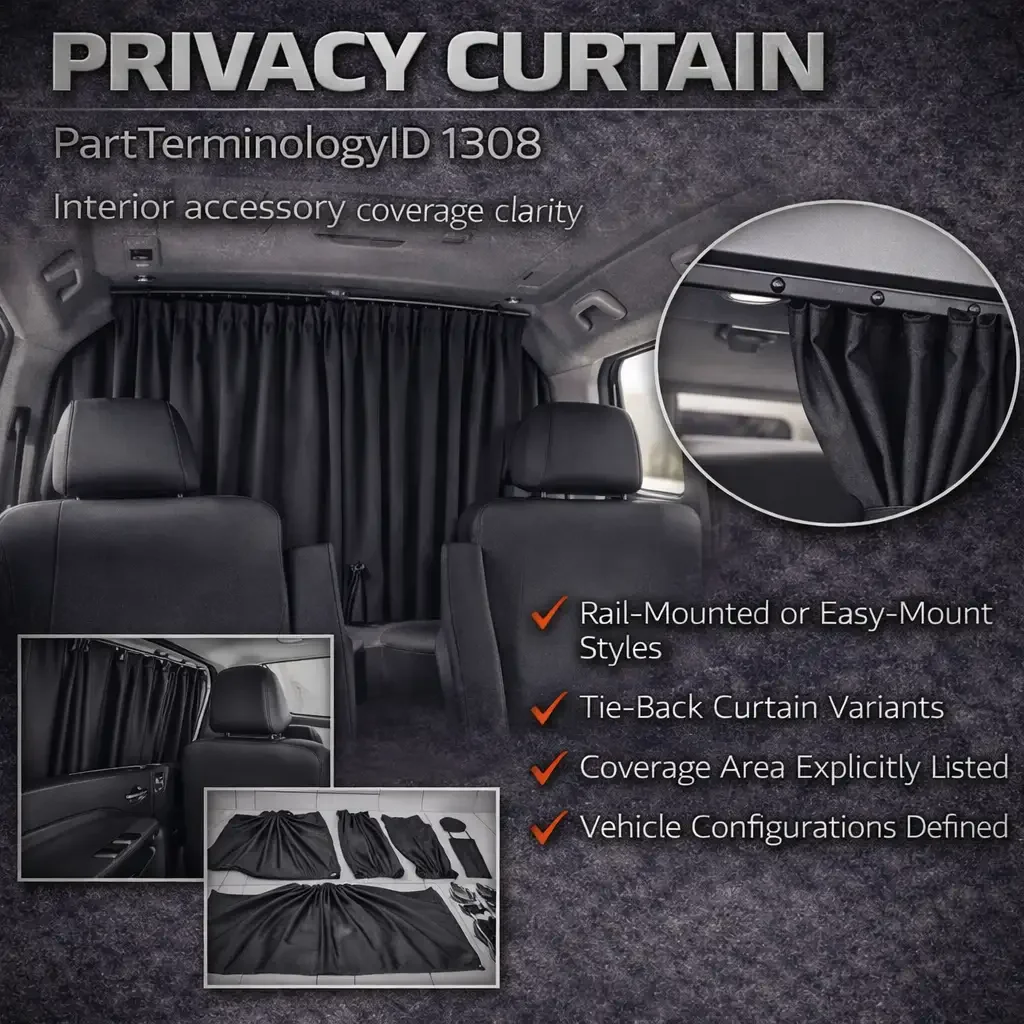
Written by Arthur Simitian | PartsAdvisory
Privacy Curtain is one of the most misnamed, mislisted, and misunderstood accessory categories in the aftermarket, and the naming problem starts at the terminology level.
Most buyers never search "privacy curtain." They search "cargo cover," "trunk cover," "retractable cargo shade," or "tonneau cover." But in ACES and PCdb, the formal part name is Privacy Curtain, PartTerminologyID 1308. That disconnect between industry taxonomy and buyer language is the root of most listing and return problems in this category.
The product itself is simple: a retractable or removable panel that covers the cargo area behind the rear seats in SUVs, crossovers, wagons, and some hatchbacks. It hides cargo from view through the rear glass, providing security and a cleaner interior appearance.
The catalog challenge is not simple. Privacy Curtain fitment is vehicle-specific, generation-specific, and often trim-specific. Mounting points, housing width, retraction mechanisms, and attachment hooks vary not just between makes and models but between body style refreshes within the same nameplate. A cargo cover that fits a 2017 to 2021 Honda CR-V will not fit a 2022 to 2025 CR-V, even though the model name is the same.
This post is built for aftermarket catalog teams, marketplace sellers, and buyers who want fewer mistakes and fewer returns.
Status in New Databases
Status in New Databases
Current: PIES 7.2 + PCdb Future: PIES 8.0 + PCdb 2.0 Status: No change
What Privacy Curtain Means in the Aftermarket
Privacy Curtain in the aftermarket refers to the retractable or removable cover that spans the cargo area of SUVs, crossovers, wagons, and hatchbacks. The product sits behind the rear seat row and extends across the cargo bay, blocking the view through the rear window and liftgate glass.
In aftermarket reality, this shows up in several product forms:
OE-style retractable cargo covers with spring-loaded roller housing
Rigid or semi-rigid removable cargo shelf panels
Soft fabric pull-out covers
Non-retractable snap-in or hook-in cargo shields
Universal or semi-universal cargo area covers
Third-row delete covers for 3-row SUVs with the third row folded or removed
This is where catalogs go wrong first. Buyers use many different terms to find this product:
Cargo cover
Trunk cover
Cargo shade
Cargo security cover
Rear trunk privacy screen
Tonneau cover (interior)
Luggage compartment cover
Retractable cargo blind
Cargo area shade
Parcel shelf
If the listing title and structured data use only "Privacy Curtain" without these search-friendly synonyms, the product will not appear in buyer searches. Conversely, if the listing uses too many generic terms without clarifying the exact product form, buyers will order the wrong type.
Why This Category Creates Fitment Problems
Privacy Curtain is not a high-SKU-count category the way Floor Carpet is. The SKU explosion risk is lower. The fitment precision risk is higher.
Every Privacy Curtain is designed to fit a specific cargo bay width, a specific set of mounting hooks or slots, and a specific housing cradle location. There is very little tolerance for error. A cover that is 5mm too wide will not snap into the mounting points. A cover with hooks spaced 2mm differently will not seat properly. A cover designed for a pre-facelift cargo bay may not clear the revised trim panels of a post-facelift vehicle.
Here is what drives fitment complexity in this category.
Generation and facelift splits
This is the number one fitment issue. SUVs and crossovers receive mid-cycle refreshes that change the cargo bay trim, liftgate inner panel shape, and mounting point locations. The Privacy Curtain housing mounts to specific attachment points on either side of the cargo bay. When those points move even slightly during a facelift, the pre-facelift cover will not fit.
5-seat vs. 7-seat (or 6-seat) configurations
Many crossovers and SUVs are offered with optional third-row seating. The cargo bay behind a folded third row is a different depth and sometimes a different width than the cargo bay behind a second row in a 5-seat configuration. Some vehicles use different D-pillar trim and different mounting points depending on seating configuration. A Privacy Curtain for the 5-seat version may not fit the 7-seat version of the same vehicle.
Power liftgate vs. manual liftgate
Some vehicles with power liftgates have different interior liftgate trim panels than manual liftgate versions. This can affect the rear mounting slot or hook location for the Privacy Curtain.
Trim-level specific cargo bay differences
Higher trim levels sometimes include different cargo bay finishes, cargo management systems, or underfloor storage configurations that change the position or type of Privacy Curtain mounting hardware.
Subwoofer or audio system packaging
Some vehicles with premium audio packages include a subwoofer in the cargo area side panel. This can change the interior trim shape and potentially interfere with Privacy Curtain housing fitment.
Naming Confusion That Causes Buyer Mistakes
Privacy Curtain suffers from a fundamental naming disconnect between industry terminology and buyer language. This creates problems at every level: search, listing, purchase, and return.
Privacy Curtain vs. Cargo Cover
This is the biggest confusion point. In ACES and PCdb, the part is called Privacy Curtain. In buyer language, almost everyone calls it a "cargo cover." Listings that only use the formal ACES name will miss the vast majority of organic search traffic. Listings should use "Privacy Curtain" in structured data and ACES mapping, but "Cargo Cover" prominently in the title and description for buyer discoverability.
Privacy Curtain vs. Cargo Net
A cargo net is an open mesh barrier that prevents items from shifting forward during braking. A Privacy Curtain is a solid or semi-opaque cover that hides cargo from external view. Buyers sometimes confuse these, especially when listings use vague terms like "cargo barrier" or "cargo security."
Privacy Curtain vs. Cargo Liner or Cargo Mat
A cargo liner or cargo mat protects the cargo floor surface. A Privacy Curtain covers the cargo area from above. These are completely different product categories, but vague titles like "cargo area cover" can lead buyers to expect a floor liner when they are actually purchasing a retractable shade.
Privacy Curtain vs. Parcel Shelf
In European and some Asian markets, the term "parcel shelf" is commonly used for what North American catalogs call a Privacy Curtain. Some products listed as "parcel shelf" are rigid shelf panels rather than retractable covers. Buyers importing vehicles or parts across markets may encounter this terminology difference.
Privacy Curtain vs. Tonneau Cover (Interior)
Some sellers and OEMs use "tonneau cover" to describe the interior cargo cover. In the broader aftermarket, "tonneau cover" almost always refers to an exterior truck bed cover. Using "tonneau" in an interior cargo cover listing can attract truck owners who are searching for bed covers, leading to confusion and returns.
The Three Fit Types You Need to Separate
Direct-Fit Privacy Curtain
This is the most common product form. It is designed for a specific vehicle application with exact-match mounting points, housing width, and retraction mechanism.
Best for
OE replacement
Buyers who lost or damaged their factory cargo cover
Buyers of used vehicles that came without the original cover
Typical fitment needs
Exact year range (watch for generation and facelift splits)
Make and model
Body style (SUV, wagon, hatchback)
Seating configuration (5-seat vs. 7-seat vs. 6-seat)
Trim level where cargo bay differences exist
Power liftgate vs. manual where relevant
Common issues
Wrong generation or facelift year range
5-seat cover ordered for a 7-seat vehicle
Mounting hooks do not match revised trim panels
Color mismatch between cover fabric and cargo bay trim
Semi-Universal Privacy Curtain
Semi-universal products are designed to fit a range of vehicles within a size class but may require minor adjustment or may not achieve a factory-finish fit.
Best for
Buyers who cannot find a direct-fit option for their vehicle
Older vehicles where OE-style covers are discontinued
Budget-conscious buyers who want basic cargo concealment
Typical fitment needs
Cargo bay width range
Mounting method compatibility
Vehicle class guidance
Common issues
Buyer expected factory-finish fit
Mounting points do not align
Cover sags or does not retract smoothly
Width is slightly too narrow or too wide
Universal Cargo Cover
Universal products provide basic cargo concealment without vehicle-specific fitment. They typically attach with straps, clips, or hook-and-loop fasteners rather than integrated mounting points.
Best for
Temporary cargo concealment
Vehicles with no direct-fit or semi-universal option available
Budget or temporary solutions
Typical fitment needs
Cargo bay dimensions
Attachment method
Material preference
Common issues
Does not look or function like an OE cargo cover
Does not retract
Sags or shifts during driving
Buyer expected an integrated retractable cover
The catalog rule is the same as always: never let a universal or semi-universal SKU inherit the same buyer messaging as a direct-fit OE-style cargo cover.
Color and Material Are Not Small Details
For Privacy Curtain, color and material matter more than sellers typically realize.
Color issues that cause returns
OE cargo covers are usually color-matched to the cargo bay trim (black, gray, tan, espresso, etc.). Aftermarket replacements that are "close but not exact" in shade will generate returns from buyers who care about interior appearance.
"Black" can mean jet black, charcoal black, or dark gray depending on the manufacturer. These are not the same.
Photos taken under warm lighting make dark gray look like black, leading to color expectation mismatch.
Material issues that cause returns
OE covers are typically a woven fabric on a rigid or semi-rigid backing. Cheap aftermarket alternatives may use thinner fabric, flimsier backing, or a material that looks visibly different from OE.
Retraction quality matters. An OE cover retracts smoothly with spring tension. A low-quality aftermarket cover may retract unevenly, jam, or not hold tension.
Noise is an issue. Poorly fitted or low-quality covers rattle or vibrate while driving, especially on rough roads.
Top Return Causes in Privacy Curtain
1) Wrong generation or facelift year range
The cover fits the model name but not the specific body generation. Mounting points do not align.
Prevention
Use generation identifiers in fitment notes
Add "new body style" or "facelift" qualifiers where applicable
Include mounting point images or diagrams when possible
2) Wrong seating configuration
A 5-seat cover was ordered for a 7-seat vehicle, or vice versa.
Prevention
Add seating configuration as a fitment qualifier
Include "5-seat only" or "7-seat only" in the title or first bullet
Add a fitment exclusion note for the other configuration
3) Mounting hardware mismatch
The cover fabric and housing are correct, but the end hooks or clips do not match the vehicle's mounting slots.
Prevention
Photograph the mounting hardware
Include mounting point dimensions or style in specs
Note if mounting hardware is included or must be reused from the original cover
4) Color mismatch
The cover is the right fit but the wrong shade.
Prevention
Use OE color names where known
Include real-world color photos
Add a note that aftermarket color may differ slightly from factory
5) Product type confusion
Buyer expected a retractable cover and received a non-retractable shelf or mat.
Prevention
State product form clearly in the title: "Retractable Cargo Cover" or "Rigid Cargo Shelf"
Use installed photos showing the product in position
First line of description should clarify what the product is
Compatibility Checklist for Buyers
1) Confirm the exact product type
Retractable cargo cover with spring-loaded housing
Rigid or semi-rigid removable cargo shelf
Soft non-retractable cargo cover
Universal strap-on cargo concealment cover
2) Confirm full vehicle details
Year (exact model year, not purchase year)
Make
Model
Submodel or trim if cargo bay differences exist
Body style
3) Confirm seating configuration
5-seat, 6-seat, or 7-seat
Third row present or removed/deleted
4) Check generation and facelift status
Confirm whether the vehicle is pre-facelift or post-facelift within the model year range
Check if the listing specifies "new body style" or generation identifiers
5) Verify mounting method
Does the product use the same hook, clip, or slot system as the vehicle's factory mounting points?
Is mounting hardware included, or must the original hardware be reused?
6) Confirm color
Match the listing color to the vehicle's cargo bay trim color
If in doubt, contact the seller with the vehicle's interior color code
7) Check what is included
Cover only
Cover plus housing
Cover plus mounting hardware
Cover plus side brackets or cradle
8) Review retraction quality expectations
OE-style spring-loaded retraction
Manual pull-out with no retraction
Semi-rigid shelf with no retraction mechanism
Catalog Checklist for Attributes and Structured Data
Core taxonomy and naming
Terminology Name: Privacy Curtain
Buyer-facing title should include "Cargo Cover" for search discoverability
Product form attribute required: Retractable Cover, Rigid Shelf, Soft Cover, Universal Cover
Controlled synonyms for search: cargo cover, trunk cover, cargo shade, cargo security cover, retractable cargo blind, luggage compartment cover
Fitment structure for direct-fit products
Year (with generation and facelift awareness)
Make
Model
Submodel
Body style
Seating configuration (5-seat, 6-seat, 7-seat)
Trim level where cargo bay differs
Power liftgate vs. manual where relevant
Mounting point type or style
Notes for audio system packaging interference
Dimensions
Housing width (critical for fitment)
Cover depth when extended
Housing diameter
Overall weight
Material attributes
Cover fabric type
Cover color
Backing material
Housing material (plastic, aluminum, composite)
Retraction mechanism type (spring-loaded, manual, none)
Package content
Cover included yes or no
Housing included yes or no
Mounting hardware included yes or no
Side brackets or cradle included yes or no
Installation instructions included yes or no
Image requirements
Main hero image (cover extended in vehicle)
Cover retracted in housing
Mounting hardware close-up
Side hook or clip detail
Color reference image in neutral lighting
Dimensional callout image
Package contents image
Common Buyer Scenarios
Scenario 1: Used vehicle buyer replacing missing cargo cover
The buyer purchased a used SUV that did not include the factory cargo cover. They search "cargo cover" plus their vehicle name.
What goes wrong:
They order a cover for the wrong generation because the listing year range spans two generations
They order a 5-seat version for their 7-seat vehicle
They order a universal cover expecting OE fit
What helps:
Clear generation callouts in the listing
Seating configuration in the title or first bullet
"OE-Style Direct-Fit" wording for vehicle-specific products
"Universal" clearly labeled on non-vehicle-specific products
Scenario 2: Marketplace seller publishes supplier feed without enrichment
The seller loads hundreds of cargo cover SKUs with titles like "Privacy Curtain Black" and basic YMM fitment.
What goes wrong:
Buyers do not find the listing because nobody searches "privacy curtain"
Buyers who do find it cannot tell if it fits their 5-seat or 7-seat configuration
Returns spike because facelift splits are not noted
What helps:
Title enrichment with "Cargo Cover" and vehicle name
Seating configuration and generation qualifiers added before publication
Product form (retractable, rigid, universal) in the title
Scenario 3: Buyer confuses cargo cover with cargo net or cargo mat
The buyer searches "cargo cover" and clicks a Privacy Curtain listing, but they actually wanted a cargo floor mat or cargo net.
What goes wrong:
The product arrives and is nothing like what the buyer expected
The return is classified as "not as described" even though the listing was technically accurate
What helps:
First line of description: "This is a retractable cargo privacy cover that mounts behind the rear seats, not a cargo floor mat or cargo net."
Installed product photos showing the cover in position
Category breadcrumbs and filters that separate cargo covers from cargo mats and cargo nets
Scenario 4: Buyer needs a cover for a third-row-delete configuration
The buyer has a 7-seat SUV with the third row permanently folded or removed. They want a cargo cover that spans the larger open area behind the second row.
What goes wrong:
They order the standard 7-seat cover, which mounts behind the third row and does not span the full area
They order the 5-seat cover, which may not have the right mounting points for the 7-seat body
What helps:
Clear documentation of which cover fits which configuration
Notes about whether a third-row-delete configuration requires a different cover or adapter brackets
Explicit fitment exclusions
FAQ
Is a Privacy Curtain the same as a cargo cover?
Yes. Privacy Curtain is the formal ACES and PCdb terminology. In everyday buyer language, this product is almost always called a cargo cover, trunk cover, or cargo shade.
Will a cargo cover from a pre-facelift model fit a post-facelift version of the same vehicle?
Usually not. Mid-cycle refreshes often change the cargo bay trim panels and mounting point locations. Always confirm the exact year range and generation.
Does seating configuration matter for Privacy Curtain fitment?
Yes. 5-seat, 6-seat, and 7-seat versions of the same vehicle often have different cargo bay dimensions and different mounting point locations for the Privacy Curtain.
What is the difference between a retractable cargo cover and a rigid cargo shelf?
A retractable cover uses a spring-loaded roller housing and a fabric cover that pulls out and retracts. A rigid cargo shelf is a solid or semi-rigid panel that sits on mounting points and does not retract.
Are aftermarket cargo covers the same quality as OE?
Quality varies widely. Some aftermarket covers closely match OE fit, finish, and retraction quality. Others use thinner materials, weaker springs, and less precise mounting hardware. Check reviews and product details before ordering.
Can I use a universal cargo cover if no direct-fit option exists?
Yes, but expectations should be set correctly. A universal cover will not look or function like a factory cover. It will typically attach with straps or hook-and-loop rather than integrated mounting points.
Final Take for Aftermarket Teams
Privacy Curtain (PartTerminologyID 1308) is a deceptively simple category that creates disproportionate return problems because of naming confusion, generation splits, and seating configuration mismatches.
The winning approach is practical:
Use "Cargo Cover" in buyer-facing titles and "Privacy Curtain" in ACES structured data
Separate direct-fit, semi-universal, and universal products clearly
Add seating configuration (5-seat, 6-seat, 7-seat) as a primary fitment qualifier
Flag generation and facelift splits in year ranges
Clarify product form (retractable, rigid, universal) in every listing title
Treat color as a fitment-adjacent attribute, not an afterthought
Include mounting hardware details and images
If your team gets Privacy Curtain right, you are building a catalog discipline that applies to every other vehicle-specific interior accessory category too.