
Night Vision Camera (PartTerminologyID 1306): Telematics Vision Sensor Fit and Catalog Precision
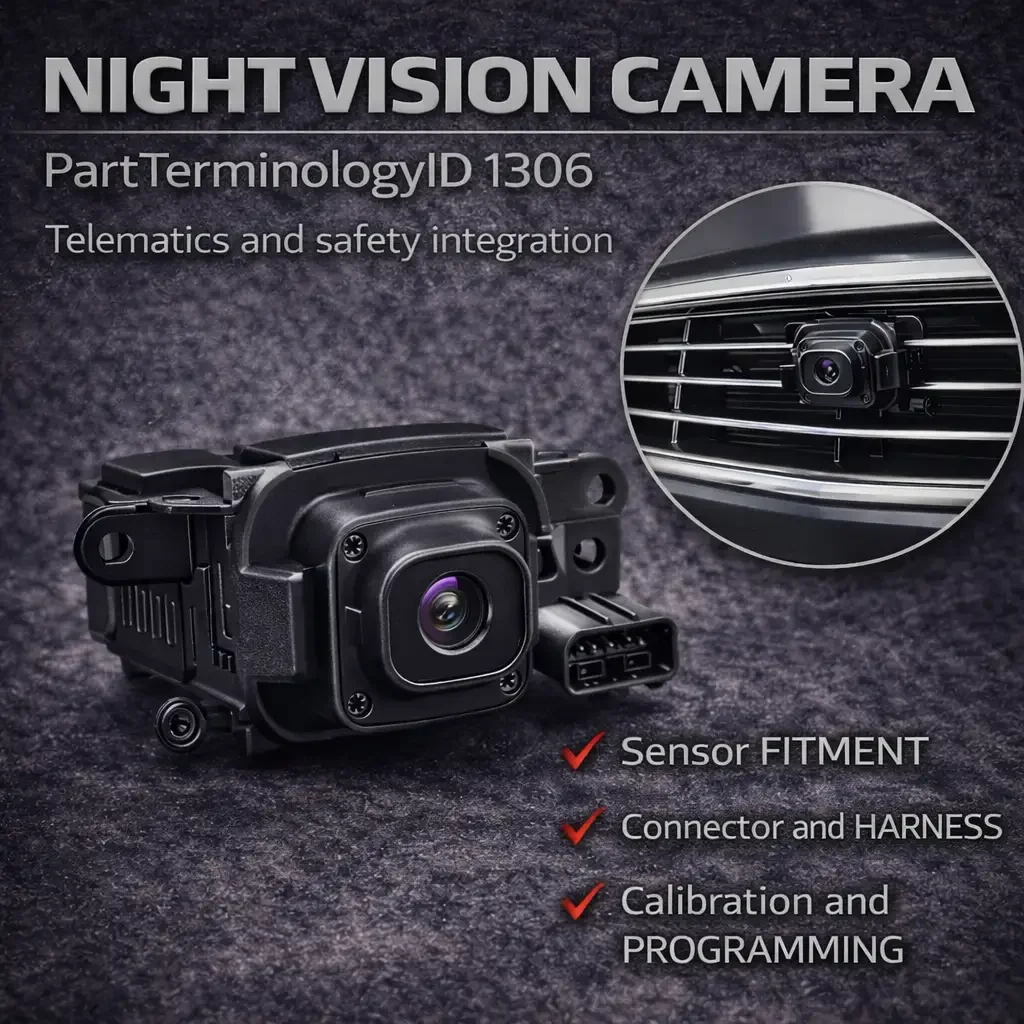
Night Vision Camera is a specialized automotive part that belongs at the intersection of safety systems, driver assistance, and telematics. Unlike most “accessory” categories, this part works with vehicle electronics, wiring, and sensor modules. That creates a catalog challenge because buyers and sellers often conflate it with other camera types (backup camera, surround view camera, dash camera, forward-facing camera, etc) - with predictable return and compatibility problems.
PartTerminologyID 1306 Night Vision Camera is not just a generic camera. It is specifically designed for night vision systems that augment driver sight in low light, often by projecting infrared or thermal imagery to the instrument cluster or infotainment display. Its integration and fitment must reflect system compatibility, wiring interface, calibration requirements, and vehicle electronics architecture.
This post is written for aftermarket catalog teams, marketplace sellers, and buyers who want better accuracy, fewer returns, and clearer listings.
Status in New Databases
Status in New Databases
Current: PIES 7.2 + PCdb
Future: PIES 8.0 + PCdb 2.0
Status: No change
What a Night Vision Camera Actually Is
A Night Vision Camera is a sensor module that captures low-light visual information and feeds it into a vehicle’s telematics or driver information system to enhance visibility in dark conditions. It may use:
infrared illumination
thermal imaging elements
near-infrared LED arrays
dedicated sensor chips
This is a component of a larger system, not a standalone accessory that sits in the cabin pocket. It typically interfaces with vehicle wiring, control modules, display units, and in some cases radar and ADAS (Advanced Driver Assistance System) subsystems.
Because of that, its catalog handling must treat it more like a vehicle system component than a simple plug-and-play gadget.
Naming Confusion That Causes Wrong Orders
This category overlaps with many camera and sensing terms. If the listing language is not precise, buyers will click first and return later.
Common naming confusion
Night Vision Camera vs Backup / Rear View Camera
These are completely different systems. A night vision camera enhances forward or side imaging in darkness. A backup camera provides rear view during reversing.
Night Vision Camera vs Surround View / 360° Camera
360° cameras stitch multiple views for a bird’s-eye perspective. Night vision cameras are designed for low-light enhancement.
Night Vision Camera vs Dash / Action Camera
These consumer-style cameras record video to storage. Night vision sensors in vehicles integrate with the telematics/Safety bus and do not function as standalone recorders.
Night Vision Camera vs ADAS Forward Facing Camera
ADAS cameras may provide lane departure, traffic sign recognition, and pedestrian detection. Night vision cameras may be an integrated or separate sensor. Clarity in naming is essential.
Night Vision Camera vs Infrared Spot Light
Some users confuse night vision accessories that use external IR lights with the actual camera sensor. These are not parts of the telematics sensor system.
Your catalog should retain the official naming of Night Vision Camera for PartTerminologyID 1306 and support search discovery with controlled synonyms (e.g., low-light vision sensor) without mixing other camera categories.
Variants and Fitment Complexity
A Night Vision Camera is not one size fits all. There are several key product distinctions that matter for fitment and function.
1) OEM Style Direct Replacement Module
These are direct replacements for the factory component and must match:
vehicle platform
mounting location
connector harness
thermal calibration
software interface version
Direct replacement modules often carry OEM part numbers and may require dealer-level configuration.
2) Aftermarket Night Vision Sensors
Some manufacturers produce aftermarket night vision sensors that claim to retrofit or upgrade existing systems. These often require:
wiring harness adapters
interface modules
software compatibility
camera mount modifications
Fitment varies greatly by platform.
3) Integrated System Modules
In some systems, the night vision sensor is integrated into a larger camera/ADAS housing. Replacement may require entire module swap and system recalibration.
4) Aftermarket Add-On Systems
These are aftermarket add-on products that are not direct replacements for OEM telematics night vision. They may integrate with aftermarket displays or use separate processors. These should be cataloged separately because their fitment and wiring logic is very different from direct replacement parts.
Catalog discipline requires separating these variants rather than lumping all “cameras” under one SKU.
Why This Part Usually Produces Returns
Night vision camera returns are rarely because of poor quality. Most returns occur because the listing did not make a small number of critical compatibility items clear.
Wrong System Compatibility
Buyers assume any night vision camera will work with their telematics system. That is rarely true. Each platform has unique electrical and software interfaces.
Wrong Mounting Location
Night vision cameras are typically mounted in specific places (grille, bumper, housing, center front module). A buyer receiving a sensor does not know where it installs unless the listing says so clearly.
Wiring Harness Mismatch
Different models and even different trims can have different harness connectors. If a replacement camera does not include harness adapters or specify connector type, it often gets returned.
Calibration and Software Requirements
Some systems require calibration after installation. A buyer who installs the camera and sees no function mistakenly thinks the camera is defective. This is common when the listing lacks system integration notes.
Misunderstood Accessory Cameras
Some buyers think a night vision camera is the same as a dash camera or a recording camera. They order it for recording or security purposes. Because the part is not a standalone recorder, they return it.
Installation and Integration Considerations
Night vision cameras are part of a vehicle system, not a simple accessory.
Mounting and Orientation
The camera must be mounted at the correct angle and location, often aligned with other sensors and vehicle reference points. Incorrect mounting can render the data useless.
Connector and Wiring
Match the connector type, pin count, and harness interface. Some systems require a specific CAN bus connection or expansion module.
Software and Calibration
Many vehicles require system calibration or programming after a camera swap. Some telematics systems disable the night vision feature until the sensor is recognized by the ECU.
Weather and Environmental Ratings
Night vision sensors may be installed behind grilles or near the bumper, so IP ratings (ingress protection against moisture and dust) matter.
Pros and Cons
Given the technical nature of this part, a practical Pros and Cons section helps both sellers and buyers set expectations.
Pros
Enhanced low-light visibility
Improves driver awareness in dark conditions.
OEM-level safety feature
Part of the vehicle’s telematics and safety system.
Strong use case for high-end and luxury vehicles
Where buyers value extended situational awareness.
Aftermarket upgrade potential
Some vehicles did not ship with night vision as standard, allowing aftermarket add-on system possibilities.
Cons
Compatibility is technical and specific
Not plug-and-play across multiple platforms.
Not a standalone recorder
Does not replace a dash cam or security camera.
Installation may require programming
Calibration and software integration may be needed.
Wiring harness adapters often required
Not every camera comes with adapters or harness changes.
Compatibility Checklist for Buyers
Because every installation is system-sensitive, a Compatibility Checklist is essential.
Compatibility Checklist
1) Confirm your exact vehicle details
Year, make, model, submodel, telematics or safety package version.
2) Confirm whether your vehicle originally came with night vision
If not, you may need aftermarket integration modules.
3) Confirm the camera mounting location and housing type
Front grille, bumper, specific sensor housing.
4) Check connector and harness type
OEM connector type, pin count, locking style.
5) Confirm if calibration is required
Dealership or diagnostic tool support may be needed.
6) Review installation and programming expectations
Some systems need ECU recognition after install.
7) Confirm if additional modules are required
Interface modules, harness adapters, control units.
8) Confirm IP rating and intended environmental exposure
Ensure the part’s ingress protection matches the intended location.
9) Check software compatibility
Some systems require firmware versions that accept the replacement camera.
10) Ask for platform-specific installer notes if unclear
Seller photos or notes can reduce returns.
Catalog Checklist for Attributes and Structured Data
Telematics and sensor products require more attributes than typical accessory parts.
Catalog Checklist for PartTerminologyID 1306 Night Vision Camera
Core naming and taxonomy
Terminology Name: Night Vision Camera
Controlled synonyms: Low-Light Vision Sensor, Infrared Vision Camera (only if applicable)
Do not use generic “camera” alone. Buyers need system specificity.
Product variant classification
OEM direct replacement
Aftermarket direct replacement (with calibration support)
Aftermarket add-on solution
Integrated sensor module variant
Fitment and compatibility
Year
Make
Model
Submodel
Trim and telematics package version
Safety/ADAS package notes (if relevant)
Mounting attributes
Mount location
Mounting bracket required yes/no
Housing or bezel included yes/no
Connector and wiring
Connector type
Pin count
Harness adapter included yes/no
CAN bus compatibility notes
Electrical attributes
Voltage rating
Signal type
Interface protocol (if known)
Environmental attributes
IP rating
Operating temperature range
Calibration and software
Calibration required yes/no
Calibration tool recommended yes/no
Dealer programming needed yes/no
Package contents
Camera only
Harness adapter included
Mounting hardware included
Installation instructions included
Return prevention fields
System compatibility callout
Connector type callout
Calibration requirement note
Integration requirement note
Image requirements
Front of camera
Rear connector view
Mounting bracket view
Installed location view (diagram or installed photo)
Connector and pin face close-up
Common Return Causes and How to Prevent Them
1) Wrong system compatibility
What happens
Buyer chooses a night vision camera based on model name alone without checking the telematics or safety package version.
How to prevent it
Add system package note, telematics version, and trim level compatibility.
2) Connector mismatch
What happens
Camera does not plug into the vehicle’s harness.
How to prevent it
Include connector type, pin count, and adapter details in the title and specs.
3) Mounting location confusion
What happens
Buyer is unsure where it installs and returns it thinking it is the wrong part.
How to prevent it
Include installation imagery and location callouts.
4) Calibration or software requirement
What happens
Camera installed, but system does not activate night vision features.
How to prevent it
Add calibration needed callout near the top of the listing and in specs.
5) Buyer expected a dash or backup camera
What happens
Buyer wants a recorder or a different camera type.
How to prevent it
Use precise naming and distance the Night Vision Camera from dash/backup/system cameras.
Buyer Scenarios
Scenario 1: OEM owner replacing a failed sensor
A buyer wants the factory night vision camera replaced after failure.
Best approach:
direct replacement precision fit
connector and wiring callout
calibration note
FAQ
Is a night vision camera the same as a backup camera?
No. Night vision cameras enhance vision in low light as part of a safety/telematics system. Backup cameras are for rear view visibility when reversing.
Will this camera record video?
Not unless it is specifically designed with recording and storage features, which is uncommon in telematics night vision parts.
Does this part require calibration?
Often yes. Many systems require calibration or programming after install.
Can I install it myself?
Only if you understand the vehicle’s telematics architecture and wiring harness. Otherwise, professional installation is highly recommended.
Do all vehicles support night vision?
No. Many models offer night vision only in certain trims or special safety packages.
Final Take for Aftermarket Teams
Night Vision Camera (PartTerminologyID 1306) is not a generic camera. It is a telematics-integrated safety sensor that requires precise fitment, wiring, and system compatibility.
For catalogs and marketplaces, success comes down to:
clean naming and product form separation
system compatibility and telematics package mapping
connector and harness details
calibration and integration notes
installation imagery
This is a category where structured data directly reduces returns and buyer frustration. Treat it like a component of a vehicle system, not a generic accessory, and your fitment accuracy will improve immediately.