
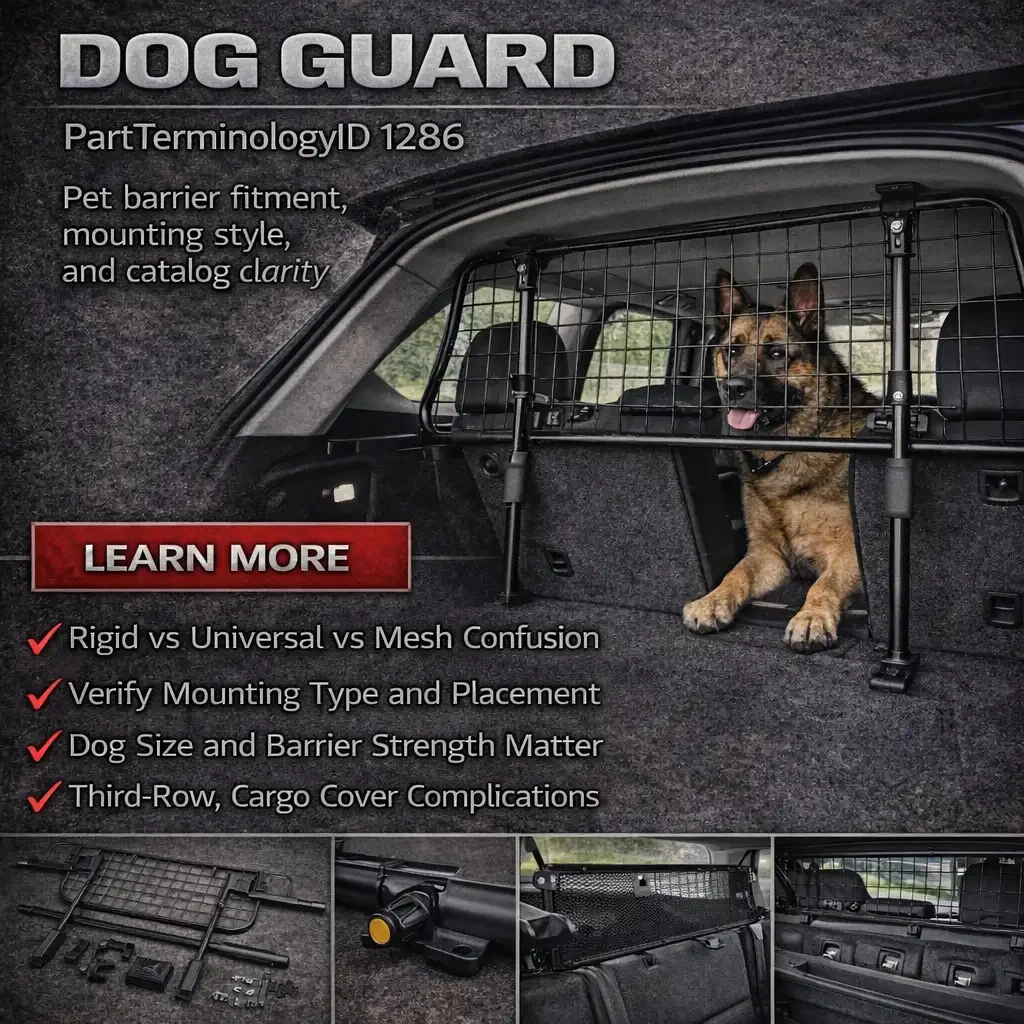
Dog Guard is a great example of an accessory category that looks simple in photos but gets complicated fast in real listings.
Most buyers just want one thing. They want to keep a dog safely in the cargo area and out of the passenger area. But in catalog terms, that can mean very different products:
a rigid metal barrier behind the second row
a universal adjustable cargo barrier
a mesh pet partition
a behind-front-seat pet barrier
a vehicle-specific guard that mounts to factory points
If the listing title only says "Dog Guard," buyers will fill in the blanks with their own assumptions. That is exactly where returns start.
For PartsAdvisory teams and aftermarket sellers, PartTerminologyID 1286 is a naming and fitment control category. It is also a strong buyer-intent category because pet owners usually have a clear use case and need the right product the first time.
Status in New Databases
Status in New Databases
PartTerminologyID: 1286
Terminology Name: Dog Guard
Current: PIES 7.2 + PCdb
Future: PIES 8.0 + PCdb 2.0
Status: No change
What Dog Guard Usually Means in the Aftermarket
In aftermarket use, Dog Guard typically refers to a barrier that separates the cargo area from the passenger cabin so pets stay in the rear section of the vehicle.
Most commonly, it is used in:
SUVs
crossovers
wagons
hatchbacks
vans
Depending on the brand and product line, a Dog Guard may be:
vehicle-specific and custom-fit
semi-universal adjustable
universal with trimming or setup adjustment
rigid steel bar style
wire mesh style
nylon or fabric barrier style
This is the first catalog challenge. The same buyer search term can map to multiple product types with very different fit, strength, and installation expectations.
Why This Category Gets Confused So Easily
Dog Guard overlaps with several nearby accessory categories. Supplier feeds often blur them together, and marketplace titles make it worse.
Common naming confusion
Dog Guard vs Pet Barrier
These are often used as synonyms. That is fine for search support, but your catalog should still identify the exact product form and mounting method.
Dog Guard vs Cargo Barrier
Some sellers use cargo barrier for a pet barrier. Others use cargo barrier for a heavy-duty load separator meant for tools or freight. Those are not always the same product.
Dog Guard vs Pet Seat Barrier
A pet seat barrier is often a smaller mesh panel that hangs between front seats to stop pets from entering the front row. A cargo area Dog Guard is a different product.
Dog Guard vs Cargo Net
Cargo nets hold items, not large dogs. Buyers still confuse these if the listing images are weak or the copy is generic.
Dog Guard vs Load Divider
Some products are for dividing cargo sections, not creating a full pet restraint barrier. This matters for buyer safety expectations.
Dog Guard vs Crate / Kennel
Some buyers search broadly for "dog car barrier" when they actually want a crate. The product type needs to be obvious.
The fix is simple and repeatable:
Keep the terminology name as Dog Guard
Add controlled synonyms for search
Make product form and mounting style visible in the title and key specs
Why Fitment Is Harder Than Buyers Expect
Dog Guard is not just width and height. Vehicle interior geometry matters a lot.
Two vehicles with similar cargo dimensions can still need different barriers because of:
roof shape
headliner contours
rear seat angle
headrest design
side trim panels
cargo cover rails
third-row seating hardware
This is a category where "universal fit" creates a lot of returns if expectations are not managed.
Fitment variables that create problems
Body style and roofline
A boxy SUV and a sloped crossover need different barrier geometry. Upper width and height taper matter.
Mounting position
Some buyers need a barrier:
behind the second row
behind the front seats
in a specific cargo zone for fleet or work use
Wrong mounting position is a common return cause.
Headrest and seat design
Many dog guards mount to:
headrest posts
seatback frames
floor points
side panels
If the seat design or headrest post spacing is different, the product may not mount correctly.
Second-row recline and split-fold seats
A barrier can interfere with:
seat recline
40/20/40 split folding
60/40 split folding
pass-through use
This matters a lot for family vehicles.
Third-row seating
Vehicles with third rows often have different cargo configurations, and buyers may not realize the barrier only fits when the third row is folded.
Cargo cover and tonneau compatibility
Some dog guards interfere with:
retractable cargo covers
side rail systems
roof-mounted cargo shades
Buyers often expect both products to work together.
Panoramic roof and upper trim shape
Upper mounting points and brackets can clash with grab handles or roof trim on some vehicles.
Universal product adjustment limits
A "fits most SUVs" listing often fails because:
width range is too narrow
height range is wrong
mounting hardware does not suit the vehicle interior
This is why Dog Guard listings need more than basic YMM fitment and one lifestyle photo.
Major Product Variants You Should Separate
Dog Guard becomes much easier to manage when you split the variants clearly in your catalog and listing templates.
1) Vehicle-Specific Rigid Dog Guard
This is usually a steel or wire barrier built for a specific vehicle application.
Typical buyer intent:
clean fit
stable installation
better safety confidence
daily pet transport
Common return causes:
wrong trim or body variant
third-row configuration mismatch
buyer expected no tools required
2) Semi-Universal Adjustable Dog Guard
This is a common aftermarket format with adjustable width and height bars.
Typical buyer intent:
lower cost
flexible use across multiple vehicles
basic pet separation
Common return causes:
buyer expected exact factory-like fit
upper trim interference
rattling due to loose adjustment
dog pushes through weak setup
3) Universal Mesh or Fabric Pet Barrier
This is often a lighter product that straps to headrests or anchor points.
Typical buyer intent:
quick install
low cost
occasional use
Common return causes:
buyer expected rigid barrier
large or strong dog defeats the barrier
poor compatibility with seat layout
sagging or movement during driving
4) Heavy-Duty Cargo / Dog Barrier Hybrid
Some products are marketed for pets and cargo separation, usually with stronger materials and fixed mounts.
Typical buyer intent:
work vehicle
fleet use
larger dogs
gear plus pet separation
Common return causes:
buyer misunderstood installation complexity
drilling required but not expected
noise or vibration complaints
The catalog rule is simple. Do not let all of these use the same generic title and same attribute set.
Pros and Cons
Dog Guard is an accessory category, so a Pros and Cons section is useful for both buyers and sellers.
Pros
Strong buyer intent and practical use case
Pet owners usually know what problem they need to solve.
Improves cabin control while driving
Helps keep pets out of the front seat area and reduces distraction risk.
Works across many vehicle types
Large category coverage across SUVs, wagons, hatchbacks, and vans.
Multiple price tiers available
Vehicle-specific, semi-universal, and universal options support different budgets.
Good upsell potential
Pairs well with cargo liners, seat covers, pet ramps, and travel accessories.
Cons
Naming confusion causes wrong orders
Buyers mix up pet barriers, seat barriers, cargo nets, and load dividers.
Universal fit claims create expectation gaps
Many buyers expect an exact fit from an adjustable product.
Mounting compatibility varies heavily
Seatbacks, headrests, and trim layouts can make or break install success.
Strength expectations differ by dog size
A light mesh barrier may be fine for a small dog but not for a large, active dog.
Rattle and noise complaints are common
Especially with adjustable metal designs if fit is not tight.
Compatibility Checklist for Buyers
For Dog Guard, a Compatibility Checklist is the right choice because mounting style, vehicle layout, and barrier type matter just as much as year and model.
Compatibility Checklist
1) Confirm the type of barrier you need
rigid vehicle-specific dog guard
adjustable semi-universal barrier
mesh/fabric pet barrier
heavy-duty cargo and pet barrier
This is the biggest mistake point in the category.
2) Confirm your vehicle details
Year
Make
Model
Submodel or trim
Body style
Cargo area shape can change by trim and body style.
3) Confirm where you want the barrier mounted
behind the second row
behind the front seats
cargo area partition point
Do not assume every guard supports both positions.
4) Check your seat and headrest setup
Look at:
headrest post style
headrest post spacing
integrated headrests vs removable headrests
second-row seat split layout
Many barriers depend on headrest mounting compatibility.
5) Check cargo area features that may interfere
retractable cargo cover
side rails
third-row seats
rear HVAC vents in cargo area
tie-down points
trim protrusions
These often create fit issues.
6) Confirm width and height range for adjustable products
For universal or semi-universal guards, compare the product adjustment range to your actual vehicle interior dimensions.
7) Check the barrier material and strength
steel bar
wire grid
aluminum frame
fabric mesh
Match the product to your dog size and behavior, not just your vehicle.
8) Confirm what is included
barrier panel
upper bars
lower bars
brackets
straps
fasteners
padding or anti-rattle pieces
installation instructions
Do not assume hardware is included.
9) Review installation type
no-drill clamp style
headrest-mounted
bracket-mounted
drilling required
Installation complexity matters more than many buyers expect.
10) If you use the vehicle for passengers often, check seat folding and access
Make sure the barrier will not block your normal use of:
split-fold seat operation
third-row access
cargo cover operation
Catalog Checklist for Attributes and Structured Data
Dog Guard is a great category for structured data discipline. Weak titles and generic fitment create avoidable returns. Good attributes fix that.
Catalog Checklist for PartTerminologyID 1286 Dog Guard
Core naming and taxonomy
Terminology Name: Dog Guard
Required product form attribute:
Vehicle-Specific Rigid Guard
Semi-Universal Adjustable Guard
Universal Mesh Barrier
Heavy-Duty Cargo/Pet Barrier
Controlled synonyms for search:
Pet Barrier
Cargo Dog Barrier
Vehicle Pet Guard
Pet Cargo Guard
Keep synonyms for search, but keep SKU names precise.
Fitment structure
Year
Make
Model
Submodel
Body style
Seating configuration
Third-row yes or no compatibility
Mounting position supported (behind front seats / behind second row)
Mounting and installation attributes
Mounting type (headrest, clamp, bracket, floor, side mount)
No-drill yes or no
Drilling required yes or no
Tool-free install yes or no
Quick-release yes or no
Folding/removable design yes or no
Dimensional attributes
Overall width
Overall height
Adjustable width range
Adjustable height range
Bar spacing or mesh opening size
Depth or protrusion into cargo area
Dimensions should be searchable and visible.
Material and finish attributes
Steel / aluminum / mesh / fabric
Coating finish (black powder coat, silver, etc.)
Padding or trim protection included
Anti-rattle components included yes or no
Vehicle feature compatibility fields
Compatible with retractable cargo cover yes or no
Compatible with third-row seating yes or no
Compatible with split-fold rear seat operation yes or no
Compatible with panoramic roof trim clearance yes or no if known
Use-case and load guidance
This is not fitment, but it helps buyer accuracy:
recommended pet size range
intended use (pet separation only, cargo separation, hybrid use)
crash-tested or not crash-tested
safety certification note if applicable
Be careful here. Do not imply crash performance unless the supplier provides it.
Package contents
barrier included
mounting brackets included
straps included
fasteners included
trim pads included
instructions included
Return prevention content
"This is a cargo area dog guard, not a front seat pet barrier"
"Verify mounting type and seat/headrest compatibility"
"Universal products require measuring"
"Match barrier strength to pet size and activity level"
Image requirements
installed rear view in vehicle
close-up of mounting brackets
side profile showing placement
dimension image
folded/removable feature image
hardware and package contents image
This category is visual and mechanical. Buyers need both.
Common Return Causes and How to Prevent Them
1) Buyer ordered the wrong barrier type
What happens
Buyer wanted a rigid cargo barrier and received a mesh seat barrier, or the opposite.
How to prevent it
Put the product form in the title and first bullet. Example:
Dog Guard Rigid Cargo Barrier
Dog Guard Adjustable Universal Barrier
Dog Guard Mesh Seat Barrier
2) "Universal fit" did not fit well
What happens
Barrier technically fits inside the vehicle but installs poorly, rattles, or leaves gaps.
How to prevent it
Publish actual width and height adjustment ranges, mounting method, and clear install expectations. Use a dimension image.
3) Headrest or seat compatibility mismatch
What happens
The guard depends on removable headrest posts, but the vehicle has integrated headrests or different spacing.
How to prevent it
Add headrest compatibility notes and bracket photos.
4) Interference with cargo cover or third-row use
What happens
Buyer cannot use the retractable cargo cover, or the barrier conflicts with third-row seats.
How to prevent it
Add compatibility fields for cargo cover and third-row setups. Put exclusions in the listing.
5) Strength expectation mismatch
What happens
Buyer uses a light barrier for a large dog, then complains about flex or movement.
How to prevent it
Add material and use-case guidance. Be clear about rigid vs mesh designs and intended pet size range.
Common Buyer Scenarios
Scenario 1: Family SUV owner with a medium-size dog
The buyer wants a clean cargo barrier for daily driving and weekend trips.
What goes wrong:
they buy a mesh barrier expecting a rigid fit
they do not check second-row seat layout
they assume cargo cover compatibility
What helps:
rigid vs mesh product form in title
bracket and mounting photos
compatibility notes for cargo cover and split-fold seats
Scenario 2: Budget buyer searching "dog barrier for car"
The buyer is searching broadly and may not know the difference between a front seat pet barrier and a cargo dog guard.
What goes wrong:
wrong product type ordered
product is installed in the wrong area
poor review based on wrong expectation
What helps:
"Cargo Area Dog Guard" in title
installed image showing barrier behind rear seats
short line explaining what the product is for
Scenario 3: Wagon owner wants a clean factory-like setup
The buyer wants a stable, quiet, vehicle-specific guard that looks integrated.
What goes wrong:
they choose a universal adjustable barrier to save money
barrier rattles or looks uneven
they return it for cosmetic reasons
What helps:
clear "vehicle-specific" labeling
dimension and fit photos
noise/anti-rattle components called out
Scenario 4: Large dog owner buys a light mesh barrier
The buyer wants quick installation, but their dog is too strong for the product type.
What goes wrong:
barrier sags or shifts
buyer says product is poor quality
the real issue is product mismatch
What helps:
material and intended use clarity
pet size guidance
rigid option cross-sell in listing content
Scenario 5: Marketplace seller loads supplier feed without enrichment
The supplier title is just "Dog Guard Black" with broad claims.
What happens:
traffic is fine
conversion is weak
returns and support questions rise
What helps:
required product form field
mounting type field
dimensions and package contents
exclusions for third-row and cargo cover setups
FAQ
Is Dog Guard the same as a pet barrier?
Often yes in buyer language, but not always in product design. A Dog Guard usually refers to a cargo area barrier, while some pet barriers are front-seat mesh blockers. Listings should clarify the exact type.
Will a universal dog guard fit my SUV?
Maybe, but you should measure and check the mounting method first. Universal products often fit a range of vehicles but may not fit tightly or cleanly in every interior.
What is the difference between a rigid dog guard and a mesh barrier?
A rigid dog guard uses bars or a solid frame and is usually more stable. A mesh barrier is lighter and easier to install, but it may not control larger or more active dogs as well.
Can I use a dog guard with my retractable cargo cover?
Sometimes, but not always. Many guards interfere with cargo cover rails or the cover path. Check compatibility notes before ordering.
Do dog guards work with third-row SUVs?
Some do and some do not. Many only fit when the third row is folded. This should be clearly listed in the fitment notes.
Are dog guards crash-tested?
Some products may have testing claims, but many do not. Sellers should only use crash or safety claims when they are clearly supported by the manufacturer.
Why do dog guard listings get returned so often?
The biggest reasons are wrong product type, universal fit expectations, mounting incompatibility, and interference with cargo features.
What should sellers include in a strong Dog Guard listing?
Product form, mounting type, dimensions, vehicle compatibility notes, cargo feature compatibility, package contents, and close-up images of brackets and installed position.
Final Take for Aftermarket Teams
Dog Guard (PartTerminologyID 1286) is a strong accessory category with real buyer demand, but it needs clean catalog structure to perform well.
The challenge is not just fitment. It is expectation control.
The best approach is practical:
separate rigid, adjustable, and mesh variants
define mounting type and placement clearly
publish dimensions and adjustment ranges
add cargo feature compatibility notes
match product strength to intended pet use
use installed and bracket close-up images to reduce guesswork
If you catalog Dog Guard correctly, you improve conversion, reduce returns, and build a better template for other pet and cargo accessory categories too.