
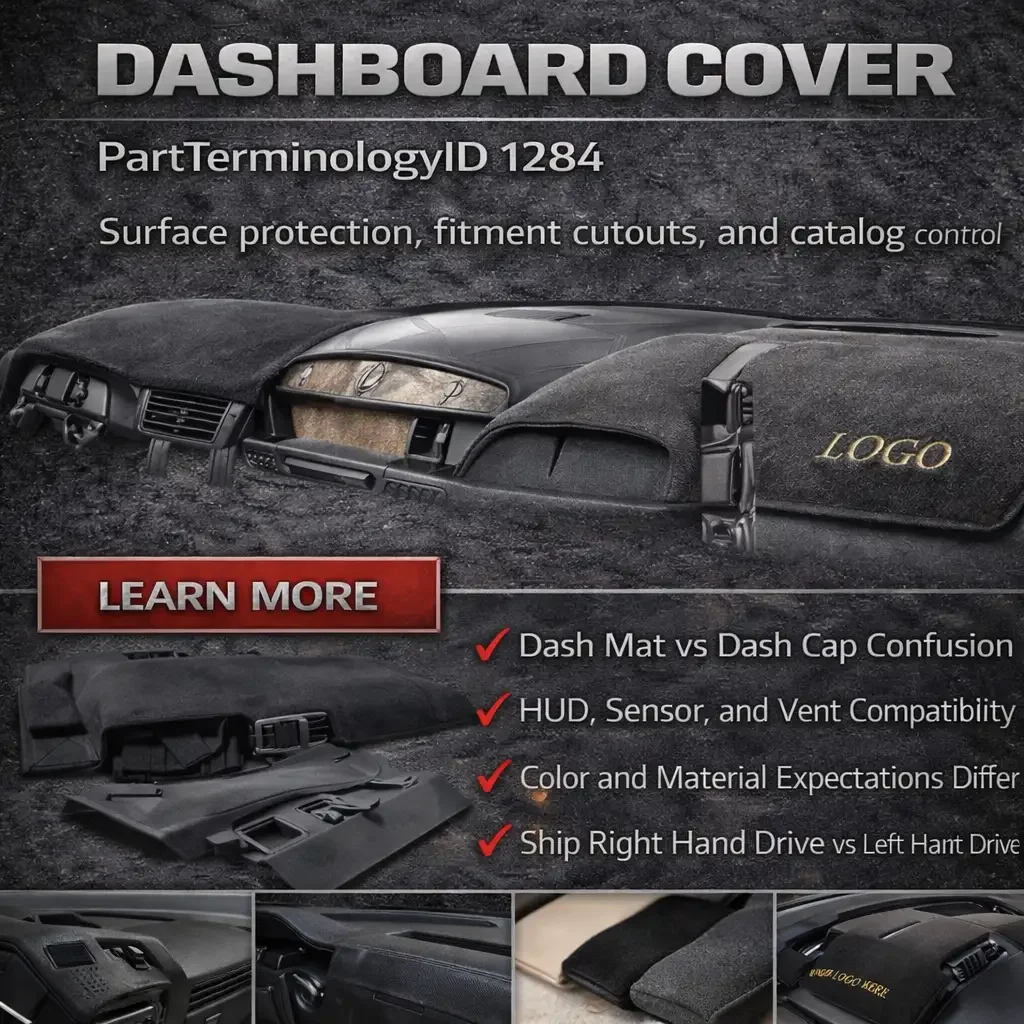
Dashboard Cover is a big category, and you are right to call it out.
This part name looks simple, but in aftermarket catalogs it can become one of the messiest interior groups because buyers and sellers use the same words for very different products.
One buyer means a soft dash mat for sun protection. Another buyer means a molded dash cap to cover cracks. Another means a trim overlay. Another wants a custom embroidered dashboard cover with a logo. All of them may search the same term.
That is why PartTerminologyID 1284 Dashboard Cover needs strong catalog discipline.
This is a category with large SKU counts, heavy visual expectations, and real compatibility risks tied to:
vent cutouts
speaker openings
sensor openings
HUD cutouts
airbag zones
color and material match
left hand drive vs right hand drive
universal vs direct-fit confusion
If the listing is vague, the return rate climbs fast.
Status in New Databases
Status in New Databases
Current: PIES 7.2 + PCdb
Future: PIES 8.0 + PCdb 2.0
Status: No change
What Dashboard Cover Usually Means in the Aftermarket
In real aftermarket selling, Dashboard Cover can refer to several product forms. This is the first reason the category creates confusion.
Depending on the brand and listing, Dashboard Cover may mean:
a soft protective dash mat
a molded dash cap that bonds over a cracked dashboard
an upholstery style dash skin cover
a trim overlay cover for a dashboard section
a custom cover with stitched logo or embroidery
These products solve different buyer problems.
Common buyer intent behind dashboard cover searches
Protection from sun and heat
The buyer wants to reduce glare, protect the dash, and slow cracking.
Crack concealment and cosmetic repair
The buyer already has a cracked dash and wants a molded cap or cover solution.
Interior restoration
The buyer wants a cleaner OEM style interior look.
Customization
The buyer wants a specific material, color, stitch pattern, logo, or image.
If the listing does not define the exact product type in the title, buyers assume the product is something else.
Why This Category Gets Misnamed So Often
Dashboard Cover overlaps with several nearby terms, and many supplier feeds are not precise enough.
Common naming confusion
Dashboard Cover vs Dash Mat
A dash mat is usually a soft, protective top cover. It reduces sun glare and protects the dashboard surface. Many listings call this a dashboard cover.
Dashboard Cover vs Dash Cap
A dash cap is usually a molded hard shell style cover that adheres over a damaged dash. Buyers searching "dashboard cover" may actually need a dash cap for crack repair.
Dashboard Cover vs Dashboard Pad
Some buyers and sellers use dashboard pad for the main dash surface or top panel. Others use it for a replacement padded dash assembly. This can cause major expectation mismatches.
Dashboard Cover vs Dash Trim Overlay
A trim overlay may cover only a decorative section, not the full dashboard top. Buyers may think they are getting full coverage.
Dashboard Cover vs Dash Carpet / Dash Protector
These are often buyer-facing synonyms for dash mat products. Catalog teams should support search terms without mixing them into the wrong product type.
Dashboard Cover vs Instrument Panel Assembly
A complete dashboard assembly is not a dashboard cover. Weak titles can attract buyers looking for a much larger part.
The fix is simple and repeatable:
Keep the official part name as Dashboard Cover
Add a required product form attribute
Put the product form in the title and first line
Why Dashboard Cover Is a Big Category for Aftermarket Teams
This category grows fast because it combines fitment, appearance, and customization.
1) Large vehicle coverage across many years
Dashboard covers are sold for:
cars
trucks
SUVs
vans
older classics
work vehicles
fleet vehicles
That creates a wide application map.
2) Dashboard shape changes are constant
Small design changes matter:
vent layout changes
center speaker changes
sensor bump changes
cluster hood shape changes
passenger airbag seam differences
A cover can look close and still be wrong.
3) Material and finish options multiply SKUs
Common materials include:
carpet style
velour
suede-like fabric
molded ABS style dash caps
vinyl style skins
Each material type changes buyer expectations and return risk.
4) Color options are a major decision point
Typical colors include:
black
charcoal
gray
beige
tan
brown
custom interior colors
Color is one of the biggest drivers of both conversion and returns.
5) Custom logo and embroidery programs expand the catalog
Some dashboard covers are customized with:
brand logos
text
image embroidery
fleet branding
That adds a made-to-order layer and custom order rules.
6) Universal and semi-universal products add more noise
Universal dash mats and trim-to-fit solutions exist, but many buyers expect direct-fit results. If the listing does not say universal clearly, returns follow.
This is exactly why Dashboard Cover becomes a large and difficult category if the data model is weak.
The Main Product Types You Must Separate
This category is much easier to manage when product forms are separated from the start.
1) Soft Protective Dash Mat
This is the most common product type for everyday buyers.
Typical purpose:
reduce glare
protect from UV
improve interior look
hide minor wear
Common features:
soft fabric
pre-cut vent openings
anti-slip or hook fasteners
stitched edges
Common return causes:
wrong cutouts for vents or sensors
buyer expected crack repair cap
color mismatch
poor fit around instrument hood
2) Molded Dash Cap
This is usually a hard molded cover that adheres over a cracked or damaged dashboard surface.
Typical purpose:
hide cracks
restore appearance
avoid full dashboard replacement
Common features:
rigid molded shape
adhesive install
contour matching
direct-fit style application
Common return causes:
buyer expected soft dash mat
wrong generation dashboard shape
cutout mismatch
poor prep or install caused bad fit review
3) Upholstery Style Dash Skin Cover
This may be a skin or wrap style cover used in restoration or interior work.
Typical purpose:
interior restoration
custom finish
re-covering a damaged dash surface
Common return causes:
buyer underestimated install difficulty
adhesive or upholstery work required
material expectation mismatch
4) Trim Overlay Dashboard Cover Piece
This is usually a decorative or partial cover for a section of the dash.
Typical purpose:
cosmetic upgrade
cover worn trim
change finish style
Common return causes:
buyer expected full dashboard coverage
wrong finish
wrong cutout layout
5) Custom Embroidered Dashboard Cover
This is usually a dash mat style product with custom text, logo, or image.
Typical purpose:
personalization
show vehicles
fleet branding
promotional vehicles
Common return causes:
custom lead time not understood
logo placement expectations differ
non-returnable custom order policy not clear
This is why the title should never say only "Dashboard Cover." It should say what kind.
Fitment Details Buyers Usually Miss
Dashboard covers are very visual, but fitment is more technical than buyers expect.
Vent cutouts
The dashboard top often includes:
defrost vents
side defrost vents
center vents
speaker grilles
Wrong cutout placement makes the cover unusable or unsafe.
Sensor and camera cutouts
Modern dashboards may have:
sun sensors
ambient light sensors
ADAS-related housings
dash top speakers
center channel openings
A cover that blocks these areas can cause poor function or buyer complaints.
HUD cutouts
Some vehicles have a head-up display opening on the dash top. Buyers with HUD need the correct cutout. Buyers without HUD usually need no cutout.
This is one of the biggest dashboard cover return traps.
Passenger airbag zone and seam design
Dashboard covers must match the dash layout and should not interfere with the airbag deployment area. Product type and fitment notes must be clear. Buyers need the correct cover for their exact dashboard design.
Left hand drive vs right hand drive
This matters a lot for:
instrument cluster hood shape
speaker layout
vent cutouts
sensor positions
A product can look correct in photos and still be mirrored wrong for the buyer's vehicle.
Trim level and option package differences
Premium trims may add:
center speakers
extra sensors
stitched dash panels
different trim contours
These must be reflected in the fitment notes.
Pros and Cons
Dashboard Cover is a strong accessory category, but buyer expectations need to be managed.
Pros
Protects the dashboard from UV and heat
Helps reduce fading, cracking, and sun damage.
Improves interior appearance quickly
A clean cover can refresh the cabin without replacing the dashboard.
Can reduce glare
Many dash mats help reduce windshield reflection in bright sunlight.
Good crack concealment options exist
Molded dash caps can hide severe dashboard cracking at a lower cost than full replacement.
Large customization opportunity
Colors, materials, and embroidery options support many buyer preferences.
Cons
Naming confusion causes wrong orders
Buyers mix up dash mats, dash caps, and trim overlays.
Cutout mismatches are common
Vents, speakers, sensors, and HUD openings must match exactly.
Color and material expectations vary
A product can fit but still be returned for appearance mismatch.
Universal products often disappoint buyers
They may fit loosely or require trimming.
Custom logo products need stricter order rules
Lead time and return policy must be clearly stated.
Compatibility Checklist for Buyers
For Dashboard Cover, a Compatibility Checklist is the best fit because exact cutouts and dashboard layout matter as much as year and model.
Compatibility Checklist
1) Confirm the product type you need
soft dash mat
molded dash cap
upholstery style skin
trim overlay
custom embroidered cover
Do not skip this. It prevents the biggest category mistakes.
2) Confirm your full vehicle details
Year
Make
Model
Submodel or trim
Dashboard layouts can vary by trim.
3) Confirm left hand drive or right hand drive
This is critical for dashboard covers.
4) Check your dashboard top layout
Look for:
center speaker opening
side defrost vent shape
center sensor bump
HUD opening
vent count and position
Compare these to listing photos and cutout diagrams.
5) Confirm HUD or non-HUD
This is one of the most common return causes in modern applications.
6) Confirm color and material
Check:
color family
fabric type or molded finish
stitch style if applicable
7) Confirm what is included
cover only
adhesive included
hook fasteners included
cleaning prep wipes included
instructions included
8) Check install method
lay-on style
hook fastener install
adhesive bond
trim-to-fit universal
professional installation recommended
9) For crack repair, inspect the dash first
If the dash is severely warped, a dash cap may not sit correctly without prep. Read the install notes.
10) For custom logo or text, confirm custom order rules
artwork requirements
placement
proof process
lead time
custom return policy
Catalog Checklist for Attributes and Structured Data
Dashboard Cover needs a strong attribute model. This is one of those categories where a good catalog setup directly lowers return rate.
Catalog Checklist for PartTerminologyID 1284 Dashboard Cover
Core naming and taxonomy
Terminology Name: Dashboard Cover
Required product form attribute:
Dash Mat
Dash Cap
Dash Skin Cover
Dash Trim Overlay
Custom Dash Cover
Controlled synonyms:
Dash Cover
Dash Mat
Dashboard Protector
Dash Cap
Dashboard Top Cover
Keep search synonyms, but keep SKU naming exact.
Fitment structure
Year
Make
Model
Submodel
Body style where needed
Trim package notes
Left hand drive / right hand drive
Dashboard version notes if mid-cycle changes exist
Cutout and feature compatibility
HUD cutout yes or no
Center speaker cutout yes or no
Sensor cutout yes or no
Vent layout type
Passenger airbag area design note
Defrost vent pattern notes
These fields are critical for this category.
Material attributes
Fabric type (carpet, velour, suede-like, other)
Molded hard cap material if applicable
Surface texture
Edge binding style
Backing type
Color attributes
Color family
Supplier color name
Stitch color if applicable
Finish style for molded caps (textured, smooth, OEM-style grain)
Dimensions
For universal or semi-universal products:
length
width
depth
trim-to-fit yes or no
For direct-fit products:
dimensions can still help support support teams and reduce disputes
Installation attributes
Installation type (lay-on, hook fastener, adhesive, trim-to-fit)
Adhesive included yes or no
Hook fasteners included yes or no
Surface prep required yes or no
Professional installation recommended yes or no
Package contents
cover included
adhesive included
fasteners included
instructions included
custom proof included or not for custom products
Customization fields
If logos or images are offered:
customizable yes or no
embroidery or print method
artwork file format
placement area
lead time
proof required
custom return policy
Return prevention content
Product form clarification at the top
HUD and cutout verification note
LHD / RHD verification note
Color disclaimer
Installation expectation note
Image requirements
full top view
dashboard cutout close-up
sensor and vent cutout area close-up
material texture close-up
installed interior photo
color swatch photo
underside or edge binding photo if relevant
For Dashboard Cover, images do a lot of the fitment work.
Common Return Causes and How to Prevent Them
1) Wrong product type
What happens
Buyer wanted a molded crack cover and ordered a soft dash mat, or the opposite.
How to prevent it
Put the product form in the title and first line:
Dashboard Cover Dash Mat
Dashboard Cover Dash Cap
Dashboard Cover Trim Overlay
2) Wrong cutout layout
What happens
HUD opening, speaker opening, or sensor cutout does not match the buyer's dashboard.
How to prevent it
Require cutout attributes and close-up images for all direct-fit listings.
3) Wrong drive side
What happens
Buyer receives a left hand drive layout for a right hand drive vehicle.
How to prevent it
Make LHD or RHD a required attribute and visible in the listing.
4) Color or material mismatch
What happens
Fit is correct but the buyer does not like the shade or texture.
How to prevent it
Use standardized color names, material close-ups, and color options displayed clearly.
5) Installation expectation mismatch
What happens
Buyer thought it was a simple lay-on cover, but the product requires adhesive and prep.
How to prevent it
Publish installation type and what is included above the fold.
Common Buyer Scenarios
Scenario 1: Cracked dashboard on an older truck
The buyer wants to hide cracks fast and searches "dashboard cover."
What goes wrong:
They order a soft dash mat when they really wanted a molded dash cap
The listing photos do not show the product type clearly
What helps:
Product form in the title
Installed crack-repair example photo
Adhesive install note for dash caps
Scenario 2: Buyer wants glare reduction on a daily driver
The buyer wants a soft dash mat for comfort and glare control.
What goes wrong:
They order a rigid dash cap
They get the wrong cutouts for speaker or sensor openings
What helps:
"Dash Mat" wording
Cutout diagram photo
Material texture and color options
Scenario 3: Modern vehicle with HUD
The buyer has a head-up display and needs the correct dashboard opening.
What goes wrong:
They order non-HUD version
The cover blocks or misaligns the HUD area
What helps:
HUD yes/no field
HUD cutout close-up image
Compatibility note in the title or bullet
Scenario 4: Fleet or promotional buyer wants logo covers
The buyer wants branded dashboard covers for multiple vehicles.
What goes wrong:
Lead time not understood
Artwork placement confusion
Return policy dispute on custom items
What helps:
Customization fields
proof approval step
lead time shown clearly
custom order policy displayed before checkout
Scenario 5: Marketplace seller imports weak supplier titles
Supplier title says only "Dashboard Cover Black" with broad fitment.
What happens:
traffic is good
returns are high
support requests increase
reviews complain about wrong cutouts
What helps:
Enrichment rules requiring product form, cutout attributes, and LHD/RHD before publish
FAQ
Is Dashboard Cover the same as a dash mat?
Not always. A dash mat is one type of dashboard cover, usually soft and protective. Dashboard Cover can also mean a molded dash cap, trim overlay, or other cover form.
What is the difference between a dash mat and a dash cap?
A dash mat is usually a soft top cover for protection and glare reduction. A dash cap is usually a rigid molded cover used to hide cracks or damage on the dashboard.
Why do dashboard covers have so many fitment issues?
Because dashboard shapes vary by year, trim, vent layout, speakers, sensors, HUD options, and drive side. Small cutout differences make a big difference.
Do I need to check for a HUD cutout?
Yes. If your vehicle has a head-up display, you should confirm the cover is made for HUD. This is a common return issue.
Can I use a universal dashboard cover?
You can, but universal products may require trimming and may not fit as cleanly as direct-fit covers. Buyers should check dimensions and expectations.
Do dashboard covers interfere with airbags?
The cover must match the dashboard layout and should be designed for the correct application. Buyers should avoid generic mismatched products and verify compatibility carefully.
Why is color matching difficult in this category?
Interior colors vary by brand and age, and dashboards fade over time. A new cover can be the correct color family but still look different from older trim.
What should sellers include in a strong dashboard cover listing?
Clear product form, cutout details, HUD and sensor compatibility, LHD/RHD note, color and material details, installation type, and close-up photos.
Final Take for Aftermarket Teams
Dashboard Cover (PartTerminologyID 1284) is a big category because it combines wide vehicle coverage with high variation and high buyer expectation.
It is not just an accessory category. It is a catalog precision category.
The teams that win here do a few things consistently:
separate product forms clearly
capture cutout and feature compatibility in structured data
treat LHD/RHD as a required field
make color and material choices visible
define install method and package contents clearly
use close-up images that prove cutout layout
If you build Dashboard Cover with strong catalog structure, you reduce returns and create a repeatable system for other high-variation interior categories too.